
Filing a workers’ compensation claim in Canton can feel overwhelming, especially when you’re dealing with an injury and trying to navigate Ohio’s system. We at Robin J Peterson Company, LLC have helped countless workers understand the Canton BWC claim tips that actually make a difference in their cases.
The right approach protects your rights and speeds up your claim. This guide walks you through what matters most.
How the Canton BWC Claim Process Actually Works
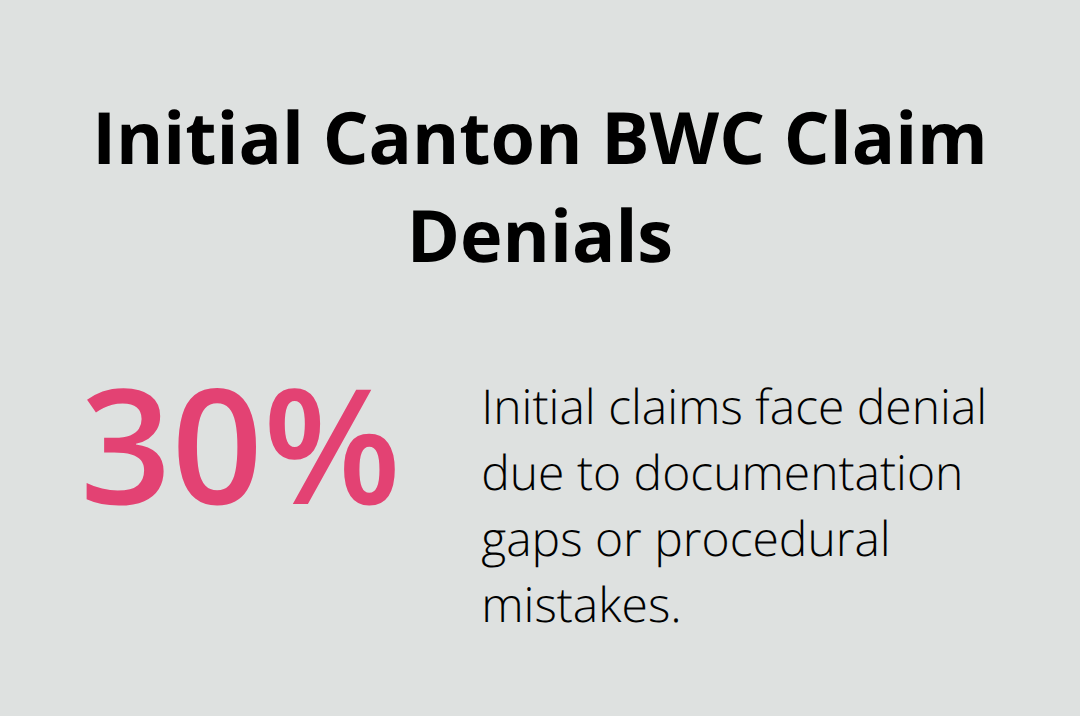
The Ohio Bureau of Workers’ Compensation operates as a state-run system that handles injury claims differently than most people expect. Your employer pays into the system, and when you get injured on the job, the BWC processes your claim and approves medical treatment and wage replacement if eligible. The system moves fast, but only when you file correctly from the start. State data from the Ohio Bureau of Workers’ Compensation and the Industrial Commission shows that roughly 30 percent of initial claims face denial, often due to documentation gaps or procedural mistakes that could have been avoided.
Filing within the critical window
You have exactly two years from your injury date or when you became unable to work to file your claim with the Canton BWC. This is an absolute deadline, and missing it nearly blocks your recovery. Your employer or treating physician should file the First Report of Injury within 24 hours of your visit, but if neither acts, you can file it yourself online through the BWC website. If you file the FROI yourself, there is no same-day requirement, which gives you flexibility. Report the injury to your employer as soon as possible-ideally within 24 hours-to establish a clear record and trigger the official process. The Industrial Commission of Ohio typically issues an approval or denial within about 28 days of filing, assuming no gaps exist in your documentation.
What the BWC actually investigates
The BWC conducts a thorough investigation into every claim, and inconsistencies between your claim narrative and your medical records can lead to denial. Vague injury narratives trigger delays, so you need to provide a precise sequence of events describing exactly what you were doing when the injury occurred. Medical documentation that directly links your treatment to the work injury forms the backbone for approval.
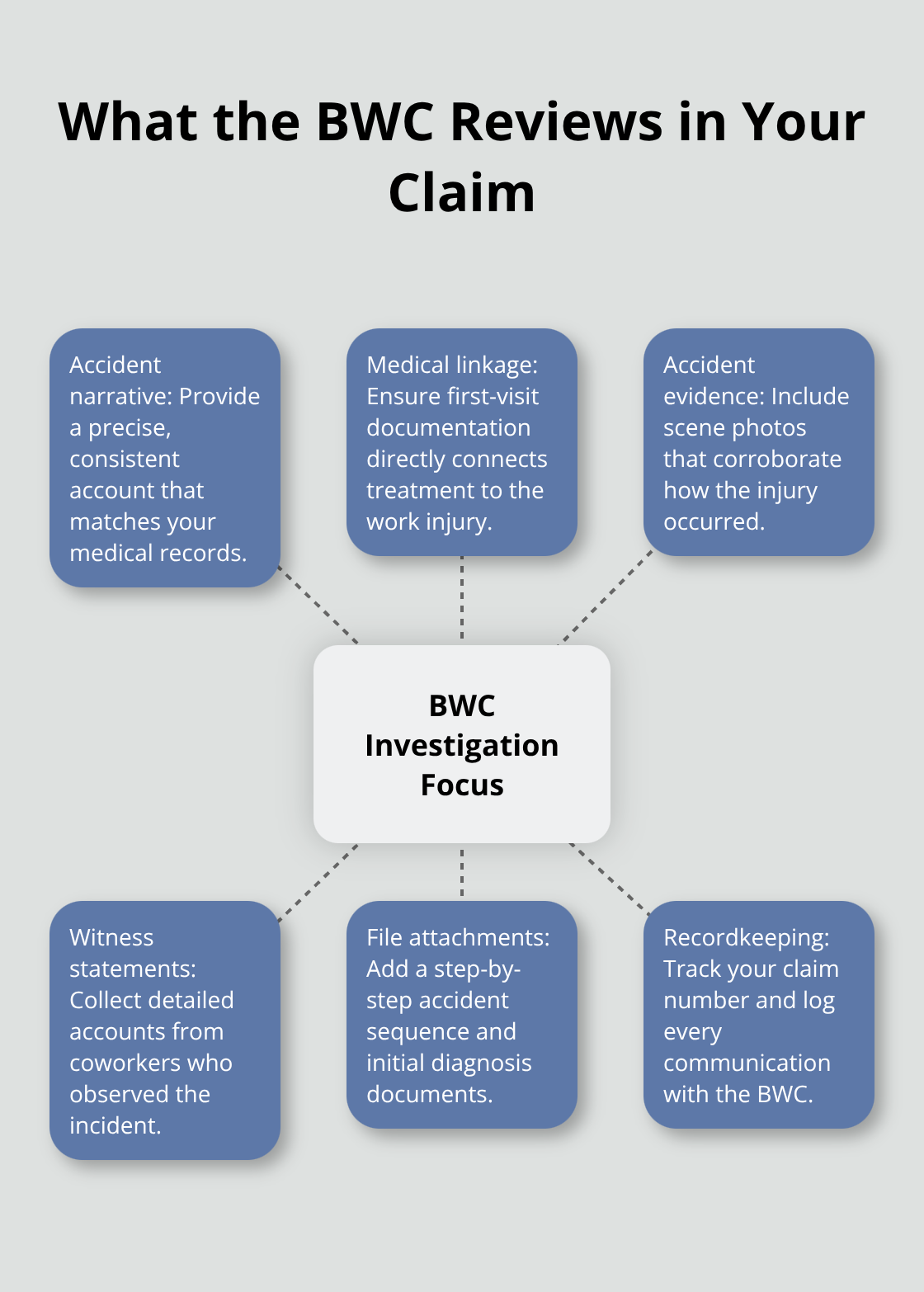
Accident photos, coworker witness statements, and detailed notes about how the injury happened speed evaluation significantly. When you file, attach specific details of the accident sequence and include first-visit medical documentation showing the diagnosis and its connection to the work injury. Track your claim number and keep copies of everything, logging all communications with the BWC for your records.
Building your documentation strategy
The more concrete evidence you provide upfront, the faster your claim moves through the system. Inconsistencies between what you report and what your medical records show will slow approval or trigger a denial. Witness statements carry significant weight in the BWC’s evaluation, so contact coworkers who saw the injury happen and ask them to document what they observed. Photographs of the accident scene, your workplace setup, and any equipment involved strengthen your case substantially. Medical records must show a clear link between your treatment and the work injury-vague diagnoses or treatment notes unrelated to your job create problems during investigation.
The documentation you gather now determines how smoothly your claim moves forward and whether you face questions or denials later. With your evidence organized and your timeline clear, you’re ready to understand the mistakes that derail many Canton workers’ compensation claims.
What Causes Canton BWC Claims to Stall
The two-year filing window sounds generous until you realize how quickly time disappears when you’re injured. Most delays don’t stem from the BWC moving slowly-they come from workers and employers making preventable mistakes in the first weeks after an injury. Missing the 24-hour reporting window to your employer, filing incomplete documentation, or waiting too long to gather evidence transforms a straightforward claim into a months-long battle. State data from the Ohio Bureau of Workers’ Compensation and the Industrial Commission shows that roughly 30 percent of initial claims face denial, and the majority of these rejections trace back to gaps created early in the process.
The timing pressure is real: you have exactly two years from your injury date to file, which sounds like plenty of time until you factor in medical appointments, recovery time, and the administrative confusion that follows a workplace accident. Workers who delay reporting their injury beyond 24 hours create documentation problems that haunt their claims for months. Employers who fail to file the First Report of Injury within 24 hours of your medical visit force you to take action yourself, and many workers don’t realize this responsibility falls to them if their employer fails to act.
The documentation trap that causes denials
Incomplete medical records represent the single largest reason for claim denials in Canton BWC cases. Your initial medical visit must explicitly connect your treatment to the work injury-vague diagnosis notes or treatment descriptions unrelated to your job become ammunition for denial later. Many workers file their FROI without attaching proof from their first doctor’s visit, forcing the BWC to request records weeks later and creating unnecessary delays.
Witness statements carry substantial weight in the BWC’s investigation, yet most injured workers never contact coworkers to document what happened. Accident scene photographs taken immediately after the injury provide undeniable evidence that speeds approval, but workers often skip this step when pain and shock cloud their judgment. The inconsistency between your injury narrative and your medical records triggers automatic investigation delays-if you describe a specific mechanism of injury but your doctor’s notes describe something different, the BWC flags this as suspicious and demands clarification.
How vague narratives invite scrutiny
Vague narratives like “I slipped at work” without describing where, when, what caused the slip, or what you were doing invite skepticism and slow processing to roughly 28 days or longer. Workers who wait weeks to gather witness statements find that coworkers’ memories fade or they move to different jobs, making statements weaker or impossible to obtain. The documentation you collect in the first week after injury determines whether your claim moves smoothly through the system or stalls waiting for information you should have collected immediately.
Taking action in the critical first days
Report your injury to your employer within 24 hours and provide as much detail as possible about how the accident occurred. Contact coworkers who witnessed the injury and ask them to write down what they observed while the event remains fresh in their minds.
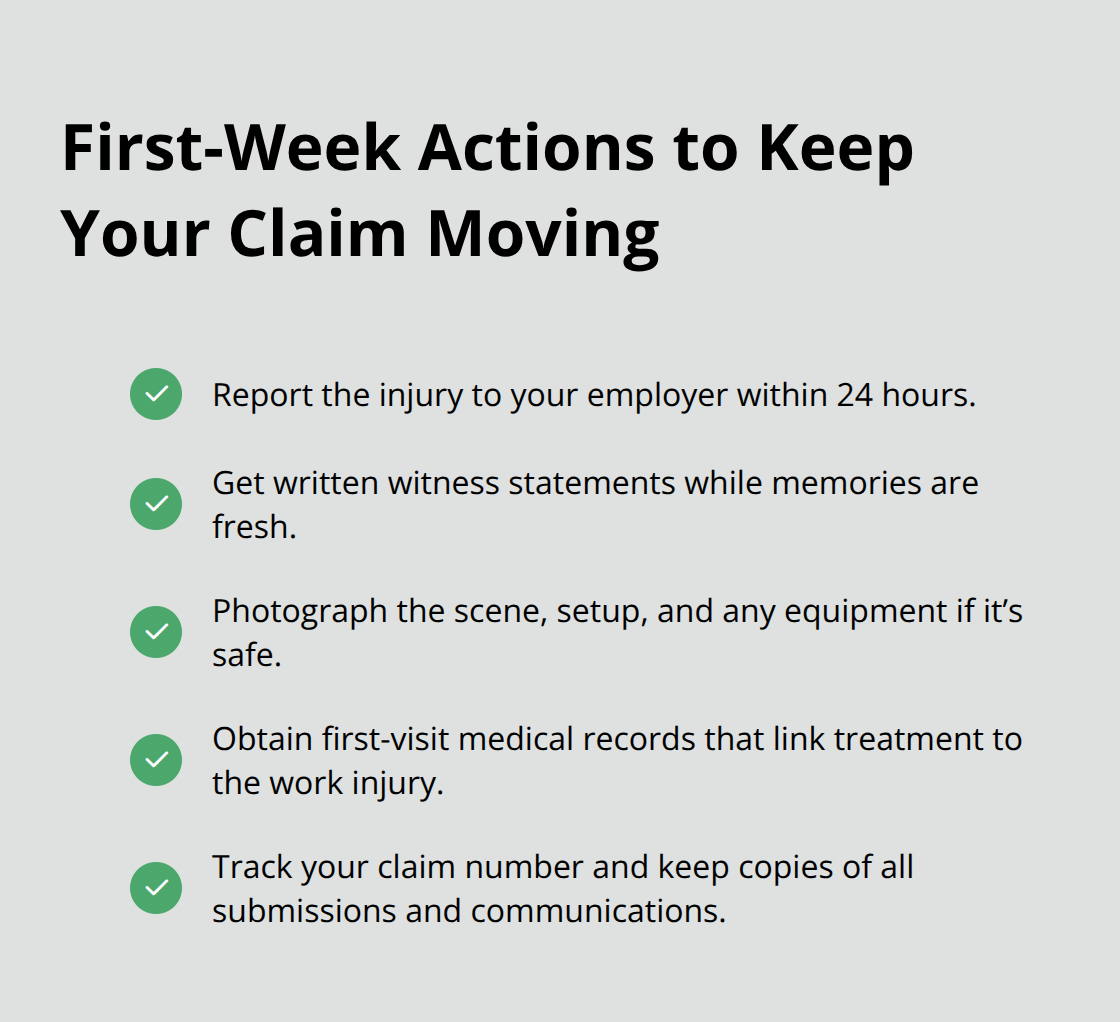
Take photographs of the accident scene, your workplace setup, and any equipment involved (if safe to do so). Obtain your medical records from your first visit and verify that the diagnosis explicitly links your treatment to the work injury. Track your claim number and keep copies of everything you submit to the BWC, logging all communications for your records.
The foundation you build in these first days determines how the BWC evaluates your claim and whether you face months of delays or quick approval. If your claim stalls beyond 30 days, contact the BWC directly to ensure your case moves forward. With your documentation strategy in place and your timeline clear, understanding when and how to involve legal representation becomes your next priority.
How to Strengthen Your Canton BWC Claim
An attorney becomes necessary the moment your claim faces denial or stalls beyond 30 days, but the smartest move involves legal representation before the BWC rejects you. Workers throughout Canton who waited too long to seek help discovered that their claims were already damaged by procedural mistakes or missing documentation. A workers’ compensation attorney organizes your medical records chronologically, identifies gaps the BWC will exploit, and coordinates witness statements into a coherent narrative that matches your injury claim. State data shows roughly 30 percent of initial Canton BWC claims face denial, but many of those denials become reversible with an attorney’s intervention.
When to involve legal representation
If your employer failed to file the First Report of Injury within 24 hours of your medical visit, an attorney verifies this lapse and files it correctly on your behalf. If your medical records lack a clear connection between your treatment and the work injury, your attorney requests specific documentation from your providers to fill those gaps before the BWC investigates. An attorney also prepares you for the reality that the BWC will scrutinize inconsistencies between your injury narrative and your medical records, and they coach you on how to address these discrepancies directly rather than letting them derail your case silently.
Gathering evidence that strengthens your position
Contact coworkers who witnessed the injury within 48 hours while their memories remain sharp, and ask them to write down exactly what they observed without editorializing or guessing. Photographs of the accident scene, your workplace setup, and any equipment involved provide undeniable documentation that the BWC cannot dismiss as subjective interpretation. Medical records from your first visit must explicitly state the diagnosis and connect your treatment directly to the work injury; vague notes like general pain or discomfort without linking treatment to your specific job duties invite denial.
Building a complete medical timeline
Track every medical appointment, every medication prescribed, and every treatment recommendation your doctor provides, because gaps in your medical timeline create opportunities for the BWC to question whether your injury was truly work-related. If your claim stalls or faces denial, an attorney uses this detailed medical record to demonstrate continuity of care and the direct relationship between your injury and your treatment. Maintain a separate file of all communications with the BWC, your employer, and your medical providers, logging dates and the substance of each conversation so you have a verifiable paper trail if questions arise later (this documentation proves invaluable if you need to appeal a denial).
Creating a paper trail that protects your rights
The documentation you assemble in the first week after injury determines whether your claim processes in roughly 28 days or becomes mired in investigation delays that stretch for months. Request specific documentation in writing from your medical providers to create a verifiable record of what you asked for and when. Obtain receipt confirmations for all submissions to the BWC, establishing proof that you filed materials on time and preventing the agency from claiming they never received your evidence.
Final Thoughts
Your Canton BWC claim succeeds or fails based on the decisions you make in the first week after injury. Report your injury to your employer within 24 hours, gather witness statements immediately, photograph the accident scene, and collect medical documentation that explicitly links your treatment to the work injury. These Canton BWC claim tips form the foundation that determines whether the Industrial Commission of Ohio approves your claim in roughly 28 days or denies it due to documentation gaps and procedural mistakes.
The two-year filing window provides time, but only if you act decisively from the start. State data shows roughly 30 percent of initial claims face denial, and most of those rejections trace back to preventable errors made when workers are injured and confused. Track your claim number, maintain copies of everything you submit, and log all communications with the BWC so you have a verifiable paper trail if questions arise later.
If your claim stalls beyond 30 days or faces denial, legal representation becomes essential. An attorney organizes your medical records chronologically, identifies gaps the BWC will exploit, and coordinates witness statements into a narrative that matches your injury claim. Contact us today to discuss your claim and understand how legal representation can reverse a denial or accelerate approval.