
A work injury in Ohio can leave you unable to earn income while you recover. Temporary disability benefits exist to bridge that gap, providing financial support during your healing period.
At Robin J Peterson Company, LLC, we help injured workers navigate Ohio’s workers’ compensation system. This guide walks you through what temporary disability benefits are, how to claim them, and why claims sometimes get denied.
What Temporary Disability Benefits Actually Cover
How Ohio’s System Replaces Your Lost Wages
Temporary disability benefits in Ohio are wage-replacement payments, not gifts or loans. The Ohio Bureau of Workers’ Compensation pays you a percentage of your lost wages when a work injury prevents you from working. The system operates on a straightforward principle: if you cannot earn your full paycheck due to a workplace injury, the BWC compensates for that income loss while you recover. This is not theoretical money. According to the National Academy of Social Insurance, up to 72% of wage replacement claims involve temporary total disability benefits, showing how common this situation is for Ohio workers.
The key word here is temporary. These benefits exist only during your recovery period, not permanently. Once you return to work, reach maximum medical improvement, or your doctor clears you to resume your former position, temporary disability ends. This distinction matters because many injured workers mistakenly believe these benefits continue indefinitely.
Temporary Total Disability (TTD)
Temporary Total Disability applies when you cannot work at all due to your injury. The BWC pays you 66 and two-thirds percent of your average weekly wage, with a minimum threshold ensuring you receive at least one-third of the statewide average weekly wage. However, for the first 12 weeks of total disability, this rate increases to 72% of your full weekly wage, capped at either the statewide average or 100% of your net take-home pay-whichever is lower. This higher rate recognizes that early recovery periods demand financial stability.
A 7-day waiting period applies after injury with no compensation, but if your total missed days exceed 14, the BWC retroactively pays those first seven days. This structure protects workers who face extended recovery timelines.
Temporary Partial Disability (TPD) and Work Capacity
Temporary Partial Disability applies when you can work but only in a limited capacity, earning less than you did before the injury. TPD pays 66 and two-thirds percent of the difference between your pre-injury average weekly wage and your current earnings. The critical eligibility requirement is straightforward: your employer must be unable to offer you suitable modified duties within your medical restrictions.
If your employer can accommodate you with light-duty work, you do not qualify for wage replacement benefits. The BWC defines eligibility this way because the system assumes you should work if possible, with benefits filling only the genuine wage gap. Your medical restrictions determine what work you can perform, and your employer’s inability to match those restrictions triggers your eligibility for TPD.
What Happens When You Return to Work
The transition back to work shapes your benefit status significantly. If you return to your former position at full capacity, temporary disability ends immediately. If you return to modified or light-duty work, TPD continues until your earnings match your pre-injury wage or your restrictions lift. The BWC requires you to report any return to work promptly, as failure to disclose new employment can affect your benefits and create complications later.
Your path forward depends on your medical recovery and your employer’s ability to accommodate your restrictions. Understanding these distinctions helps you anticipate when benefits will end and plan accordingly for your financial stability during the recovery phase.
How to File Your Claim With the BWC
Notify Your Employer and Start the Clock
The moment you sustain a work injury, you must notify your employer immediately. This is not optional advice but a legal requirement that protects your claim. Your employer then has specific obligations to report the injury to the BWC within a defined timeframe. Speed matters because delays in notification can complicate your eligibility and push back your benefit start date. The sooner you report, the sooner the BWC can begin processing your claim.
Gather Complete Medical Documentation
Your treating physician must provide detailed medical documentation that establishes the work-related nature of your injury and your inability to work. The physician should detail your job duties, your medical restrictions, and whether those restrictions are temporary with a 90-day expiration date. Without this specificity, the BWC cannot process your claim efficiently. Include information about any medications you take, past medical tests related to the injury, and how the injury prevents you from performing your former position. The difference between a claim approved in two weeks versus one delayed for months often comes down to whether your initial medical documentation answers the BWC’s questions completely.
Submit Your Claim Through the Proper Channels
You can submit your claim through the official BWC portal or by contacting the Columbus office directly at 30 W. Spring St., Columbus, OH 43215-2256. Processing delays plague Ohio’s system due to medical documentation backlogs and incomplete employer submissions. To accelerate approval, send your complete medical records immediately rather than waiting for the employer to gather everything. If your claim stalls beyond 30 days, contact the BWC directly to verify receipt and identify missing documents-do not assume silence means progress.
Prepare for Classification Disputes and Delays
Injury-classification disputes frequently delay payments, particularly when the BWC questions whether your condition is truly work-related. Back injuries and other conditions sometimes trigger additional scrutiny requiring vocational or medical evidence linking your symptoms directly to workplace activities. Expect the entire process to take anywhere from two to six weeks under normal circumstances, though straightforward cases with complete documentation sometimes resolve in ten business days.
Understand Your Benefit Calculation and Waiting Period
Once approved, the BWC calculates your benefit amount based on your average weekly wage from the four completed quarters before your injury, minus applicable taxes. The 7-day waiting period begins on day one of your injury, but you receive retroactive payment for those seven days if your total missed time exceeds 14 days. This retroactive structure protects workers who face extended recovery timelines and ensures you do not lose income permanently for that initial week. With your claim filed and benefits calculated, the next challenge emerges when claims face denial or unexpected obstacles.
Common Reasons Claims Get Denied or Delayed
The BWC receives thousands of claims monthly, and processing backlogs create real consequences for injured workers. Medical documentation gaps rank as the single biggest reason claims languish in limbo. Your treating physician must connect your injury directly to your job duties and explain specifically what work you cannot perform. Vague statements like “you cannot work” or “you have restrictions” are insufficient. The BWC needs detail: if you work in manufacturing and your shoulder injury prevents overhead lifting, your doctor should state exactly that. Include information about any imaging results, medication names, and whether restrictions expire after 90 days or remain open-ended.
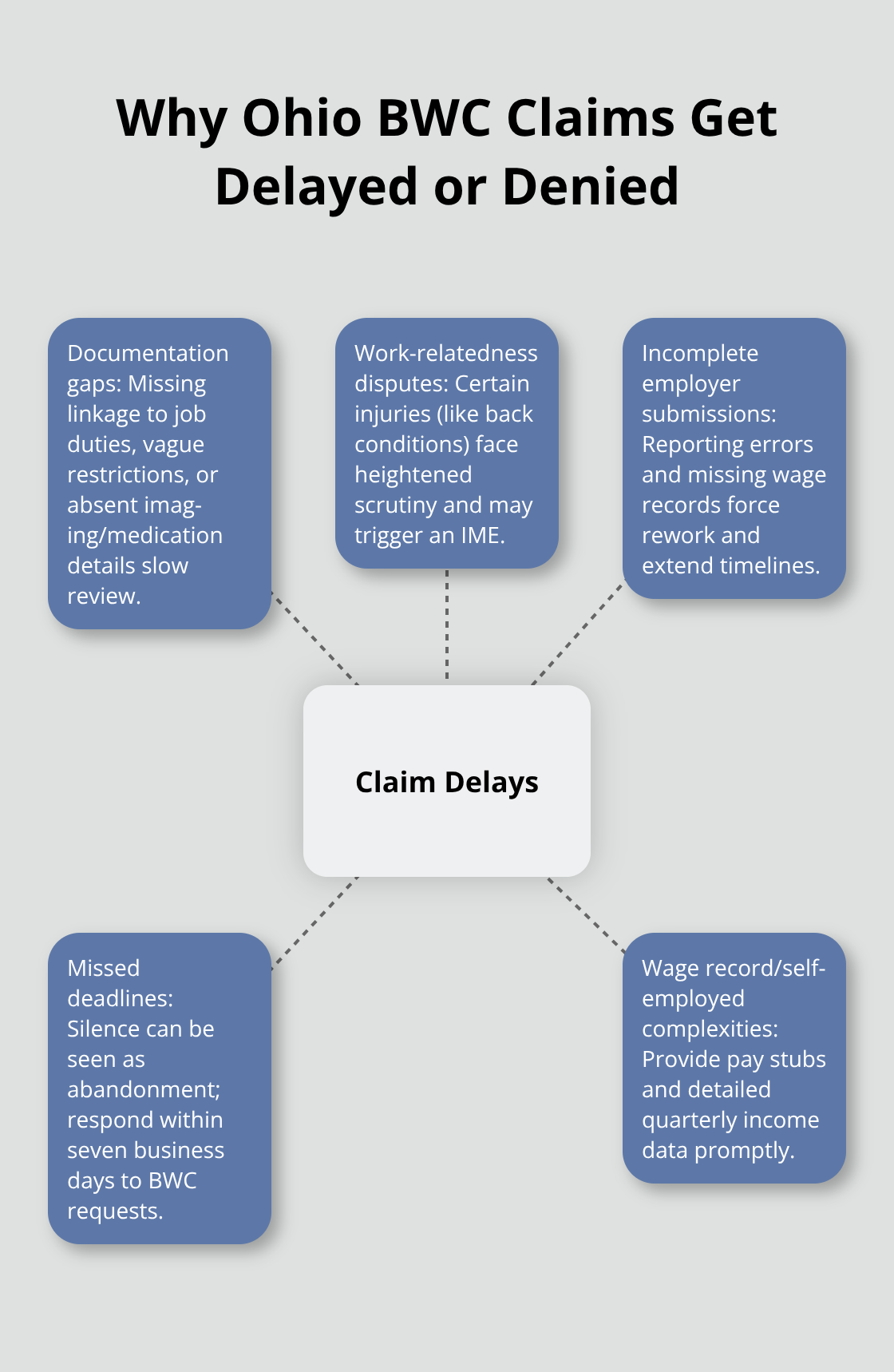
Missing this specificity forces the BWC to request clarification, adding weeks to processing time. Submit medical documentation immediately after your injury rather than waiting for your employer to gather records. This single action cuts processing delays substantially because you control the timeline instead of relying on employer responsiveness.
When the BWC Questions Work-Relatedness
Injury classification disputes create the most frustrating delays because they shift the burden of proof onto you. The BWC scrutinizes certain injuries more heavily than others, and conditions affecting your back trigger heightened skepticism automatically. Your medical records must establish a clear causal link between your workplace activities and your symptoms. If you lifted a heavy object and felt immediate pain, document that sequence precisely. If your condition developed gradually over months at your job, medical evidence becomes harder to establish and the BWC may request an independent medical examination. Missing deadlines compounds these problems because the BWC interprets silence as abandonment of your claim. Ohio law requires you to respond to BWC requests within specific timeframes, and failure to meet those deadlines can result in claim dismissal. If you receive a request for additional information, treat it as urgent and respond within seven business days. Contact the BWC at 30 W. Spring St., Columbus, OH 43215-2256 if you need clarification about what they require. Beyond 30 days without progress, call directly rather than assuming your claim is processing normally.
How Incomplete Employer Submissions Slow Your Approval
Incomplete employer submissions create unnecessary delays even when your medical evidence is solid. Your employer must report the injury to the BWC properly, and some employers (particularly small businesses) make procedural errors that require correction. Verify that your employer actually filed the claim by contacting the BWC directly. Request confirmation of claim receipt rather than assuming notification occurred. If your claim was not filed, provide the BWC with your medical documentation immediately and request expedited processing. Wage records present another frequent obstacle because the BWC needs accurate earnings data from the four completed quarters before your injury to calculate benefits correctly. Request your most recent pay stubs directly from your employer and provide them to the BWC proactively. Self-employed workers face additional complexity because present earnings equal gross income minus business expenses, requiring quarterly reporting. If you are self-employed, prepare detailed income documentation for the quarters preceding your injury. These concrete steps eliminate the most common reasons claims stall, moving your approval forward substantially faster than waiting passively for the system to process your file.
Final Thoughts
Temporary disability benefits in Ohio protect your income while you recover from a work injury, but the system demands precision from you. Three factors determine your success: notifying your employer immediately, submitting complete medical documentation that answers the BWC’s questions directly, and responding promptly to any requests for additional information. Most delays stem from incomplete submissions or missing details that you can control, so taking action upfront accelerates your approval substantially.
Medical evidence linking your injury directly to your job duties matters more than anything else in the process. Specific physician statements about your restrictions and work capacity accelerate approval, while vague documentation creates delays that push back your benefit start date. If your claim stalls beyond 30 days, contact the BWC directly at 30 W. Spring St., Columbus, OH 43215-2256 instead of assuming silence means progress.
A workers’ compensation attorney changes the outcome significantly when claims face denial or classification disputes, handling the complexity so you can focus on recovery. Robin J Peterson Company, LLC represents injured workers throughout the Cleveland, Akron, and Canton areas, fighting for the benefits you earned through your work injury. Notify your employer of your injury today, gather your medical documentation immediately, and file your claim with the BWC.