
The Ohio Bureau of Workers’ Compensation denies thousands of claims each year, often for preventable reasons. Understanding the most common BWC denial reasons in Ohio helps you protect your claim from the start.
At Robin J Peterson Company, LLC, we’ve seen workers lose benefits due to simple mistakes in documentation or timing. This guide walks you through what causes denials and exactly how to respond if yours is rejected.
Why the BWC Rejects Most Claims
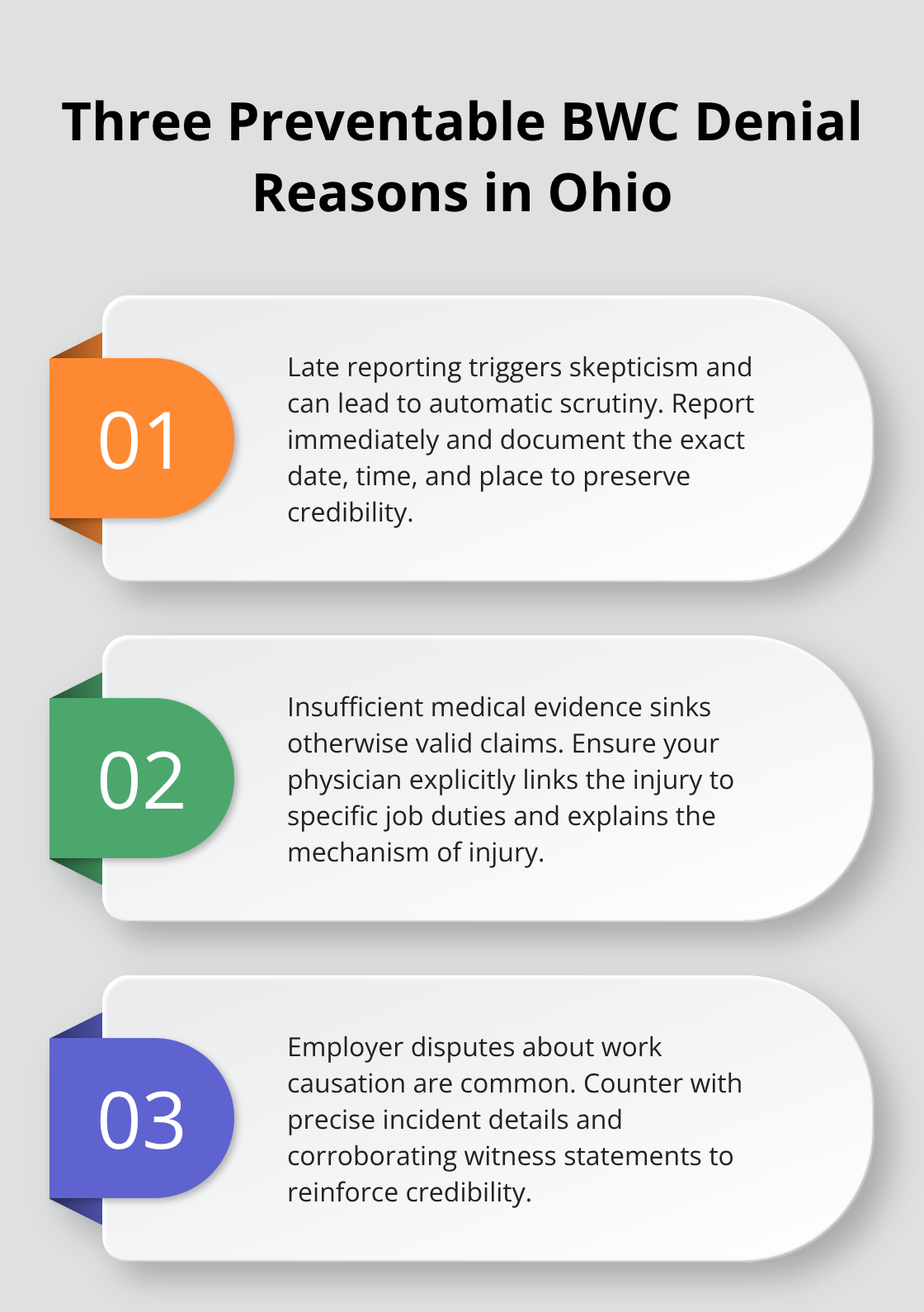
The Three Preventable Denial Reasons
The Ohio Bureau of Workers’ Compensation denies claims for three concrete reasons, and each one you can prevent with the right approach. The BWC itself identifies late reporting, insufficient medical evidence, and employer disputes about work causation as the primary culprits behind denials. Understanding these three categories helps you build a stronger claim from day one and avoid the mistakes that cost workers their benefits.
Medical Evidence Must Explicitly Connect Your Injury to Work
Medical records that fail to explicitly connect your injury to specific job duties represent the single biggest problem. Generic medical notes stating only that you have a back injury or shoulder pain mean nothing to the BWC-your doctor must write that the work incident caused the condition and explain exactly how your job duties led to the injury. A physician note reading “patient reports work injury” without describing the mechanism of injury or linking it to your actual job responsibilities gives the BWC grounds to deny.
The timing of your medical documentation matters equally. If medical records don’t reach the BWC within 17 days of your injury report, automatic denial becomes likely. Coordinate directly with your healthcare provider to confirm they submit records promptly and include explicit work-causation language that connects the dots between what happened at work and your physical condition.
Employer Disputes and Credibility Challenges
Employers sometimes challenge the credibility of your account, especially when the incident lacked witnesses or occurred in a way that seems unclear. Vague incident details-saying only that you hurt yourself at work without describing where, when, or what you were doing-invite skepticism. Instead, provide the exact date and time, the precise location within your workplace, and the specific job duties you performed when the injury happened.
Witness statements from coworkers carry substantial weight in countering employer denials because the Industrial Commission values corroboration. Collect written statements from anyone who saw the incident or heard about it immediately afterward. These accounts strengthen your position significantly when disputes arise.
Administrative Errors That Undermine Your Claim
Administrative errors on initial paperwork represent a third major preventable denial cause. Misspelled names, incorrect dates, missing signatures, or conflicting information between your First Report of Injury and your medical records create doubt about claim validity. Review every form carefully before submission and maintain consistency across all documents you file with the BWC. Small mistakes in paperwork can trigger denials that have nothing to do with the actual merit of your injury.
Once you understand these three denial categories, the next step involves knowing exactly what to do if the BWC rejects your claim anyway.
Turning a Denial Into a Winning Appeal
Act Within 14 Days or Lose Your Right to Appeal
When the BWC denies your claim, you have exactly 14 days to file the IC-12 Notice of Appeal with the Industrial Commission of Ohio. This window is not flexible-missing it eliminates your right to formal appeal and closes off almost all paths to recovery.
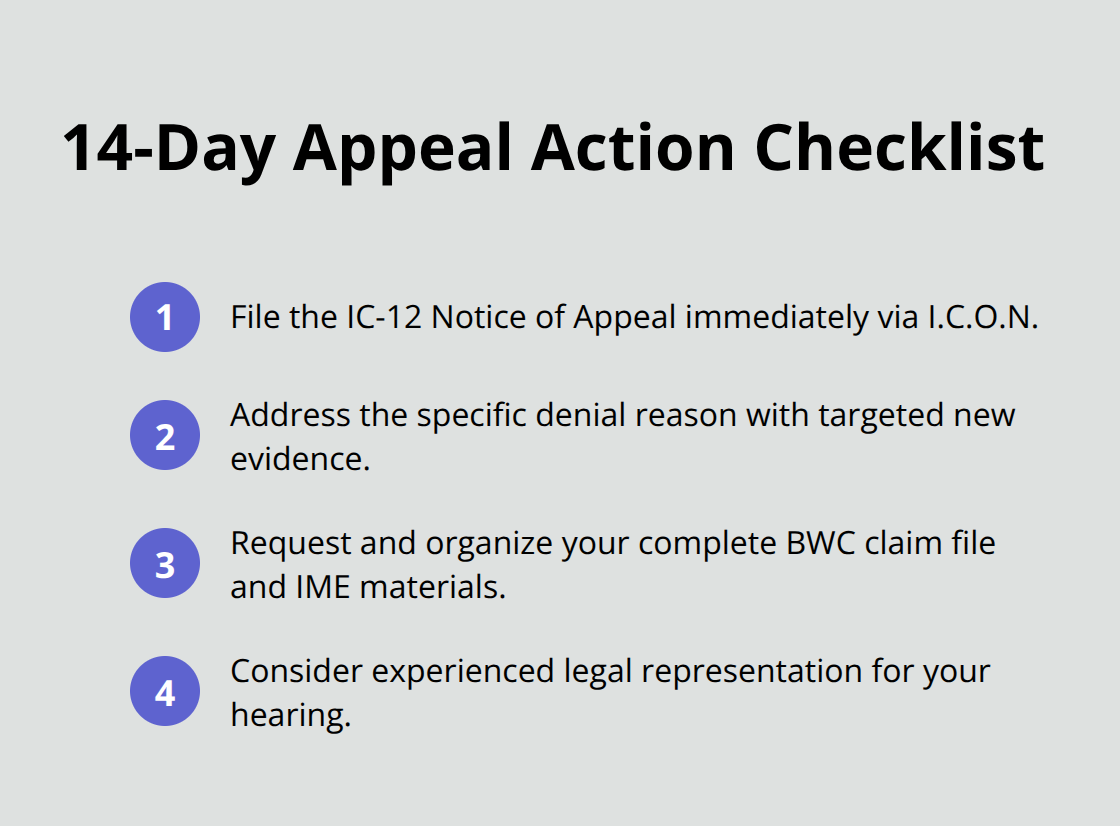
File immediately through the Ohio Industrial Commission Online Network (I.C.O.N.) and submit the form to the BWC at 30 W. Spring St., Columbus, OH 43215-2256. Speed matters more than perfection at this stage; a timely filing protects your legal standing even if you need to strengthen your evidence afterward.
Address the Specific Denial Reason With New Evidence
The Industrial Commission reviews appeals based on the strength of evidence presented, which means your response strategy must directly address why the BWC rejected your claim in the first place. If the denial cited insufficient medical evidence, your appeal must include updated physician statements that explicitly connect your injury to work and describe the mechanism of injury in concrete detail. If the employer disputed work causation, gather written statements from coworkers who witnessed the incident or heard about it immediately after. These witness accounts carry substantial weight at the Industrial Commission level because they corroborate your version of events without relying solely on your word against your employer’s.
Organize Your Complete Claim File and Medical Records
Request your complete BWC claim file immediately to understand exactly what evidence the agency considered and what gaps exist in your documentation. Organize all post-injury medical records chronologically and obtain any Independent Medical Examination reports the BWC commissioned. If an IME report exists, prepare a detailed rebuttal addressing specific discrepancies and emphasizing how the injury represents a substantial contributing factor in your condition. Correct any administrative errors that appeared in your initial claim-misspelled names, conflicting dates, or missing signatures-because consistency across all documents strengthens your credibility.
Consider Legal Representation for Your Appeal
An attorney experienced in Industrial Commission appeals can significantly improve your odds of success. Many firms offer free consultations to injured workers, and legal representation helps you present evidence effectively and obtain credible causation opinions from physicians. Structure your appeal to directly address the specific denial reason with new or clarifying medical evidence, a corrected timeline, and witness statements rather than simply resubmitting the same materials that failed the first time.
With your appeal strategy in place and evidence organized, the next critical step involves understanding what happens during the actual hearing process at the Industrial Commission.
Build Your Claim From Day One
Report Your Injury Immediately and Create a Paper Trail
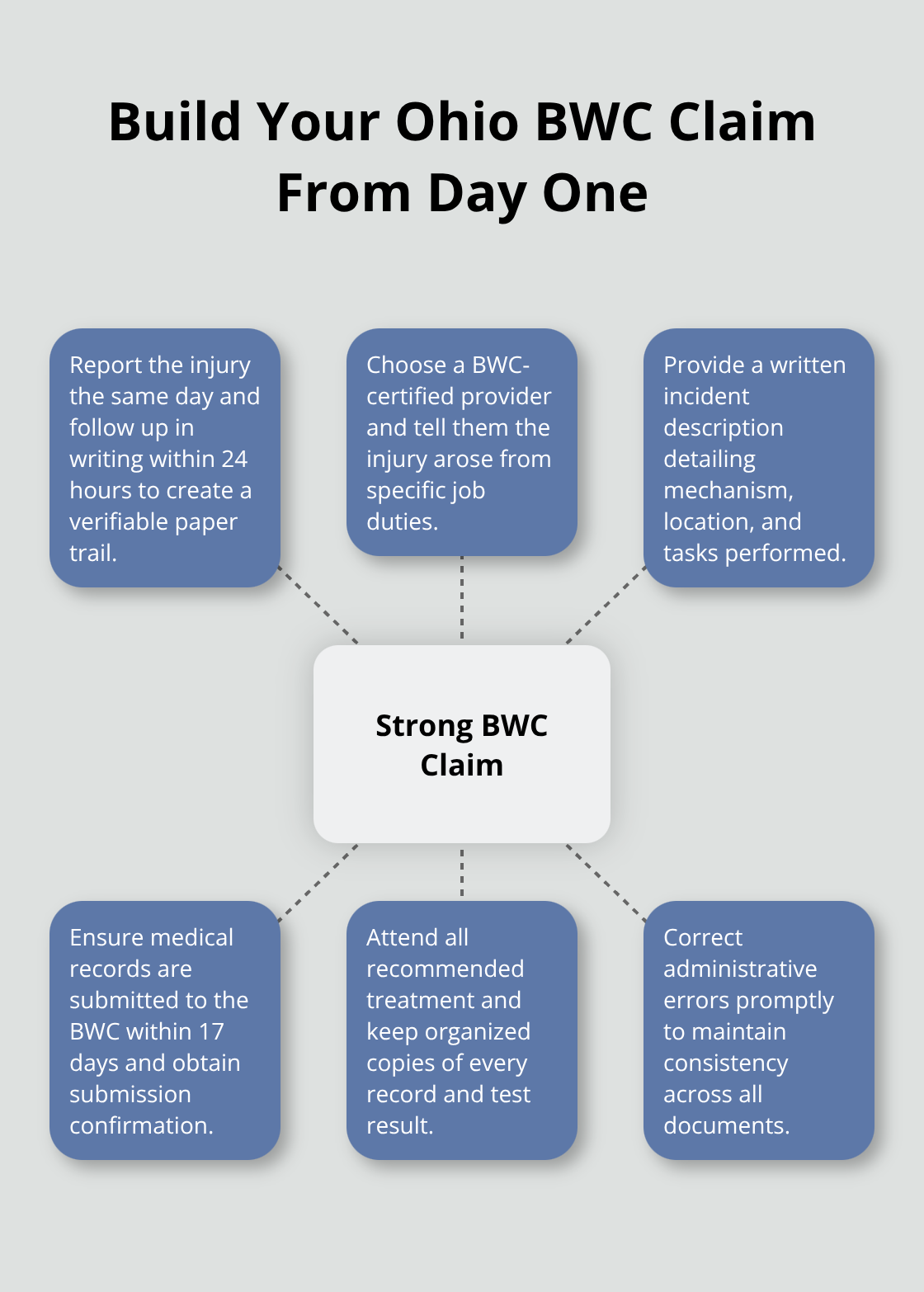
The time to prevent a BWC denial is before it happens, not after the rejection letter arrives. Report your injury on the exact day it occurs and file a written follow-up within 24 hours to create an auditable record that the BWC cannot later dismiss as delayed or suspicious. The Ohio Bureau of Workers’ Compensation flags any injury report submitted beyond 30 days as highly suspicious, and delays of even two weeks can trigger automatic scrutiny. When you report immediately, you establish credibility from the start and eliminate one of the three preventable denial reasons the BWC uses most often.
Coordinate with your employer’s safety or HR department to confirm they receive your report and document the names of anyone you spoke with and the exact time you reported. This creates a paper trail that protects you if your employer later claims they never heard about the injury.
Select a BWC-Certified Provider and Provide Detailed Incident Information
Your healthcare provider selection determines whether your medical records will contain the explicit work-causation language the BWC demands or vague notes that guarantee denial. Choose a doctor or clinic certified by the BWC and tell them during your first appointment that your injury occurred at work and resulted from specific job duties. Bring a written description of the incident including the exact mechanism of injury, the precise location in your workplace where it happened, and what you were doing when it occurred.
Hand this to your physician before they write their clinical notes so the causation language appears directly in the medical record rather than buried in a separate incident report. Medical records must reach the BWC within 17 days of your injury report or automatic denial becomes likely, so confirm with your healthcare provider’s office that they submit electronically to the BWC and ask for a submission confirmation.
Maintain Consistent Treatment and Organized Medical Records
Attend every recommended medical appointment without gaps because missed treatment undermines your claim and signals to the BWC that your injury may not be serious. Keep personal copies of every medical record, test result, and treatment note in a single organized file with dates clearly marked. If you have a pre-existing condition that your work injury aggravated, document the timeline carefully by collecting prior medical records showing stability before the incident and decline afterward, with explicit physician statements about how your job duties worsened the condition.
Understanding your workplace injury rights matters less than understanding the specific documentation standards the BWC uses to evaluate claims, so focus your energy on gathering the exact evidence types the agency requires rather than studying general legal concepts.
Final Thoughts
The three most common BWC denial reasons Ohio workers face-late reporting, weak medical evidence, and employer disputes about work causation-are entirely preventable with the right approach from day one. You now understand what causes denials and how to build a claim that withstands scrutiny. Report your injury immediately, select a BWC-certified provider who documents explicit work causation, maintain consistent treatment, and organize your records meticulously to eliminate the mistakes that cost workers their benefits.
If the BWC denies your claim anyway, act within 14 days to file the IC-12 Notice of Appeal through the Ohio Industrial Commission Online Network. Your appeal strategy must directly address the specific denial reason with new medical evidence, witness statements, and corrected documentation rather than simply resubmitting the same materials. The Industrial Commission reviews appeals based on evidence strength, which means a well-supported case can overcome an initial rejection.
Contact Robin J Peterson Company, LLC immediately if you received a denial letter to discuss your appeal options. The firm represents injured workers throughout the Cleveland, Akron, and Canton areas and specializes in navigating the complexities of the Ohio Bureau of Workers’ Compensation and the Industrial Commission. Your 14-day window to appeal is not flexible, so act now rather than waiting.