
A work injury in Ohio can feel overwhelming, especially when you’re unsure about your rights and next steps. We at Robin J Peterson Company, LLC created this BWC claim guide Ohio to walk you through the entire process from start to finish.
Whether your claim gets approved immediately or you need to appeal a decision, knowing what to expect makes all the difference. This guide covers everything you need to navigate the Bureau of Workers’ Compensation system successfully.
How the Ohio BWC System Works
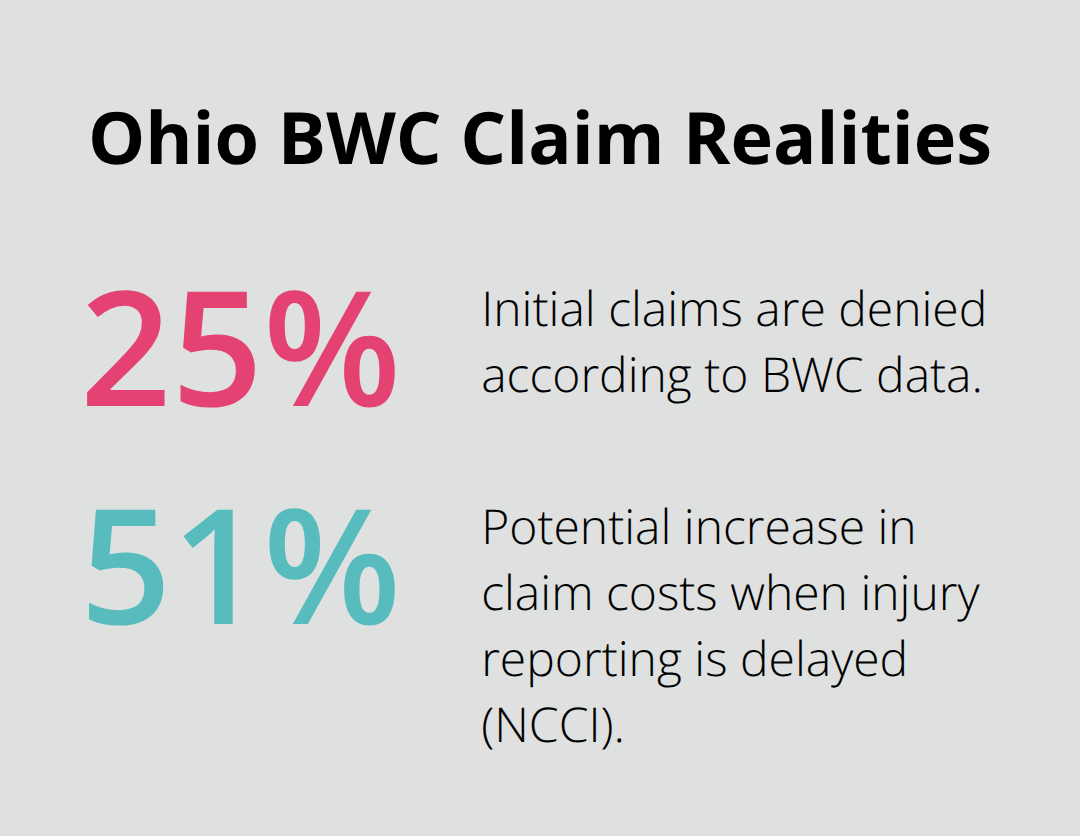
Ohio operates a no-fault workers’ compensation system, which means you don’t have to prove your employer was negligent to receive benefits. The Bureau of Workers’ Compensation administers all claims, handles medical authorization, processes benefit payments, and sets employer premiums. This differs fundamentally from a traditional lawsuit where you’d need to demonstrate fault. In Ohio’s system, the only requirement is proving the injury happened during work and that medical treatment was necessary. The BWC covers both traumatic injuries like fractures from falls or machinery accidents and occupational diseases including certain cancers and poisonings from substances like asbestos, lead, mercury, and arsenic. About 25% of initial claims are denied according to BWC data, which highlights why understanding the process matters. Denials typically stem from timing issues, documentation gaps, or inconsistencies between your accident report and medical records rather than the severity of your injury.
Filing deadlines matter more than you think
You have strict timeframes to file a claim in Ohio. You must report your injury to your employer within 24 hours, which triggers the First Report of Injury filing. After that, you have one year from a work-related accident to submit your formal claim, two years for occupational diseases, and one year for death claims. The investigation window after you submit a claim lasts 28 days, during which the BWC reviews your documentation and may request additional information. Delaying injury reporting can raise claim costs by up to 51% according to the National Council on Compensation Insurance, making immediate action essential. The BWC typically acknowledges receipt within about ten business days and assigns a claim number for tracking purposes. This means every day counts from the moment you’re injured.
What separates a BWC claim from a traditional lawsuit
A traditional lawsuit requires you to prove fault and negligence, involves jury trials, and can take years to resolve. The BWC system skips all of that. You file a claim, the BWC investigates, and they approve or deny it based on work-relatedness. If denied, you appeal to the Industrial Commission of Ohio, where an administrative law judge reviews your evidence. You have exactly 14 days to request a hearing after a denial, so missing this deadline eliminates your appeal rights entirely. The no-fault approach means faster decisions but also stricter requirements around documentation and timeliness. Medical evidence dominates the appeal process, so you should gather comprehensive records, witness statements, and detailed medical documentation from day one to strengthen your position significantly.
How the BWC evaluates work-relatedness
The BWC focuses on one central question: did the injury occur in the course of employment? This determination shapes everything that follows in your claim.
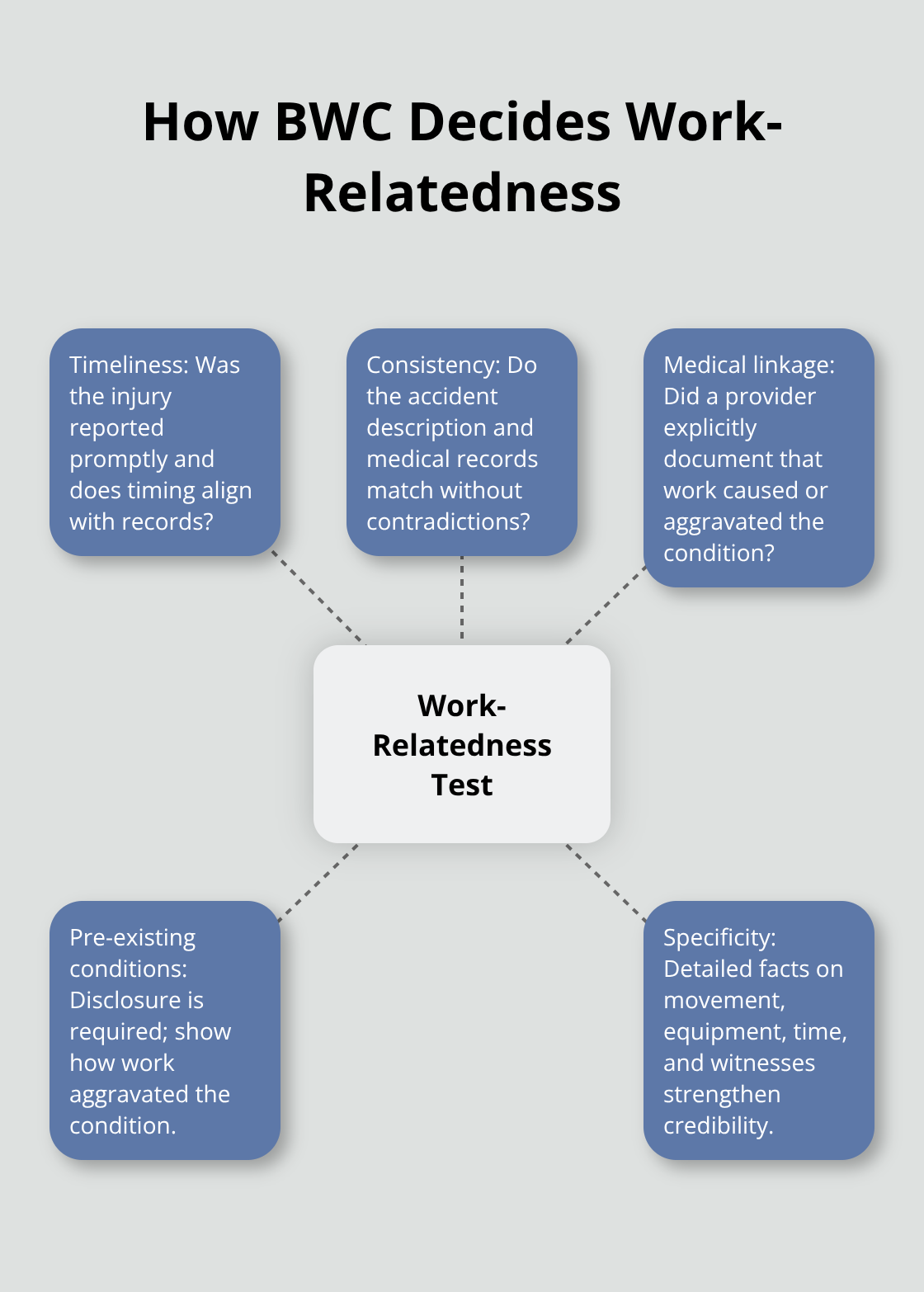
The agency examines the timing of your injury report, the consistency between your accident description and your medical records, and whether your medical provider documented the work connection. Pre-existing conditions don’t automatically disqualify a claim, but you must truthfully disclose them and show how work aggravated the condition. Vague injury descriptions extend processing time, so you should provide precise details about movement, equipment involved, and witnesses present. The more specific your account (for example, “I strained my lower back lifting a 50-pound box at 2 PM on March 20 in the warehouse”), the stronger your claim stands against scrutiny.
Next steps after understanding the system
Now that you understand how Ohio’s no-fault system operates and why deadlines and documentation matter, the actual filing process becomes clearer. Your next move involves reporting your injury to your employer and gathering the documentation that will support your claim through the entire BWC review.
How to File Your Claim the Right Way
Report Your Injury Within 24 Hours
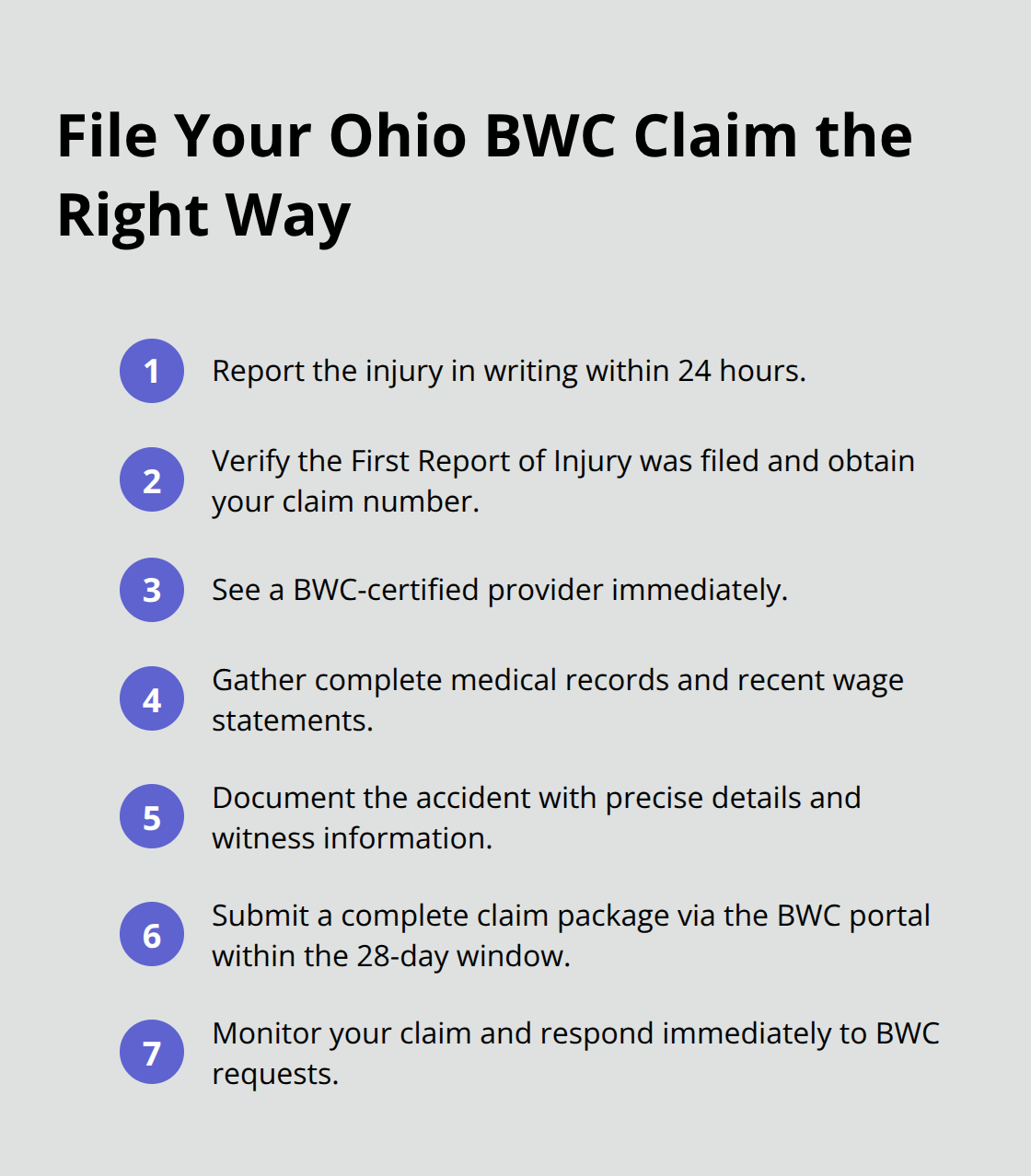
The moment you’re injured at work, the clock starts ticking. You have 24 hours to report the injury to your employer in writing, either through email or a formal accident report. This written notification creates a verifiable paper trail that protects you later if disputes arise about when you reported the injury. Many workers make the mistake of telling a supervisor verbally and assuming that’s sufficient-it isn’t.
The BWC needs documentation that your employer received notice within that critical window.
Once you’ve reported to your employer, they or their managed care organization must file the First Report of Injury form. However, don’t assume they’ll do it correctly or on time. Contact the BWC directly to verify the filing status and obtain your claim number. This proactive step prevents delays that could cost you significantly; according to the National Council on Compensation Insurance, delaying injury reporting can raise claim costs by up to 51 percent.
Schedule an Appointment With a BWC-Certified Provider
After reporting, schedule an appointment with a BWC-certified medical provider immediately. Non-certified providers won’t be able to bill the BWC for treatment, leaving you responsible for those bills. The provider’s documentation of your injury and work-relatedness becomes the foundation of your entire claim, so choose someone experienced with workers’ compensation cases who understands what the BWC requires.
Gather Comprehensive Documentation
Documentation determines whether your claim succeeds or fails, yet most injured workers gather it haphazardly. Start with your medical records-every test result, imaging report, treatment note, and physician statement matters. Your doctor must explicitly document the work connection and any work restrictions they impose.
Simultaneously, collect your wage statements from the past few pay periods to establish your earning capacity for wage replacement calculations. Photograph the work area and any equipment involved in your injury if possible. Write down the names and contact information of any coworkers who witnessed the accident, because witness statements carry substantial weight during investigations and appeals.
Document the Accident With Precision
Include a detailed written account of exactly what happened: the time, location, specific movements you performed, equipment you used, and how the injury occurred. Vague descriptions like “I hurt my back at work” won’t cut it; provide precision like “I strained my lower back lifting a 50-pound box from a shelf at 2 PM on March 20 in the warehouse.” Gather any prior medical records related to the injury area, and truthfully disclose any pre-existing conditions-the BWC will find them anyway, and honesty prevents claim denials based on dishonesty.
Submit Your Complete Claim Package
Submit your complete claim package through the BWC online portal within the 28-day investigation window. Incomplete submissions restart the clock and delay processing, so verify every document is included before hitting submit. The BWC typically acknowledges receipt within ten business days and assigns a claim number. Monitor your claim status through the BWC portal and respond immediately to any requests for additional information, because delays in your responses extend the investigation timeline and give the BWC reason to deny your claim.
Once the BWC assigns your claim number and begins its formal review, you enter the next phase where the agency evaluates whether your injury qualifies for benefits and what type of support you’ll receive.
What Happens After You File Your Claim
After the BWC receives your claim package, the agency enters its formal evaluation phase where it determines whether your injury qualifies for benefits and what type of support you’ll receive. The BWC has 28 days to investigate your submission, review medical records, and decide on approval or denial. During this window, the agency examines whether your injury meets the work-relatedness requirement, whether your medical documentation supports the claim, and whether any inconsistencies exist between your accident report and your medical records.
Understanding Your Benefits If Approved
If the BWC approves your claim, you become eligible for two primary benefit categories: medical benefits and wage replacement. Medical benefits cover all reasonable and necessary treatment from BWC-certified providers, including doctor visits, physical therapy, imaging, and surgical procedures related to your work injury. Wage replacement provides partial income if your injury prevents you from working, calculated as a percentage of your average weekly wage depending on your disability classification.
The BWC distinguishes between temporary total disability, which applies while you’re unable to work but expected to recover, and permanent partial disability, which applies when you’ve reached maximum recovery but retain lasting limitations. Your medical provider determines your work capacity and any restrictions, which directly affects your wage replacement eligibility. Occupational disease claims follow the same benefit structure but often take longer to investigate because the BWC must establish the connection between your workplace exposure and your diagnosed condition.
How Medical Evidence Shapes Your Claim
The agency prioritizes medical evidence throughout this process, meaning your physician’s documentation of work-relatedness, treatment necessity, and functional limitations carries far more weight than your own statements about how the injury occurred. Your treating provider’s records become the foundation upon which the BWC builds its approval or denial decision.
What to Do If the BWC Denies Your Claim
If the BWC denies your claim or approves it with reduced benefits, you have exactly 14 days from the denial date to request a hearing with the Industrial Commission of Ohio. This deadline is absolute; missing it eliminates your appeal rights permanently. To strengthen an appeal, you should gather updated medical records from your treating provider that directly address the reason for denial, obtain a written statement from your physician explaining the work connection and necessity of treatment, collect witness statements from coworkers who saw the accident, compile wage documentation showing your earning capacity, and organize a chronological record of all medical treatment and correspondence with the BWC.
The Appeal Hearing Process
The Industrial Commission assigns an administrative law judge to review your case, and you present your evidence at a hearing where the judge determines whether the BWC’s decision was correct. Many injured workers significantly improve their appeal outcomes when they hire an Ohio workers’ compensation attorney early in the process, particularly when facing a denial. An attorney handles discovery requests, prepares you for cross-examination, obtains expert medical testimony if needed, and presents a compelling case to the judge. Robin J. Peterson Company, LLC represents injured workers throughout Ohio and can evaluate your claim during a free consultation to determine whether legal representation improves your chances of overturning a denial or securing additional benefits.
Final Thoughts
Successfully navigating the Ohio BWC system requires three critical actions: report your injury within 24 hours, gather comprehensive documentation immediately, and submit a complete claim package within the investigation window. The 25% denial rate underscores how easily claims fail when workers skip steps or provide incomplete information. Your accident report must align precisely with your medical records, your provider must document work-relatedness explicitly, and your timeline must remain airtight-these fundamentals separate approved claims from denied ones far more than the severity of your injury.
Legal representation becomes valuable when the BWC denies your claim or approves it with reduced benefits, since you have only 14 days to appeal and that window closes permanently if you miss it. An experienced workers’ compensation attorney handles the appeal process, obtains medical evidence supporting your position, prepares you for the hearing before an administrative law judge, and presents a compelling case that significantly improves your chances of overturning a denial. Many injured workers wait too long to seek legal help, missing critical deadlines or failing to obtain the medical testimony that dominates appeal decisions.
Whether you’re filing your initial claim or appealing a denial, contact Robin J. Peterson Company, LLC early to protect your rights and prevent costly mistakes. We offer a free consultation to evaluate your claim and determine whether legal representation strengthens your position using this BWC claim guide Ohio. Ohio workers have specific protections under the no-fault system, and you deserve representation that understands both the BWC process and how to present evidence effectively to the Industrial Commission.