
Most office workers assume they’re not eligible for workers’ compensation because they don’t work in construction or manufacturing. That’s a dangerous misconception that costs injured desk workers thousands in lost benefits every year.
At Robin J Peterson Company, LLC, we’ve helped countless office employees understand their office worker compensation rights and successfully navigate Ohio’s claims process. Whether you’ve suffered a workplace injury or developed an occupational illness, you have legal protections and benefits available to you.
Understanding Workers’ Compensation Coverage for Office Workers
Who Qualifies for Workers’ Compensation in Ohio
Office workers in Ohio qualify for workers’ compensation if they work for an employer with at least one employee. This includes part-time workers, temporary employees, and contractors in certain situations. The Ohio Bureau of Workers’ Compensation administers coverage for most private employers, while some large employers self-insure their programs. What matters is not your job title or industry-it’s whether you have an employment relationship with a covered employer. If you sit at a desk for a company in Ohio, you almost certainly qualify for coverage. The only real exceptions are independent contractors, sole proprietors, and specific categories like certain agricultural workers or domestic employees. Many office workers miss out on benefits simply because they don’t realize they qualify, assuming compensation only applies to construction sites or factories.
Office Injuries Happen More Often Than You Think
Lower back strain from prolonged sitting affects roughly 80 percent of adults at some point, and office workers experience this at higher rates than the general population. Neck and shoulder pain from computer work, eye strain, and wrist injuries from keyboard use develop as common workplace conditions over time. Slip and fall accidents in office buildings, motion injuries from data entry, and injuries sustained during work travel also qualify for coverage. Acute injuries like a fall from a ladder while changing a ceiling light, a hand injury from a paper cutter, or a back injury from lifting heavy files present straightforward claims. Ohio’s workers’ compensation system covers both traumatic injuries that occur suddenly and occupational diseases that develop from ongoing workplace exposure. Your injury or illness must arise out of and occur in the course of your employment-meaning it happened because of your job duties or the workplace environment.
What Ohio’s System Actually Covers
Ohio’s workers’ compensation provides medical benefits, wage replacement when you cannot work, rehabilitation services, and disability benefits for permanent impairment. You receive treatment from authorized medical providers chosen by your employer’s insurer, though you can request a change of physician under certain circumstances.
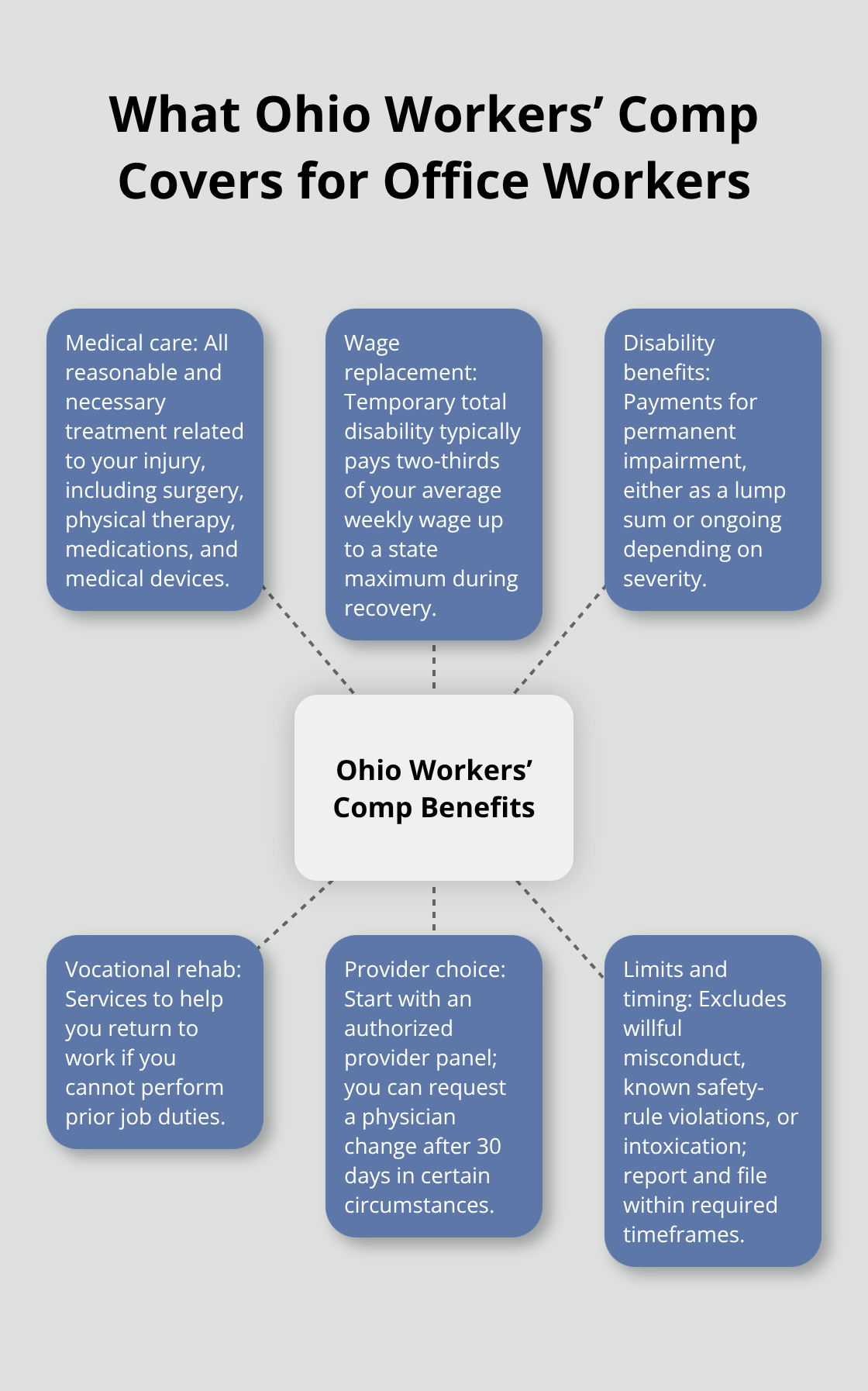
The system covers all reasonable and necessary medical treatment related to your workplace injury, including surgery, physical therapy, medications, and medical devices. Temporary total disability benefits replace a portion of your lost wages while you recover, typically at two-thirds of your average weekly wage up to a state maximum. If your injury causes permanent disability, you receive a one-time lump sum payment or ongoing payments depending on the severity. Vocational rehabilitation services help you return to work if you cannot perform your previous job duties. The system excludes injuries that occur during willful misconduct, violations of safety rules you knew about, or injuries caused by intoxication. Ohio does not cover pre-existing conditions unless the workplace injury substantially aggravates them. Claims must be reported to your employer and filed with the Ohio Bureau of Workers’ Compensation within specific timeframes to protect your eligibility.
Understanding what coverage actually includes sets the foundation for your next steps. Once you know you qualify and what benefits apply to your situation, you need to understand your specific rights as an injured office worker in Ohio.
Your Rights After a Workplace Injury
File Your Claim Without Fear
The moment you report an injury to your Ohio employer, your rights activate. You have the legal right to file a claim with the Ohio Bureau of Workers’ Compensation without needing your employer’s permission or approval. Many office workers hesitate because they fear retaliation, but Ohio law explicitly protects you from employer punishment for filing a legitimate claim. Your employer cannot fire you, demote you, reduce your hours, or treat you differently because you filed. If retaliation occurs within one year of your claim, the law presumes your employer acted unlawfully unless they prove otherwise. This protection matters because roughly 40 percent of workers report concerns about job security when considering a claim, yet filing protects you far more than silence ever will.
Report Your Injury Immediately
Start your claim immediately after your injury by notifying your supervisor or HR department in writing. Include the date, time, location, what happened, and which body parts were affected. File your formal claim through the Ohio Bureau of Workers’ Compensation within one year, though waiting costs you benefits for every day you delay. Written notification creates a documented record that protects you if disputes arise later about when you reported the injury.
Access Medical Care and Wage Replacement
Once filed, you gain access to authorized medical providers who treat your injury at no cost to you. You choose your initial treating physician from the employer’s panel, and after 30 days of treatment, you can request a change of physician if needed. The insurer cannot limit your medical care to only certain treatments or deny necessary procedures without proper justification. You receive wage replacement benefits if you miss work during recovery, typically calculated at two-thirds of your average weekly wage. Your employer’s insurer must communicate claim decisions within specific timeframes, and you have the right to appeal any denial or inadequate benefit determination.
Navigate Disputes Through the Industrial Commission
If disputes arise over your medical care or benefit amounts, the Industrial Commission of Ohio handles appeals and mediations. The commission maintains an official website with claim resources, timelines, and contact information to guide you through each step. Protecting your rights means documenting everything immediately: take photos of the injury site, collect witness names and contact information, save all medical records and communications, and keep detailed notes about your recovery timeline and missed work days. This documentation becomes essential when you move forward with navigating the actual claims process itself.
Navigating the Claims Process
The first 24 hours after your injury determine how smoothly your claim proceeds through Ohio’s workers’ compensation system. Report your injury to your supervisor or HR department immediately, preferably in writing, and include the exact date, time, location, and body parts affected. Seek medical attention right away, even if the injury seems minor, because delaying treatment weakens your claim and creates gaps that insurers exploit during disputes. Notify the Ohio Bureau of Workers’ Compensation within one year of your injury, though filing within 30 days protects you from losing benefits for the delay period.
Document Everything Immediately
Write down everything while it remains fresh: witness names and contact information, what you were doing when injured, environmental conditions, and any safety violations that contributed to the incident. Take photographs of the injury site, your workspace, and any equipment involved before conditions change. This immediate documentation becomes your foundation for the entire claims process and prevents details from fading as weeks pass.
Collect Evidence That Supports Your Claim
Medical records from your treating physician form the core of your evidence, so obtain copies of all doctor visits, test results, imaging reports, and treatment plans immediately. Keep receipts for any out-of-pocket medical expenses, transportation costs to appointments, and medications you purchased. Document your lost wages by collecting pay stubs from before and after your injury, and calculate exactly how many workdays you missed. Save all email communications with your employer, the insurer, and medical providers because these messages establish timelines and demonstrate what information was communicated when. Witness statements from coworkers who saw your injury or know about your job duties strengthen your credibility significantly. If your employer has safety policies or training records related to your injury, request these documents because they show what precautions should have been taken. The Industrial Commission of Ohio processes claims faster when you submit complete documentation upfront rather than responding to requests for missing information months later.
Present Your Case to the Commission
If your claim faces denial or the insurer offers inadequate benefits, the Industrial Commission of Ohio provides a structured appeal process without requiring you to hire an attorney immediately. File your appeal within specific timeframes (typically 14 days from the denial notice) and include all supporting evidence in one submission rather than sending documents piecemeal. The commission schedules a hearing where you present your case before an administrator, and the insurer must justify their position with evidence, not assumptions. Attend every hearing and appointment the commission schedules because missing dates results in claim dismissal regardless of your injury’s severity. Bring your medical records, wage documentation, and witness statements to the hearing, and answer the administrator’s questions directly without speculation. The commission’s website provides claim status updates, hearing schedules, and contact information for your specific case. Many office workers resolve claims through mediation rather than formal hearings, which typically reaches settlements faster and costs less than fighting through the full appeal process (and an experienced workers’ compensation attorney can guide you through either path).
Final Thoughts
Office worker compensation rights in Ohio protect you far more comprehensively than most desk workers realize. You qualify for coverage regardless of your industry, your injuries matter whether they happen suddenly or develop over time, and the system provides medical care, wage replacement, and disability benefits when you need them most. Filing a claim activates legal protections against retaliation, and the Industrial Commission of Ohio exists specifically to resolve disputes when insurers deny or underpay your benefits.
The claims process demands immediate action and thorough documentation. You must report your injury within the first 24 hours, seek medical attention right away, and collect evidence before details fade or circumstances change. Written notification to your employer, medical records from your treating physician, witness statements, and wage documentation form the foundation of a strong claim (the Industrial Commission processes claims faster when you submit complete information upfront rather than responding to requests for missing documents months later).
You should consult a workers’ compensation attorney when your claim faces denial, when the insurer offers benefits you believe are inadequate, when medical disputes arise, or when you feel confused about your office worker compensation rights. An attorney interprets Ohio’s complex workers’ compensation laws, gathers essential evidence, negotiates with insurers, and represents you at hearings or appeals. Contact our firm to discuss your situation and understand how we can protect your rights.