
Returning to work after an injury is a critical moment where your decisions directly affect your compensation and health. At Robin J Peterson Company, LLC, we’ve seen workers unknowingly give up their injury rights by signing documents or accepting job changes without understanding their protections.
Your injury rights after work don’t end when you’re cleared to return. Understanding what Ohio law requires from your employer-and what you can refuse-keeps you protected during this vulnerable transition.
What Ohio Requires Your Employer to Disclose
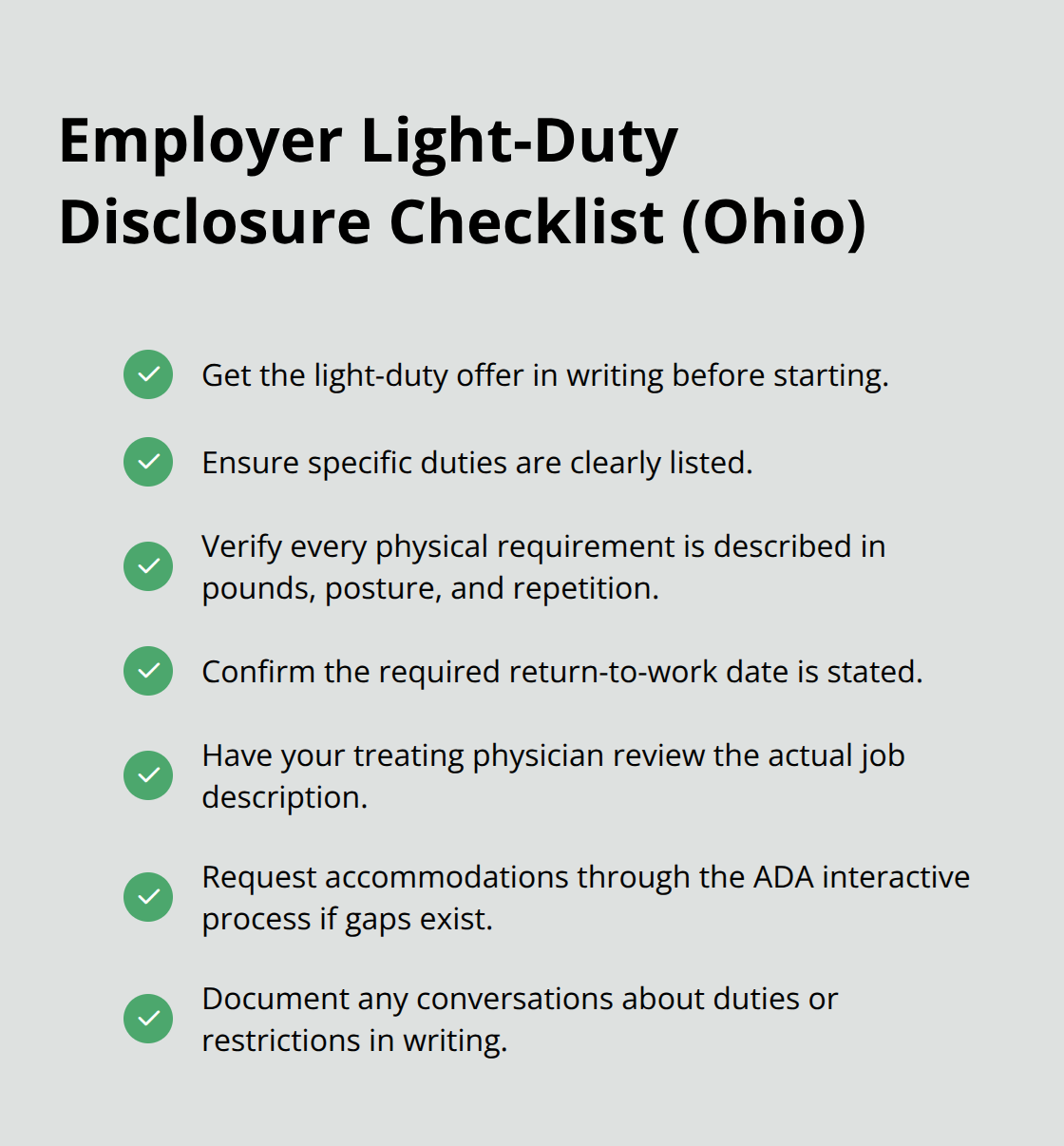
Ohio’s modified duty framework places specific obligations on employers that many workers don’t know about. When your employer offers light-duty work, they must inform you in writing of the specific duties, physical requirements, and the date you must return according to 20 CFR Part 10 Subpart F Section 10.507. This isn’t optional communication-it’s a legal requirement. Too many workers accept verbal job offers or vague descriptions of modified positions, only to discover weeks later that the actual work violates their medical restrictions. Obtain the written offer before your first day. If your employer provides only a verbal offer, request the written version within two business days. This document protects you if disputes arise later about whether the job matched your restrictions.
Medical Restrictions Must Match Exactly
Your treating physician’s restrictions form the boundary of what work you can accept. If your doctor limits lifting to 10 pounds, your employer cannot assign you tasks requiring 15-pound lifts and claim it’s light duty. The written job offer must describe every physical requirement-lifting capacity in pounds, posture limitations, repetitive motion constraints, and shift length. Your physician should review the actual job description before you start work. If gaps exist between your restrictions and available positions, your employer has obligations under the Americans with Disabilities Act to engage in what’s called the interactive process (exploring accommodations like modified tools, adjusted schedules, or remote work options). Write down this conversation if it happens verbally. Many workers skip this step and suffer reinjury because they performed work their doctor never approved.
Your Right to Refuse Unsafe Assignments
You have a legal right to refuse work that would expose you to hazard or violate your medical restrictions without fear of retaliation. This protection comes from OSHA standards and Ohio workers’ compensation law. If your employer pressures you to perform tasks beyond your restrictions or in conditions your doctor warned against, that’s a violation you can report to the Ohio Bureau of Workers’ Compensation. Keep detailed notes of what your employer asked you to do, who requested it, and what your restrictions actually stated. If you refuse unsafe work, your employer cannot cut off your temporary disability benefits or terminate you for this refusal. If they do retaliate, you have grounds for a separate claim.
What Happens When Your Employer Fails to Disclose
Employers sometimes withhold information about job modifications or misrepresent the physical demands of light-duty positions. When this occurs, you lose the ability to make an informed decision about whether the work fits your medical restrictions. The law requires transparency so you can protect your health and your claim. If your employer fails to provide written job descriptions, refuses to match work to your restrictions, or pressures you into unsafe assignments, you need guidance from someone experienced in Ohio workers’ compensation law. Robin J. Peterson Company, LLC represents injured workers throughout the Cleveland, Akron, and Canton areas who face these situations. The firm fights to protect your rights against employers and the BWC when disclosure failures occur.
Mistakes That Cost You During the Return-to-Work Transition
Most workers make critical errors in their first weeks back at work that undermine their entire claim. The Ohio Bureau of Workers’ Compensation reported that workers who fail to document their work activities and medical status during light-duty assignments lose leverage in disputes with insurers.
Document Your Daily Work Activities and Physical Response
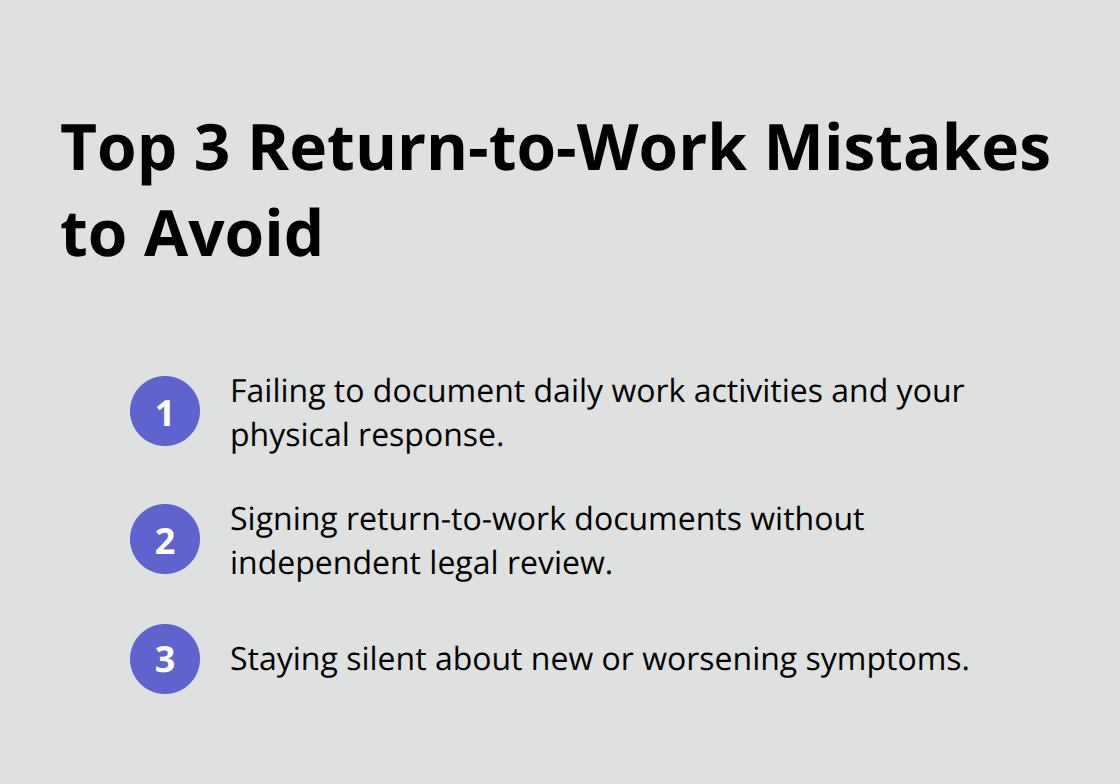
The first mistake is accepting light-duty work without creating a written record of what you actually do each day and how your body responds. Your treating physician issued restrictions for a reason, and your employer’s light-duty position may seem to fit on paper but feel entirely different in practice. Start a simple log on day one: write down the specific tasks you performed, how long you spent on each one, and any pain or symptoms that emerged. Include the names of supervisors who assigned work and any comments they made about your performance or limitations.
This log becomes evidence if your employer later claims you performed heavy work or if you need to prove the job aggravated your injury. Many workers skip this step because it feels tedious, but insurers routinely deny claims for wage loss or permanent impairment when workers cannot prove what work they actually performed. The Bureau of Labor Statistics found that 2.8 million nonfatal workplace injuries and illnesses occurred in private industry in 2018, yet workers who lack detailed activity records struggle to win settlements or benefit extensions because they cannot demonstrate the job’s physical demands.
Review All Documents Before You Sign Them
Your second critical error is signing any document your employer places in front of you without independent legal review. Employers sometimes embed language in return-to-work agreements, light-duty job descriptions, or acknowledgment forms that waives your right to future benefits or claims. One sentence buried in a document might state that you accept the modified position as permanent or that you release the employer from liability for future injury.
Many workers sign these forms believing they are routine paperwork, only to discover later that they surrendered rights they did not understand they were giving away. Before signing anything related to your return to work, send it to an experienced workers’ compensation attorney in Ohio. An attorney reviews these documents for injured workers and frequently finds problematic language that workers nearly signed without understanding the consequences.
Report New Symptoms Immediately to Your Physician and Employer
Your third error is staying silent about new or worsening symptoms. Your restrictions were based on your medical condition at a specific point in time. If you develop new pain, swelling, weakness, or other symptoms during light-duty work, you must report these changes to your treating physician immediately and notify your employer in writing.
Many workers assume that minor new symptoms are normal recovery or worry that reporting them will jeopardize their job. In reality, failing to report symptoms creates a gap in your medical record that insurers later exploit to deny claims. If you suffer a setback and your medical file shows no complaints during your light-duty period, the insurer will argue that the job did not cause harm or that your condition improved. Document every conversation with your employer about your symptoms and send follow-up emails confirming what you reported. If your employer discourages you from seeking medical attention or pressures you to work through pain that contradicts your restrictions, that pressure itself is evidence of a violation.
These three mistakes-failing to document work activities, signing documents without review, and staying silent about symptoms-create vulnerabilities that insurers exploit when disputes arise. The next section examines what steps you should take immediately after you return to work to protect yourself and strengthen your claim.
How to Build Evidence That Protects Your Claim
Create a Daily Log of Your Work Activities
Start documenting your work activities the moment you step back into your job. Create a simple daily log that records the specific tasks you performed, the duration of each task, and your physical response. Write down whether you lifted items and their approximate weight, how long you stood or sat, which arm or leg you used more heavily, and any pain that emerged during or after work. Include the names of supervisors who assigned tasks and any comments they made about your performance or your limitations.
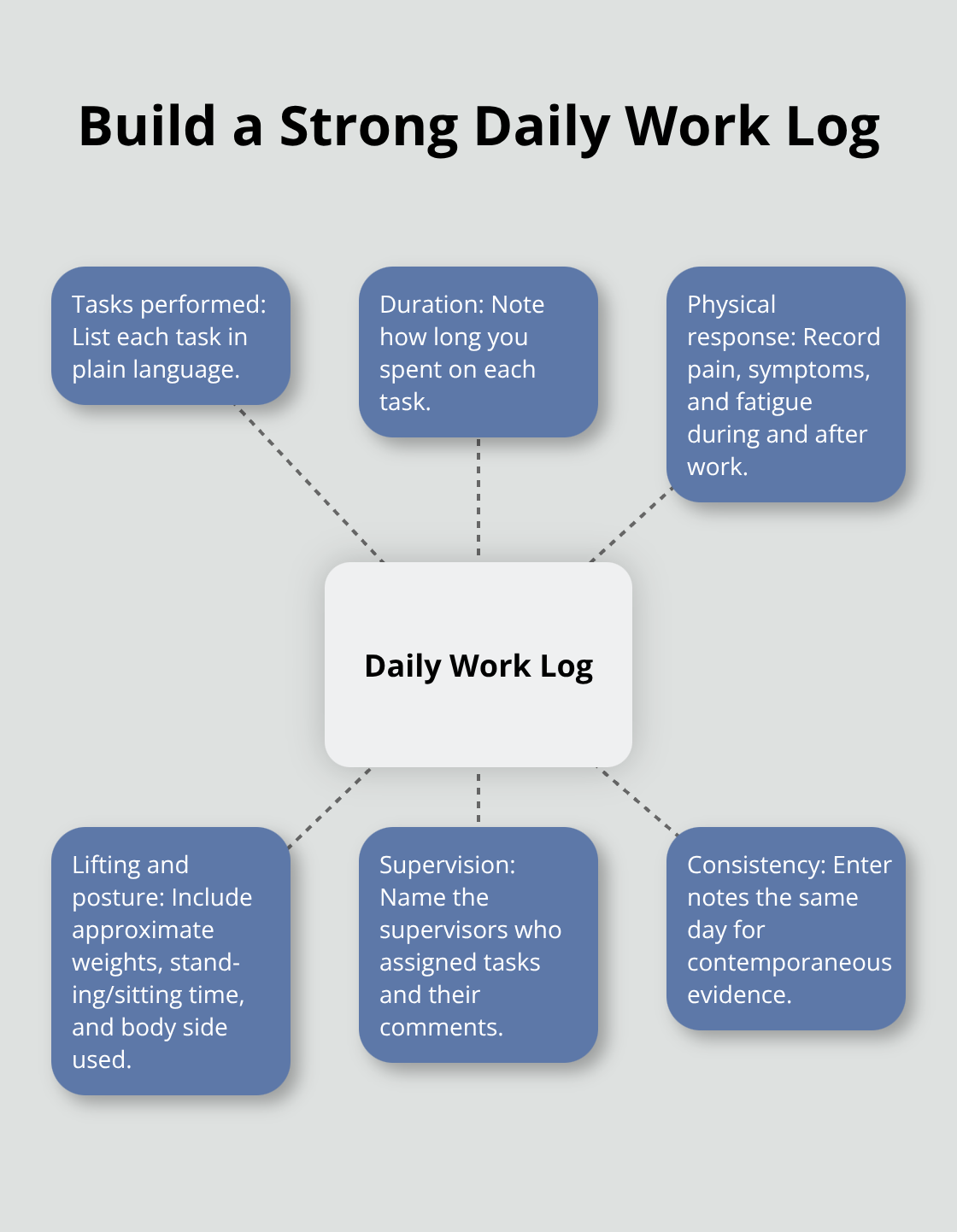
This log becomes your strongest defense if an insurer later claims your job was lighter than it actually was or if your employer disputes the physical demands you faced. Strong medical documentation from the outset protects your claim and prevents the BWC from questioning whether your injury truly qualifies for coverage. Without this documentation, your word becomes one person’s account against your employer’s account, and insurers typically favor employer testimony. Your daily log shifts this balance because you have contemporaneous written evidence created during the work itself, not months later during a dispute.
Capture Visual Evidence of Your Work Environment
Take photos of your work environment if possible. Capture the layout of your workspace and photograph any tools or equipment you used. These images provide visual proof of the job’s physical demands that a written description alone cannot convey.
Request and Review the Written Job Description
Request the written job description from your employer on your first day and have your treating physician review it before you start work. Your doctor needs to confirm that every physical requirement in the job description aligns with your medical restrictions. If your physician finds conflicts, report this to your employer immediately and request modified duties that fit your restrictions.
Document this conversation in writing by sending an email to your supervisor and HR confirming what was discussed and what adjustments were agreed upon. When disputes arise with the Ohio Bureau of Workers’ Compensation or your employer, this email chain becomes evidence that you acted in good faith to protect your health and comply with medical guidance. If your employer refuses to provide a written job description or claims one does not exist, send a formal written request by email and keep a copy for your records. This creates a paper trail showing that you requested transparency and your employer refused.
Act Immediately When Problems Arise
If your employer offers modified duties that contradict your restrictions or if you experience new symptoms during light-duty work, contact an experienced Ohio workers’ compensation attorney immediately. An attorney reviews your documentation, advises whether the job complies with your restrictions, and protects your rights if your employer or the BWC attempts to minimize your claim or cut off your benefits. Robin J. Peterson Company, LLC works with injured workers throughout Cleveland, Akron, and Canton who face these situations and fights for their rights against employers and the Ohio Bureau of Workers’ Compensation.
Final Thoughts
Your injury rights after work extend far beyond the moment you receive medical clearance to return. The decisions you make during those first weeks back determine whether you protect your compensation or inadvertently surrender protections you earned through your injury claim. Ohio law gives you specific rights during this transition, and those rights matter only when you actively exercise them.
When you document your daily work activities, request written job descriptions, and report new symptoms immediately, you create evidence that strengthens your position if disputes arise with the Ohio Bureau of Workers’ Compensation or your employer. Insurers routinely deny claims when workers lack documentation, so your daily log and written communications become the foundation of a defensible claim. Your employer’s obligation to disclose job modifications and match work to your medical restrictions is not a suggestion-it is a legal requirement.
The complexity of Ohio workers’ compensation law means that many injured workers miss critical deadlines, sign documents that waive their rights, or fail to document problems until it is too late to recover. If your employer pressures you to work beyond your restrictions, refuses to provide written job descriptions, or retaliates against you for reporting safety concerns, contact an experienced Ohio workers’ compensation attorney to protect your injury rights after work and secure the compensation you deserve.