
Healthcare workers in Ohio face unique challenges when navigating workers’ compensation claims. Understanding which medical services your healthcare workers comp benefits cover can mean the difference between getting the care you need and facing unexpected gaps in coverage.
At Robin J Peterson Company, LLC, we’ve helped countless healthcare professionals understand their rights and benefits. This guide walks you through exactly what Ohio covers, what it doesn’t, and how to access the care you’re entitled to.
What Medical Care Does Ohio Workers’ Comp Actually Cover
Emergency and Hospital Treatment
Ohio’s workers’ compensation system covers all reasonable and necessary medical expenses for work-related injuries and illnesses, but healthcare workers need to know exactly what that means in practice. Emergency hospital care is fully covered from the moment you sustain an injury on the job. If you receive treatment in an emergency room for an acute workplace injury, the Ohio Bureau of Workers’ Compensation processes those costs directly, not your personal health insurance. After the emergency phase, inpatient hospital stays and all associated medical supplies remain covered as part of your recovery.

You should not receive invoices for emergency or hospital treatment related to your work injury.
Diagnostic Testing and Surgical Procedures
Diagnostic testing-including X-rays, MRIs, CT scans, and blood work-is covered to establish an accurate diagnosis. Surgical procedures required to treat your work injury are fully covered, and the workers’ compensation process manages these costs entirely rather than your personal insurance. The Ohio BWC processes all bills directly, eliminating the need for you to handle payment arrangements with hospitals or surgical centers.
Medications, Devices, and Rehabilitation
Prescription medications prescribed specifically for your work-related condition are covered when properly billed to the Ohio BWC. If you pay out-of-pocket for medications, inform the pharmacy that you have a workers’ compensation claim so they can file for reimbursement directly. Medical devices and supplies such as crutches, wheelchairs, bandages, and braces needed during your recovery are covered as part of treatment. Physical therapy and rehabilitation services are fully covered when they’re necessary to help you return to work (this includes outpatient treatment ranging from routine follow-ups to specialized therapies). Medical transportation, including ambulance services and travel to medical appointments, is also covered.
Choosing and Verifying Your Provider
The key requirement is that after your first medical visit, you must use a BWC-certified provider to maintain coverage. The Ohio BWC website maintains an official list of certified providers in your area, and your employer or claims administrator can help you identify in-network options. Using a non-certified provider after your initial visit can result in coverage denial, so verify your provider’s status before scheduling ongoing treatment. This distinction between your first visit (where you have more flexibility) and subsequent care (where certification matters) often confuses healthcare workers navigating their claims.
What Ohio Workers’ Comp Won’t Cover
Pre-existing Conditions and Work-Related Aggravation
Ohio’s workers’ compensation system has clear boundaries, and healthcare workers need to understand where coverage stops. The system covers work-related injuries and illnesses, but it explicitly excludes conditions that existed before your workplace injury occurred. If you had a pre-existing back condition and your job aggravated it, the BWC may argue that only the aggravation-not the underlying condition-qualifies for coverage. This distinction matters enormously in practice.
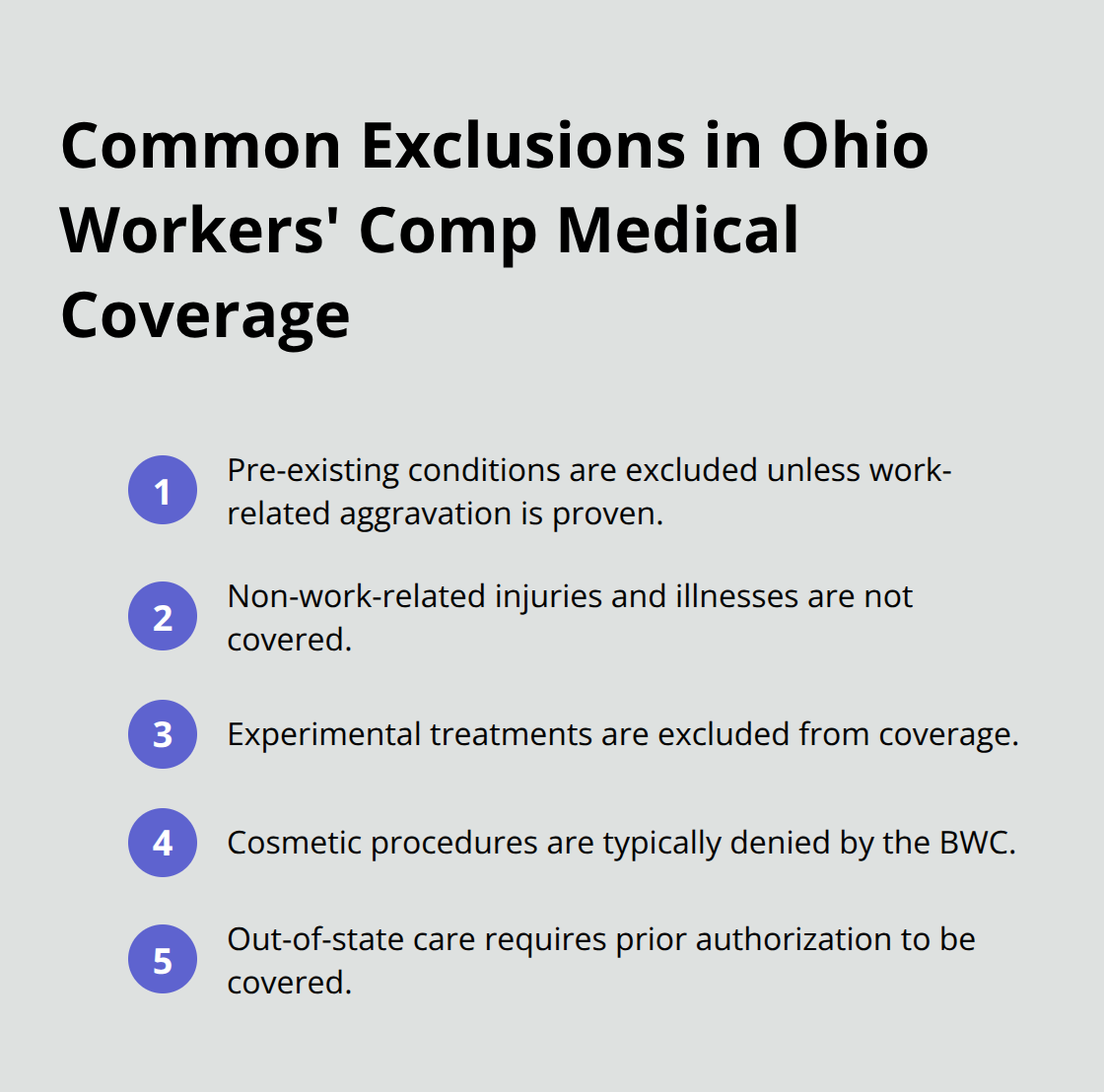
Healthcare workers often face scrutiny on pre-existing claims because employers and the BWC review medical records carefully to separate what was already there from what the job caused. The Ohio Industrial Commission Ombuds Office can help if you dispute a pre-existing condition denial, but you’ll need clear medical documentation showing your work injury made the condition worse. Non-work-related injuries and illnesses receive zero coverage under workers’ compensation, regardless of how they occurred. Your personal health insurance handles conditions that develop outside of work, not the BWC.
Experimental and Cosmetic Treatments
Experimental treatments and cosmetic procedures fall outside coverage because the BWC limits benefits to reasonable and necessary medical care. This means treatments without established medical protocols or those considered investigational won’t receive payment. Cosmetic surgery, even if medically necessary after a burn or disfiguring injury, typically gets denied because the BWC classifies it as cosmetic rather than reconstructive.
The Enhanced Care Program available through Ohio’s BWC demonstrates the state’s commitment to covering necessary treatments for specific injuries like knee injuries, but experimental protocols outside established programs receive denial. If the BWC denies your claim based on these limitations, the Industrial Commission offers an appeal process through Alternative Dispute Resolution, where you can present evidence that your treatment was reasonable and necessary despite initial denial.
Out-of-State Medical Care Restrictions
Out-of-state medical care creates additional complications. While Ohio covers treatment in other states if medically necessary and approved in advance, the BWC’s managed care organization must authorize out-of-state providers beforehand. Healthcare workers treating injuries in neighboring states like Pennsylvania or Michigan should contact their MCO before scheduling appointments to confirm coverage. Traveling across state lines for treatment without prior approval often results in denied claims.
When disputes arise over what the BWC covers and what it excludes, understanding your appeal rights becomes essential to protecting your benefits.
How to Navigate Ohio’s Workers’ Compensation Medical Benefits
Report Your Injury Immediately and Document Everything
File your workers’ compensation claim with the Ohio Bureau of Workers’ Compensation without delay. Report your injury to your employer as soon as it occurs-delays weaken your position and can jeopardize coverage. Your employer must then file the claim with the BWC within a specific timeframe, and you should request written confirmation of this filing. Contact the BWC directly at 30 W. Spring St., Columbus, OH 43215-2256 if you suspect your employer hasn’t submitted paperwork. Many healthcare workers assume their employer will handle everything; this passive approach often results in claim denials or processing delays. Take an active role instead by maintaining detailed records of your injury, all medical visits, medications, and communications with your employer and the BWC.
Select a BWC-Certified Provider for Ongoing Treatment
The moment your claim receives approval, you gain access to the certified provider network, but this is where most healthcare workers stumble. After your initial medical visit with any provider, you must switch to a BWC-certified provider to maintain coverage. The Ohio BWC website provides a searchable directory of certified providers, and your claims administrator can identify in-network options in your area. Using a non-certified provider after your first visit leaves you personally responsible for medical bills-a costly mistake that healthcare workers often discover too late.
Inform Providers About Your Work-Related Injury
Tell every provider that your treatment stems from a work-related injury so billing routes correctly to the BWC instead of your personal insurance. If you’ve already paid out-of-pocket for medications or medical supplies, the pharmacy can file for reimbursement through the BWC after your claim approval-never assume you’re stuck with those expenses.

This simple step prevents billing confusion and ensures the correct payer covers your care.
Understand Your Appeal Rights When Disputes Arise
Your rights during treatment extend far beyond simply receiving care. The Ohio Industrial Commission Ombuds Office exists specifically to help you when disputes arise, and this office operates independently from the BWC, making it a genuine advocate for injured workers. If the BWC denies a treatment request or disputes your medical provider’s recommendations, you can file an appeal through the Alternative Dispute Resolution process rather than accepting the initial decision passively. Healthcare workers frequently encounter situations where the BWC questions whether a recommended treatment is truly necessary for work-related recovery, and having documentation from your provider explaining the medical rationale strengthens your position considerably. Request that your treating physician provide written justification for any contested treatments before the BWC makes a final determination.
Seek Legal Guidance for Complex Claims
Healthcare workers in the Cleveland, Akron, and Canton areas who face complex disputes over medical coverage should consult with a workers’ compensation attorney who understands Ohio’s system and can advocate effectively with the BWC and the Industrial Commission. An experienced attorney can navigate the appeals process and help protect your benefits when coverage questions arise.
Final Thoughts
Ohio’s workers’ compensation system covers extensive medical care for healthcare workers injured on the job, from emergency hospital treatment to physical therapy and rehabilitation services. The key to protecting your healthcare workers comp benefits lies in understanding exactly what the Ohio Bureau of Workers’ Compensation covers and taking active steps to navigate the system correctly. Emergency care, diagnostic testing, surgical procedures, medications, medical devices, and transportation to appointments all receive coverage when your injury stems from work.
What the system excludes matters equally-pre-existing conditions, experimental treatments, cosmetic procedures, and unapproved out-of-state care fall outside coverage boundaries. These limitations create real gaps that healthcare workers must anticipate and address proactively. When disputes arise over whether the BWC should cover your recommended treatment, you possess appeal rights through the Ohio Industrial Commission Ombuds Office and the Alternative Dispute Resolution process.
Your next step is straightforward: report any workplace injury immediately to your employer and the BWC, then verify that your treating provider holds BWC certification before scheduling ongoing appointments. If coverage questions emerge or the BWC denies treatment you believe is necessary, contact Robin J Peterson Company, LLC, a law firm serving injured workers throughout Ohio’s Cleveland, Akron, and Canton areas.