
The Bureau of Workers’ Compensation denies thousands of Ohio claims each year, leaving injured workers confused about their options. At Robin J Peterson Company, LLC, we know that a denial doesn’t mean the end of your case.
You have the right to appeal a BWC denial in Ohio, and understanding the process gives you a real chance to overturn that decision. This guide walks you through every step.
Why the BWC Denies Claims and What It Means
Medical Evidence Gaps Cause Most Denials
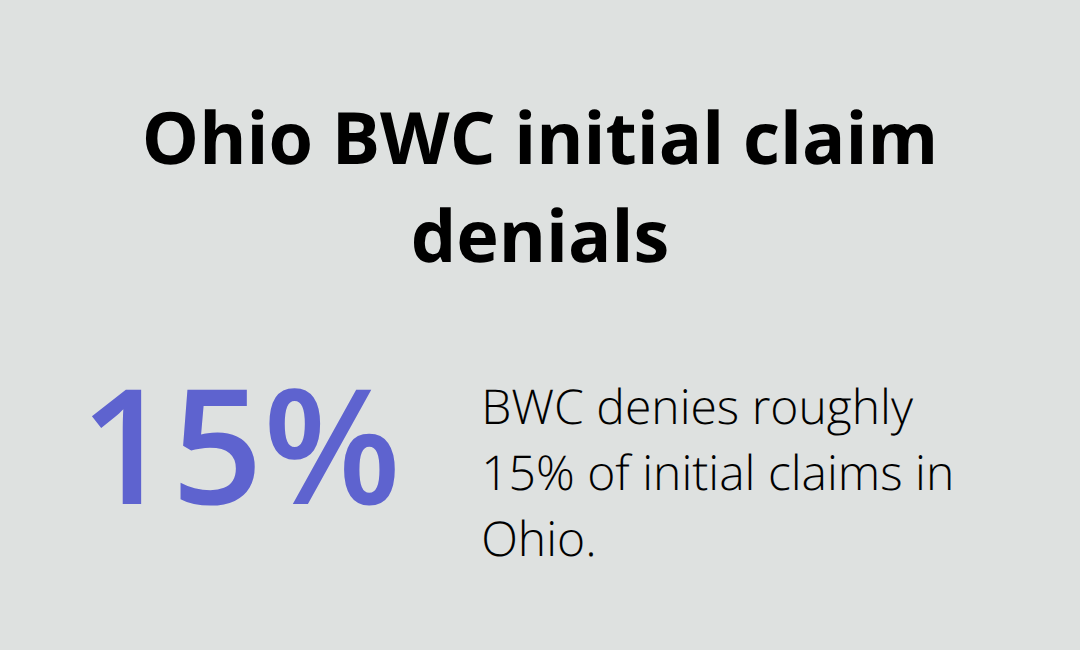
The Bureau of Workers’ Compensation denies roughly 15% of initial claims in Ohio according to BWC data, and the reasons follow predictable patterns. The most common denial reason is medical records that fail to explicitly connect the injury to your job. Doctors must state work causation directly-a report that acknowledges your condition but omits the link to work duties or the incident itself gives the BWC an easy reason to deny. Your treating physician must document how job duties, tasks, and the incident caused or aggravated the injury.
Timing Mistakes That Trigger Denials
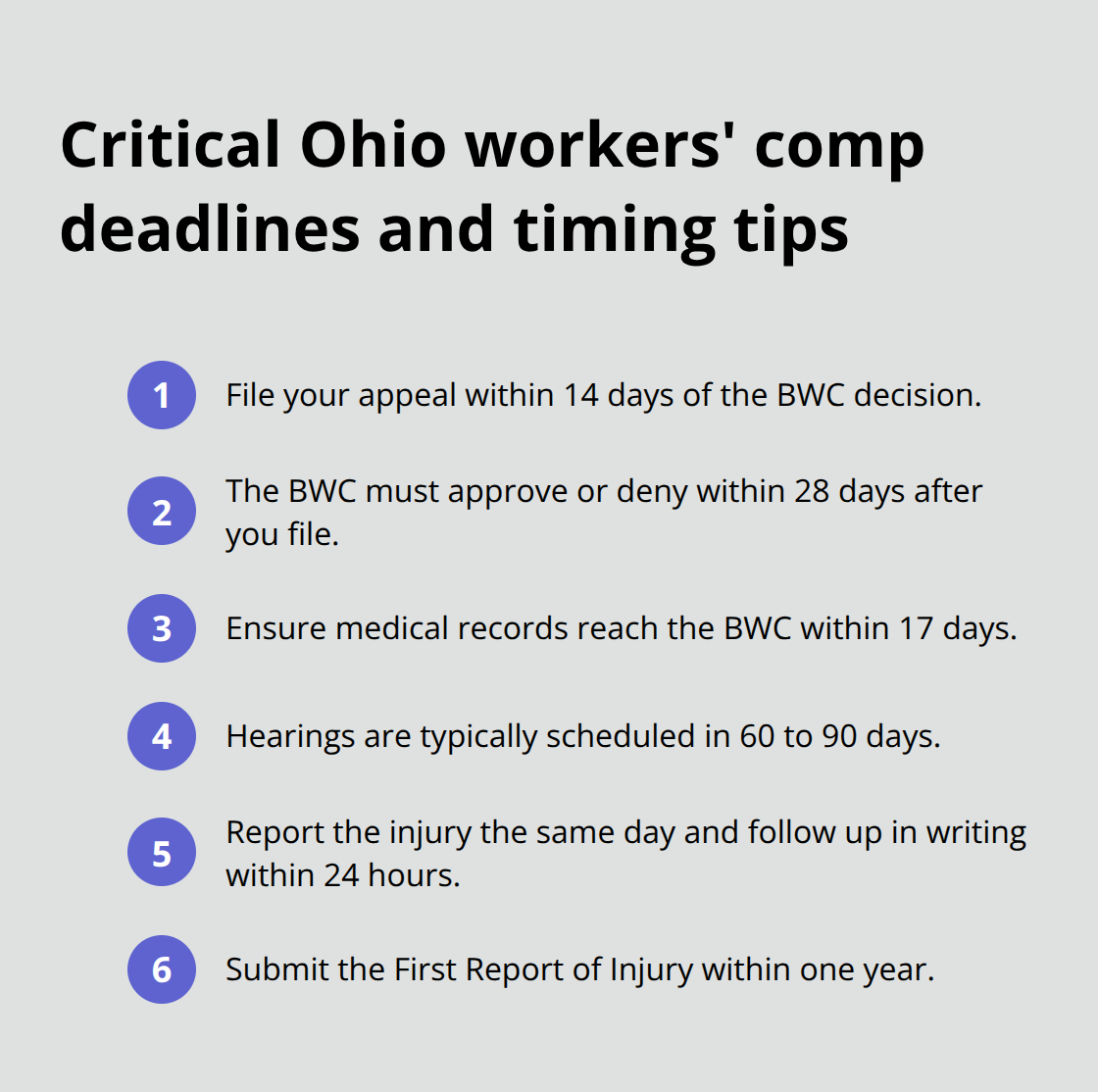
Delayed injury reporting weakens your case significantly. The First Report of Injury must reach the BWC within one year, but submissions delayed beyond 30 days are flagged as suspicious and damage your credibility. Report the injury on the day it happens and follow up in writing within 24 hours to create an auditable record the BWC cannot dismiss as an afterthought. Written documentation is the standard the BWC expects; rely on written reports rather than only verbal notices to avoid disputes about notice.
Administrative Errors and Treatment Gaps
Administrative errors compound the problem. Misspelled names, incorrect dates, missing signatures, and gaps between your accident report and medical records give the BWC grounds to deny without examining the medical evidence at all. Inconsistent or delayed medical treatment also hurts your case because gaps suggest the injury was not serious enough to warrant immediate care or that it was not truly work-related. The BWC has 28 days to approve or deny after you file, and medical records have a 17-day deadline to arrive at the BWC; late submissions trigger automatic denials.
Pre-Existing Conditions and Your Burden of Proof
Pre-existing conditions are not automatic disqualifiers, but you must prove the workplace incident aggravated or substantially contributed to the condition with clear medical documentation. Build a timeline showing stability before the incident and decline afterward, including prior records and any delays in seeking treatment. Medical documentation must show clear causation, not just acknowledge a prior condition; compare pre-injury baselines to post-injury status to establish the connection.
The 14-Day Appeal Deadline
Once the BWC issues its decision, you have exactly 14 days to file an appeal with the Industrial Commission of Ohio. This deadline is absolute and cannot be extended, so marking your calendar the moment you receive the denial notice is non-negotiable. The sooner you file, the sooner you can gather additional evidence and prepare your case for the hearing that follows.
How to File Your Appeal and Build Your Case
File Your Appeal Within the 14-Day Window
Filing your appeal with the Industrial Commission of Ohio requires precision because the 14-day deadline allows no room for error. Obtain Form IC-12 from the Industrial Commission’s website or call 614-466-5100 to request it, then complete the form with your claim number, the specific BWC decision you are challenging, and a clear statement explaining why the denial was wrong. Submit the IC-12 to your local Industrial Commission office or file online through the Industrial Commission Online Network (I.C.O.N) system, which processes submissions faster and creates an automatic record of your filing date. There is no filing fee for this appeal, which means cost never prevents you from challenging a denial. Once filed, the Industrial Commission schedules a hearing before a staff hearing officer, typically within 60 to 90 days, though complexity and case backlogs affect timing.
Request Your Complete Claim File Immediately
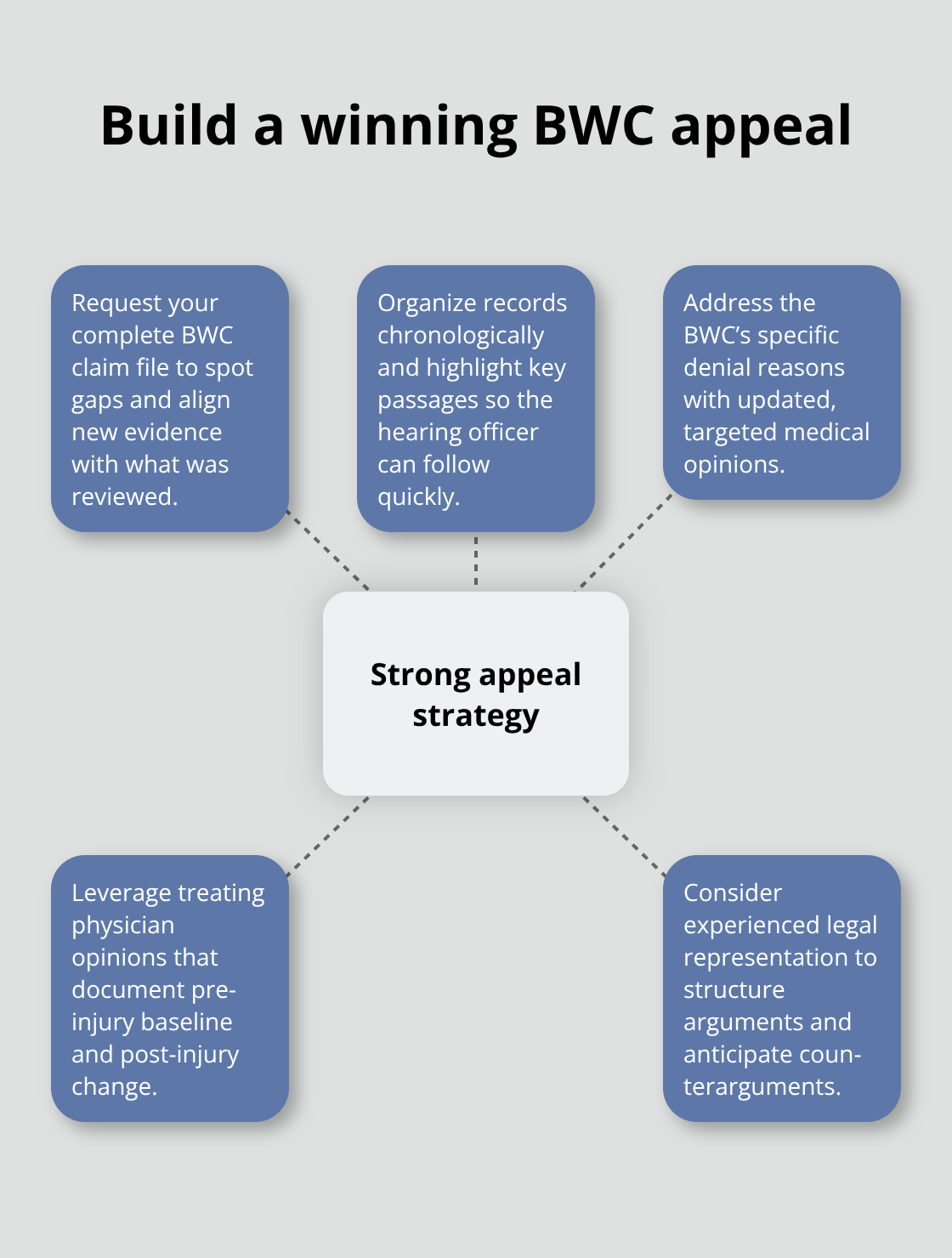
Gathering evidence before your hearing is where appeals succeed or fail. Request your complete BWC claim file immediately after filing to see exactly which evidence the Bureau reviewed and where gaps exist. Collect all original medical records, imaging results, medical reports from every treating provider, and any correspondence with the BWC, plus employment history documents and wage information showing your average weekly wage calculation. If the denial stemmed from insufficient medical evidence, obtain updated medical opinions from your treating physician that directly address the specific reasons for denial, and include new medical records that were unavailable during the original claim review because new evidence often carries particular weight with hearing officers.
Organize Evidence Chronologically and Highlight Key Passages
Organize everything chronologically with clear labels and highlight passages supporting your position so the hearing officer follows your argument without struggling through disorganized stacks of paper. Medical evidence forms the foundation of successful appeals because the Commission prioritizes treating physician opinions, especially from doctors who examined you and understand your injury history. Prepare a one-page summary of your case that identifies concrete weaknesses in the BWC’s reasoning and addresses them with direct evidence showing misinterpretation, missing considerations, or misapplication of Ohio workers’ compensation law. The strength of your presentation determines whether the hearing officer sees your case as compelling or dismissible, which is why strategic organization of medical records matters far more than volume alone.
How to Win at the Industrial Commission Hearing
Medical Evidence Forms Your Foundation
Medical evidence dominates Industrial Commission hearings, and the difference between winning and losing often comes down to how you present it. Hearing officers review thousands of cases annually and develop a sharp eye for weak presentations versus compelling ones. Your medical records should tell a clear narrative: what your condition was before the injury, what happened on the day of the incident, and how your status changed afterward. Treating physician opinions carry the most weight, particularly from doctors who examined you directly and documented their findings in detail.
Address the BWC’s Specific Denial Reasons
If your original denial cited insufficient medical evidence, submit updated medical opinions that specifically address the BWC’s stated reasons for rejection rather than submitting a stack of new records without explanation. A hearing officer needs to see the connection between the evidence and the BWC’s error, which means your presentation must isolate the exact point where the Bureau misinterpreted, overlooked, or misapplied the law. Organize medical records chronologically with tabs and a summary sheet that guides the hearing officer through your argument. Highlight the specific passages that prove work causation or show how the injury aggravated a pre-existing condition.
Many injured workers lose appeals not because their medical evidence is weak, but because they present it poorly, forcing the hearing officer to dig through disorganized documents to find supporting passages. Strategic presentation matters far more than volume alone.
Legal Representation Changes Your Odds
Legal representation fundamentally changes your odds at the Industrial Commission. Self-represented workers face a significant disadvantage because hearing officers expect formal presentation, proper evidence handling, and anticipation of the BWC’s counterarguments. An experienced workers’ compensation attorney structures your case so the hearing officer follows a logical progression, presents medical evidence strategically rather than overwhelming with volume, and counters the BWC’s likely arguments before they surface.
Hearings typically last 30 minutes to two hours depending on complexity, which means every minute counts; an attorney knows which medical reports deserve emphasis and which can be referenced briefly. The Industrial Commission hearing is informal and less intimidating than a courtroom, but it remains a high-stakes proceeding where presentation quality directly affects outcomes. We at Robin J Peterson Company, LLC recommend seeking at least a free consultation with an experienced representative before your 14-day filing deadline expires, because strategic advice during case preparation often determines whether you win or lose at the hearing itself.
Final Thoughts
The 14-day filing deadline after a BWC denial in Ohio is absolute, so file your IC-12 appeal immediately after receiving the denial notice. Organize your medical records chronologically, identify the specific weaknesses in the Bureau’s reasoning, and connect your evidence directly to the stated grounds for denial. Medical evidence forms the foundation of your case, but only clear presentation and strategic organization determine whether the hearing officer finds your argument compelling.
Self-representation at an Industrial Commission hearing puts you at a disadvantage because hearing officers expect formal presentation and anticipation of counterarguments. An experienced workers’ compensation attorney structures your case strategically, highlights the medical evidence that carries the most weight, and counters the Bureau’s likely objections before they surface. Many injured workers lose appeals not because their evidence is weak, but because they present it poorly or fail to address the specific reasons the BWC rejected their claim.
We at Robin J Peterson Company, LLC represent injured workers throughout Ohio who appeal BWC denial decisions and fight for compensation at the Industrial Commission. Contact our firm for a consultation if you need guidance on your appeal or want to discuss your case with an experienced representative. The Ohio Industrial Commission Ombuds Office also offers free guidance if you need additional support navigating the appeal process.