
A knee injury at work can disrupt your life and leave you uncertain about your next steps. At Robin J Peterson Company, LLC, we help injured workers understand their rights and navigate the process of securing knee injury benefits in Ohio.
This guide walks you through what happens after you file a claim, from initial reporting through benefit approval. You’ll learn about the types of coverage available and how to strengthen your case.
What Knee Injuries Does Ohio Workers’ Compensation Cover
The Ohio Bureau of Workers’ Compensation covers knee injuries that arise directly from your job duties or workplace conditions. ACL tears, meniscus tears, MCL and PCL sprains, fractures, and dislocations all qualify when they occur during work activities. The BWC accepts claims from both single traumatic events like falls and from repetitive workplace tasks that aggravate your knee over time. What matters is that medical evidence connects your knee damage to work. Construction workers face the highest risk, with knee injuries occurring at about 13.2 per 10,000 workers annually. Warehouse workers, nurses, and anyone who kneels or squats regularly also file frequent claims. Pre-existing knee conditions don’t automatically disqualify you. If your job substantially aggravated an old injury or caused new damage on top of it, you can still receive benefits. The critical factor is clear documentation showing the work incident caused new harm or worsening.
Establishing the Work Connection
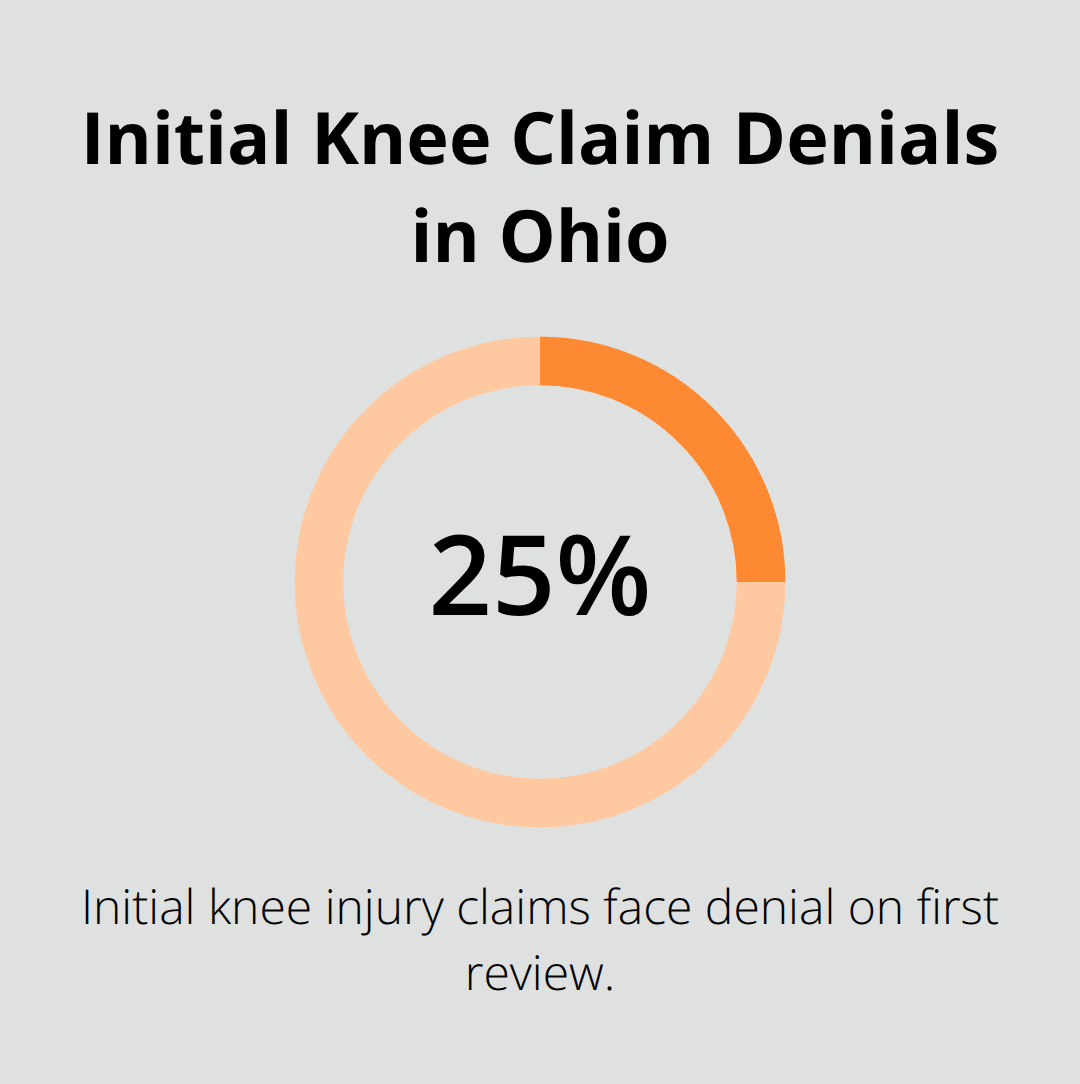
The BWC evaluates your claim using four main pieces of evidence: your medical records, your job description, incident reports, and witness statements. Your medical notes must explicitly describe how the injury happened at work and what specific job task triggered it. A vague note saying you have knee pain won’t work. Instead, your doctor needs to document something like “fell from a ladder while stocking shelves” or “twisted knee while stepping off equipment.” X-rays and MRI results carry substantial weight because they show structural damage, not just symptoms. Surgical records matter even more. If you had knee surgery, those operative notes provide objective proof of injury severity and work-relatedness. The Industrial Commission of Ohio ultimately decides whether your claim meets the legal standard for compensation, but strong medical documentation makes approval far more likely. Roughly 25 percent of initial knee claims face denial, and weak documentation linking the injury to work is the leading reason.
How the Ohio Bureau of Workers’ Compensation Operates
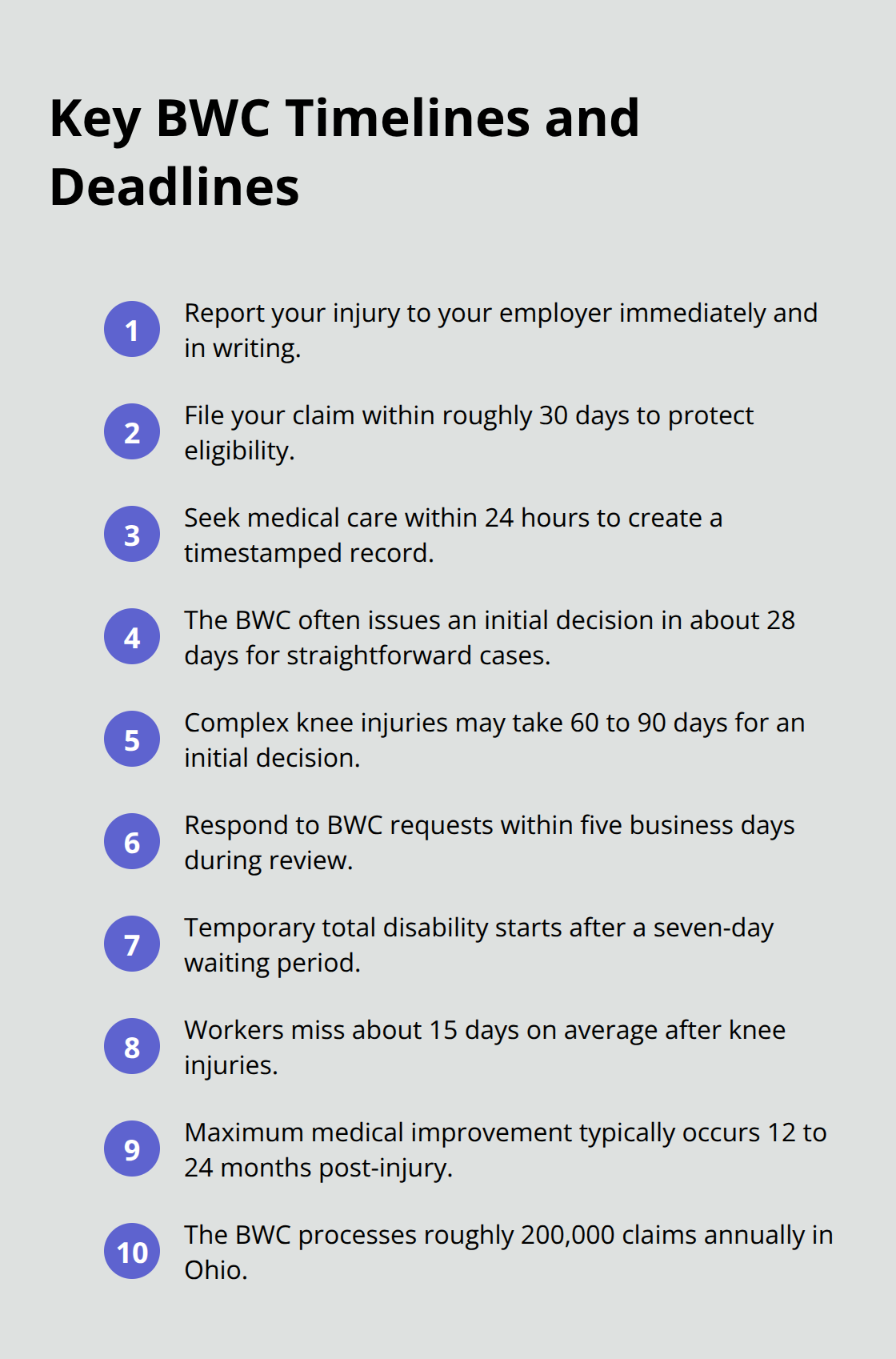
The BWC administers all workers’ compensation benefits in Ohio and processes roughly 200,000 claims annually. This state agency applies Ohio law uniformly to determine if your knee injury qualifies and what benefits you receive-independent of what your employer or insurance companies prefer. Once you file, the agency has about 28 days to make an initial decision on straightforward claims, though complex knee injuries often take 60 to 90 days. You can track your claim progress online using your assigned claim number. The BWC authorizes your medical treatment through approved healthcare providers and pays for medically necessary care. If you miss work due to your knee injury, the agency calculates your wage replacement based on your average weekly wage and your disability percentage. Understanding that the BWC operates independently from your employer removes confusion about who controls your benefits and helps you focus on proper documentation rather than employer politics.
What Happens Next in Your Claim
Once the BWC receives your claim, the agency begins reviewing whether your knee injury meets the legal requirements for coverage. Your medical provider’s documentation becomes the foundation of this review. The clearer your doctor’s notes connect your injury to a specific work task or incident, the faster the BWC can move forward with approval. This is where the strength of your initial reporting and medical evidence directly influences your timeline and outcome.
Filing Your Claim and Starting the Process
Report Your Injury Immediately and in Writing
The moment you report a knee injury to your employer, the clock starts ticking. You have roughly 30 days to file a formal claim with the Ohio Bureau of Workers’ Compensation, though filing immediately is far smarter than waiting. When you report to your employer, do it in writing and request written confirmation that your supervisor received the report. This eliminates disputes later about whether you ever reported the injury. If your employer fails to file the First Report of Injury with the BWC, you can file it yourself using the BWC online portal. Filing electronically gives you an immediate claim number and creates an official record dated from your submission, protecting your eligibility window. The portal is straightforward, and having your claim number allows you to track progress anytime.
Seek Medical Care Within 24 Hours
Within 24 hours of your injury, seek medical care at an emergency room or urgent care facility. An emergency room visit creates a timestamped medical record that the BWC treats as strong evidence of injury severity and timing. Your initial medical notes must describe exactly how the injury happened at work. Tell your doctor the specific task you were performing, whether you fell, twisted, or struck your knee, and what equipment or surface was involved. Vague descriptions like “knee pain from work” hurt your claim. Precise details like “stepped off a truck and twisted my knee” or “fell on wet concrete while restocking shelves” give the BWC clear work-relatedness. Gather copies of incident reports, witness contact information, and photographs of the work area or equipment involved. These materials become part of your documentation package that you submit with your claim.
Choose a BWC-Certified Healthcare Provider
Medical evaluation and treatment authorization follow once the BWC receives your claim. Choose a BWC-certified healthcare provider for all treatment to avoid billing disputes and ensure your medical records meet state standards. The BWC reviews your medical records, your job description, and incident documentation to determine whether your knee injury qualifies for coverage. This review typically takes 28 days for straightforward cases, though knee injuries with surgery or complex recovery timelines often extend to 60 to 90 days. During this period, respond to every BWC request within five business days. If the agency asks for wage records, employment documents, or additional medical information, submit complete materials with a cover letter summarizing what you are providing.
Delayed or incomplete responses slow your claim unnecessarily.
Understand What the BWC Covers During Treatment
The BWC authorizes medical treatment once your claim is approved, covering doctor visits, imaging like MRI and X-ray, physical therapy, medications, and surgery if medically necessary. Maintain detailed records of all treatment, including provider names, dates of service, and diagnoses documented in each visit. After you reach maximum medical improvement (the point where further improvement is not expected), the BWC determines whether you have permanent disability and what level of compensation applies. This process typically occurs 12 to 24 months after injury, depending on your recovery trajectory.
What Comes After Approval
Once the BWC approves your claim and authorizes treatment, your focus shifts to following medical recommendations and maintaining strong documentation. Your medical provider’s progress notes, imaging results, and treatment records all influence what benefits you ultimately receive. The next stage of your claim-understanding the actual benefits available to you-depends directly on how well you document your recovery and any lasting limitations from your knee injury.
What Benefits Can You Actually Receive
After the Ohio Bureau of Workers’ Compensation approves your knee injury claim, you access three distinct benefit categories that address different aspects of your recovery and financial hardship. Understanding exactly what each category covers prevents surprises and helps you plan your return to work realistically. The benefits start immediately upon approval and continue based on your medical condition and work status.
Temporary Disability Wage Replacement
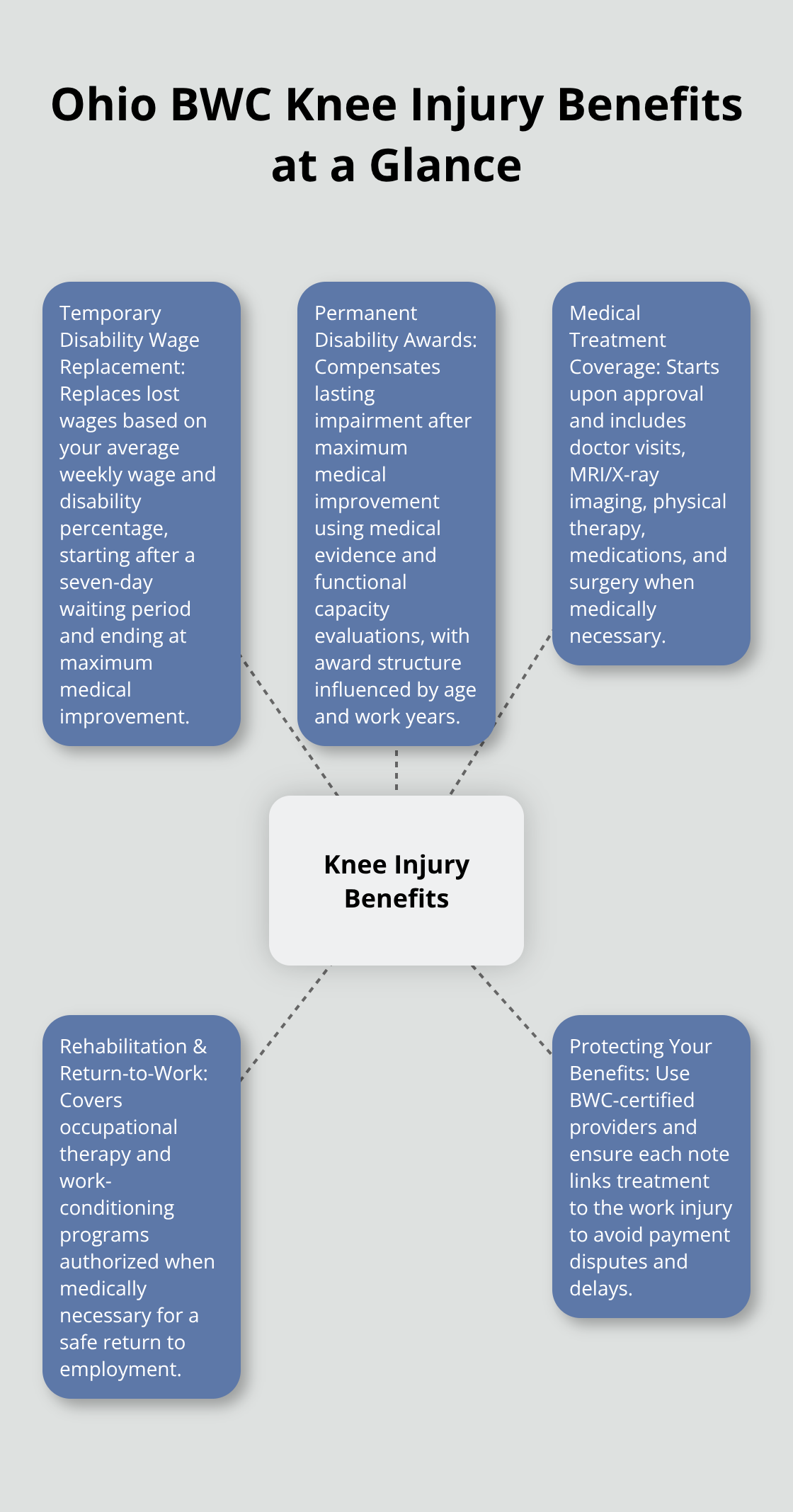
Temporary total disability payments start after a seven-day waiting period from your injury date and replace your lost wages while you cannot work. The BWC calculates this amount by taking your average weekly wage from the 52 weeks before your injury and multiplying it by your disability percentage. If you earn $800 per week and cannot work at all, you receive temporary total disability payments. However, if you can perform light-duty work earning $300 per week while recovering, your payment covers only the $500 difference. The Bureau of Labor Statistics reports that workers miss approximately 15 days on average after knee injuries, though serious cases requiring surgery extend far longer. Once you reach maximum medical improvement (typically 12 to 24 months post-injury depending on injury severity), the BWC stops temporary payments and evaluates whether permanent disability exists.
Permanent Disability Awards
If your doctor determines lasting impairment remains after maximum medical improvement, you receive a permanent partial disability award calculated based on your specific functional loss. This award recognizes that your knee injury has created a lasting limitation that affects your ability to work or perform daily activities. The BWC uses medical evidence and functional capacity evaluations to determine the percentage of permanent disability you have sustained. Your age and remaining work years influence how the BWC structures this compensation, as younger workers typically face longer career impacts from permanent knee damage.
Medical Treatment and Rehabilitation Coverage
Medical treatment coverage starts immediately upon claim approval and includes all necessary care: doctor visits with BWC-certified providers, MRI and X-ray imaging, physical therapy sessions, medications, and surgical procedures if medically required. The National Safety Council estimates that non-fatal knee injuries average $42,000 in medical and related expenses, underscoring why comprehensive coverage matters for your recovery. Physical therapy typically runs several months post-injury and represents a substantial portion of treatment costs, yet the BWC covers these sessions fully when prescribed by your treating physician.
Rehabilitation and Return-to-Work Services
Rehabilitation services extend beyond physical therapy to include occupational therapy and work-conditioning programs designed to prepare you for job return. These programs help you rebuild strength and confidence in your knee function before you resume full work duties. The BWC authorizes these services when your medical provider documents that they are medically necessary for your recovery and return to employment.
Protecting Your Benefits Through Proper Documentation
The critical action here is choosing only BWC-certified healthcare providers and ensuring every medical note explicitly connects your treatment to your work-related knee injury. Gaps in treatment documentation or visits to non-certified providers create payment disputes that delay your benefits and leave you responsible for bills the BWC should cover. Maintain detailed records of all treatment, including provider names, dates of service, and diagnoses documented in each visit. Your medical provider’s progress notes, imaging results, and treatment records all influence what benefits you ultimately receive.
Final Thoughts
Your knee injury benefits Ohio claim succeeds when you act immediately after injury and maintain strong documentation throughout the process. Report the injury in writing to your employer, seek medical care within 24 hours, and ensure your doctor documents the specific mechanism of injury with clear work-relatedness language. Respond promptly to every BWC request, choose only certified healthcare providers, and gather witness statements and incident photos that support your case.
The BWC denies roughly 25 percent of initial knee injury claims, and weak documentation linking the injury to work remains the leading reason for rejection. Common obstacles emerge when medical records lack precise causation language, when employers dispute the work connection, or when independent medical examinations contradict your treating physician’s findings. If the BWC denies your claim, you have 14 days to appeal-missing this deadline forfeits your right to challenge the decision.
An experienced workers’ compensation attorney identifies weaknesses in your documentation early and responds strategically to agency requests that could derail approval. Contact us for a complimentary case evaluation to learn how we can strengthen your knee injury claim and help you secure the benefits you deserve.