
Construction sites in Ohio see thousands of injuries annually, and navigating construction injury claims Ohio can feel overwhelming without proper guidance. We at Robin J Peterson Company, LLC help workers understand their rights and maximize the benefits they deserve.
This guide walks you through the entire process-from identifying common injuries to filing your claim and avoiding costly mistakes that could reduce your compensation.
What Injuries Happen Most on Ohio Construction Sites
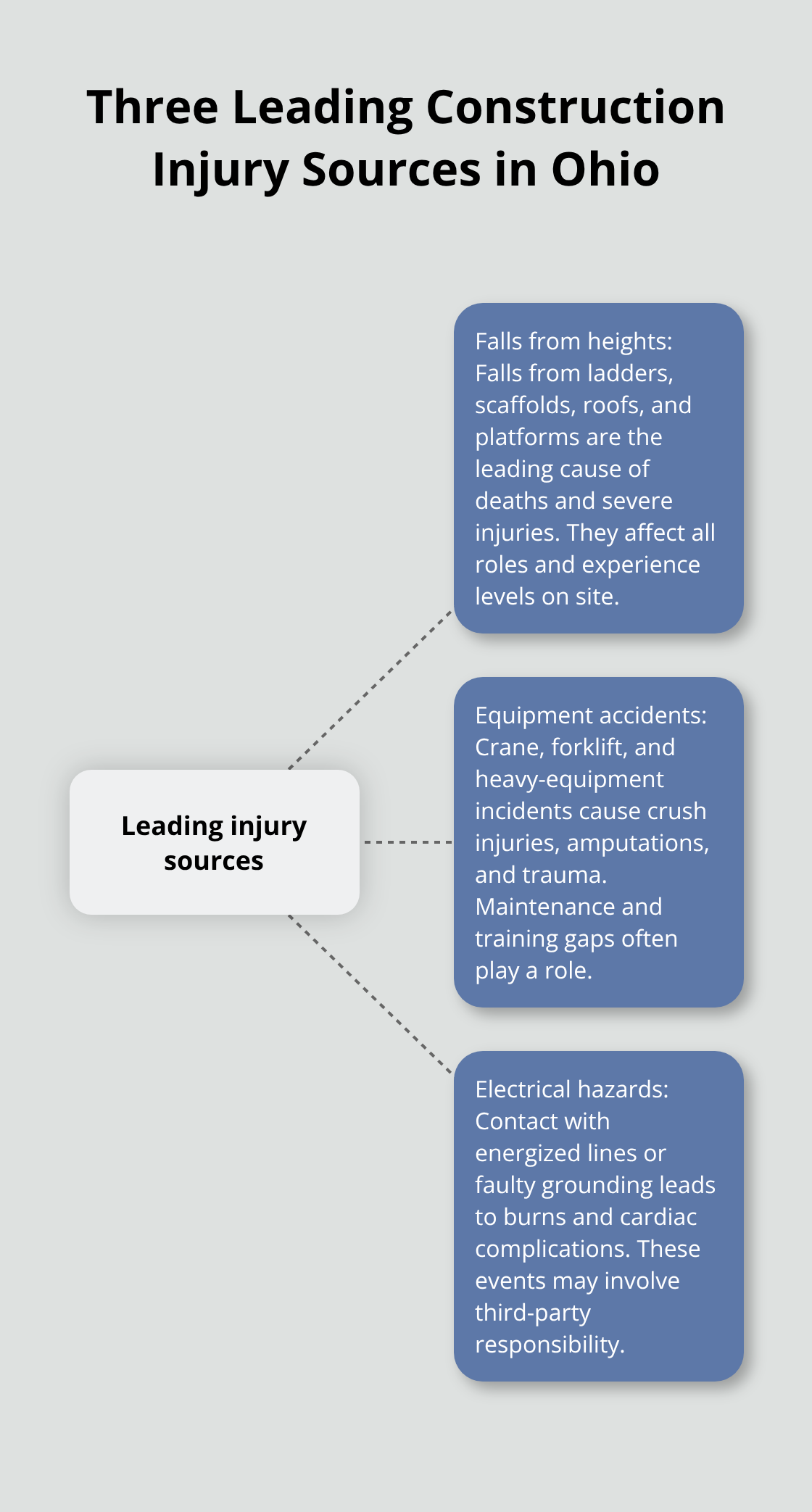
Construction injuries in Ohio span a wide range of incidents, but three categories account for the majority of serious claims. According to the U.S. Bureau of Labor Statistics, construction had the second-highest number of fatal accidents in the U.S. in 2022, making injury prevention and proper claim documentation essential for workers. Falls from heights represent the most common cause of construction deaths and serious injuries nationwide, followed closely by equipment-related accidents and electrical hazards.
Understanding which injuries occur most frequently helps you recognize dangerous situations and strengthens your claim when an accident happens.
Falls Remain the Leading Threat
Falls dominate Ohio construction injury statistics because they happen across all job types and experience levels. OSHA enforcement data consistently shows fall protection violations among the top ten most frequent safety violations in construction, indicating that many sites fail to implement proper safeguards. Falls from ladders, scaffolding, roofs, and elevated platforms result in fractures, spinal injuries, head trauma, and internal bleeding.
After a fall occurs, photograph the exact location where you fell, the ladder or scaffold condition, any missing safety equipment, and environmental factors like wet surfaces or debris. Collect names and contact information from anyone who witnessed the fall, as witness statements carry significant weight in claim disputes. Medical documentation from the emergency room or hospital becomes your foundation for proving injury severity, so preserve all records (including X-rays, MRI results, and initial diagnosis notes).
Equipment and Electrical Hazards Demand Immediate Action
Machinery accidents involving cranes, forklifts, heavy equipment, and power tools cause catastrophic injuries that require aggressive claim management. Electrical injuries and burns occur when workers contact energized wires, faulty equipment, or improperly grounded machinery, often resulting in cardiac complications or severe tissue damage. Both injury types frequently involve third-party liability-meaning a contractor, equipment vendor, or maintenance company bears responsibility beyond your direct employer.
This distinction matters significantly because you may have claims against both the Ohio Bureau of Workers’ Compensation and a negligent third party. After any equipment or electrical incident, request copies of maintenance records, equipment inspection logs, and training documentation from your employer. Photographs showing the hazardous condition, the equipment involved, and any warning labels or safety signage become critical evidence (and often prove whether proper maintenance occurred).
Why Third-Party Claims Matter for Your Recovery
Equipment and electrical injuries often justify pursuing both workers’ compensation benefits and third-party personal injury claims to maximize your recovery. A contractor, vendor, or maintenance company may share liability for your injury, opening additional compensation routes beyond standard workers’ comp benefits. Identifying all responsible parties early in your claim process significantly impacts your total recovery.
The distinction between employer liability and third-party negligence determines which legal avenues you can pursue. Your next step involves understanding Ohio’s workers’ compensation system and how to file your claim with the Bureau of Workers’ Compensation.
How to File Your Construction Injury Claim with the Ohio BWC
Report Your Injury Immediately to Your Employer
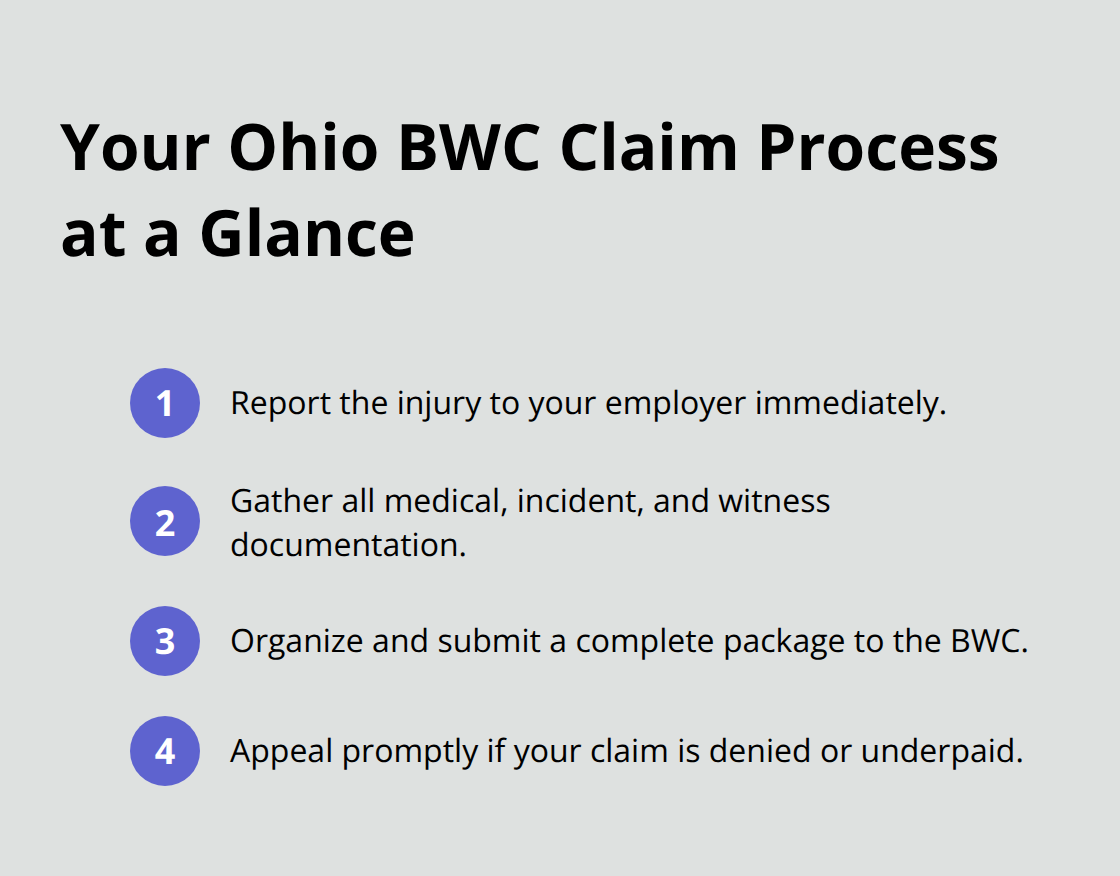
Filing a construction injury claim in Ohio requires speed and precision because the Ohio Bureau of Workers’ Compensation operates under strict timelines and procedural rules. You must report your injury to your employer within a specific window, and your employer has ten days to file the Initial Report of Injury with the BWC. Contact your supervisor immediately after the accident and request written confirmation that your injury was reported. Missing these deadlines jeopardizes your entire claim, so act fast and document every communication with management.
The BWC will then assign your case a claims administrator who manages benefits, medical approvals, and wage replacement payments. Your role involves gathering documentation before filing, organizing it clearly, and submitting everything to the BWC in one complete package rather than piecemeal. Construction workers often lose claim value by filing incomplete applications that trigger additional requests for information, delays in benefit processing, and reduced medical coverage approvals.
Gather Complete Documentation Before Submission
Documentation determines whether the BWC approves your claim quickly or denies it outright. Collect the incident report your employer filed, all emergency room and hospital records from the day of injury, follow-up medical reports, imaging results, and any ongoing treatment notes from specialists. Photograph the accident scene, hazardous conditions, and equipment involved before anyone removes or repairs anything. Obtain written statements from coworkers and witnesses who saw the injury happen, including their full names, phone numbers, and dates.
If a third party caused the injury (a contractor, equipment vendor, or maintenance company), gather evidence of their negligence, maintenance failures, or safety violations. The Ohio BWC requires medical documentation linking your injury directly to work, so your physician must explicitly state that the injury occurred on the job and resulted from work duties. Submit all documentation to the BWC within thirty days of the incident whenever possible.
Submit Your Complete Claim Package
Construction workers who delay submitting evidence face claim denials or reduced benefits because the BWC cannot approve what it cannot verify. Review your entire claim file before submission to identify gaps, missing dates, or unclear medical diagnoses that could trigger denial letters. Organize documents chronologically and include a cover letter summarizing the injury, the date it occurred, and the names of all witnesses present at the scene.
If the BWC initially denies your claim or reduces your benefits, you have the right to appeal and request a hearing before the Industrial Commission of Ohio. Legal representation significantly improves your chances of reversal at the appeal stage, particularly when third-party liability exists alongside your workers’ compensation claim.
Mistakes That Tank Your Claim Before It Starts
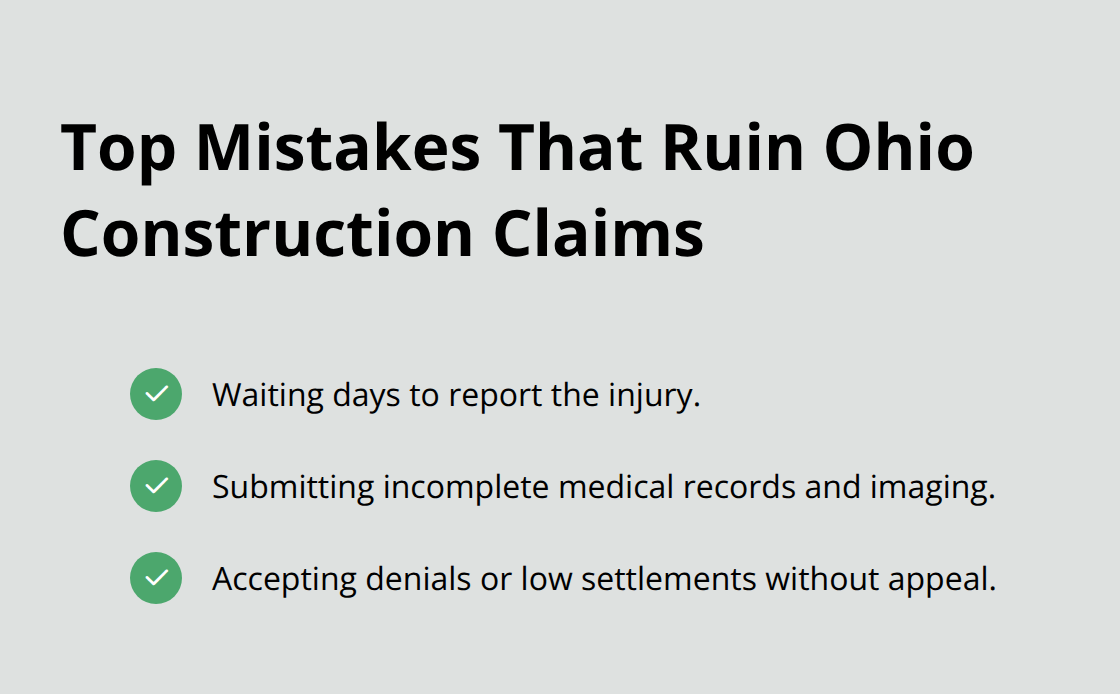
Construction workers lose thousands in benefits every year by making preventable errors during the filing process. The most damaging mistake happens immediately after injury: failing to report the accident to your employer within hours rather than days.
Report Your Injury Immediately-Don’t Wait
Your employer has ten days to file the Initial Report of Injury with the Ohio Bureau of Workers’ Compensation, but that clock only starts when you report the incident. If you wait a week to tell your supervisor about a fall or equipment injury, you’ve already compressed the timeline and given the BWC reason to question whether the injury actually happened on the job.
Construction sites operate with constant personnel changes, equipment movement, and environmental alterations, meaning the physical evidence of your accident vanishes quickly. Photographs taken the day of injury show hazardous conditions, missing safety equipment, and damaged machinery that photos taken three weeks later cannot capture. Witness statements collected immediately carry more credibility than recollections gathered months later when coworkers have moved to different jobs or forgotten details.
Claims get denied because workers delayed reporting by just three days, giving the BWC grounds to argue the injury may have occurred off-site. Speed matters more than perfection in the first hours after an accident.
Submit Complete Medical Records and Treatment Documentation
The second critical failure involves submitting incomplete medical records and treatment documentation to the BWC. Many construction workers assume their employer or insurance company automatically submits all medical information, only to discover later that imaging results, specialist reports, or physical therapy notes never reached the claims administrator.
The Ohio BWC cannot approve benefits for treatment it has no record of, meaning missing documentation directly reduces your compensation. If your emergency room visit included X-rays, MRI scans, or CT imaging, request copies immediately and include them with your claim submission rather than waiting for the hospital to send them weeks later.
Your physician must explicitly document that your injury occurred at work and resulted from job duties, not a pre-existing condition or off-site accident. If your doctor’s initial report fails to make this connection clear, contact the office and request an amended report before submitting to the BWC. This single step prevents denials based on insufficient medical evidence linking your injury to work.
Challenge Denials and Settlement Offers
The third mistake compounds the first two: accepting settlement offers or medical benefit denials from the BWC without legal review. Construction workers frequently receive letters offering reduced wage replacement or denying coverage for specific treatments, then accept these decisions assuming they cannot fight back.
You absolutely have the right to appeal any BWC decision and request a hearing before the Industrial Commission of Ohio. Legal representation dramatically improves your chances of reversal or increased benefits. An attorney can identify whether the BWC made procedural errors, misinterpreted your medical evidence, or applied incorrect benefit calculations that justify an appeal.
Final Thoughts
Construction injury claims in Ohio succeed when workers act decisively from the moment an accident occurs. The three mistakes we outlined-delayed reporting, incomplete medical documentation, and accepting unfavorable BWC decisions without challenge-destroy claims that should have succeeded. Speed, thoroughness, and persistence determine whether you receive full benefits or face denials that leave you struggling financially.
Your injury report to your employer starts the clock on your workers’ compensation claim, and every hour matters when evidence disappears and witnesses move on to other jobs. Medical records must be complete and explicitly link your injury to work duties, not submitted piecemeal over months. When the BWC denies your claim or reduces your benefits, you have the legal right to appeal and fight for what you deserve.
Construction workers in Ohio face genuine hazards that cause serious injuries, and the system exists to compensate you for those injuries. We at Robin J Peterson Company, LLC represent injured workers throughout Ohio, fighting against the BWC and employers who deny legitimate construction injury claims Ohio. Contact our firm to discuss your case with an attorney who understands Ohio law and the specific hazards construction workers face.