
Returning to work after an injury in Ohio comes with specific legal protections and practical options you need to understand. We at Robin J Peterson Company, LLC help workers navigate this process with clarity and confidence.
This guide walks you through your rights under Ohio workers’ compensation law, the reemployment programs available to you, and the steps to take when heading back to your job.
What Protections Do You Actually Have After a Work Injury?
Ohio’s workers’ compensation system protects you the moment you get hurt on the job, but most injured workers don’t realize how broad those protections actually are. The system isn’t optional for employers-it’s mandatory. Your employer must carry workers’ compensation insurance and report your injury to the Ohio Bureau of Workers’ Compensation within 14 days. If they miss that deadline, your claim approval gets delayed, which means your benefits get delayed. You should push for immediate reporting and follow up if you don’t see claim status updates within two to three weeks of your injury.
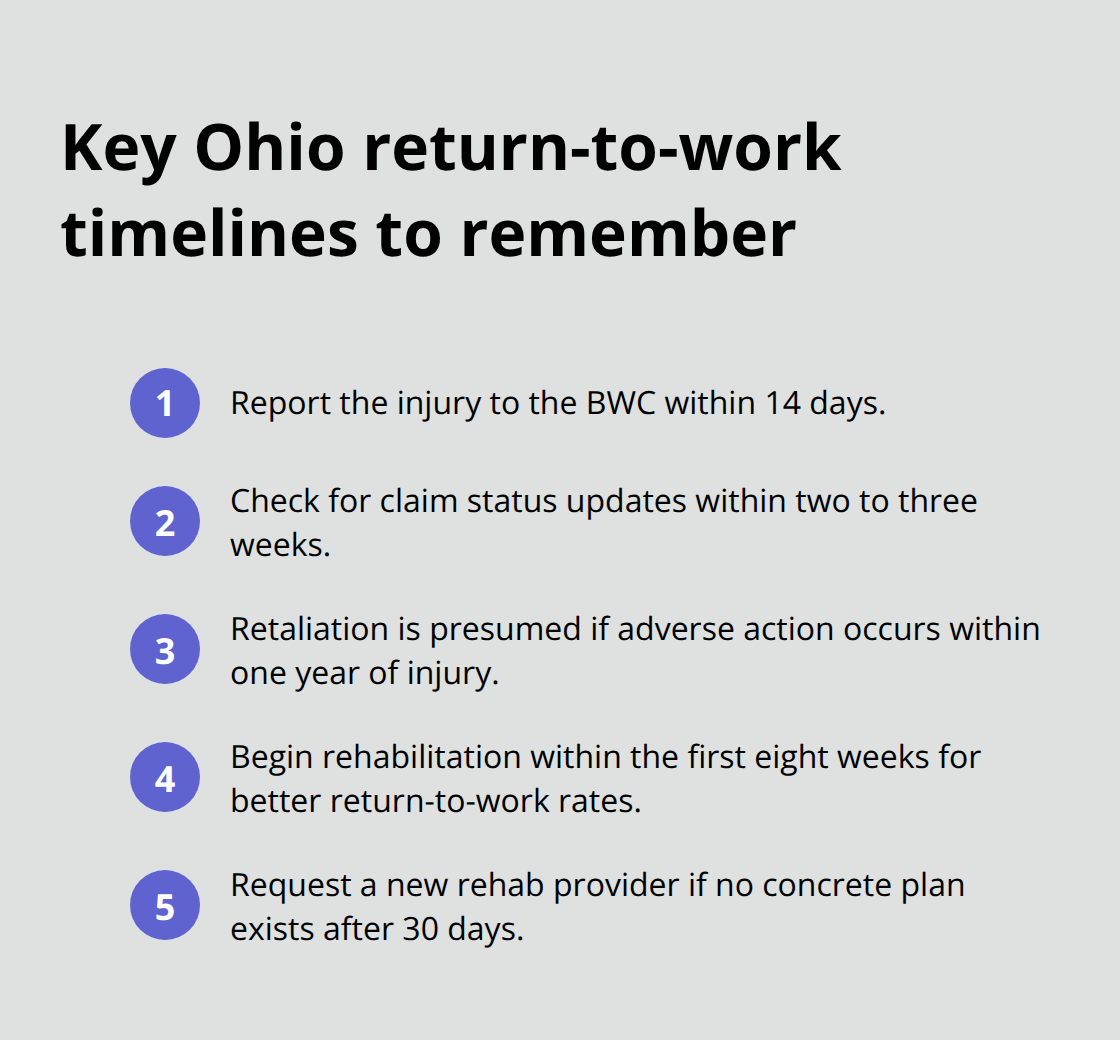
Once the BWC approves your claim, you gain access to medical treatment for your injury at no cost to you, plus temporary income replacement if you can’t work. The income replacement isn’t full wages-it typically covers about two-thirds of your lost earnings-but it protects your financial stability while you recover. This protection extends from day one of your injury through your entire return to work, and the law makes it illegal for your employer to retaliate against you for filing a claim or taking time off. The law presumes retaliation if your employer takes adverse action within one year of your injury, which means the burden shifts to them to prove they had a legitimate reason for any negative employment decisions.
Your employer must actively support your recovery
Your employer isn’t just passively letting you heal-they have real obligations. Once your claim receives approval, your employer must work with you and your doctor to create an actual return-to-work plan that includes modified or light duty work when it’s medically feasible. If your doctor says you can lift 10 pounds but your employer assigns you 25-pound tasks, that violates your restrictions and your employer breaks the law.
You need written documentation of your restrictions from your doctor, and you should present any light-duty offers in writing so you have proof of what was actually offered. Starting rehabilitation within the first eight weeks of injury connects to significantly higher return-to-work rates according to the National Institute for Occupational Safety and Health, which is why you shouldn’t delay conversations with your employer about modified work.
Your managed care organization coordinates the process
Your managed care organization, or MCO, acts as the coordinator between you, your employer, and the BWC. Contacting your MCO representative directly speeds up decisions about whether light-duty work fits your condition. If your employer claims there’s no suitable light-duty work available, that claim needs documentation in writing and must be reported to the BWC-employers can’t simply refuse without consequence.
These protections form the foundation of your return-to-work journey, but understanding them is only the first step. The real opportunity lies in the specific reemployment options and programs Ohio makes available to you.
What Reemployment Options Are Available to You in Ohio
Light Duty and Modified Duty Work
Light duty and modified duty work form the practical bridge between injury and full employment, and Ohio’s system makes these options your primary path back to earning full wages. Light duty is temporary, doctor-directed work that matches your medical restrictions exactly-not a permanent job change and not an end to your workers’ compensation claim. Your doctor defines light duty through the MEDCO-14 form, which specifies lifting limits, sit-stand tolerances, restricted movements, and hour reductions. If your doctor restricts you to lifting 10 pounds maximum and standing no more than two hours continuously, your employer must assign tasks within those exact boundaries. The actual job title does not matter; what matters is whether the work conforms to your restrictions.
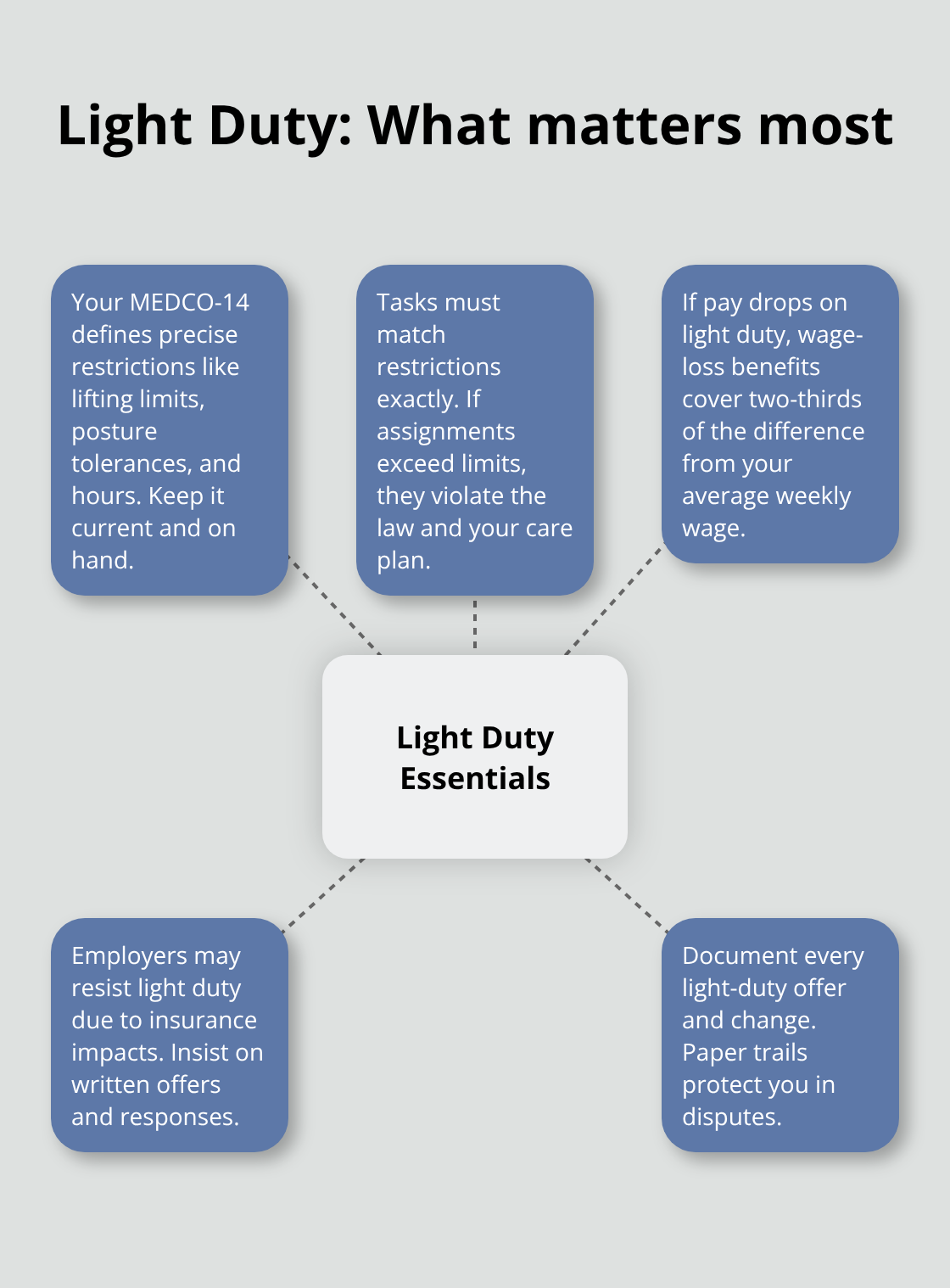
Ohio law provides wage-loss benefits equal to two-thirds of the difference between your current light-duty earnings and your average weekly wage if your pay drops during this period. That protection applies whether your reduction comes from fewer hours or a lower hourly rate. Many employers resist light duty because temporary total disability payments can increase their insurance costs, which means you need written documentation of every light-duty offer to protect yourself in disputes.
Protecting Yourself When Light Duty Is Offered
If your employer claims no light-duty work exists within your restrictions, file a C-84 form for Temporary Total Disability and stay home-you cannot be fired for doing so. Keep email records of all conversations about light-duty offers, and decline in writing any tasks outside your restrictions to protect your claim. Document every offer in writing so you have proof of what was actually offered and can reference it later if disputes arise.
Vocational Rehabilitation When Light Duty Isn’t Enough
Vocational rehabilitation services step in when light duty alone cannot restore you to your previous job or when your injury prevents return to that specific role. Beginning rehabilitation within the first eight weeks of injury produces significantly higher return-to-work rates according to the National Institute for Occupational Safety and Health, which means delays cost you real opportunity. The BWC funds approved retraining, apprenticeships, and on-the-job training programs tailored to your medical restrictions and local labor market conditions.
Your MCO coordinates these services and connects you to reemployment programs for resume help, interview preparation, and current hiring data in healthcare, skilled trades, and logistics sectors. If your initial rehabilitation provider has not developed a concrete return-to-work plan within 30 days, you can request a different provider through your MCO. The Ohio Industrial Commission Ombuds Office offers free consultation if your plan stalls or feels inadequate.
Moving Forward With Your Return-to-Work Plan
These reemployment options give you real pathways back to work, but navigating them successfully requires clear communication with your employer and healthcare provider. The next section walks you through the documentation and communication strategies that protect your rights and accelerate your return to full employment.
Making Your Return to Work Stick
Your return to work after an injury requires more than just showing up-it demands a strategy that protects your claim while building trust with your employer and doctor. The coordination between these parties determines whether your return accelerates or stalls, which is why your role as the central communicator matters enormously.
Schedule a Formal Meeting Before Your First Day Back
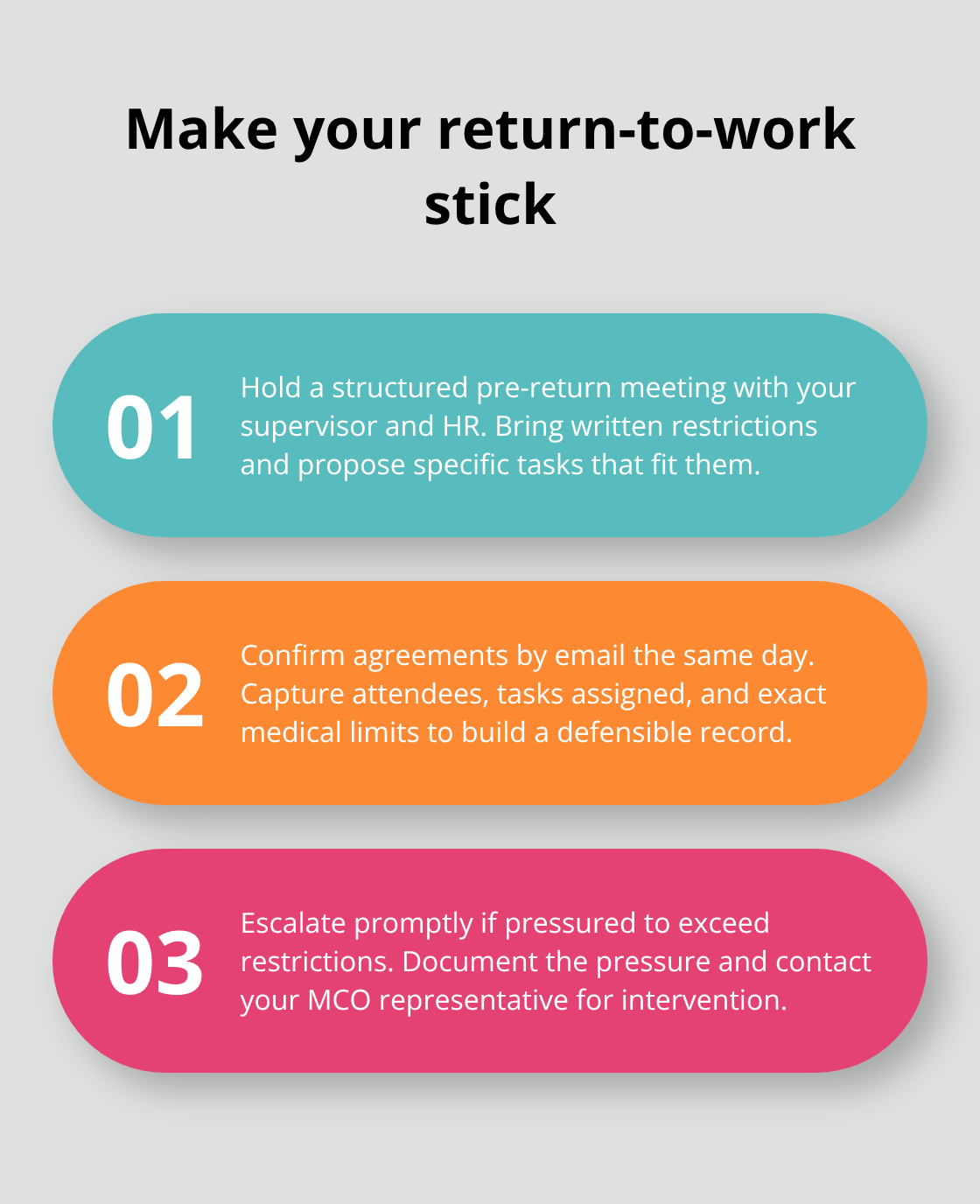
Schedule a formal meeting with your supervisor and HR before your first day back, not a casual hallway conversation. Bring your doctor’s written restrictions and specify exact limits like cannot lift more than 20 pounds or stand more than two hours continuously. Propose specific tasks that fit those boundaries. This meeting sets the tone for your entire return-to-work experience.
After the conversation ends, send an email summarizing what was discussed, who attended, what tasks were assigned, and any restrictions mentioned. This creates a paper trail that protects you if disputes arise later. If your employer pushes back on your restrictions or suggests you can do more than your doctor cleared, document that pressure in writing and contact your MCO representative immediately-this is exactly what they exist for.
Work With Your Doctor to Create a Progression Plan
Your doctor’s role extends far beyond the initial injury diagnosis. Request written statements from your physician about your current restrictions and your timeline for progression from light duty to transitional to full duty. Without a concrete progression plan, you risk staying in light duty indefinitely while your employer avoids full wage restoration.
If pain or limitations worsen during light-duty work, notify your employer in writing and ask your doctor to update your restrictions through a new MEDCO-14 form. Missing medical care rights appointments directly reduces your benefits under Ohio law, so treat these appointments as non-negotiable regardless of how well you feel.
Document Your Pain and Physical Response to Work
Keep a pain journal that records what tasks trigger discomfort, how long the pain lasts, and what adjustments help. This objective data becomes invaluable if you need to request additional restrictions or if your claim faces scrutiny. When disputes emerge over whether you can handle assigned tasks, request a functional capacity evaluation from an independent medical professional to obtain objective assessment data rather than relying on subjective claims.
Know When to Seek Legal Help
Contact an attorney immediately if your employer pressures you to work beyond your restrictions, stops paying you, asks you to sign documents, or retaliates against you for filing your claim. We at Robin J Peterson Company, LLC represent injured workers throughout Ohio and can help you protect your rights during this critical phase of your recovery.
Final Thoughts
Your return to work in Ohio rests on three core principles: your employer must follow your doctor’s restrictions exactly, you must document every conversation and offer in writing, and you must contact your MCO when obstacles appear. Get written restrictions from your doctor before any light-duty conversation happens, schedule formal meetings with HR and your supervisor rather than casual discussions, and send follow-up emails that summarize what was discussed and what tasks were assigned. Keep records of every light-duty offer, every pain response, and every conversation about your recovery timeline so you protect yourself far better than those who rely on memory or verbal agreements.
Return to work Ohio cases often turn on documentation. Workers who maintain detailed records of conversations, medical restrictions, and task assignments have the evidence they need if disputes arise over whether they can handle assigned work or whether their employer offered appropriate light duty. If your employer pushes beyond your restrictions, your claim faces denial, or your rehabilitation plan stalls after 30 days, contact your MCO immediately or reach out to the Ohio Industrial Commission Ombuds Office for free guidance.
We at Robin J Peterson Company, LLC represent injured workers throughout Ohio who face obstacles during their return to work. Whether your employer pressures you beyond your restrictions or your rehabilitation plan isn’t progressing, contact our firm to discuss your situation with an attorney who understands Ohio workers’ compensation law and knows how to navigate the Industrial Commission of Ohio.