
A denied Ohio workers claim can feel overwhelming, especially when you’re already dealing with a work injury. The good news is that a denial isn’t the end of the road-you have the right to appeal.
At Robin J Peterson Company, LLC, we’ve helped many workers navigate this process successfully. This guide walks you through each step, from understanding why your claim was denied to presenting your case before the Industrial Commission of Ohio.
Understanding Why the BWC Denies Workers’ Compensation Claims
The Most Common Denial Reasons
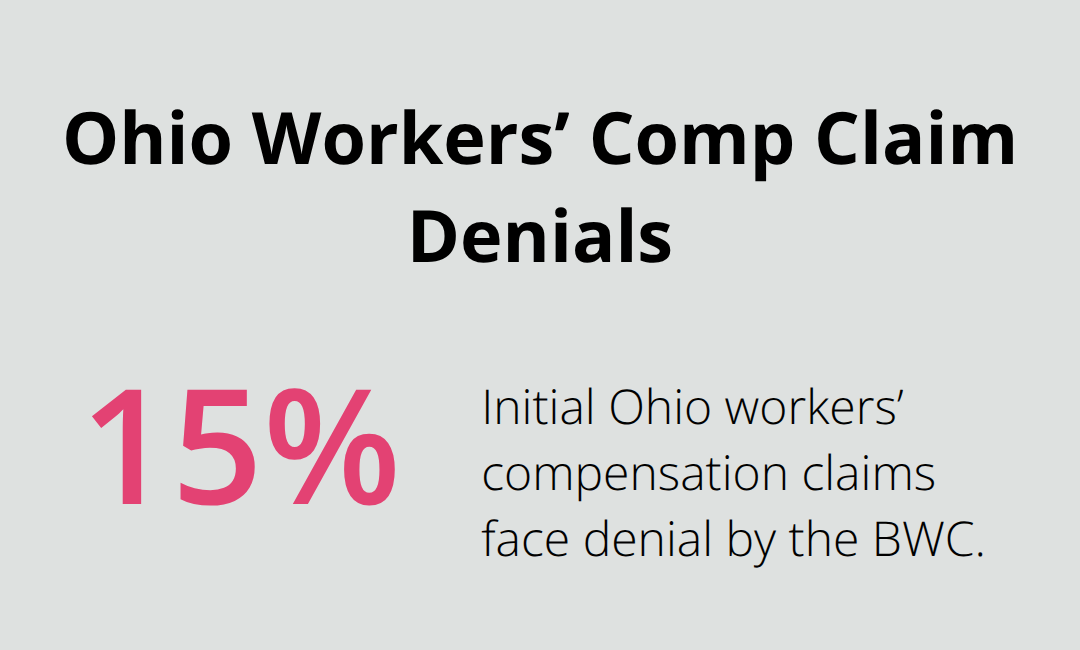
About 15% of initial Ohio workers’ compensation claims face denial from the Bureau of Workers’ Compensation, according to BWC data. The most common reason for denial is medical records that fail to explicitly connect your injury to your job duties or the specific incident that caused it. The BWC requires what’s called work causation-your treating physician must clearly document how your job duties, tasks, and the incident caused or aggravated the injury. Without this explicit connection, the BWC rejects the claim outright, regardless of how serious your injury is.
Administrative Errors That Sink Claims
Administrative errors tank claims frequently and often go unnoticed until it’s too late. Misspelled names, incorrect dates, missing signatures, and gaps between your accident report and medical records lead to denial without the BWC even reviewing your medical evidence. These mistakes seem minor, but the BWC treats them as red flags that suggest carelessness or fraud. You must verify every detail on your initial paperwork before submission.
Timing and Documentation Deadlines
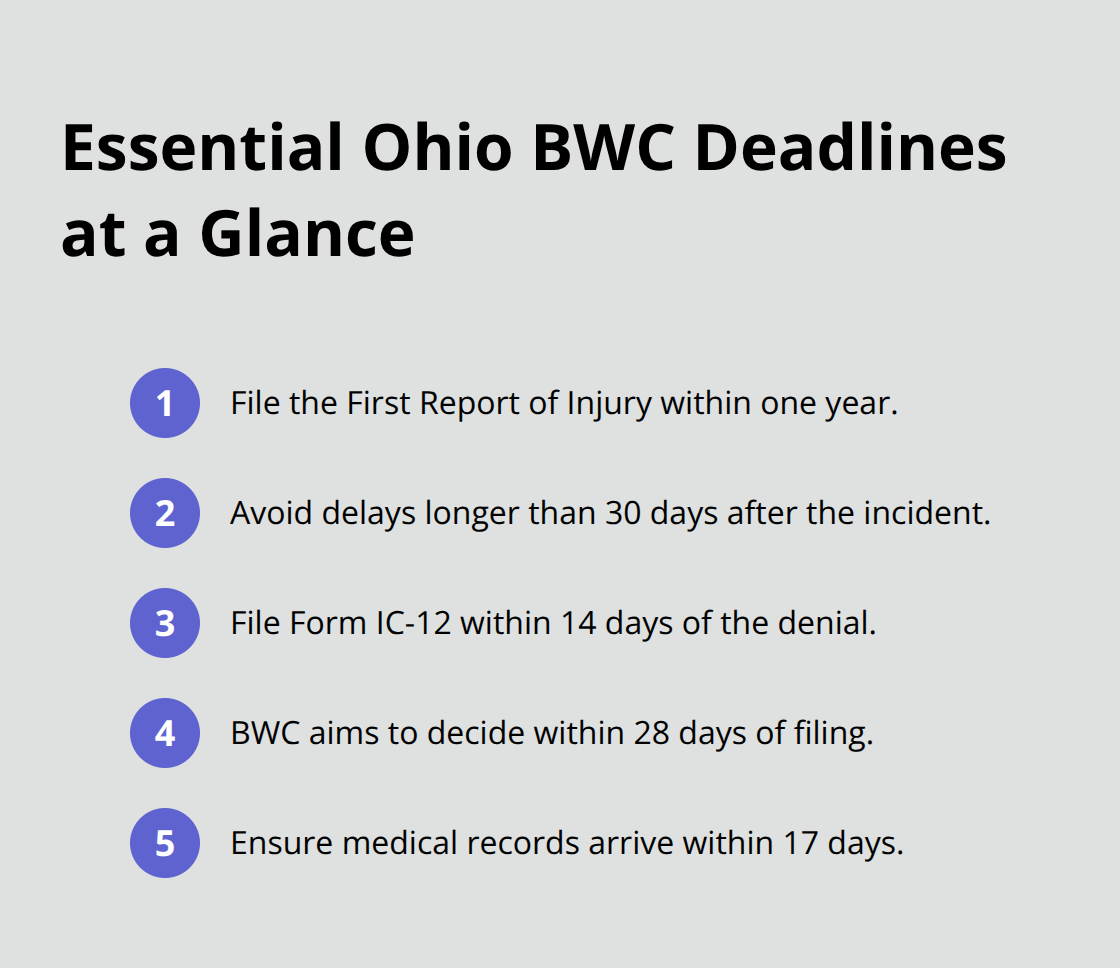
Timing matters enormously in workers’ compensation claims. The First Report of Injury must reach the BWC within one year, but delays longer than 30 days are flagged as suspicious and hurt your credibility. Report the injury on the day it happens and follow up in writing within 24 hours to create an auditable record the BWC cannot dismiss as an afterthought. Delayed or inconsistent medical treatment also damages your case because the BWC has a 28-day window to approve or deny after you file, and medical records typically have a 17-day deadline to arrive, with late submissions risking outright denial.
Pre-existing Conditions Aren’t Automatic Disqualifiers
Pre-existing conditions do not automatically disqualify your claim. You can win your claim if you prove the workplace incident aggravated or substantially contributed to the condition with clear medical documentation and a timeline showing the condition was stable before the incident and declined after it. Many workers assume a prior injury or diagnosis means their claim will fail, but Ohio law recognizes aggravation of preexisting conditions as compensable when employment substantially contributes to the problem. Your physician must explicitly state this connection in writing for the claim to succeed.
The 14-Day Appeal Window
After the BWC denies your claim, you have exactly 14 days from the denial date to file an appeal with the Industrial Commission of Ohio. This deadline is absolute and cannot be extended under normal circumstances. Missing it makes the denial final and binding.
Understanding your denial reasons and preparing your appeal strategy during these 14 days sets the foundation for everything that follows at the Industrial Commission.
How to File Your Appeal and Meet Critical Deadlines
File Form IC-12 Within 14 Days
You have exactly 14 days from the BWC denial date to file Form IC-12, the Notice of Appeal, with the Industrial Commission of Ohio. This deadline is absolute and cannot be extended under normal circumstances. The form does not require a lengthy legal brief-a concise statement of disagreement preserves your appeal rights. You can file online through the Industrial Commission Online Network (IC-ON) or submit a printed copy to your local Industrial Commission office. The filing itself is free, but the real work starts immediately after submission.
Request Your Complete Claim File Immediately
Request your complete BWC claim file the same day you file your appeal so you can review exactly what evidence the Bureau considered and identify gaps that hurt your case. Many workers wait weeks to gather records, but every day counts because your hearing typically schedules within 60 to 90 days depending on case complexity and backlog. Organize all original medical records, imaging reports, statements from every treating provider, correspondence with the BWC, and wage information chronologically with clear labels. This organization helps you spot missing pieces and strengthens your presentation.
Obtain Updated Medical Evidence That Addresses Denial Reasons
If the denial cites insufficient medical evidence, contact your treating physicians and request updated medical opinions that directly address the specific reasons the BWC rejected your claim. New medical records that were unavailable during the initial review can shift the outcome significantly. Create a one-page case summary identifying concrete weaknesses in the BWC’s reasoning and linking your evidence directly to the denial grounds-this document guides the hearing officer through your strongest points without overwhelming them with paperwork.
Understand the Hearing Structure and Evidence Standards
The hearing itself is an informal, quasi-judicial proceeding, not a courtroom trial, which makes it less intimidating than many workers expect. District Hearing Officer hearings typically last 15 to 20 minutes, while Staff Hearing Officer hearings allow new medical and factual evidence and operate on a de novo basis (meaning the hearing officer reviews your case from scratch rather than deferring to the BWC’s initial decision). Medical evidence forms the foundation of your appeal-treating physicians’ opinions, especially from doctors who actually examined you, carry the most weight.
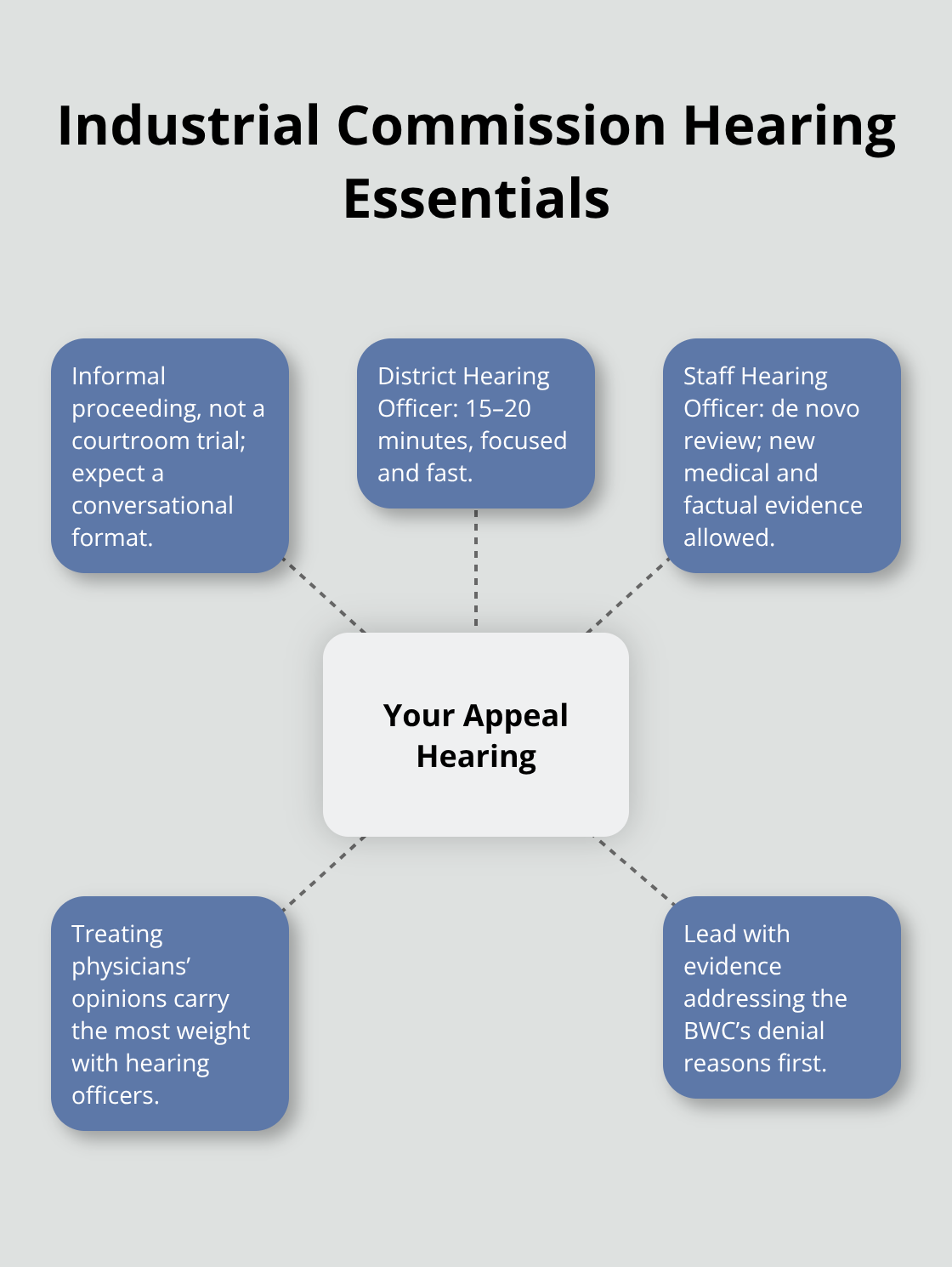
Focus your presentation on the BWC’s specific denial reasons rather than simply submitting additional records; show exactly where the Bureau misinterpreted or overlooked relevant law.
Consider Legal Representation to Strengthen Your Position
Legal representation significantly improves your odds because hearings are high-stakes and benefit from experienced strategy. An attorney structures your case to emphasize key medical evidence and anticipates employer or insurer counterarguments before they arise. Seek a free consultation with an experienced Ohio workers’ compensation attorney before the 14-day filing deadline to refine your strategy and improve your chances at the hearing. The next chapter covers how to build your strongest case with the right preparation and professional guidance.
Building Your Medical Evidence and Hearing Strategy
Organize Medical Records to Address Denial Reasons
Medical records form the backbone of your appeal, and the difference between winning and losing often comes down to how thoroughly you present them. After filing your IC-12, your first task is to gather every medical document from every provider who treated you since the injury occurred. This includes exam notes, diagnostic imaging reports, lab results, treatment plans, and progress notes. The BWC rejected your claim for specific reasons, and your medical evidence must directly address those reasons rather than simply proving you were injured.
If the denial cited insufficient work causation, obtain a written statement from your treating physician that explicitly connects your job duties to the injury or aggravation. If the denial mentioned a pre-existing condition, request medical records showing your condition was stable before the workplace incident and declined afterward. Organize all medical records chronologically with tabs and annotations that highlight passages supporting your position.
Leverage New Evidence at the Staff Hearing Officer Level
At a Staff Hearing Officer hearing, you can introduce new medical evidence that was unavailable during the initial BWC review, so do not assume your case is limited to what the Bureau already considered. Create a one-page summary that identifies the specific weaknesses in the BWC’s denial and links each piece of evidence directly to those weaknesses. A hearing officer reviewing 60 to 90 cases monthly will spend minimal time on your file, so clarity and organization matter far more than volume.
Present Your Case With Focused Strategy
District Hearing Officer hearings typically run 15 to 20 minutes, leaving no room for tangential discussion or poorly organized testimony. State the disputed issue concisely, explain why the BWC’s reasoning was flawed, and present your strongest medical evidence first. Treating physicians carry the most credibility with hearing officers, especially doctors who physically examined you rather than those offering opinions based solely on records.
If your physician can attend the hearing and testify about the work-relatedness of your injury, that testimony often outweighs written statements. However, if in-person testimony is not possible, obtain a detailed written medical opinion addressing the specific denial reasons and have that statement available for the record.
Strengthen Your Position With Legal Representation
Legal representation significantly strengthens your position because an experienced Ohio workers’ compensation attorney structures your case to anticipate the employer’s or insurer’s counterarguments before they surface. An attorney knows which evidence carries weight with hearing officers, which procedural mistakes derail cases, and how to present complex medical information in plain language. We at Robin J Peterson Company, LLC recommend seeking a free consultation with an experienced workers’ compensation attorney before your hearing so you can refine your strategy and understand exactly what to expect during the proceeding.
Final Thoughts
A denied Ohio workers’ claim stops many injured workers in their tracks, but the appeal process exists to challenge denials that should never have happened. The steps are straightforward: file your IC-12 within 14 days, gather your complete claim file immediately, and obtain updated medical evidence addressing the specific denial reasons. Speed matters because every day you delay moves you closer to missing deadlines or losing evidence.
Medical evidence wins appeals, and treating physicians who explicitly connect your injury to your job duties carry the most weight with hearing officers. If your initial medical records failed to establish work causation, new physician statements addressing that gap can reverse the denial entirely. Focus your presentation on the BWC’s specific mistakes rather than overwhelming the hearing officer with paperwork.
An experienced workers’ compensation attorney strengthens your position significantly by anticipating counterarguments and structuring your case strategically. We at Robin J Peterson Company, LLC serve injured workers throughout Ohio, fighting denials and securing the benefits workers deserve. Contact us for a free consultation to discuss your denied Ohio workers’ claim and refine your appeal strategy before your hearing.