
Filing a workers’ compensation claim in Ohio can feel overwhelming if you don’t know where to start. The Ohio Bureau of Workers’ Compensation (BWC) has specific requirements and timelines that you need to follow to protect your rights.
At Robin J Peterson Company, LLC, we’ve helped many injured workers navigate Ohio BWC claim filing successfully. This guide walks you through each step, from gathering documentation to submitting your claim and understanding what comes next.
How the Ohio BWC Works and Your Filing Timeline
What the Ohio Bureau of Workers’ Compensation Covers
The Ohio Bureau of Workers’ Compensation operates a fully state-funded system that handles most workplace injury claims across Ohio. Unlike private insurance models used in other states, the BWC manages claims directly without involvement from commercial insurers. This means your claim goes straight to a government agency that processes roughly 100,000 claims annually. The BWC covers two main types of benefits: medical care for your injury and wage replacement if you cannot work.
The agency operates under a no-fault framework, which is a significant advantage for you. You do not need to prove your employer was negligent or at fault to receive benefits. What matters is that your injury occurred during work and is tied to your job duties. The BWC covers traumatic events like fractures from falls, vehicle collisions, and machinery accidents. It also covers musculoskeletal conditions from typical job activities, including lower back strains, rotator cuff tears, and pinched nerves. The agency maintains a schedule of occupational diseases as well, covering conditions from asbestos, lead, mercury, and arsenic exposure.
The One-Year Filing Deadline
The filing deadline is the most critical number you need to remember: you have exactly one year from the date of your injury to file your claim. Missing day 366 results in automatic denial with no exceptions. This deadline applies to death-benefit claims as well.
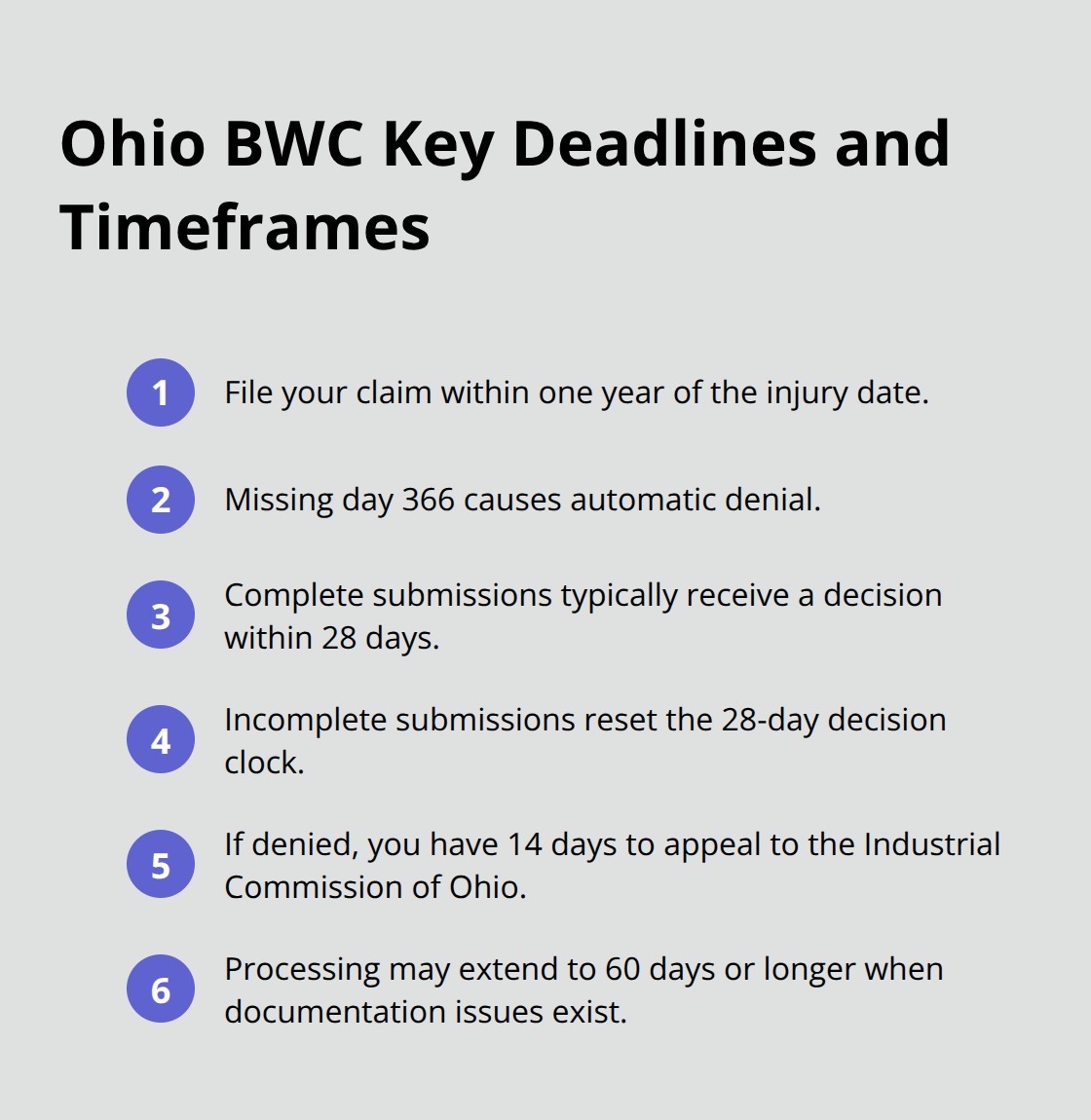
The BWC typically issues a decision within 28 days after receiving your complete First Report of Injury, though incomplete submissions reset this clock and cause delays.
Ohio’s processing speed depends heavily on the quality of your initial documentation. If you report your injury to your employer on the same day it occurs and submit complete, accurate forms immediately, you stand a much better chance of receiving a decision within that 28-day window. Many claims miss this target because workers delay reporting, submit incomplete medical records, or fail to gather witness statements early. The sooner you act, the sooner the BWC can evaluate your claim and issue a determination.
What Happens If the BWC Denies Your Claim
If the BWC denies your claim, you then have 14 days to appeal to the Industrial Commission of Ohio. This appeal window is strict and non-negotiable. Understanding what documentation strengthens your initial submission helps you avoid denial in the first place, which is why the next section focuses on preparing your evidence before you file.
Building Your Documentation Before You File
The difference between a claim that gets approved in 28 days and one that gets denied comes down to documentation. The Ohio Bureau of Workers’ Compensation processes roughly 100,000 claims annually, and about 25 percent of initial cases face denial due to timing problems and documentation gaps. You control whether your claim falls into that denial category.
Gather Evidence Immediately After Your Injury
Start collecting evidence immediately after your injury occurs, before details fade and witnesses scatter. Write down exactly what happened, where it happened, and when it happened. Include the specific machinery, task, or activity involved. The more precise your account, the harder it becomes for the BWC to find gaps in your story.
Create Strong Medical Documentation
Medical records form the foundation of your entire claim, so treat them as your most important asset. Seek treatment from a BWC-certified provider immediately, and when you do, make sure the medical documentation explicitly states that your injury is work-related. Vague medical notes that say shoulder pain or lower back strain without connecting the condition to your job duties create problems later. Medical records must clearly show how your work caused or aggravated your condition.
Keep copies of every medical bill, prescription, diagnostic test result, and appointment record organized chronologically. When you submit your claim, these records prove you received necessary treatment and establish a timeline that matches your injury report. Start a daily symptom journal immediately after your injury. Record what hurts, how the pain affects your ability to work, and how the injury impacts your daily activities. This journal demonstrates the severity and ongoing nature of your condition.
Collect Witness Statements and Physical Evidence
Gather witness statements from coworkers who saw the incident or know about your injury. Write down their names, contact information, and what they witnessed. If possible, have them write a brief statement describing what they saw. Photographs or videos of the workplace, the equipment involved, or the conditions that caused your injury provide visual evidence that strengthens your claim significantly. Take photos from multiple angles and capture any hazards or unsafe conditions. If the incident left physical damage, document that too.
Collect any incident reports filed at work, safety reports, or accident logs that your employer created. These documents show that your injury was serious enough to warrant official documentation at the time it occurred.
Document Your Report to Your Employer
When you report your injury to your employer, do it in writing via email or a formal accident report form, and request written confirmation that they received your report. This creates a verifiable paper trail showing you reported promptly. Keep this confirmation with your other documentation. With your evidence organized and your medical records in hand, you’re ready to move forward with the actual filing process-which requires specific forms and information that the BWC demands.
Filing Your Claim with the Ohio BWC
Submit Your First Report of Injury
With your documentation organized, you now submit your claim through the correct channels using the forms the BWC requires. The First Report of Injury officially starts your claim, and you can file it online through the BWC portal, by mail, or by phone. Online filing is your fastest option because you receive immediate confirmation that the BWC received your submission, and you can track your claim status in real time through your OHID account. When you submit online, the BWC typically acknowledges receipt within about 10 business days.
The First Report of Injury must include precise details: exactly what happened, the date and time of the injury, the location where it occurred, the specific task or machinery involved, and any witnesses present. Vague descriptions like “fell at work” or “hurt my back” create immediate red flags that slow processing or trigger denials. Instead, write something like “fell from an eight-foot ladder while installing electrical wiring on the second floor at 2:15 PM on July 10, 2026, with supervisor John Martinez present.” This specificity eliminates ambiguity and demonstrates you paid attention to details.
Verify Your Employer Filed Correctly
If your employer files the First Report of Injury on your behalf, do not assume they filed it correctly or on time. Verify directly with your HR department that the form was submitted to the BWC, and request proof of the submission date and your claim number. Many workers discover too late that their employer never filed the form or filed it weeks after the injury occurred, which damages your credibility with the BWC even though you reported to your employer promptly.
Submit Your Complete Documentation Package
Alongside the First Report of Injury, you submit your complete documentation package: medical records from a BWC-certified provider with explicit statements linking your treatment to the work injury, your daily symptom journal, witness statements with contact information, photographs of the workplace or equipment, any incident reports your employer created, and wage statements showing your income before the injury. Submit everything at once rather than trickling documents in over weeks, because incomplete submissions reset the BWC’s 28-day decision clock.
The Ohio Bureau of Workers’ Compensation processes roughly 100,000 claims annually, and the agency’s determination depends on four specific factors: the accident description you provide, the medical diagnosis, evidence explicitly linking treatment to the work injury, and the disability outlook based on your medical records. If any of these four elements is weak or missing, the BWC will request additional information, which delays your decision.
Monitor Your Claim Status and Respond to Requests
After you submit your complete claim package via the online portal or certified mail, monitor your claim status regularly through your OHID account. The BWC typically issues a determination within 28 days, though processing times extend to 60 days or longer if documentation errors exist or if the agency requests clarification. If the BWC requests additional information, respond immediately within the specified timeframe because missing that deadline results in automatic denial.
When your determination arrives, the BWC will either approve your claim, deny it, or approve it with restrictions. An approval means medical benefits and potentially wage replacement if you cannot work. A denial means you have 14 days to file an appeal with the Industrial Commission of Ohio, which is a hard deadline that cannot be extended.
Final Thoughts
Filing an Ohio BWC claim requires three actions that determine whether you succeed or fail: report your injury immediately to your employer in writing, submit complete and accurate documentation to the BWC within one year of your injury, and maintain organized records throughout the process. The difference between approval and denial often comes down to whether you gathered medical records that explicitly link your treatment to work, collected witness statements on the day of your injury, and submitted everything together rather than piecemeal. About 25 percent of initial claims face denial because workers miss deadlines or submit incomplete forms, but you control whether your claim falls into that category by acting fast and staying organized.
After you submit your claim, monitor your status through your OHID account and respond immediately to any BWC requests for additional information. Most decisions arrive within 28 days if your submission is complete, but delays extend to 60 days or longer when documentation gaps exist. If the BWC denies your claim, you have exactly 14 days to appeal to the Industrial Commission of Ohio-this deadline is strict and cannot be extended.
The complexity of Ohio BWC claim filing and the stakes involved make legal representation valuable. An experienced workers’ compensation attorney reviews your forms before submission to catch issues that would cause delays or denials, organizes your evidence in the strongest way possible, and handles appeals if the BWC initially rejects your claim. Contact our firm for a free consultation to discuss your claim and learn how we can help you navigate the process successfully.