
Workplace injuries in Akron can leave you confused about your next steps. The Ohio Bureau of Workers’ Compensation system has specific rules and timelines that affect your claim’s outcome.
At Robin J Peterson Company, LLC, we’ve helped injured workers navigate Akron BWC claim guidance and understand their rights. This guide walks you through the process, from filing your initial claim to appealing a denial if needed.
How the Ohio BWC System Actually Works
The Ohio Bureau of Workers’ Compensation is a state agency that processes work injury claims through a standardized system, not a court. This distinction matters enormously because the BWC operates on documented criteria and established timelines rather than subjective judgment. When you file a claim in Akron, you enter a process that handles over 900,000 claims statewide each year, which means the system runs on strict procedures. The BWC does not decide your case based on sympathy or negotiation-it examines three core elements: whether you were an employee at the time of injury, whether the injury occurred within the scope of your job, and whether the injury caused your diagnosed condition. If all three are present and documented properly, the claim receives approval. If any element is missing or weak, denial follows.
How Medical Evidence and Employment Documentation Drive Decisions
Unlike a lawsuit where you might present arguments to a judge or jury, the BWC evaluation relies on objective medical evidence and employment documentation. This is why speed and completeness matter far more than persuasive storytelling. The 30-day window from your filing date is when the BWC decides to accept or deny your claim-this clock starts the moment you file online, not when you realize you were injured. Filing through the Ohio BWC online application begins this evaluation immediately, offering you the fastest path to a decision.
The 28-Day Decision Window
Once your claim is filed with the BWC, the agency has 28 days to decide whether the claim is allowed or denied. Medical documentation proves work-relatedness and causation during this window, so incomplete medical records often trigger denials. If you were treated in an emergency department, request those ER records explicitly and send all medical documents directly to the BWC at 30 W. Spring St., Columbus, OH 43215-2256. Proving employment status is equally essential-pay stubs, tax forms, or an employment contract prevent the common denial reason of independent contractor misclassification. The BWC begins coordinating treatment through a Managed Care Organization even while the claim is under initial review, so medical care can proceed during the evaluation period.
What Happens Next in Your Claim
The MCO does not make the initial eligibility decision; it coordinates medical care while the BWC evaluates your claim. This means you can access treatment without waiting for final approval. However, you must use only BWC-certified providers for ongoing medical treatment to ensure the BWC pays the bills. Non-certified providers may leave you with unpaid expenses. The most common denial reasons are delayed reporting and lack of credible witness statements, so prompt reporting improves your credibility with the agency. Respond promptly to any BWC information requests (typically within 10–14 days) and align your responses with your original claim filing and medical records to avoid triggering further investigation.
What to Do Right After Your Injury and Before Filing
The first 24 hours after a workplace injury in Akron determine how credible your claim appears to the BWC. Report the injury to your supervisor immediately and request a written incident report on the spot. The BWC views delayed reporting as a red flag that weakens your case significantly, so act the same day rather than waiting until you feel better or think the injury is serious enough. Document every detail in writing: what happened, where it happened, which body parts hurt, the exact activity you performed, and any environmental factors like wet floors or faulty equipment. Email your supervisor and HR about the accident, complete any accident report form your employer provides, and keep copies for yourself. This creates a paper trail that the BWC uses to verify your story later.
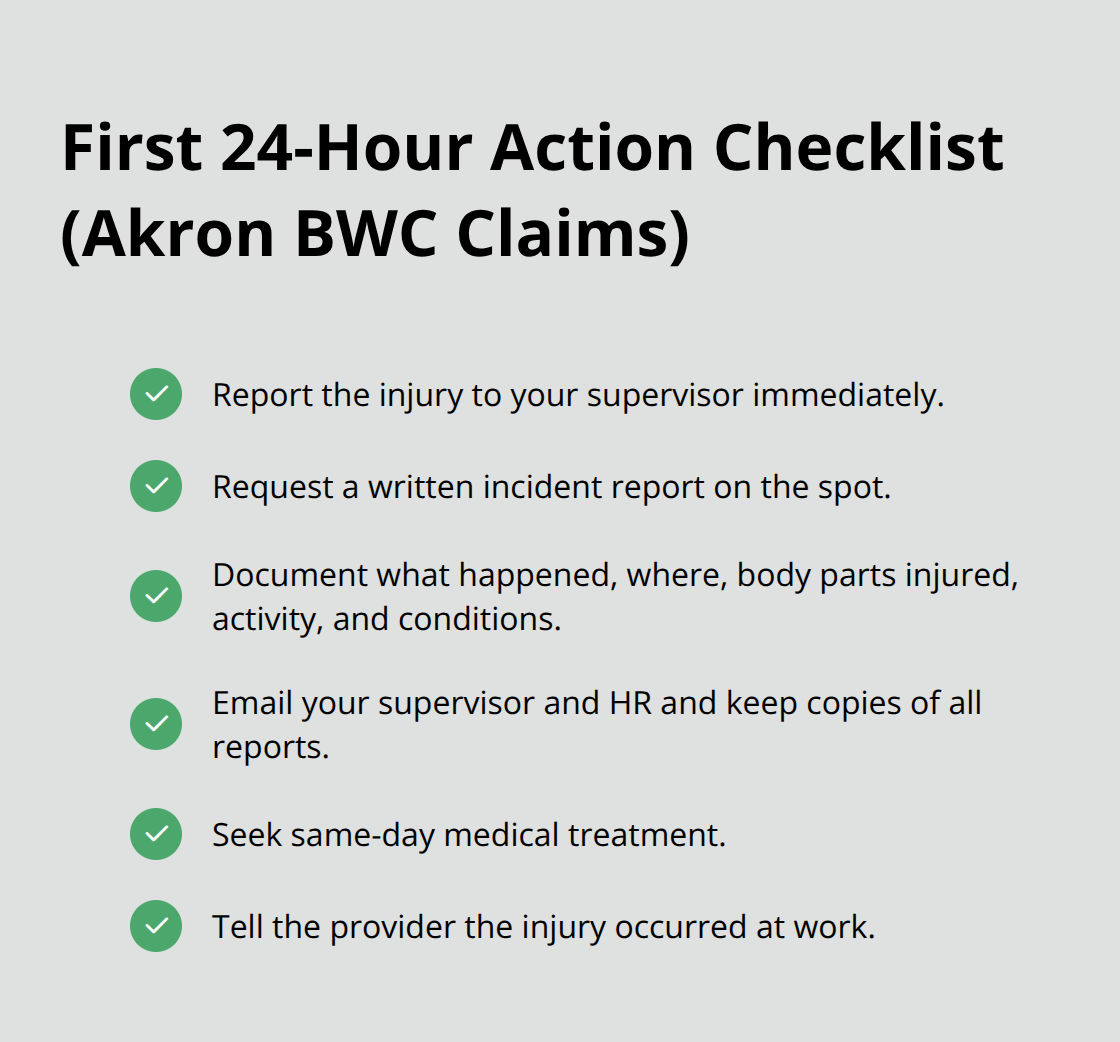
Seek medical treatment the same day if possible and tell the provider explicitly that the injury occurred at work. This establishes a prompt medical record that connects your diagnosis directly to the workplace, which is exactly what the BWC needs to approve your claim.
Collect Your Supporting Documentation Early
The BWC has a one-year deadline from the date of injury to file your claim, but filing within 30 days dramatically improves approval odds because it shows you took the injury seriously. Assemble your supporting documentation before you file: initial medical records from any provider you saw, 52 weeks of wage history to prove your employment status, and any witness statements from coworkers who saw the accident happen. Employment documentation is critical because independent contractor misclassification ranks among the most common denial reasons the BWC encounters. Gather pay stubs, tax forms, or your employment contract to eliminate any question about whether you were actually an employee. If you received treatment in an emergency department, request those ER records explicitly because the BWC requires objective medical evidence that proves work-relatedness and causation. Have all medical documents sent directly to the BWC at 30 W. Spring St., Columbus, OH 43215-2256. When you file Form FROI-1 (First Report of Injury), complete it with precision: the exact mechanism of injury, your medical diagnosis, the date and time, witnesses present, and your average weekly wage. Inaccuracies or vague descriptions trigger further investigation and delays.
Why Claims Fail and How to Avoid It
Delayed reporting stands as the single most common reason the BWC denies claims, followed closely by missing witness statements or weak medical documentation. The agency does not grant extensions for late submissions, so the one-year window is non-negotiable. The BWC cross-checks your claim against your employer’s accident report and safety records, and discrepancies between these documents trigger deeper investigation. If your story in the FROI-1 contradicts what appears in the employer’s report or your medical records, the BWC will request clarification (typically within 10 to 14 days). Respond promptly and align your responses precisely with your original claim filing and medical records to avoid raising suspicion. Many injured workers file their own FROI-1 online through the Ohio BWC application to ensure accuracy and gain immediate confirmation of submission. Your treating physician’s report carries significant weight, so request written documentation that explicitly connects the workplace injury to your current diagnosis and treatment plan. Non-certified providers may not receive payment from the BWC, leaving you with unpaid medical bills, so verify that any ongoing treatment happens through a BWC-certified provider from the start.
What Happens When You File Form FROI-1
Filing Form FROI-1 officially launches your claim and starts the 30-day evaluation clock. The BWC examines three core elements during this window: whether you held employee status at the time of injury, whether the injury occurred within the scope of your job, and whether the injury caused your diagnosed condition. Medical evidence and employment documentation drive these decisions far more than any narrative you provide. The MCO (Managed Care Organization) assigned to your claim does not make the initial eligibility decision; it coordinates medical care while the BWC evaluates whether to accept or deny your claim. This means you can access treatment without waiting for final approval, but only through BWC-certified providers. The most common denial reasons are delayed reporting and lack of credible witness statements, so prompt reporting and strong documentation improve your credibility significantly. If the BWC denies your claim, you have exactly 14 days from the denial letter to file an appeal with the Industrial Commission of Ohio-this deadline is non-negotiable and cannot be extended.
What You Actually Get If Your Claim Is Approved
Medical Treatment and Wage Replacement Benefits
Approved claims provide three distinct forms of support: medical treatment coverage, lost wage replacement, and potential lump-sum settlements. Medical treatment means the BWC pays for all reasonable and necessary care related to your work injury through BWC-certified providers, which includes doctor visits, physical therapy, imaging, surgery, and prescription medications. Lost wage replacement typically covers two-thirds of your average weekly wage up to a state maximum, paid while you cannot work due to your injury. The Ohio Industrial Commission publishes current wage replacement rates annually, so your specific amount depends on your earnings history and injury severity. If your injury results in permanent disability, you may receive a lump-sum settlement that compensates for long-term functional loss.
Vocational Rehabilitation and Payment Verification
Vocational rehabilitation services also become available if your injury prevents you from returning to your previous job, covering retraining and job placement assistance. Track every medical bill submitted to the BWC and verify that payments arrive on schedule, because gaps in payment can disrupt your treatment plan. Use only BWC-certified providers for ongoing care to avoid unpaid medical expenses that leave you responsible for the bills.
The 14-Day Appeal Deadline After Denial
When the BWC denies your claim, you have exactly 14 days from the denial letter to file an appeal with the Industrial Commission of Ohio, and this deadline cannot be extended under any circumstances. At the Industrial Commission hearing, you must prove three things: you held employee status, the injury occurred within your job scope, and the injury caused your diagnosed condition. The burden falls entirely on you to present compelling evidence, which means gathering objective medical reports from treating physicians, employment documentation, witness statements from coworkers, and any photographs or safety records related to the incident.
Evidence That Carries Weight in Appeals
Treating physicians’ reports carry the most weight because they document the mechanism of injury and connect it directly to your diagnosis. Many injured workers in the Akron area file appeals without legal representation and lose because they lack understanding of required evidence or miss procedural requirements. An experienced workers’ compensation attorney understands exactly what evidence the Industrial Commission demands, knows how to prepare witnesses for testimony, and prevents dismissal on technical grounds. Robin J. Peterson Company, LLC can identify weaknesses in the denial decision and present evidence at hearings that directly counters the BWC’s reasoning. The decision to pursue an appeal often determines whether you access the benefits you earned through your work.
Final Thoughts
Your Akron BWC claim guidance starts with one critical action: file your claim promptly after your workplace injury. Speed determines credibility with the BWC, and the 30-day evaluation window moves quickly regardless of how prepared you feel. Gather your medical records, employment documentation, and witness statements before filing Form FROI-1 to eliminate delays caused by missing information.
When you file online through the Ohio BWC application, the evaluation clock starts immediately and you must respond to any BWC information requests within 10 to 14 days. Align your responses precisely with your original filing and medical records, and use only BWC-certified providers for ongoing treatment to avoid unpaid medical bills. If the BWC denies your claim, you have exactly 14 days to file an appeal with the Industrial Commission of Ohio-this deadline cannot be extended.
The difference between approval and denial often comes down to documentation quality and filing speed, which is why consulting with an experienced workers’ compensation attorney strengthens your case significantly. We at Robin J Peterson Company, LLC represent injured workers throughout Northeast Ohio and identify weaknesses in BWC denials while preparing your case for an Industrial Commission hearing. File your claim today and contact us to discuss your situation.