
Permanent total disability in Ohio workers’ comp is the benefit meant for injured workers whose allowed conditions keep them from returning to any sustained work, not just their old job. It is one of the most significant decisions the Industrial Commission makes, and it is also one of the most closely examined. Understanding who qualifies, what evidence the Commission expects, and what can cause an application to fail gives you real control over one of the most important steps in a serious claim.
At Robin J Peterson Company, LLC, we help injured workers across Northeast Ohio protect what they have earned through the workers’ compensation system. This guide explains what permanent total disability actually means under Ohio law, how the Commission reviews an application, and the mistakes that most often lead to a denial.
What Permanent Total Disability Actually Means in Ohio
Ohio Administrative Code Rule 4121-3-34 defines permanent total disability as the inability to perform sustained remunerative employment due to the allowed conditions in the claim. The rule explains that the purpose of the benefit is to compensate an injured worker for impairment of earning capacity. In plain terms, the question is not whether you can do the job you had on the day you were hurt, but whether you can do any sustained paid work at all.
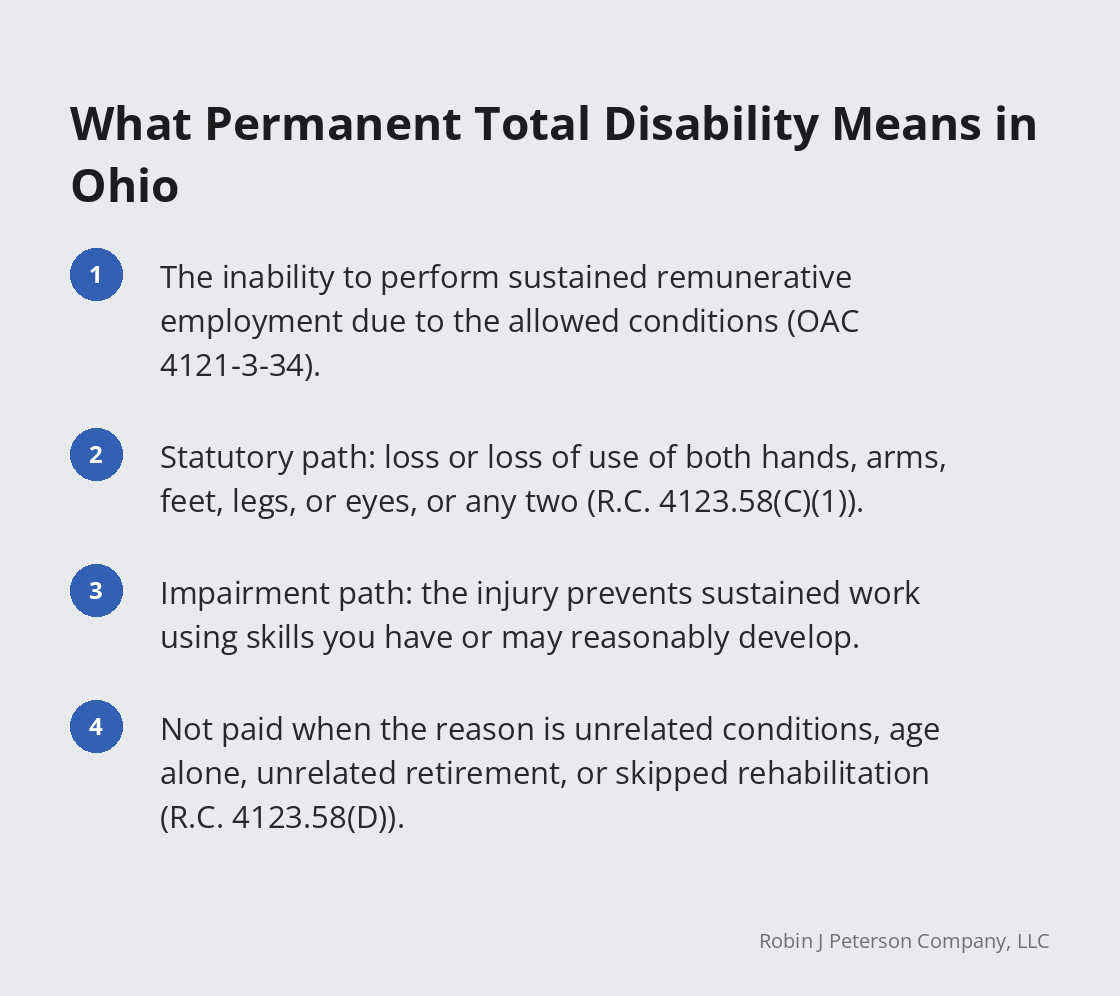
The word permanent also has a specific meaning. Under the rule, it does not require that the disability last for the rest of your life. It means the disability will, within reasonable probability, continue for an indefinite period of time without any present indication of recovery.
Two Paths to Permanent Total Disability
Ohio Revised Code Section 4123.58(C) allows permanent total disability compensation only when at least one of two situations applies. The first is often called statutory permanent total disability: the claimant has lost, or lost the use of, both hands or both arms, both feet or both legs, both eyes, or any two of these. The statute clarifies that losing one limb, or the use of one limb, does not count as losing two body parts.
The second path applies when the impairment resulting from the injury or occupational disease prevents the employee from engaging in sustained remunerative employment using the employment skills the employee has or may reasonably be expected to develop. This second path requires a careful look at both medical and vocational evidence.
How Long the Benefit Lasts
Under Section 4123.58(A), an award for permanent total disability continues until the employee’s death. That long horizon is one reason the Commission reviews these applications so carefully and why the evidence supporting them needs to be thorough.
Section 4123.58(E) also provides that permanent total disability compensation is in addition to benefits payable for scheduled losses under division (B) of Section 4123.57. If your injury involved the loss of a hand, foot, or eye, our guide to amputation and scheduled loss awards in Ohio explains how those separate awards work.
When the Law Does Not Allow the Benefit
Section 4123.58(D) lists situations in which permanent total disability will not be compensated, whether the reasons apply individually or in combination. These include an inability to work caused by impairments that are not the result of an allowed injury or occupational disease, an inability to work due solely to age or aging, retirement or not working for reasons unrelated to the allowed injury, and a failure to engage in educational or rehabilitative efforts to improve employability unless those efforts are determined to be in vain.
These exclusions are frequently at the center of contested applications. Employers often argue that a worker’s limitations come from unrelated health problems or that the worker left the workforce for reasons that had nothing to do with the claim.
How the Industrial Commission Decides an Application
Applications for permanent total disability are filed with the Industrial Commission and follow a structured process set out in Rule 4121-3-34. Each step creates opportunities to strengthen your case or, if overlooked, to weaken it.
Knowing how the process works helps you prepare the right evidence at the right time.
Medical Evidence Required at Filing
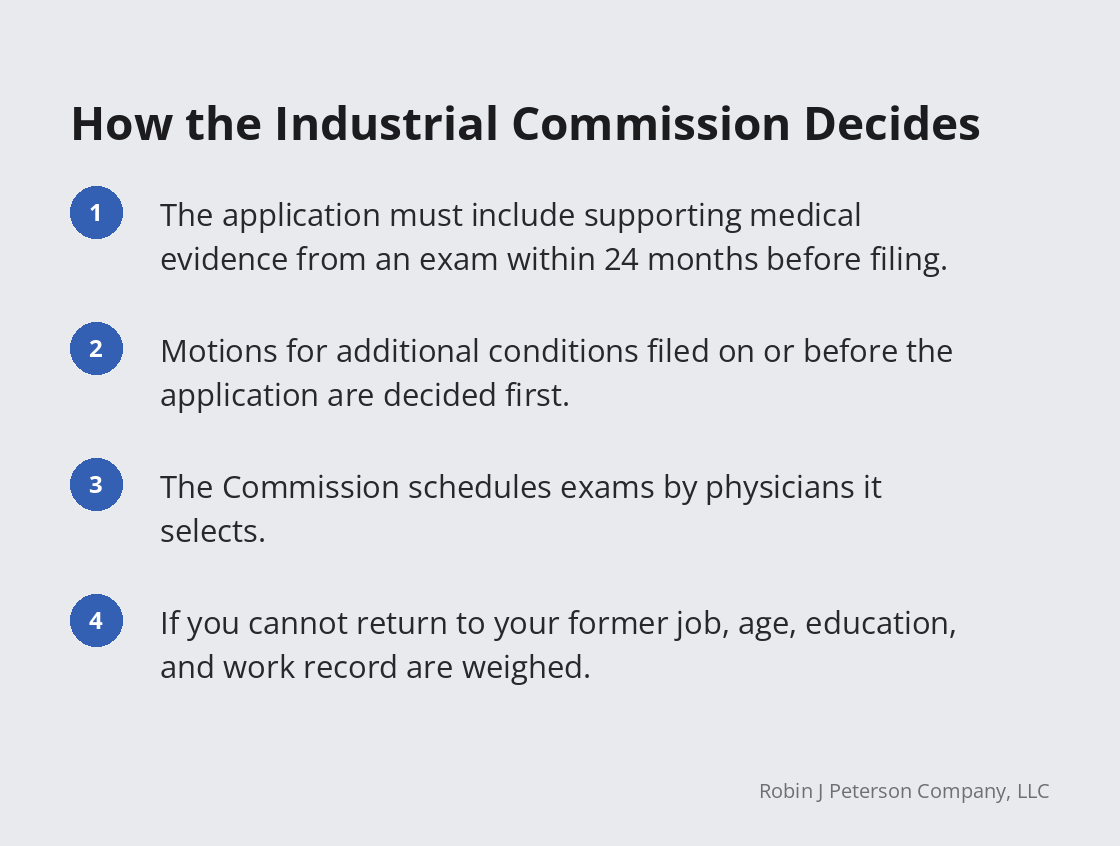
Under Rule 4121-3-34(C)(1), each application must identify, if already on file, or be accompanied by medical evidence from a physician that supports the application. In claims allowed for a psychiatric or psychological condition, that evidence may come from a psychologist or another qualified provider described in the rule. The medical examination on which the report is based must have been performed within twenty-four months before the date the application is filed.
The rule also places responsibility on the injured worker to make sure that copies of the medical records and reports the worker intends to rely on are contained within the claim file at the time the application is filed. Once the application is filed, the Commission serves a copy on the employer or its representative and schedules medical examinations by physicians the Commission selects.
Additional Conditions and Their Timing
Timing matters when you have conditions that have not yet been recognized in your claim. Under Rule 4121-3-34(C)(3)(c), a motion requesting recognition of additional conditions filed on or before the date of the permanent total disability application is processed before the application. A motion filed after the application is processed only after the application is decided.
Because the Commission evaluates disability based on the allowed conditions, making sure every related condition is recognized before you apply can directly affect the outcome. Our article on psychological injury claims in Ohio explains how mental health conditions can become part of a claim.
Medical Impairment and Nonmedical Factors
Under Rule 4121-3-34(D)(3)(a), the burden of proof is on the injured worker to establish permanent total disability by a preponderance of the evidence, including that the disability is permanent and that the inability to work is causally related to the allowed conditions. If the medical impairment from the allowed conditions alone prevents any sustained remunerative employment, the worker is found permanently and totally disabled without reference to vocational factors.
If the worker cannot return to the former position but may be able to do other work, the adjudicator considers nonmedical factors such as age, education, work record, and other physical, psychological, and sociological factors in the record. If the adjudicator finds the worker can return to sustained remunerative employment using past skills or skills that may reasonably be developed through retraining or rehabilitation, the application will be denied. The rule also states that the percentage of permanent partial impairment cannot be the sole basis for the decision, and when a psychiatric condition is allowed, the adjudicator must consider it in combination with the physical conditions.
Mistakes That Can Derail a Permanent Total Disability Application
Permanent total disability applications are often denied not because the worker is able to work, but because the record does not clearly show why the worker cannot. Many of these problems can be avoided with planning.
The following missteps come up again and again in contested applications.
Filing With Outdated or Incomplete Medical Support
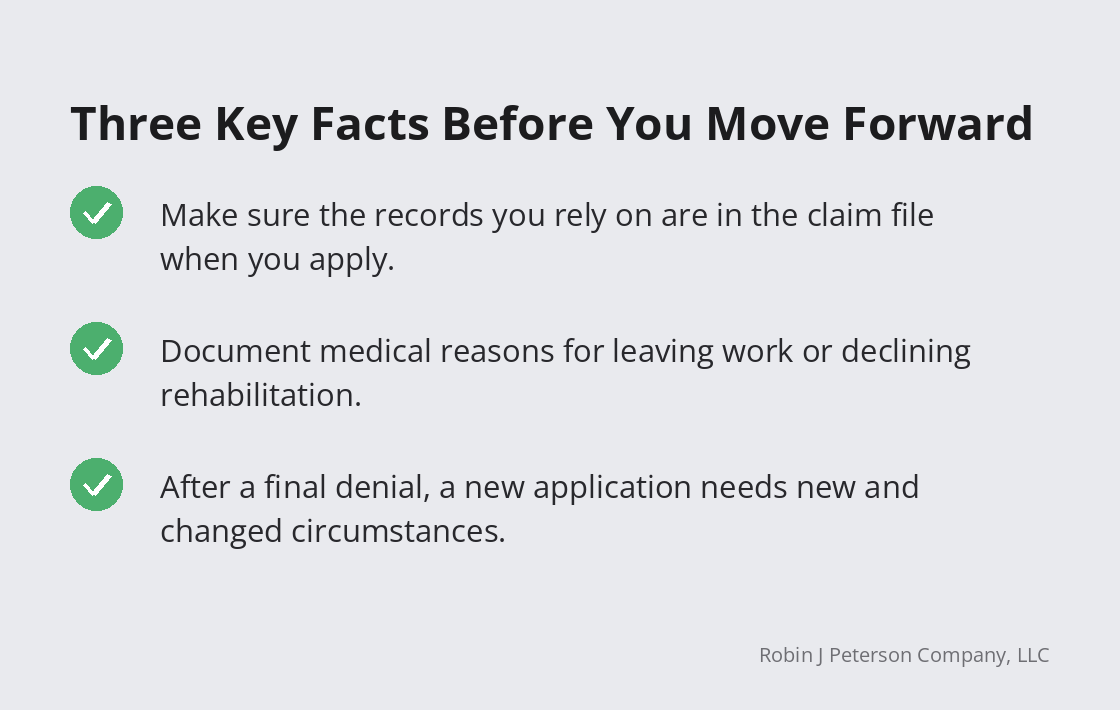
A supporting medical report based on an examination older than twenty-four months does not meet the rule’s requirements. Reports that do not address how the allowed conditions, rather than unrelated health issues, prevent sustained work can also leave the application vulnerable. Ask your treating physician to explain your limitations in terms of the allowed conditions and to describe what activities you can and cannot sustain.
Gathering complete treatment records before filing matters as well, since the rule expects the records you rely on to already be in the claim file.
Overlooking Rehabilitation and Work History Issues
Because Section 4123.58(D) bars compensation when a worker has not engaged in educational or rehabilitative efforts to enhance employability, unless such efforts would be in vain, a history of declining vocational rehabilitation without a medical reason can become a serious obstacle. The same is true when the record suggests you retired or stopped working for reasons unrelated to the injury.
If you left work or declined a program because of your allowed conditions, make sure that explanation is documented by your doctors and reflected in the record before the hearing.
Missing Objections and Reapplying Without New Evidence
In statutory permanent total disability cases involving the loss or loss of use of two qualifying body parts, Rule 4121-3-34(E) allows a staff hearing officer to issue a tentative order without a hearing. A party may file a written objection within thirty days of receiving that tentative order; if no objection is filed in time, the order becomes final, and if one is filed, the application is set for hearing.
If an application is denied by a final order, Section 4123.58(G) requires the claimant to present evidence of new and changed circumstances before the Commission may consider a later application for the same injury or occupational disease. Reading every order promptly and responding within the deadlines it describes protects your options. Our guide to the Ohio Industrial Commission hearing explains what to expect when your application is heard.
Final Thoughts
Permanent total disability in Ohio workers’ comp is designed for workers whose allowed conditions truly prevent sustained remunerative employment, and the Industrial Commission expects the record to prove it. The statute, the Commission’s rule, and the exclusions for unrelated conditions, age alone, retirement, and rehabilitation all shape how an application is decided.
Strong applications are built on current medical evidence, a complete claim file, recognized conditions, and a clear explanation of why retraining or other work is not realistic. You do not have to assemble that record alone.
If you are considering an application for permanent total disability, contact Robin J Peterson Company, LLC to talk with our team about your claim. We will review your file, explain your options, and help you take the next step with confidence.