
A violation of a specific safety requirement in Ohio, often called a VSSR, can change the outcome of a workers’ compensation claim after a serious workplace accident. Ohio’s workers’ comp system generally takes the place of lawsuits against employers for workplace injuries, but the Ohio Constitution adds an important layer when an injury results from an employer’s failure to follow a specific safety rule. In those cases, an injured worker may apply for an additional award on top of the regular workers’ comp benefits. The rules are strict and the deadline is short, so knowing how a VSSR claim works can protect a right that many injured workers never realize they have.
At Robin J Peterson Company, LLC, we help injured workers throughout Ohio pursue every benefit the law provides after a workplace injury, so you can move forward with confidence. This guide walks you through what a VSSR claim actually is, how the Industrial Commission processes an application, and the mistakes that most often derail these claims.
What a VSSR Claim Actually Is in Ohio
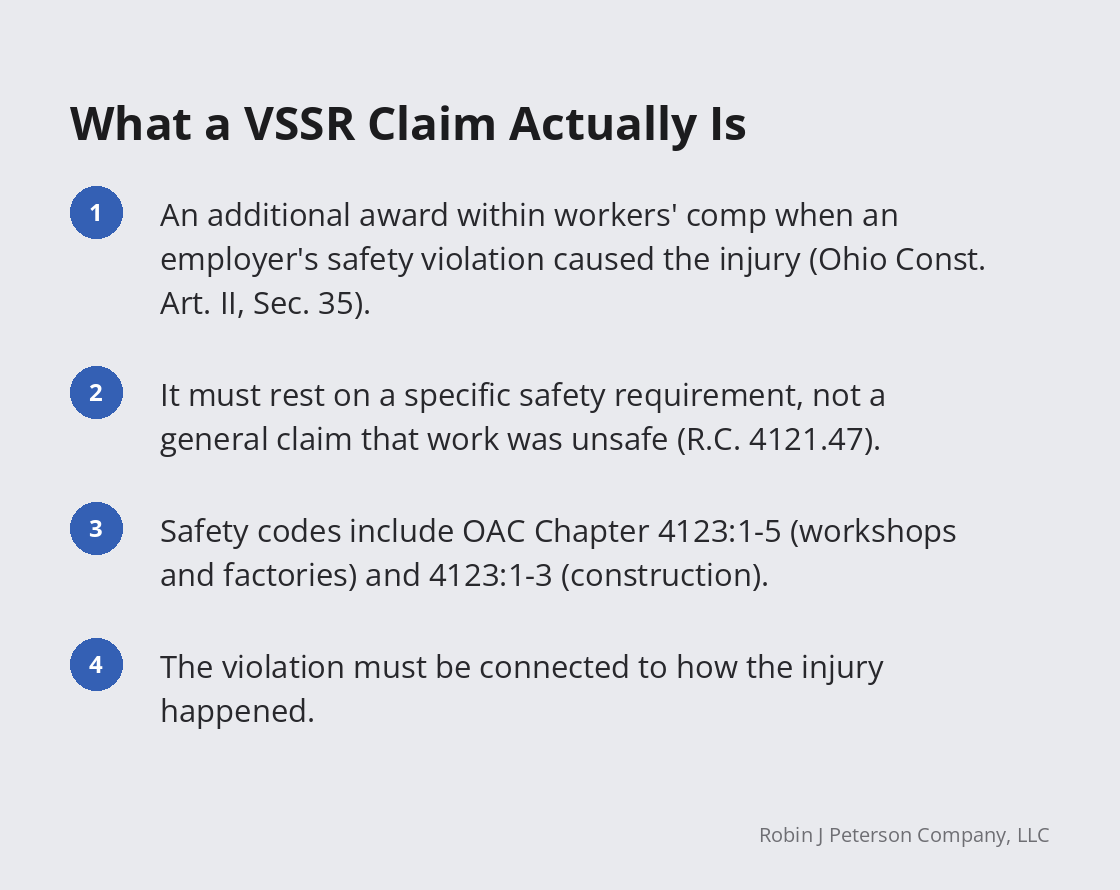
The foundation of a VSSR claim is Article II, Section 35 of the Ohio Constitution. That section establishes the workers’ compensation system and gives the board established under it full power and authority to hear and determine whether an injury, disease, or death resulted because of the employer’s failure to comply with any specific requirement for the protection of the lives, health, or safety of employees. When a hearing finds that it did, the Constitution provides that an additional amount found to be just is added to the compensation awarded for the injury. In other words, a VSSR award is not a separate lawsuit. It is an additional award within the workers’ comp system, decided through the Industrial Commission.
Specific Safety Requirements Versus General Safety Duties
The word “specific” is central. A VSSR claim is not based on a general argument that the workplace was unsafe or that the employer could have been more careful. It must be tied to a particular requirement for the protection of employees. Ohio Revised Code Section 4121.47 states that no employer shall violate a specific safety rule adopted by the Administrator of Workers’ Compensation or an act of the General Assembly to protect the lives, health, and safety of employees under Section 35 of Article II. The Ohio Administrative Code contains chapters of these rules, including Chapter 4123:1-5 for workshops and factories and Chapter 4123:1-3 for construction, covering subjects such as guarding of floor openings, ladders, scaffolds, mechanical power transmission apparatus, and mechanical power presses.
The Link Between the Violation and the Injury
Proving that a safety rule was broken is only part of the case. The Constitution allows an additional award when the injury, disease, or death resulted because of the employer’s failure to comply. That means the evidence has to connect the specific violation to what actually happened to you. A missing guard on a machine that played no role in your accident, for example, would not support a VSSR award for that accident. Investigators and hearing officers look closely at how the equipment worked, what the rule required, and whether compliance would have prevented the harm.
How a VSSR Award Relates to Your Regular Benefits
A VSSR award does not replace your workers’ comp claim. It depends on it. Ohio Administrative Code Rule 4121-3-20 requires the application to contain the claim number the Bureau of Workers’ Compensation assigned to the underlying claim. Your medical benefits, wage loss benefits, and other compensation continue through the regular claim, and the VSSR application asks the Industrial Commission to add an additional award because of the employer’s safety violation. Because the two are connected, decisions in the underlying claim can affect the VSSR application as well.
How the VSSR Application Process Works
The procedure for a VSSR claim is set out in Ohio Administrative Code Rule 4121-3-20. It differs from many other workers’ comp hearings, with its own filing deadline, investigation, prehearing conference, and rehearing rules. Understanding each stage helps you prepare the right evidence at the right time.
Filing the Application on Time
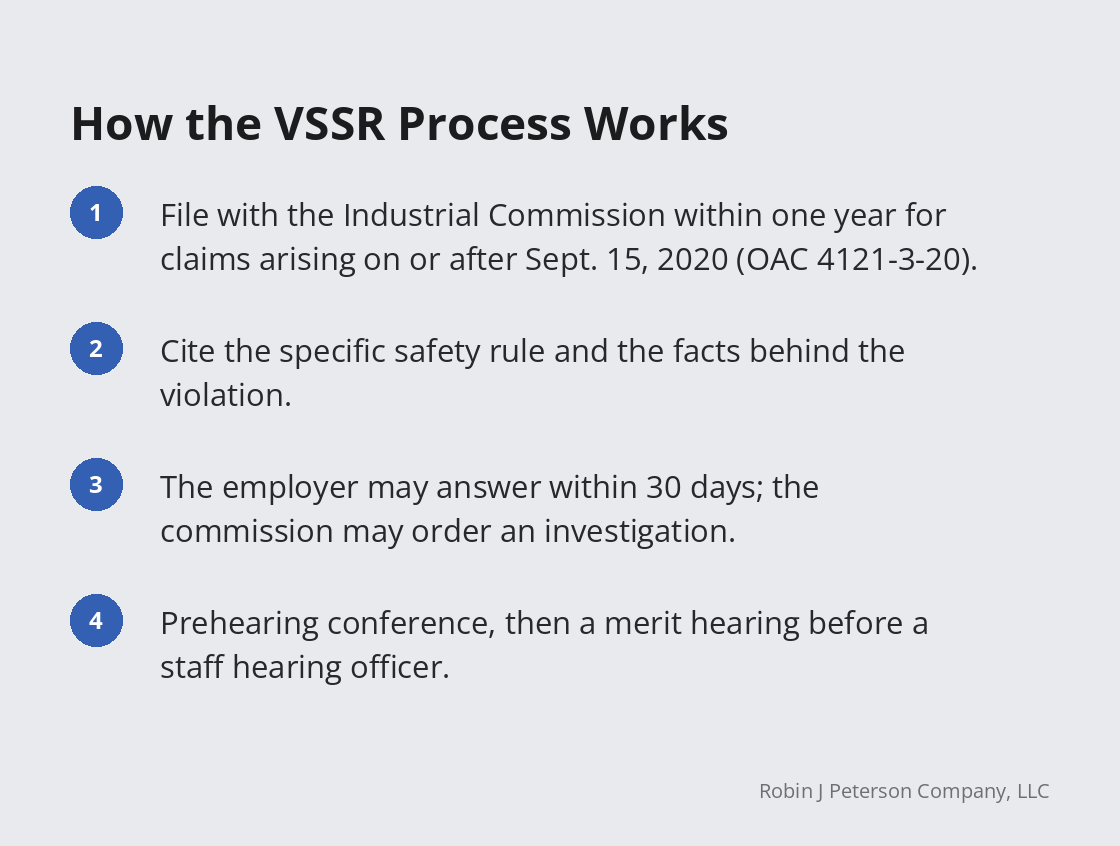
The deadline is the first and most important rule. Under Rule 4121-3-20(A), for claims arising on or after September 15, 2020, an application for an additional award must be filed with the Industrial Commission within one year of the injury, death, or inception of disability due to occupational disease. For older claims arising before that date, the period was two years. The rule also requires the application to set forth the facts that form the basis of the alleged violation and to cite the section or sections of the law or safety code that the employer allegedly violated. The Industrial Commission makes a form available for this purpose.
Investigation and the Employer’s Answer
Once the application is filed, the Industrial Commission sends a copy to the employer and its representatives, and the employer has thirty days to file an answer unless a staff hearing officer extends that time for good cause. The commission may assign the application for an investigation or set it for hearing without one, particularly when the application raises a legal question such as whether it was timely filed. When an investigation takes place, the commission mails the report to both sides and gives them a period, not to exceed thirty days, to submit additional proof, with one possible extension. The rule also allows a claimant to amend the application within a limited window after receiving the investigation report to clarify a previously alleged violation.
The Prehearing Conference and the Merit Hearing
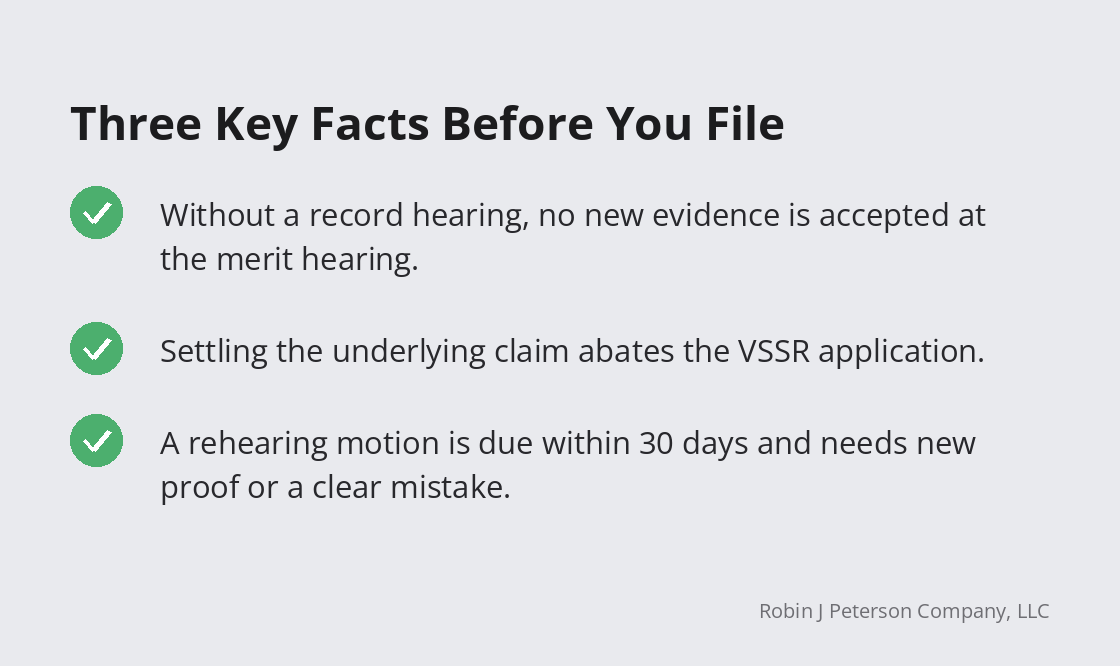
Unless a staff hearing officer directs otherwise, the application is then scheduled for a prehearing conference, with written notice at least fourteen days in advance. The conference addresses practical matters such as whether everyone has received the evidence, whether either side has requested a record hearing, and whether subpoenas are pending. The case then proceeds to a merit hearing before a staff hearing officer. One rule surprises many people: if no one requests a record hearing, no new documentary evidence or testimony will be accepted at the hearing on the merits. A request for a record hearing must be made between the filing of the application and the date of the prehearing conference.
Rehearing After the Decision
After the staff hearing officer issues an order, either party may file a motion for rehearing within thirty days of receiving it. Rule 4121-3-20(E) limits rehearing to motions supported by new and additional proof that could not have been obtained earlier with due diligence, or to exceptional cases where the order was based on an obvious mistake of fact or a clear mistake of law. A motion that does not meet these standards is denied without further hearing, and the rule states that no rehearing may be granted from an order adjudicating a rehearing.
Mistakes That Can Derail a VSSR Claim
Because VSSR claims follow their own rules, ordinary assumptions about workers’ comp can lead injured workers astray. The most common problems involve timing, vague applications, and decisions in the underlying claim that unexpectedly affect the VSSR application.
Waiting Too Long to File
Many injured workers spend the first months after an accident focused on medical care, and that is understandable. The one-year deadline for claims arising on or after September 15, 2020, however, keeps running during treatment and recovery. A worker who assumes there is plenty of time can lose the right to an additional award entirely. Preserving photographs, the names of coworkers who saw the accident, and information about the equipment involved early on also makes it easier to file a complete application within the deadline.
Failing to Cite the Right Safety Rule
An application that simply says the workplace was dangerous does not meet the rule’s requirement to cite the specific section of the law or safety code that was violated. Identifying the correct requirement often takes careful review of the Ohio Administrative Code chapters that apply to the type of workplace and equipment involved. The rule allows certain amendments within limited periods, but an amendment may not raise a previously unstated claim, so getting the application right the first time matters.
Settling the Underlying Claim Without Considering the VSSR
Rule 4121-3-20(A) states that settlement of the underlying claim from which a VSSR application has been or may be filed abates any action on that application. In plain terms, resolving the main workers’ comp claim can end a pending or future VSSR application. Before agreeing to resolve the underlying claim, an injured worker who has a potential VSSR claim should understand exactly how the two interact. The same rule also recognizes that an employer intentional tort case in court is a separate path, and it allows the commission to hold the VSSR application in abeyance in some circumstances if all parties agree.
Final Thoughts
A violation of a specific safety requirement claim in Ohio gives injured workers a way to hold an employer accountable within the workers’ comp system when a specific safety rule was ignored and that failure caused the injury. The process is governed by the Ohio Constitution, Revised Code Section 4121.47, and Administrative Code Rule 4121-3-20, and it includes a short filing deadline, an investigation, a prehearing conference, and limited rehearing rights.
If your injury involved missing guards, unsafe scaffolds, defective ladders, or other equipment covered by Ohio’s safety codes, it is worth looking closely at whether a VSSR application belongs in your case. Acting early protects your evidence and your deadline.
If you were hurt at work and believe a safety rule was violated, contact Robin J Peterson Company, LLC to speak with our team about your options. We will review your claim, the safety requirements that apply, and help you take the next step with confidence.