
An amputation at work changes everything at once. A press, saw, conveyor, or piece of heavy equipment can take a finger, a hand, or part of a foot in a single moment, and the recovery that follows involves surgery, rehabilitation, new routines, and often a prosthetic device. Ohio’s workers’ compensation system recognizes that these losses are permanent, and it treats them differently from injuries that heal over time. Understanding how Ohio workers’ comp handles an amputation gives you real control over the benefits you are entitled to receive.
At Robin J Peterson Company, LLC, we help injured workers across Cleveland, Akron, Canton, and Independence protect their Ohio workers’ compensation rights so you can move forward with confidence. This guide explains how scheduled loss awards actually work, how loss of use is treated, what other benefits may apply alongside an award, and the mistakes that most often weaken an amputation claim.
How Ohio Workers’ Comp Actually Treats an Amputation
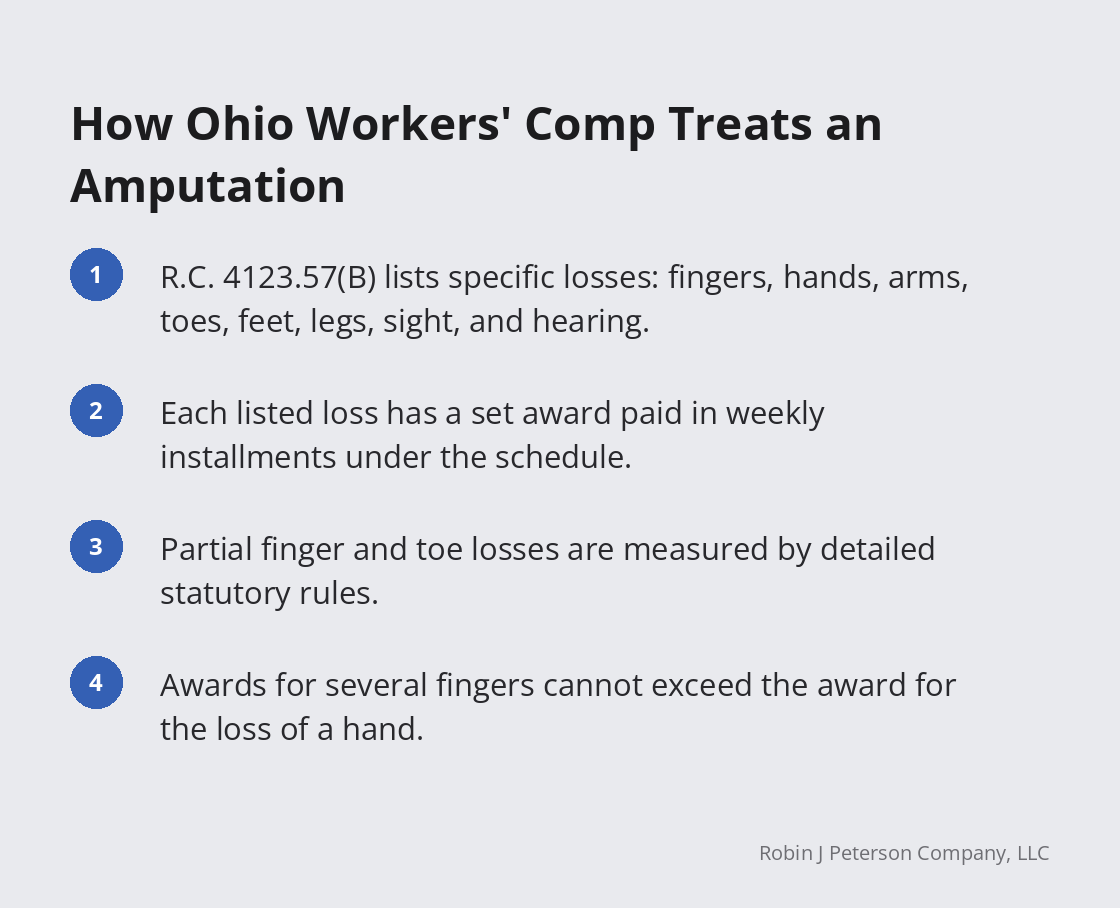
Most workers’ compensation benefits are tied to how long you are unable to work or to the medical treatment you need. An amputation adds another layer. Ohio Revised Code Section 4123.57(B) sets out a schedule of specific losses, covering fingers, thumbs, hands, arms, toes, feet, legs, the sight of an eye, and hearing. When a work injury results in one of these listed losses, the statute provides a set award for that body part rather than requiring you to prove a percentage of overall impairment the way a general permanent partial disability claim does.
What a Scheduled Loss Award Is
A scheduled loss award compensates you for the permanent loss itself. The statute assigns each listed body part a fixed period of compensation, and the award is paid in weekly installments according to that schedule. Section 4123.57(B) also provides that compensation paid in weekly installments under the schedule may only be commuted to one or more lump sum payments through the procedure in Section 4123.64. Because the schedule is written into the statute, the key questions in most claims are which body part was lost and how much of it was lost, not whether you can still perform a particular job.
How Partial Finger and Toe Losses Are Measured
The statute goes into detail for partial losses. For example, the loss of the distal phalange of the thumb is considered equal to the loss of one half of the thumb, and the loss of more than one half of the thumb is considered equal to the loss of the whole thumb. The loss of the distal phalange of any finger is considered equal to the loss of one third of the finger, and the loss of more than the middle and distal phalanges is considered equal to the loss of the whole finger. Toes have their own rules, including a provision that the loss of more than two thirds of any toe is considered equal to the loss of the whole toe. Section 4123.57(B) also allows additional compensation when the metacarpal bone of the palm is lost along with the corresponding thumb or finger.
When Several Fingers Are Lost
Losing more than one finger is not treated as simple addition. The statute provides that the amount received for more than one finger cannot exceed the amount provided for the loss of a hand. At the same time, if you lost two or more fingers by amputation or ankylosis and the nature of your job makes the resulting impairment greater than normal, the administrator may take that into consideration and increase the award, though not beyond the award for the loss of a hand. Describing exactly how you used your hands at work can matter when this provision applies.
Loss of Use and the Other Benefits That May Apply
A scheduled loss does not always require a physical amputation. Ohio law also recognizes situations where a body part is still present but no longer functions. In addition, a scheduled loss award does not replace your other workers’ compensation benefits. Knowing how these pieces fit together helps you avoid leaving benefits unclaimed.
Ankylosis, Contractures, and Loss of Use
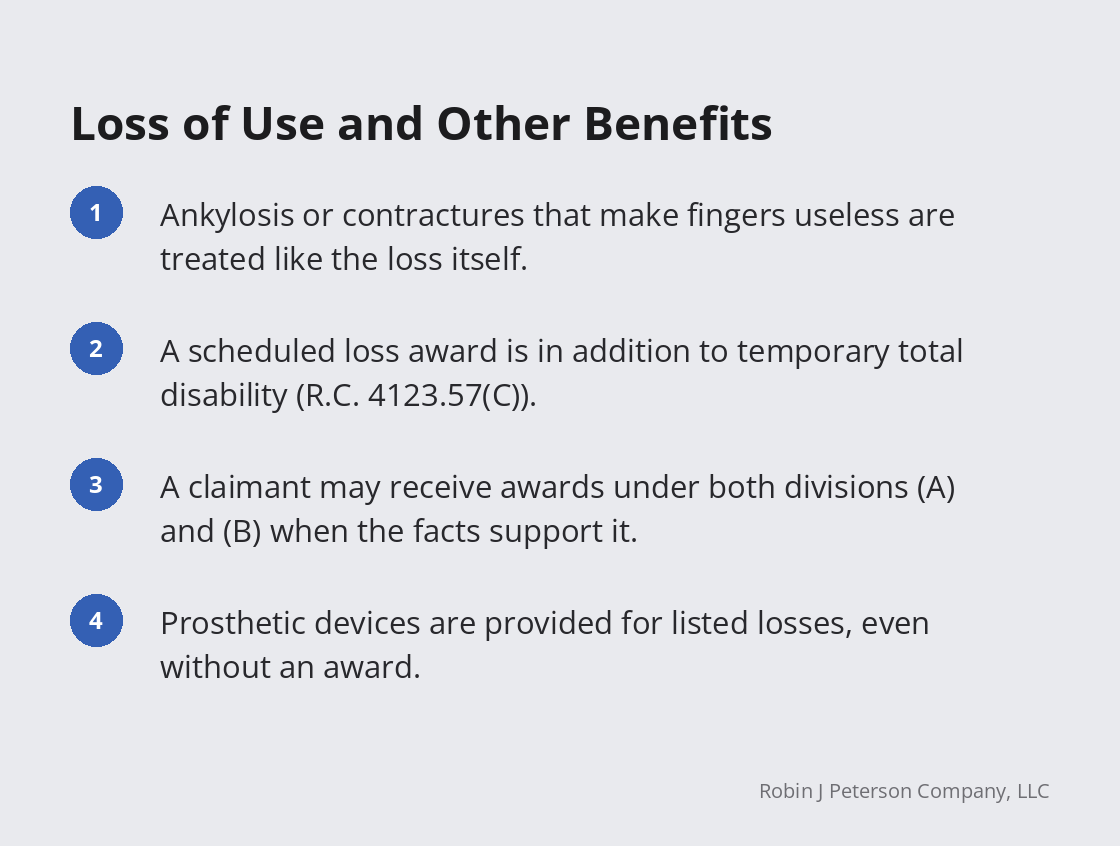
Section 4123.57(B) states that for ankylosis, meaning total stiffness, or contractures due to scars or injuries that make any fingers, thumbs, or parts of either useless, the same schedule applies as for the loss of those parts. In practical terms, a finger that is frozen in place or so damaged that it cannot be used may be treated like a finger that was amputated. These claims depend heavily on medical documentation that clearly describes the condition and the loss of function, so the records from your treating providers carry real weight.
Wage Loss and Temporary Disability Alongside an Award
Section 4123.57(C) provides that compensation for partial impairment under divisions (A) and (B) is in addition to the compensation paid under Section 4123.56, which covers temporary total disability. That means a scheduled loss award does not cancel your right to benefits for the period when you cannot work while recovering. The same subsection states that a claimant may receive compensation under both division (A), which covers percentage-based permanent partial disability, and division (B), the scheduled loss provision, when the facts support both.
Prosthetic Devices and Repairs
For many amputation survivors, a prosthetic device is essential to returning to daily life and work. Section 4123.57(C) directs the administrator to provide for the purchase, repair, or replacement of a prosthetic device when a claimant has sustained an amputation or a loss listed in the schedule, even if no scheduled loss award has been made. The statute also lists who may determine that an artificial appliance is needed, including an amputee clinic or a prescribing provider approved by the administrator. Keeping your prosthetist and treating physician involved in the claim helps make sure your needs are documented as they change.
Mistakes That Weaken Ohio Amputation Claims
Amputation claims can seem straightforward because the injury is so visible, but problems still arise. Claims are delayed by incomplete paperwork, awards are limited because the full extent of the loss was not documented, and related conditions are never added to the claim. Avoiding a few common mistakes protects the full range of benefits available to you.
Missing the One-Year Filing Requirement
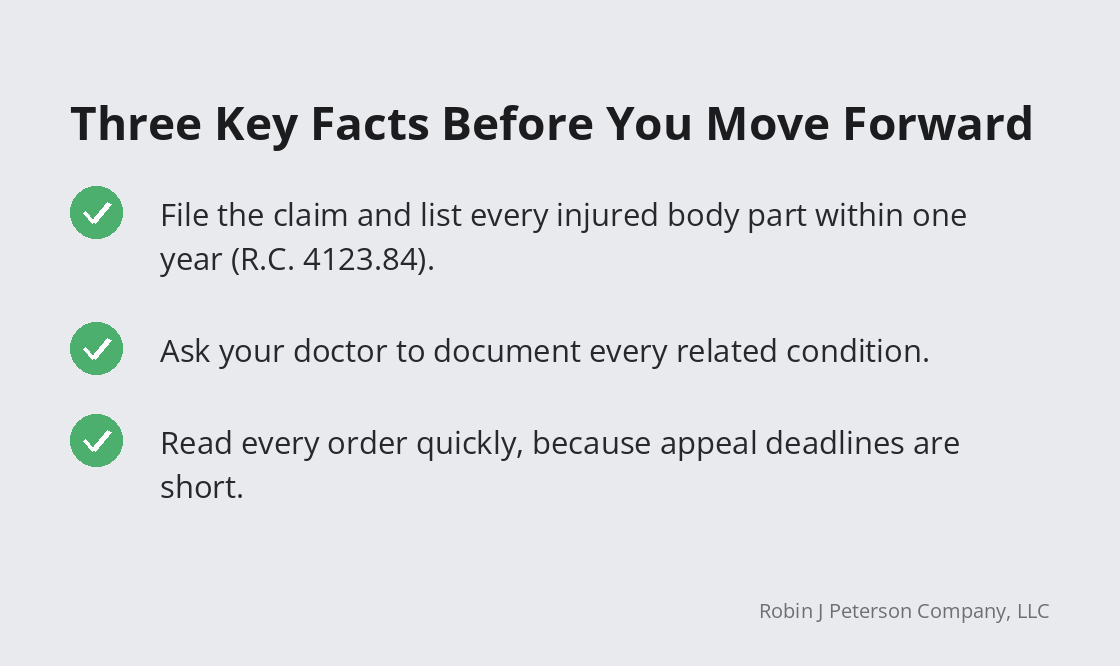
Ohio Revised Code Section 4123.84(A) provides that claims for compensation or benefits for the specific part or parts of the body injured are forever barred unless certain steps happen within one year after the injury, such as written notice of the specific body parts injured being made to the Industrial Commission or the Bureau of Workers’ Compensation. Even when an employer knows about a serious injury, you should make sure a claim is actually filed and that every injured body part is listed. Our guide to keeping your BWC claim active explains other time limits that can affect a claim later on.
Leaving Related Conditions Out of the Claim
An amputation often comes with other injuries and conditions, such as nerve damage, infections, phantom limb pain, or injuries to other parts of the hand or arm. If these conditions are not formally recognized in your claim, treatment and benefits for them may be denied. Review the allowed conditions in your claim carefully and ask your treating physician to document every condition connected to the injury so that the claim reflects the full picture.
Not Contesting an Incomplete Decision
Sometimes the bureau’s decision does not match the medical evidence, such as an award for part of a finger when the records show a larger loss. Under Section 4123.511, when an administrator’s order is timely appealed, the Industrial Commission refers the matter to a district hearing officer. Appeal deadlines are short, so read every order as soon as it arrives. Our guide to Ohio Industrial Commission hearings explains what to expect if your case goes to a hearing.
Final Thoughts
Ohio workers’ comp treats an amputation as a permanent loss with its own schedule under Section 4123.57(B), along with detailed rules for partial losses, multiple fingers, and loss of use through ankylosis or contractures. Section 4123.57(C) makes clear that a scheduled loss award is in addition to temporary total disability compensation and that prosthetic devices are provided for listed losses, while Section 4123.84 requires that a claim be filed within one year.
Focus on your recovery, but keep copies of your surgical and therapy records, make sure every injured body part is listed in your claim, and respond quickly to every order you receive.
If you suffered an amputation or the loss of use of a hand, foot, finger, or toe at work, contact Robin J Peterson Company, LLC to speak with our workers’ compensation team. We will review your medical records and your claim, explain your rights under Ohio law, and help you take the next step with confidence.