
Psychological injury in Ohio workers’ comp is one of the least understood parts of the system. A serious workplace accident can leave lasting effects that go well beyond a broken bone or a surgical scar. Many injured workers develop depression, anxiety, or post-traumatic symptoms after a fall, a crush injury, or a long and painful recovery, yet they are never told whether those conditions can become part of their claim. Ohio law answers that question with a specific set of rules, and understanding them gives you real control over your benefits and your treatment.
At Robin J Peterson Company, LLC, we help injured workers across Cleveland, Akron, Canton, and Independence protect their Ohio workers’ compensation rights, including when a work injury affects their mental health. This guide explains how Ohio workers’ comp actually treats psychological conditions, how to add one to an existing claim, and the mistakes that most often derail these requests, so you can move forward with confidence.
How Ohio Workers’ Comp Actually Treats Psychological Conditions
Ohio does not cover every mental health condition that a worker experiences on the job. Instead, the Ohio Revised Code ties coverage for psychological conditions to specific circumstances. Knowing where those lines fall is the first step in deciding whether, and how, to pursue an additional allowance.
The Statutory Definition of Injury
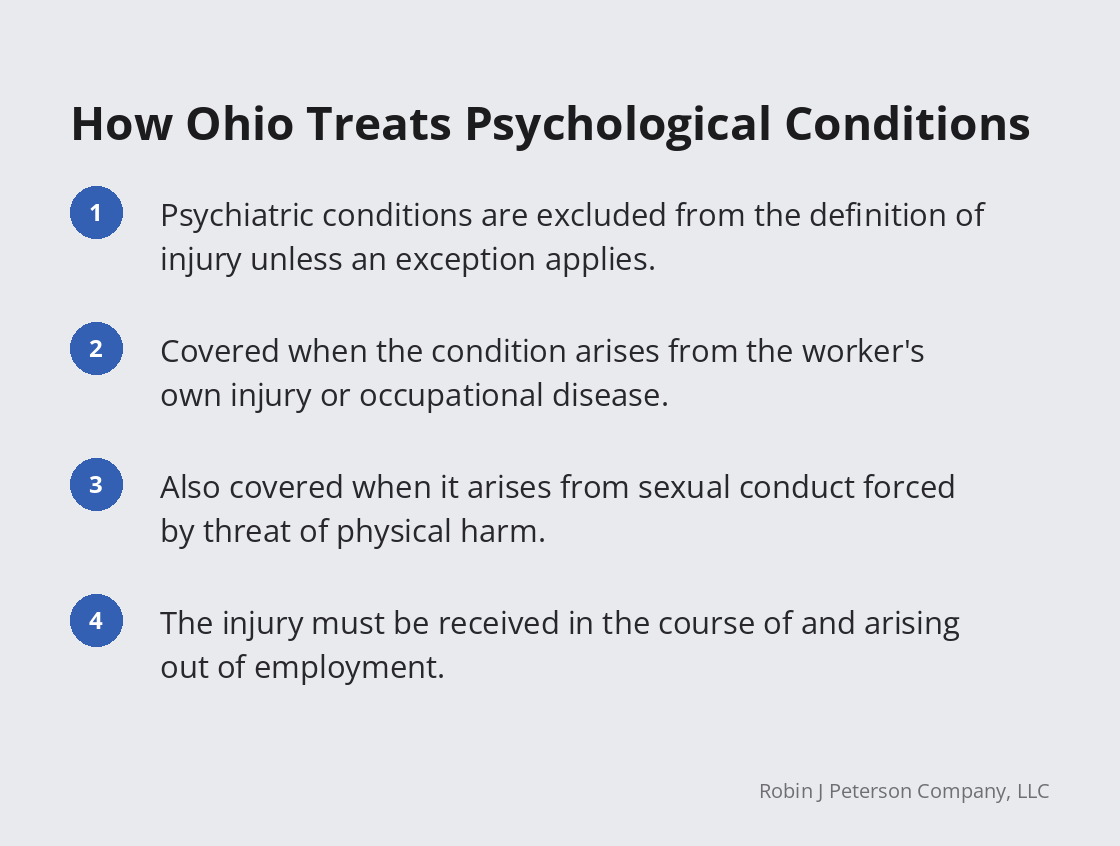
Ohio Revised Code Section 4123.01(C) defines an injury as any injury, whether caused by external accidental means or accidental in character and result, received in the course of, and arising out of, the injured employee’s employment. That broad definition is followed by a list of conditions that the law does not treat as an injury. Psychiatric conditions appear first on that list, which is why a mental health claim in Ohio almost always depends on an exception rather than on the general rule. The same section also addresses pre-existing conditions, which we discuss in our guide to pre-existing conditions and Ohio workers’ comp.
The Physical Injury Requirement
Under Section 4123.01(C)(1), the term injury does not include psychiatric conditions except where the claimant’s psychiatric conditions have arisen from an injury or occupational disease sustained by that claimant. In practice, this means that a psychological condition is usually recognized in Ohio when it grows out of the worker’s own physical injury or occupational disease. A worker who develops major depression after a disabling back injury, or anxiety that follows a traumatic amputation, may be able to show the required connection. The focus is on the link between the allowed physical injury or disease and the mental health condition, so medical documentation of that link is essential.
The Forced Sexual Conduct Exception
The statute contains a second exception. Section 4123.01(C)(1) also allows coverage where the claimant’s psychiatric conditions have arisen from sexual conduct in which the claimant was forced by threat of physical harm to engage or participate. This exception recognizes that some of the most serious workplace harms leave psychological injuries that may not be accompanied by a separate physical injury. Workers in this situation should know that the law specifically addresses their circumstances and that the claim must still meet the statute’s requirements, including that the injury was received in the course of and arising out of employment.
How to Add a Psychological Condition to Your Claim
Most psychological conditions enter an Ohio workers’ comp claim as an additional allowance, meaning a condition added after the original claim has been allowed for physical injuries. The Ohio Bureau of Workers’ Compensation (BWC) and the Industrial Commission follow specific procedures for these requests, and missing a step can lead to dismissal.
Filing a C-86 Motion With Your Signed Statement
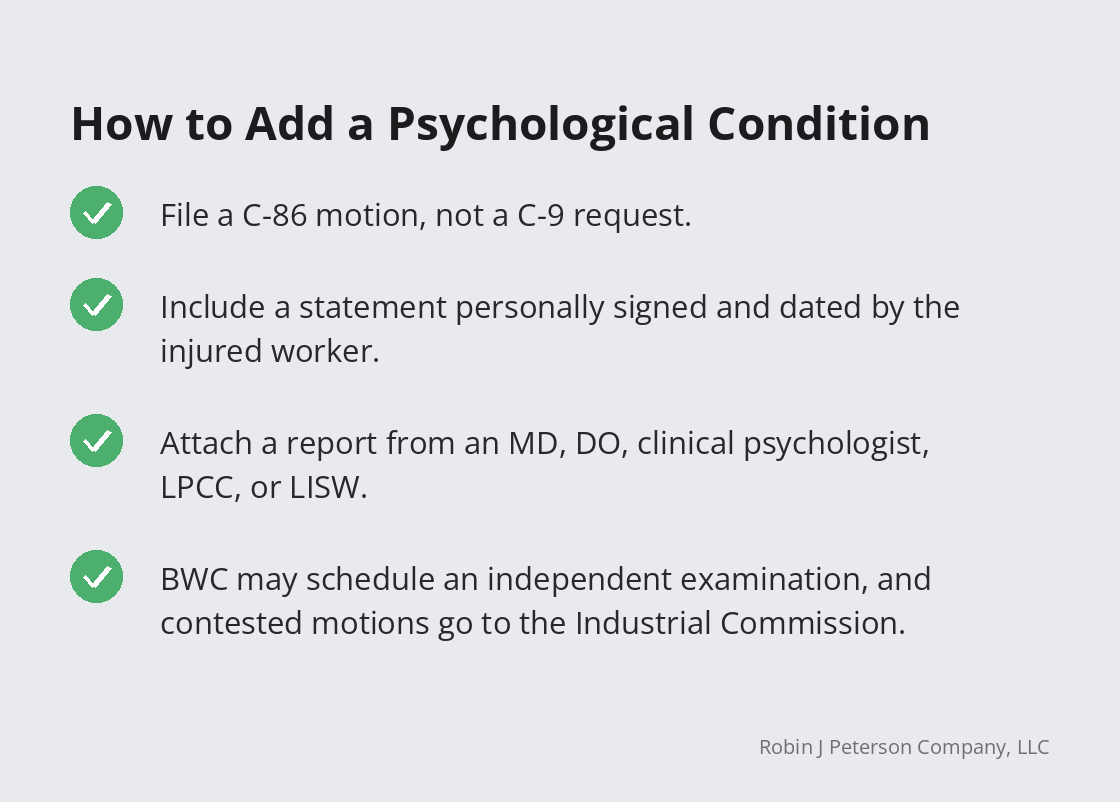
BWC’s Additional Allowance policy states that BWC will not address a recommendation for the additional allowance of a psychological or psychiatric condition on a C-9, the form doctors commonly use to request treatment. Instead, BWC requires that a C-86 motion be filed with a declaration statement signed and dated by the injured worker. Ohio Administrative Code Rule 4123-3-16(I)(1) requires the motion to include a statement, personally signed and dated by the claimant, acknowledging that the claimant is aware the motion is being filed to request recognition of a psychiatric or psychological condition as a result of the allowed injury. The C-86 form itself contains that acknowledgment and a signature line for the injured worker.
Supporting Medical Evidence
A signed motion is not enough on its own. Under Rule 4123-3-16(I)(2), a motion requesting recognition of an additional psychiatric or psychological condition must be accompanied by supporting evidence consisting of a report by a doctor of medicine, a doctor of osteopathic medicine, a clinical psychologist, a licensed professional clinical counselor, or a licensed independent social worker. The strongest reports clearly identify the diagnosis, describe the worker’s history, and explain how the condition arose from the allowed injury. A vague note that a worker seems stressed is unlikely to carry the request.
Independent Examinations and Hearings
Rule 4123-3-16(I)(3) provides that BWC may schedule the claimant for an examination by an independent examiner. If the claimant fails to comply with BWC’s requests relating to the motion, Rule 4123-3-16(I)(4) states that BWC will refer the motion to the Industrial Commission with a recommendation to dismiss it. When there is no conflict in the evidence and the motion is not contested, BWC will decide the motion. When the evidence conflicts or the motion is contested, BWC refers it to the Industrial Commission for further consideration, which often means a hearing like those described in our guide to the Ohio Industrial Commission hearing process. Separately, Ohio Revised Code Section 4123.651 allows an employer to require one examination by a physician or another listed practitioner of its choice.
Mistakes That Can Derail a Psychological Condition Claim
Psychological condition requests are often contested, and small missteps can give the employer or BWC a reason to deny them. Avoiding the most common problems helps keep your request on solid ground.
Assuming Workplace Stress Alone Is Enough
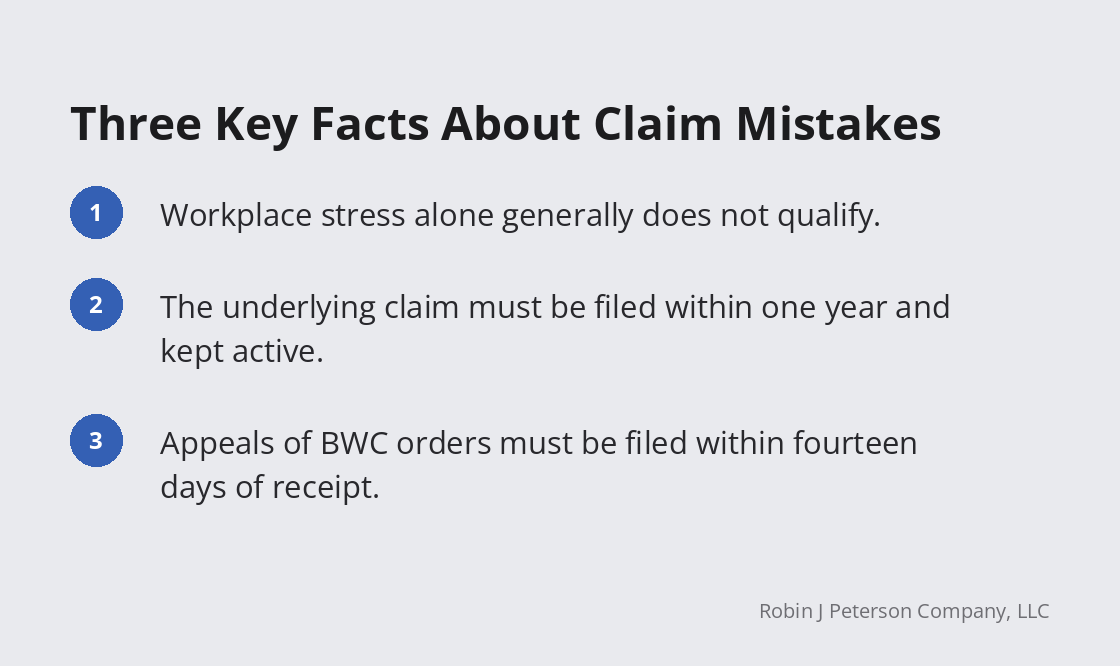
Many workers assume that any stress, burnout, or conflict on the job can support a claim. Because Section 4123.01(C)(1) excludes psychiatric conditions except in the circumstances it lists, mental health conditions that do not arise from the worker’s own injury or occupational disease, or from forced sexual conduct as described in the statute, generally fall outside Ohio workers’ compensation. Understanding this limit early helps you focus on the evidence that matters, which is usually the connection between your allowed physical injury and the condition you are experiencing now.
Waiting Too Long to Act
Under Ohio Revised Code Section 4123.84, claims for compensation or benefits for the specific parts of the body injured are forever barred unless, within one year after the injury, written notice of those parts of the body has been made to the Industrial Commission or BWC, or another event listed in the statute has occurred. A psychological condition is requested within an allowed claim, so the underlying claim must be filed on time and kept active. Our guide to Ohio workers’ comp claim expiration explains why an inactive claim can create problems. Waiting also makes it harder for a treating provider to connect symptoms to the injury.
Missing Appeal Deadlines
If BWC or the Industrial Commission denies a psychological condition, the time to respond is short. Under Ohio Revised Code Section 4123.511, the employer or claimant may appeal a BWC order within fourteen days after the date of receipt of the order, and appeals from later hearing officer orders generally carry fourteen-day deadlines as well. A missed deadline can leave a denial in place even when the medical evidence supports the condition, so it is important to read every order as soon as it arrives.
Leaving Gaps in Treatment Records
Mental health conditions are often challenged on the theory that they came from something other than the work injury. Consistent treatment, honest reporting of symptoms to every provider, and records that describe how the injury has affected your daily life all help show the connection. Gaps in care, or records that never mention the injury, can give the other side room to argue that the condition is unrelated.
Final Thoughts
Psychological injury in Ohio workers’ comp is covered only in specific situations, most often when a psychiatric condition arises from the worker’s own physical injury or occupational disease. Adding that condition requires a C-86 motion with the worker’s signed statement, supporting evidence from a qualified provider, and cooperation with any examination BWC schedules. Contested requests move to the Industrial Commission for a decision.
The steps you take now, including seeking treatment, keeping your claim active, documenting the link between your injury and your symptoms, and responding to orders within the deadlines, have a direct effect on whether the condition is recognized. Careful preparation helps the decision-maker see the full impact of your injury.
If a work injury has affected your mental health, contact Robin J Peterson Company, LLC to speak with our team. We’ll review your claim, explain your options under Ohio law, and help you take the next step with confidence.