
A drug test after a workplace injury in Ohio can feel like an accusation, even when you did nothing wrong. Many injured workers are asked to provide a sample in the emergency room or at a clinic within hours of getting hurt, and few understand how the results can affect a workers’ compensation claim. Ohio law sets out a specific framework for when a test can be used against you, what the employer must do first, and how you can respond. Knowing that framework gives you real control over your claim from the very first day.
At Robin J Peterson Company, LLC, we help injured workers across Cleveland, Akron, Canton, and Independence protect their Ohio workers’ compensation rights when an employer or the Ohio Bureau of Workers’ Compensation (BWC) raises drug or alcohol questions. This guide explains how the intoxication presumption actually works, which tests qualify under the statute, and the mistakes that most often hurt these claims, so you can move forward with confidence.
How the Ohio Intoxication Presumption Actually Works
Ohio’s workers’ compensation law starts from a broad rule: injured employees are entitled to compensation and medical benefits for injuries connected to their work, subject to a short list of exceptions. The legislature carved out one of those exceptions for injuries caused by intoxication or drug use. Understanding exactly where that exception begins and ends is the first step in protecting a claim that involves a post-injury test.
The Statutory Exclusion for Intoxication
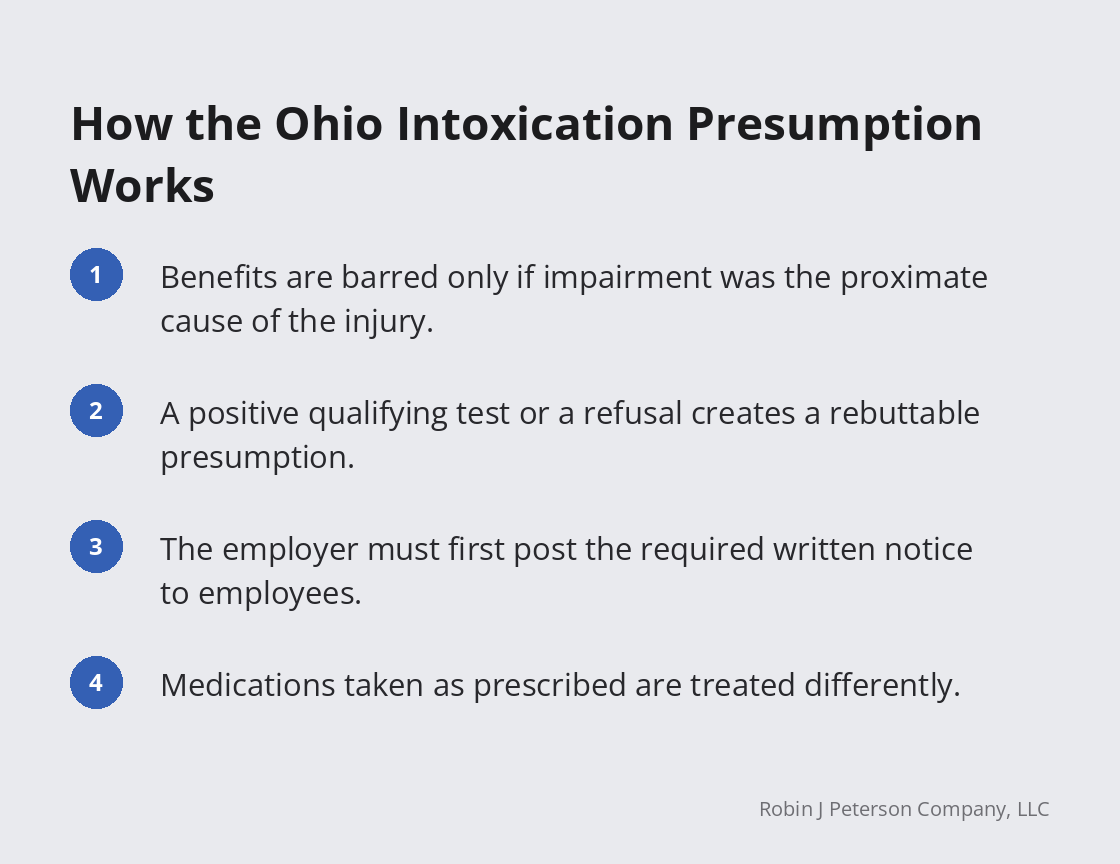
Ohio Revised Code (ORC) 4123.54(A) sets out the general right to compensation and medical benefits and then lists the exceptions. Under ORC 4123.54(A)(2), an employee is not entitled to compensation or benefits if the injury was caused by the employee being intoxicated, under the influence of a controlled substance not prescribed by an authorized medical provider, or under the influence of marihuana, and that condition was the proximate cause of the injury. The word “proximate” matters. The statute does not bar a claim simply because a substance was present. The question is whether being impaired actually caused the injury.
What a Rebuttable Presumption Means
ORC 4123.54(B) creates a rebuttable presumption that an employee was intoxicated or under the influence, and that this was the proximate cause of the injury, when certain test results or a test refusal exist. A presumption shifts the starting point of the case. Instead of the employer proving impairment caused the injury, the injured worker is expected to come forward with evidence that overcomes the presumption. Because the statute calls the presumption rebuttable, it is not the end of the claim. Medical records, witness statements, and evidence about how the accident happened can all be used to show that something other than a substance caused the injury.
The Posted Notice Requirement
The presumption does not apply automatically. ORC 4123.54(B) makes it available only if the employer has posted written notice to employees that the results of, or a refusal to submit to, a chemical test may affect the employee’s eligibility for compensation and benefits. Under ORC 4123.54(F), that notice must be the same size or larger than the proof of workers’ compensation coverage furnished by the BWC, and it must be posted in the same location as the proof of coverage or the certificate of self-insurance. The statute also allows an employer to post the notice on the internet in a way that employees can access. Whether your employer met this requirement is one of the first questions to ask.
Prescribed Medications Are Treated Differently
The statute focuses on controlled substances that were not prescribed for the employee by a physician or certain other licensed prescribers named in the law. If you were taking a medication exactly as your own doctor prescribed, that medication is treated differently from a substance taken without a prescription. Keep a current list of your prescriptions and the prescribing provider, because that documentation can become important evidence if a test result is questioned.
Which Drug and Alcohol Tests Count Under Ohio Law
Not every test can trigger the presumption. ORC 4123.54 sets timing rules, threshold rules, and rules about who may request the test. A test that falls outside those rules is not a qualifying chemical test for purposes of the presumption, even if the result looks unfavorable at first glance.
Timing Windows After an Injury
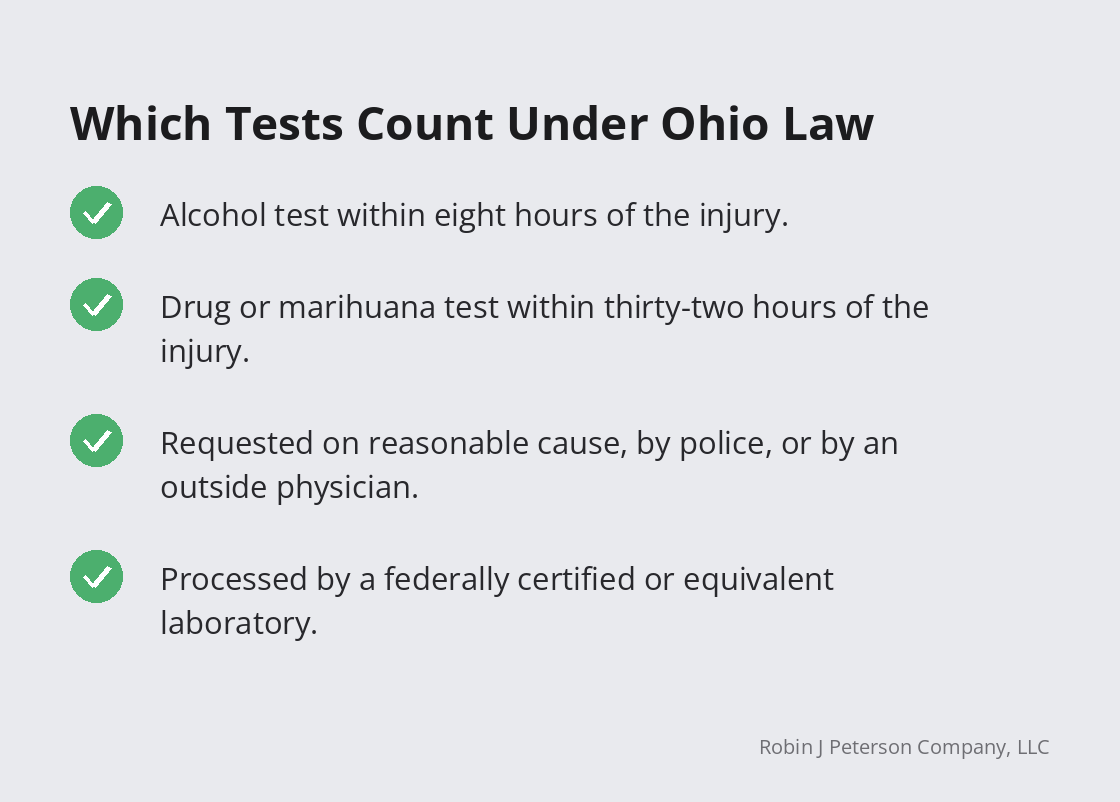
Under ORC 4123.54(B)(1)(a), the presumption can arise when a qualifying chemical test administered within eight hours of an injury shows an alcohol concentration at or above the levels set in the Ohio operating-a-vehicle-impaired statute, ORC 4511.19. Under ORC 4123.54(B)(1)(b), it can arise when a qualifying test administered within thirty-two hours of an injury shows a non-prescribed controlled substance or marihuana at or above the federal cutoff concentration levels in 49 C.F.R. 40.85. Division (B)(1)(c) adds a similar rule for barbiturates, benzodiazepines, or methadone above levels established by federally certified laboratories. If a test was taken outside these windows, the presumption does not apply.
Who Can Request a Qualifying Test
ORC 4123.54(C)(1) lists the situations in which a post-injury test is a qualifying chemical test. The first is when the employer had reasonable cause to suspect that the employee may have been intoxicated or under the influence. The second is when a police officer requests the test under ORC 4511.191, and not at the employer’s request. The third is when a licensed physician or certain other licensed providers who are not employed by the employer request the test, again not at the employer’s request. A test that does not fit one of these categories does not create the presumption.
What Reasonable Cause Requires
ORC 4123.54(C)(2) explains that reasonable cause means evidence drawn from specific, objective facts and reasonable inferences from those facts. The statute gives examples, including direct observation of use or possession, physical symptoms such as slurred speech, dilated pupils, or the odor of alcohol or marihuana, a pattern of abnormal conduct or deteriorating work performance that appears related to substance use, a report from a reliable and credible source, and repeated or flagrant safety violations that appear related to substance use. A general policy of testing everyone after every accident is a different question from whether reasonable cause existed in your specific case.
Laboratory Standards for Test Results
ORC 4123.54(E) requires that qualifying test results be processed by laboratories certified by the United States Department of Health and Human Services, or by laboratories that meet or exceed that department’s certification standards. Asking which laboratory handled your sample, and requesting the paperwork that tracked it, can reveal problems with how a result was produced.
Mistakes That Hurt Workers Facing a Drug Test Issue
Most claims that involve a post-injury test are won or lost on details. Injured workers often make decisions in the first few days that are hard to undo later, usually because they assume a test result or a refusal automatically ends the claim. Avoiding the following mistakes keeps your options open.
Refusing a Test Without Understanding the Consequences
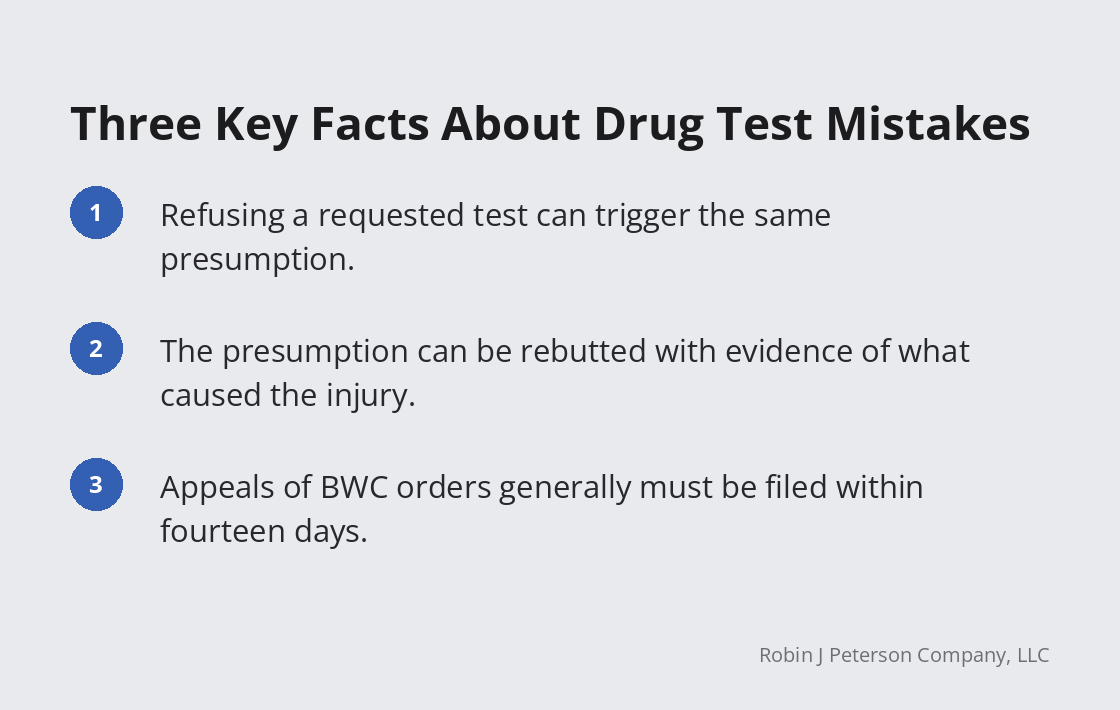
Under ORC 4123.54(B)(2), refusing a requested chemical test can also trigger the presumption, provided the employee is or was given notice that a refusal may affect eligibility for compensation and benefits. Some workers refuse because they are in pain, confused, or worried about privacy, and they do not realize the refusal can be treated much like a positive result. If you have concerns about a test request, write down who asked, when, and why, and talk with a workers’ compensation attorney as soon as you can.
Assuming a Positive Result Ends the Claim
A positive test is evidence, not a final decision. The presumption is rebuttable, and the statutory exclusion requires that impairment was the proximate cause of the injury. Equipment failures, unsafe conditions, another person’s conduct, or a hazard that would have injured anyone in your position can all be part of the evidence that a substance did not cause the accident. Ohio’s workers’ compensation statutes are also to be liberally construed in favor of employees under ORC 4123.95.
Missing Appeal Deadlines
If the BWC or an Industrial Commission hearing officer issues an order denying your claim, the clock starts running quickly. Under ORC 4123.511, appeals from these orders generally must be filed within fourteen days after receipt of the order. Waiting to see what happens can forfeit your chance to present evidence that rebuts the presumption. Our guide to the Ohio Industrial Commission hearing process explains what happens once an appeal is filed.
Final Thoughts
A drug test after a workplace injury in Ohio does not decide your claim on its own. The intoxication presumption applies only when the employer posted the required notice, the test was a qualifying chemical test, the timing and threshold rules were met, and the presumption is not rebutted with evidence about what really caused the injury. Each of those steps is a place where a claim can be defended.
The most important things you can do are to keep records of your prescriptions, write down the details of any test request, preserve evidence about how the accident happened, and act quickly on any order you receive. Those steps give you the strongest footing if your employer or the BWC raises intoxication as a defense.
If you were injured on the job and a drug or alcohol test is being used to challenge your benefits, contact Robin J Peterson Company, LLC to speak with our workers’ compensation team in Northeast Ohio. We’ll review the test, the notice, and the facts of your injury and help you take the next step with confidence.