
A work from home injury in Ohio raises questions that many remote employees never thought about until something went wrong. You may have tripped while carrying company equipment down your stairs, or been hurt while handling a task your employer assigned from your home office. Ohio’s workers’ compensation law does cover some of these injuries, but it applies a specific test to injuries that happen in a home work area. Understanding that test gives you real control over whether and how to pursue a claim.
At Robin J Peterson Company, LLC, we help injured workers across Cleveland, Akron, Canton, and Independence protect their Ohio workers’ compensation rights from the first report of injury through every step that follows. This guide explains how Ohio law treats injuries in a home work area, how to report and document a remote work injury with the Ohio Bureau of Workers’ Compensation (BWC), and the mistakes that most often weaken these claims, so you can move forward with confidence.
How Ohio Law Treats a Work From Home Injury
Remote work has changed where many Ohioans do their jobs, and the law has changed with it. The starting point is the same as for any workplace injury, but Ohio added a separate rule for injuries that happen in a work area inside an employee’s home. Knowing both parts of the analysis helps you see where your situation fits.
The General Rule for Workplace Injuries
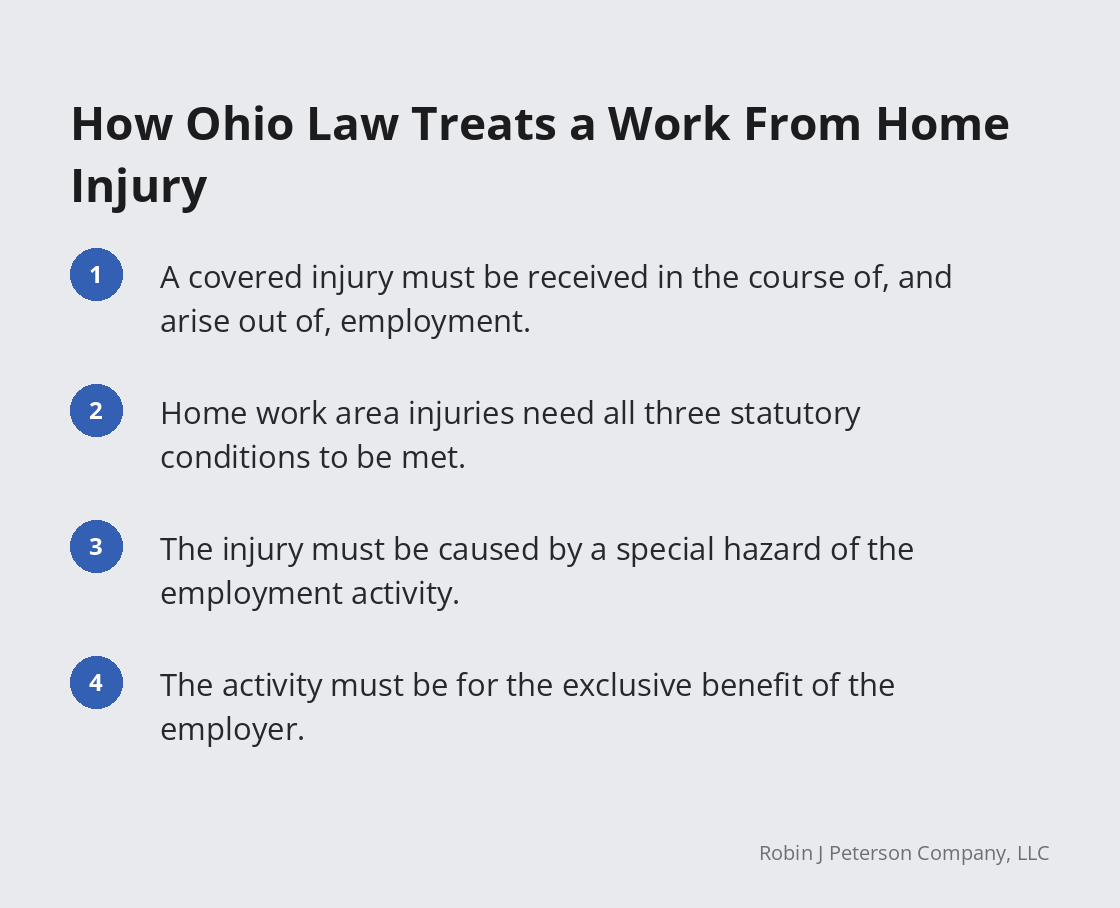
Under Ohio Revised Code (ORC) 4123.01(C), an “injury” for workers’ compensation purposes includes any injury, whether caused by external accidental means or accidental in character and result, received in the course of, and arising out of, the injured employee’s employment. In plain terms, the injury must happen while you are doing your job, and it must be connected to the work itself. This two-part idea applies to every claim, whether you work on a factory floor, at a construction site, or at a kitchen table.
The Home Work Area Rule
ORC 4123.01(C)(4) adds a specific limit for remote workers. It says an injury does not include an injury or disability sustained by an employee who performs job duties in a work area located within the employee’s home that is separate and distinct from the location of the employer, unless all of the following apply. First, the injury must arise out of the employee’s employment. Second, it must be caused by a special hazard of the employee’s employment activity. Third, it must be sustained in the course of an activity undertaken by the employee for the exclusive benefit of the employer. Because the statute says all three must apply, missing even one can defeat a claim.
The phrase “separate and distinct from the location of the employer” matters, too. By its terms, the rule applies to a work area in the home that is a different place from the employer’s location. That is why remote employees should think carefully about where the injury happened, what they were doing at that moment, and how the activity connected to the job. Two injuries that happen in the same house on the same day can lead to very different results depending on those details.
When the Rule Took Effect
The home work area language is part of the current version of ORC 4123.01, which became effective on September 23, 2022, through House Bill 447 of the 134th General Assembly. Injuries that occur in a home work area today are measured against this standard. If you are unsure whether an older injury falls under a prior version of the law, that question is worth raising early, because the answer depends on dates and the specific facts of the claim.
Reporting a Remote Work Injury to Ohio BWC
Reporting a home-based injury follows the same basic path as any other Ohio workers’ compensation claim. What changes is the level of detail you will want to capture, because the person reviewing your claim was not there and has no coworkers to ask.
Telling Your Employer Right Away
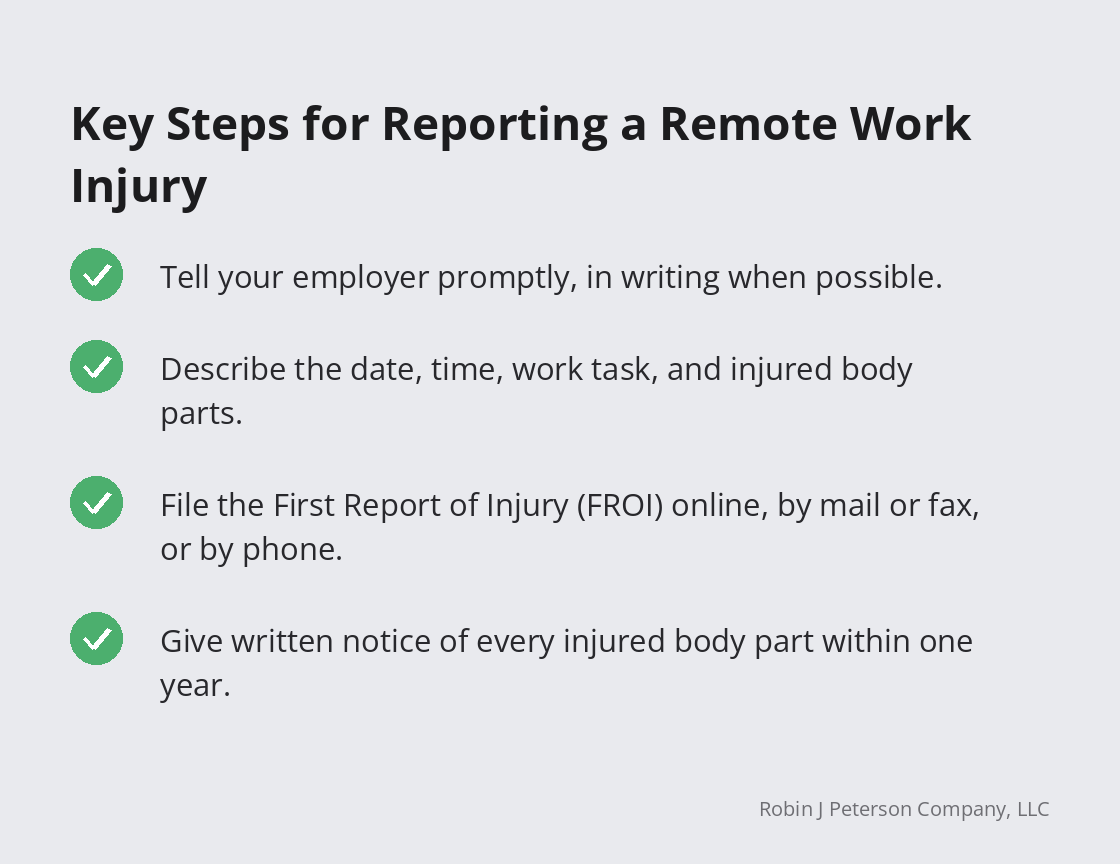
When you work alone at home, your employer learns about an injury only if you tell them. Letting a supervisor or human resources contact know promptly, and in writing when possible, creates a clear record of when and how the injury happened. A short message describing the date, the time, what you were doing for work, and which body parts were hurt can become one of the most useful documents in your file. Prompt notice also helps answer questions later about whether the activity was truly for your employer’s benefit. If it is safe to do so, photos of the area where you were hurt, such as a staircase, a cord, or equipment your employer provided, can help show the conditions that caused the injury. Keeping copies of any messages or assignments that show what task you were working on adds further support.
Filing the First Report of Injury
BWC explains that injured workers who are hurt on the job can file a claim, and that employers, medical providers, and authorized representatives can also file. The claim starts with the First Report of an Injury, Occupational Disease or Death, known as the FROI, which BWC accepts online, by mail or fax, or by phone. The form asks for details of the injury, including the date, time, location, and a description. BWC also notes that if you work for a self-insuring employer, the form goes to your employer’s workers’ compensation manager instead.
Meeting the One-Year Deadline
Time matters. Under ORC 4123.84, claims for compensation or benefits for the specific part or parts of the body injured are forever barred unless, within one year after the injury, written notice of those body parts is made to the Industrial Commission or BWC, or another event listed in the statute occurs. BWC’s own guidance likewise states that a claimant must file a notice of injury with BWC or the Industrial Commission within one year of the injury. Listing every injured body part in that notice helps protect your claim.
Mistakes That Weaken a Work From Home Injury Claim
Remote work claims often rise or fall on the details. Because the home work area rule requires several conditions to be met, small gaps in the record can create big problems. Avoiding the following mistakes can make a meaningful difference.
Failing to Connect the Injury to a Work Task
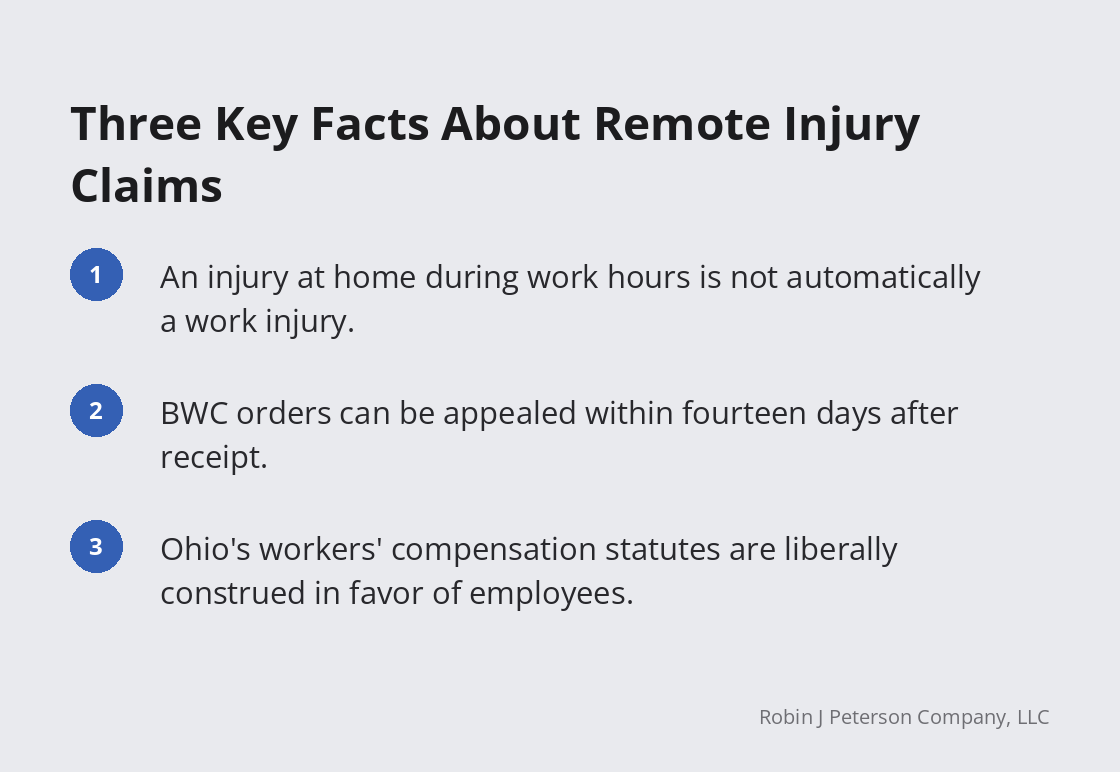
An injury that happens at home during the workday is not automatically a work injury. The statute asks whether the injury was caused by a special hazard of your employment activity and whether you were doing something for the exclusive benefit of your employer. A fall while making lunch or handling a household chore is likely to be treated very differently from an injury while moving employer-issued equipment or completing an assigned job task. Describing exactly what you were doing, and why it was part of your job, is essential.
Leaving Gaps in the Medical Record
Seeing a doctor promptly and explaining how the injury happened gives your claim a medical foundation. When the history in your medical records matches what you told your employer and what appears on the FROI, it is harder for anyone to question the connection between the injury and your work. Inconsistent descriptions, or a long delay before treatment, can invite doubts that are hard to overcome later in the process.
Missing Appeal Deadlines
If BWC denies the claim, the window to respond is short. Under ORC 4123.511, the employer or claimant may appeal an order of the BWC administrator within fourteen days after the date of receipt of the order, and the claim then goes to a district hearing officer of the Industrial Commission. Orders of hearing officers carry their own fourteen-day appeal periods. Reading every order as soon as it arrives and acting quickly protects your right to be heard.
Assuming Remote Work Means No Coverage
Some remote employees never file because they assume home injuries are never covered. That is not what the statute says. ORC 4123.01(C)(4) sets conditions for coverage rather than excluding every home injury, and ORC 4123.95 directs that Ohio’s workers’ compensation statutes be liberally construed in favor of employees. If your injury happened while you were performing a job task that exposed you to a hazard of your work, it is worth getting your questions answered before deciding not to file.
Final Thoughts
A work from home injury in Ohio can qualify for workers’ compensation, but the law asks more questions about home-based injuries than about injuries at a traditional job site. The injury must arise out of your employment, be caused by a special hazard of your work activity, and happen while you were doing something for the exclusive benefit of your employer.
Prompt notice to your employer, a detailed First Report of Injury, consistent medical records, and close attention to every deadline are what turn an uncertain remote work claim into a well-supported one. With the right preparation, you can focus on recovery while your claim moves forward.
If you were hurt while working from home, contact Robin J Peterson Company, LLC to speak with our team serving Cleveland, Akron, Canton, and Independence. We’ll review what happened, explain your options, and help you take the next step with a practical plan.