
Filing a BWC claim in Ohio can feel overwhelming, especially when you’re dealing with a work injury. We at Robin J Peterson Company, LLC know that understanding the process makes all the difference.
This guide walks you through each step, from reporting your injury to handling appeals if needed. You’ll learn what mistakes to avoid and how to protect your benefits.
How the Ohio BWC System Actually Works
The No-Fault Structure That Speeds Your Path to Benefits
Ohio’s workers’ compensation system operates on a no-fault structure, which means you don’t have to prove your employer was negligent to receive benefits. The Bureau of Workers’ Compensation handles medical care, wage replacement, and rehabilitation for work-related injuries and occupational diseases. This matters because it speeds up the process compared to a lawsuit. The BWC covers both sudden traumatic injuries like fractures or machinery accidents and occupational diseases including certain cancers and poisonings from asbestos, lead, mercury, and arsenic exposure.
What You Must Do, What the BWC Must Do
Your job is to report the injury quickly and provide clear documentation of what happened. The BWC’s job is to review your case and make a decision. What separates workers who get approved fast from those facing delays comes down to one thing: how thoroughly you prepare your initial filing.
The 28-Day Window That Controls Everything
Speed determines everything in a BWC claim. You must report your injury to your employer within 24 hours, then file your formal claim within one year of the injury. Your employer has 10 days to submit the First Report of Injury to the BWC after learning about your injury, so delays on their end slow your entire process. Once filed, the BWC has 28 days to investigate and request additional information if needed. Workers with complete documentation move through the system 30 to 40 percent faster than those who submit incomplete paperwork.
Why One in Four Claims Face Denial
About 25 percent of initial claims get denied, according to BWC data, and the most common reasons are timing problems, documentation gaps, and inconsistencies between your accident report and medical records. Late reporting beyond 24 hours can trigger investigations that add weeks to processing. Incomplete forms force adjusters to chase missing details, often adding two to three weeks. The third killer is silence after filing-workers who fail to respond to requests from the claims adjuster or vanish after submitting paperwork stall their own claims.
Three Actions That Protect Your Claim
Respond to any information requests within two business days, check your claim status every two weeks using the BWC online portal, and organize all relevant documents before submission (photos, witness contacts, police reports if applicable, and medical records backed up in cloud storage). This foundation matters because the adjuster reviews medical records, witness statements, and incident details to determine your eligibility for benefits. Your next move is to understand exactly what happens when you report that injury to your employer.
Filing Your Claim Without Delays
Report Your Injury Within 24 Hours
You must report your injury to your employer within 24 hours of when it happens. Ohio Administrative Code 4121-3-01 makes this a requirement to keep your benefits access open. Write it down and email it to your supervisor or HR department. Get a response confirming receipt so you create a verifiable paper trail that proves you reported on time. Your employer then has 10 days to file the First Report of Injury with the BWC, and if they miss that window, your entire timeline gets pushed back.
Contact your employer’s HR or safety department within three days to confirm they’ve filed and ask for your claim number. Don’t assume they’ll handle it without follow-up. Filing a BWC claim in Ohio requires knowing the right steps and avoiding common pitfalls that can delay your benefits. Late reporting can trigger investigations that add weeks to processing.
Schedule Medical Care With a Certified Provider
Schedule a medical appointment with a BWC-certified provider immediately after reporting. Non-certified providers can’t bill the BWC, so your treatment won’t be covered and won’t count toward your claim. Call the provider’s office and tell them you have a work injury, then ask if they’re on the BWC’s approved list. Get your treating physician’s name, exact diagnosis, prescribed medications, and any work restrictions documented in writing before your first visit ends. Medical evidence dominates the entire process, so early and thorough treatment records carry more weight in establishing work-relatedness and eligibility.
Organize Your Documentation Before Submission
Gather comprehensive documentation before submitting anything to the BWC. Collect the exact time and location of the injury, names and contact information for all witnesses, details about equipment involved, and a precise narrative of how the injury occurred. Take photos of the scene and equipment if possible. Obtain police reports if law enforcement responded. Organize all medical records, test results, imaging reports, and physician statements that explicitly link your injury to work duties. Include your wage statements or recent pay stubs so the BWC can calculate wage replacement accurately. Back everything up in cloud storage. Avoiding common mistakes helps workers move through the system faster than those submitting incomplete paperwork.
Submit Your Claim Package and Track Progress
Submit your complete claim package through the BWC online portal within the 28-day investigation window. If you mail it, use certified mail and keep the receipt. Incomplete submissions restart the clock, forcing the adjuster to request missing information and delaying your approval. The BWC typically acknowledges receipt within about 10 business days and assigns a claim number. Use that number to track your case on the online portal. Check your status every two weeks and respond to any information requests from the claims adjuster within two business days. Silence after filing stalls your own claim. Proactive follow-up and timely responses reduce time to benefits and keep the claim moving forward.
When the BWC makes its decision, you’ll either receive approval or face a denial. Understanding what happens next-and why denials occur-positions you to protect your benefits or mount an effective appeal.
Navigating Denials and Appeals
The BWC denies about 25 percent of initial claims, and most denials stem from three specific failures: timing problems, documentation gaps, and inconsistencies between your accident report and medical records. If your accident report describes a fall at 2 p.m. but your medical records show treatment for a gradual strain injury, the adjuster will flag the discrepancy and deny the claim. Late reporting beyond 24 hours triggers investigations that can add weeks and raises suspicion about work-relatedness. Incomplete paperwork forces the adjuster to request missing details, restarting the clock and extending the denial process. Industrial Commission of Ohio data shows that workers who face denials often made one critical error: they failed to align their accident narrative with their medical documentation from day one.
Understanding Your 14-Day Appeal Window
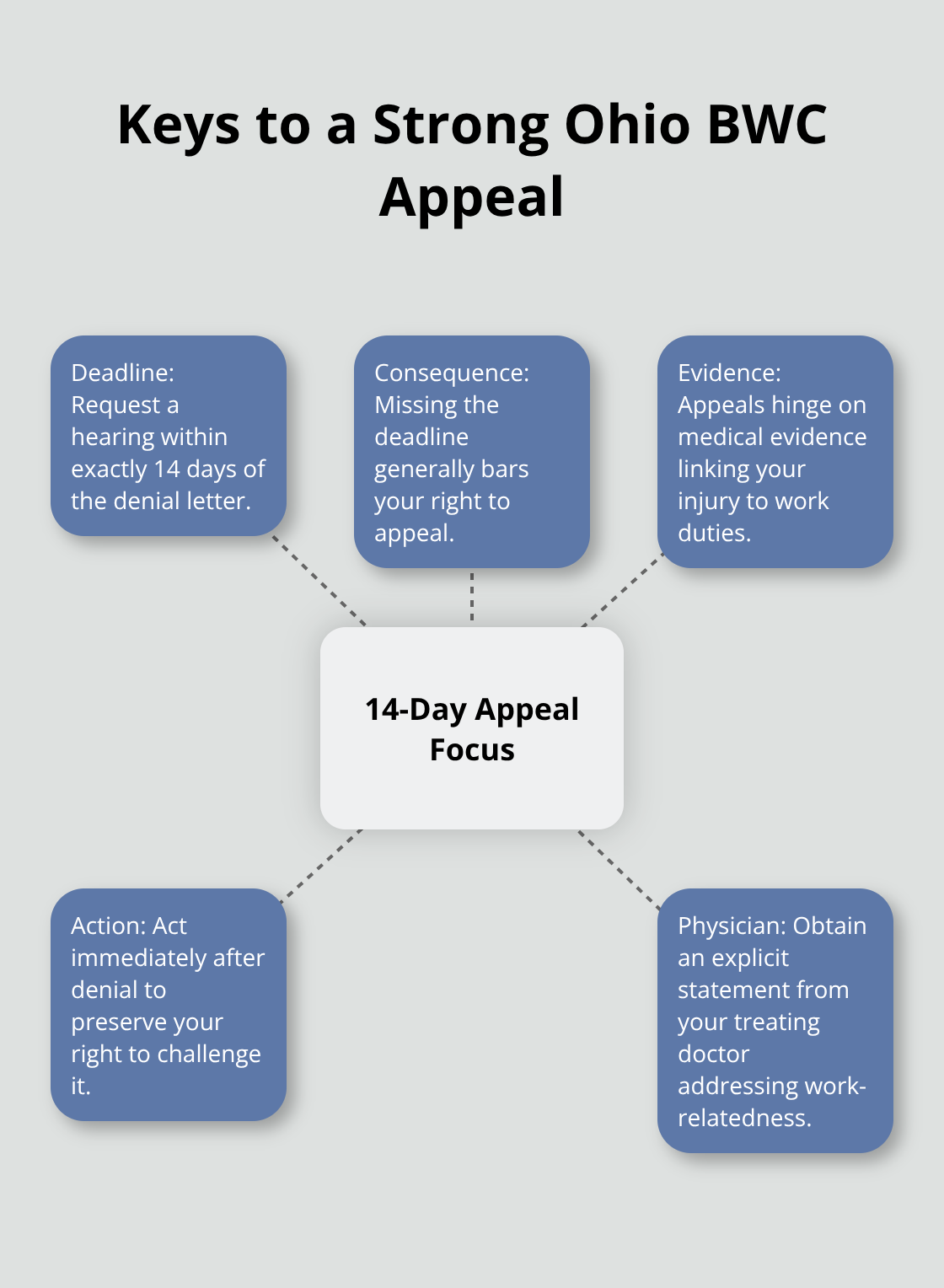
If the BWC denies your claim, you have exactly 14 days to request a hearing with the Industrial Commission of Ohio. Missing this deadline generally bars your right to appeal, so mark it on your calendar the moment you receive the denial letter. The appeal process focuses almost entirely on medical evidence, so your physician’s explicit statement linking your injury to work duties matters far more than your own testimony. Act immediately after receiving the denial to preserve your right to challenge it.
Gathering Evidence That Wins Appeals
Start your appeal by collecting updated medical records from your treating provider, including any new test results or imaging since the initial denial. Request a written physician statement that specifically addresses why the BWC denied your claim and how your injury connects to your work duties. Organize all documents chronologically: incident photos, witness statements with contact information, wage records, police reports if applicable, and a detailed timeline of your treatment and communications with the employer and BWC. Discrepancies between documents killed your initial claim, so consistency across all materials wins your appeal.
When to Consult an Ohio Workers’ Compensation Attorney
The Administrative Law Judge at the Industrial Commission of Ohio will review whether the evidence supports work-relatedness, not whether your employer was negligent. If your case involves complex medical issues, occupational disease exposure, or significant wage calculations, consulting an Ohio workers’ compensation attorney early can improve your odds. An attorney can review your denial letter and assess whether an appeal is winnable based on available medical and factual evidence before the 14-day deadline expires.
Final Thoughts
Filing a BWC claim in Ohio requires three core actions: report within 24 hours, assemble complete documentation, and submit everything within the 28-day window. Workers who follow this sequence move through the system 30 to 40 percent faster than those who delay or submit incomplete paperwork. The difference between approval and denial often comes down to consistency between your accident narrative and medical records, so align these details from day one.
If the BWC denies your claim, you have 14 days to appeal to the Industrial Commission of Ohio. Missing this deadline bars your right to challenge the decision, so act immediately when you receive the denial letter. Appeals succeed when medical evidence clearly establishes work-relatedness, so gather updated treatment records and request a physician statement that directly addresses the denial reason.
Complex cases involving occupational disease exposure, significant wage calculations, or medical disputes benefit from early legal guidance. Robin J Peterson Company, LLC represents injured workers throughout Ohio’s workers’ compensation system and can review your denial, assess whether an appeal is winnable, and navigate deadlines before your window closes.