
Back injuries at work can derail your career and finances fast. At Robin J Peterson Company, LLC, we help injured workers understand their rights and access the support they need.
Ohio’s workers compensation system provides medical coverage and wage replacement for back injuries-but only if you know how to navigate it. This guide walks you through the types of injuries covered, the benefits available, and exactly how to file your claim.
What Back Injuries Does Ohio Workers Compensation Cover
Acute Traumatic Injuries from Workplace Accidents
Ohio workers compensation covers three main categories of back injuries, and understanding which one applies to your situation matters because it affects how you file your claim and what benefits you receive. Acute traumatic injuries from workplace accidents are the most straightforward to prove. These happen suddenly-a fall from a ladder, a heavy object dropped on your back, a car accident during work travel, or a slip on a wet floor. The injury occurs at a specific moment, and you can point to the exact event that caused it. The Ohio Bureau of Workers Compensation recognizes these immediately because the connection between the accident and your injury is clear.

Gradual Onset Injuries from Job Duties
Many workers don’t realize that gradual onset injuries from your regular job duties are equally covered, even though they develop slowly over weeks or months. Construction workers, warehouse staff, nurses, and manufacturing employees often develop back pain from repetitive lifting, awkward postures, or constant strain. These injuries are legitimate workers compensation claims in Ohio, but you need medical documentation showing that your job duties caused the condition. Your treating physician must confirm the link between your work and the injury for the claim to succeed.
Herniated Discs and Spinal Injuries
Herniated discs and other spinal injuries fall into a special category because they can result from either acute trauma or gradual wear. A herniated disc might happen when you lift incorrectly one time, or it might develop after years of improper body mechanics at work. Ohio workers compensation covers both scenarios as long as your treating physician confirms the injury is work-related. About 17,500 new spinal cord injuries occur annually across the United States, and many of these stem from workplace events. The most common workplace events that cause spinal injuries are car accidents and falls, according to the Spinal Cord Injury Center.
Documentation Requirements and Third-Party Claims
When you file your claim, you must clearly document which type of injury you have because the medical evidence required differs. For acute injuries, your employer’s accident report and immediate medical evaluation are essential. For gradual injuries, you need consistent medical records showing the condition worsened due to work duties. If your back injury involves a third party (for example, another driver hit your work vehicle), you may qualify for both workers compensation and a separate personal injury claim, which could provide additional compensation beyond what the state system covers. This dual-claim approach requires careful coordination, and understanding how medical benefits and wage support work together will help you maximize your recovery.
Medical Coverage and Wage Replacement: How Ohio’s System Works
How Medical Treatment Gets Paid
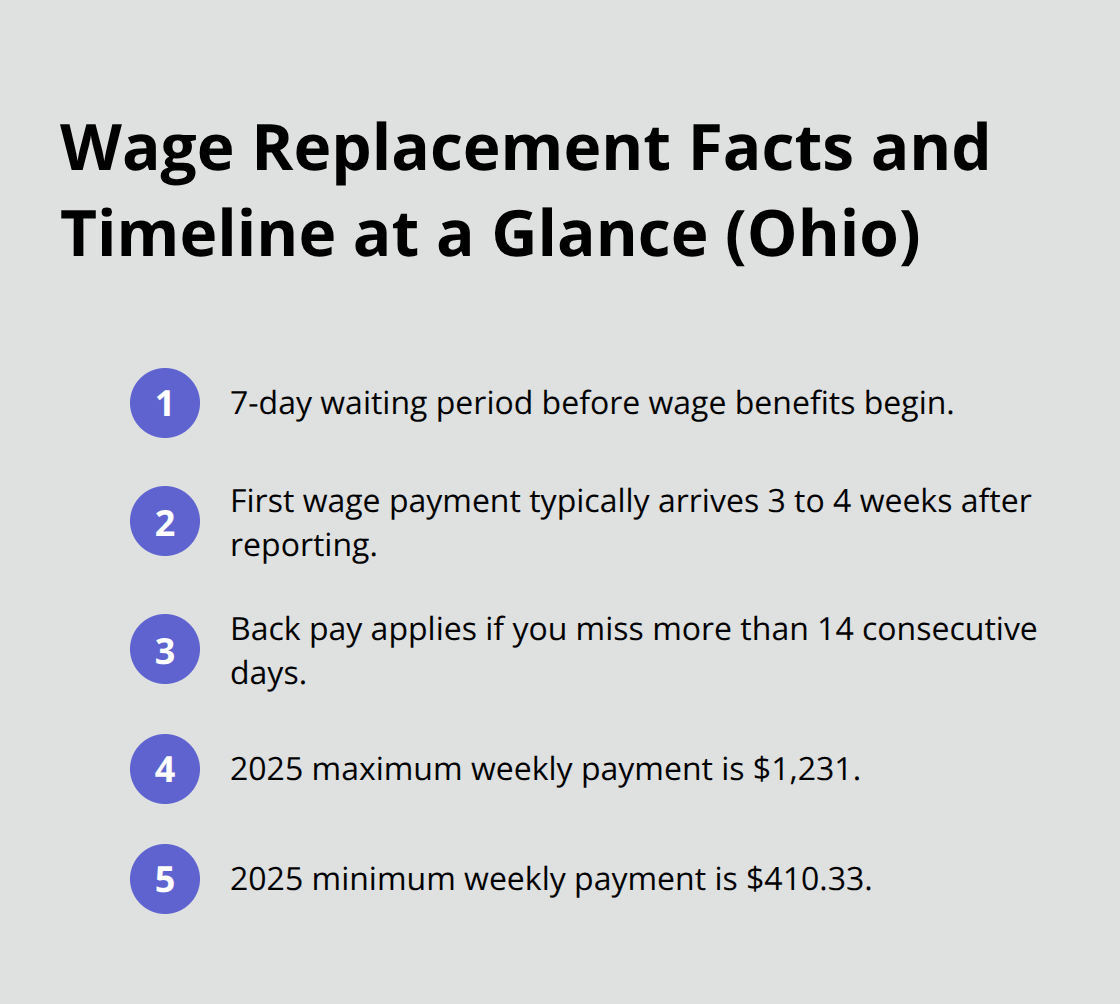
Ohio’s workers compensation system splits support into two distinct streams: medical care paid directly to providers and wage replacement paid to you. Medical treatment starts immediately once your claim is allowed, even during the mandatory 7-day waiting period before wage benefits begin. The Ohio Bureau of Workers Compensation routes all medical payments through your assigned Managed Care Organization, which means authorized treatment should never result in bills sent to your home.
Your treating physician controls what care you receive-surgery, physical therapy, imaging, medications, ongoing appointments. The MCO coordinates approvals based on medical necessity, not cost. This matters because you should never pay out-of-pocket for authorized treatment related to your work injury. If you receive a bill, contact your MCO immediately at 1-800-644-6292 to verify the treatment was authorized.
Understanding Your Wage Replacement Timeline
Wage replacement follows a different timeline and calculation than medical benefits. For the first 12 weeks, you receive 72 percent of your Full Weekly Wage, which is the higher of your gross earnings in the six weeks before injury or your average from the seven days before injury. After week 12, the rate drops to 66 2/3 percent of your Average Weekly Wage based on your full 52 weeks of pre-injury earnings.
In 2025, the maximum weekly payment is $1,231 and the minimum is $410.33. These payments compensate for lost income while you cannot work, but the waiting period means your first payment typically arrives three to four weeks after injury reporting. If you miss more than 14 consecutive days, you receive back pay for the entire period.
Wage Continuation and Transitions
Some employers offer wage continuation during early recovery, paying your full salary while you heal. When wage continuation ends, you transition directly to Temporary Total Disability without losing benefits. This arrangement protects your financial stability during the critical early recovery phase.
Long-Term Disability Options
If your injury causes lasting impairment after you reach maximum medical improvement, you may qualify for Permanent Partial Disability or Permanent Total Disability, which provides different compensation structures based on the severity of your permanent condition. These benefits replace the temporary wage replacement and reflect your permanent functional limitations.
Protecting Your Wage Calculation
Gather your recent pay stubs and overtime records immediately after your injury. Calculate your likely Full Weekly Wage yourself and verify the BWC’s calculation matches your records before accepting the first payment. Accurate documentation of your pre-injury earnings prevents underpayment and protects your financial recovery during the claims process. Once you understand how medical coverage and wage support flow to you, the next critical step involves actually filing your claim and working directly with the Ohio Bureau of Workers Compensation to activate these benefits.
Filing Your Claim and Activating Benefits
Report your injury to your employer immediately, ideally on the day it happens. Your employer must file a First Report of Injury form with the Ohio Bureau of Workers’ Compensation within 10 days of learning about your injury, but do not wait for your employer to initiate this process. Notify your supervisor, HR department, or whoever handles safety at your workplace in writing if possible, and keep a copy for your records. If your employer resists or delays reporting, you can file the claim directly with the Ohio BWC yourself. The sooner your employer files the FROI-1 form, the sooner your medical care begins and the sooner the mandatory 7-day waiting period for wage benefits starts counting down.
Scheduling Your First Medical Appointment
Your first medical appointment should happen within days of reporting, not weeks. Seek treatment from a physician who understands workers’ compensation and can document clearly that your injury is work-related. This medical connection is not optional-without it, your claim will fail. The physician you choose sets the tone for your entire recovery, so select someone experienced with workplace injuries.
Understanding the Processing Timeline
Once your employer files, the Ohio BWC assigns a Managed Care Organization to coordinate your medical care and process approvals. Your assigned MCO will contact you, typically within 5 to 10 business days, with information about your case number, your designated physician network, and how to schedule appointments. Do not ignore this contact. Your claim number becomes your reference for every interaction going forward. Write it down and use it whenever you communicate with the MCO, your employer, or the BWC directly.
Processing timelines vary, but expect your first wage payment to arrive 3 to 4 weeks after your injury is reported because the BWC must verify employment history, calculate your Full Weekly Wage and Average Weekly Wage, and confirm the claim is allowable. During this waiting period, medical bills are covered immediately for authorized treatment, but you receive no wage replacement. This gap catches many workers off guard financially, so plan accordingly.
Maintaining Documentation and Communication
Your job during claims processing is to maintain clear documentation and communication. Save every piece of correspondence from the MCO, the BWC, or your employer. If you receive bills for treatment related to your injury, do not ignore them-contact your MCO at 1-800-644-6292 immediately to verify authorization and resolve the issue.
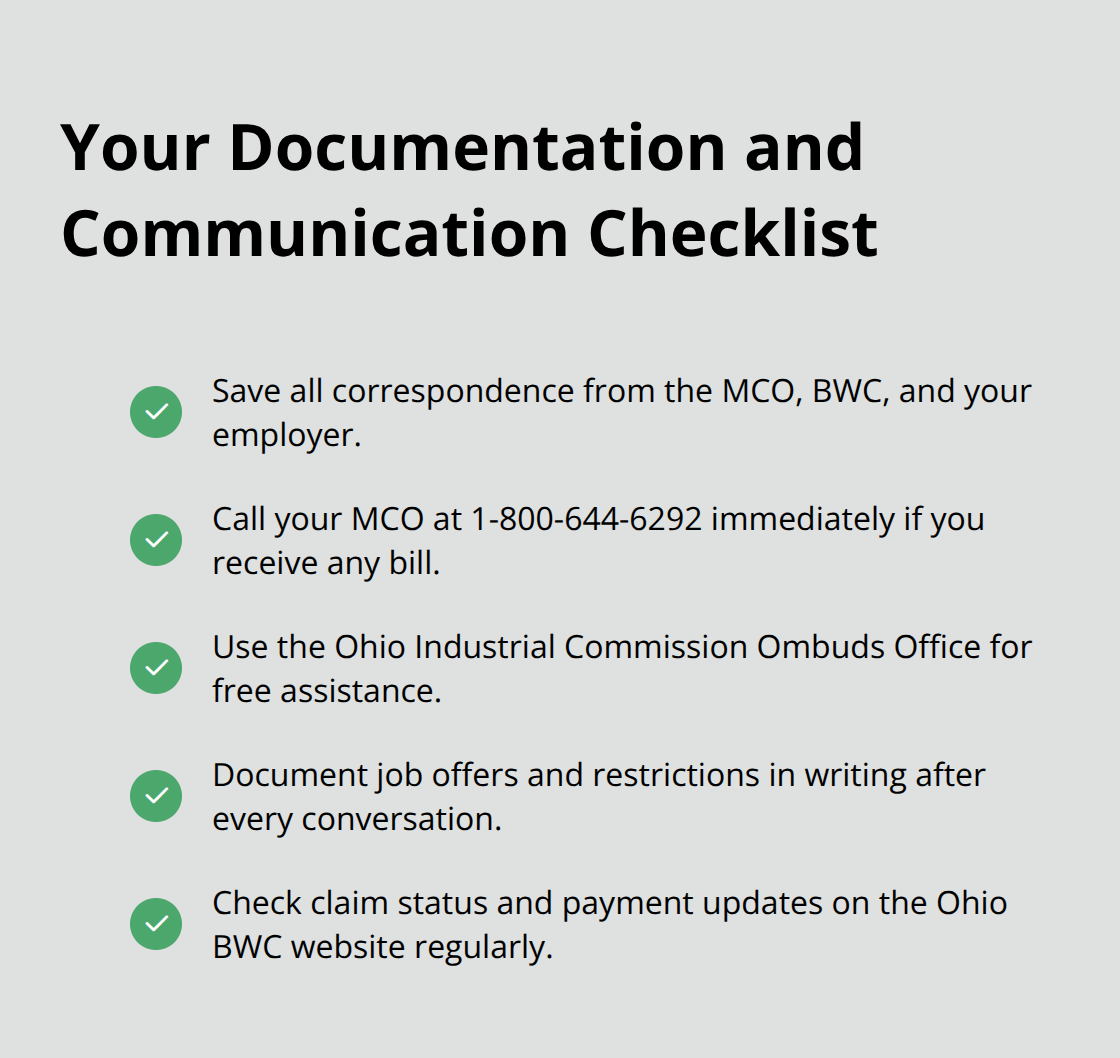
The Ohio Industrial Commission Ombuds Office offers free assistance if you encounter problems with your claim or medical care approvals, and this resource requires no formal legal action to access.
Navigating Return-to-Work Offers
Keep your treating physician informed about any work restrictions or accommodations your employer proposes, and always obtain written confirmation from your doctor before accepting modified duty work. Many return-to-work disputes arise because job offers lack clear physical demands or because workers accept positions that violate their medical restrictions. Request a written job description from your employer that specifies hours, duties, and physical demands, then have your physician review it against your restrictions.
Document every conversation about job offers in writing-email a summary to yourself and your employer after each discussion with dates, people involved, what was discussed, and what restrictions prevent you from accepting. This paper trail protects your benefits if disputes arise later. The Ohio BWC website provides claim status updates, benefit payment information, and contact details for your assigned case manager. Check your claim status regularly rather than waiting passively for updates.
Final Thoughts
Back injury Ohio benefits protect your financial stability and health during recovery, but only if you actively claim them and enforce your rights. The Ohio workers compensation system provides medical coverage from day one and wage replacement after a mandatory waiting period, yet many injured workers miss deadlines or fail to document their claims properly. Understanding the injury categories, the split between medical and wage support, and the filing process puts you in control of your recovery instead of leaving it to chance.
You have the right to all reasonable medical treatment determined by your treating physician, not by your employer or the insurance company. You cannot face retaliation for filing a claim or seeking care, and you deserve accurate wage calculations based on your pre-injury earnings. You can refuse work that violates your medical restrictions without losing benefits, provided you document your refusal clearly in writing.
Start by reporting your injury to your employer immediately and in writing, then schedule a medical appointment with a physician experienced in workers compensation cases within days. Gather your pay stubs and overtime records to verify your wage calculations, monitor your claim status through the Ohio BWC website, and document every conversation about job offers or medical care. If navigating back injury Ohio benefits feels overwhelming or if your employer resists your claim, Robin J Peterson Company, LLC can guide you through the process and fight to secure the benefits you are entitled to.