
Returning to work after an injury in Ohio comes with real questions about your rights and what happens next. We at Robin J Peterson Company, LLC understand that this transition can feel overwhelming, which is why we’ve created this guide to walk you through every step.
You’re protected by Ohio’s workers’ compensation laws, and knowing those protections matters. This blog post covers what you need to know to move forward with confidence.
Your Legal Protections When Returning to Work
Ohio’s workers’ compensation system provides injured workers with specific legal protections that apply from the moment you’re hurt until you’re back on the job. The Ohio Bureau of Workers’ Compensation manages these protections, and the Industrial Commission of Ohio enforces them. Your employer cannot retaliate against you for filing a claim or for taking time off work to recover. This protection is absolute-retaliation includes firing you, cutting your hours, reassigning you to worse duties, or reducing your pay. If your employer takes any of these actions within a year of your injury, the law presumes retaliation occurred, and you have grounds for legal action.
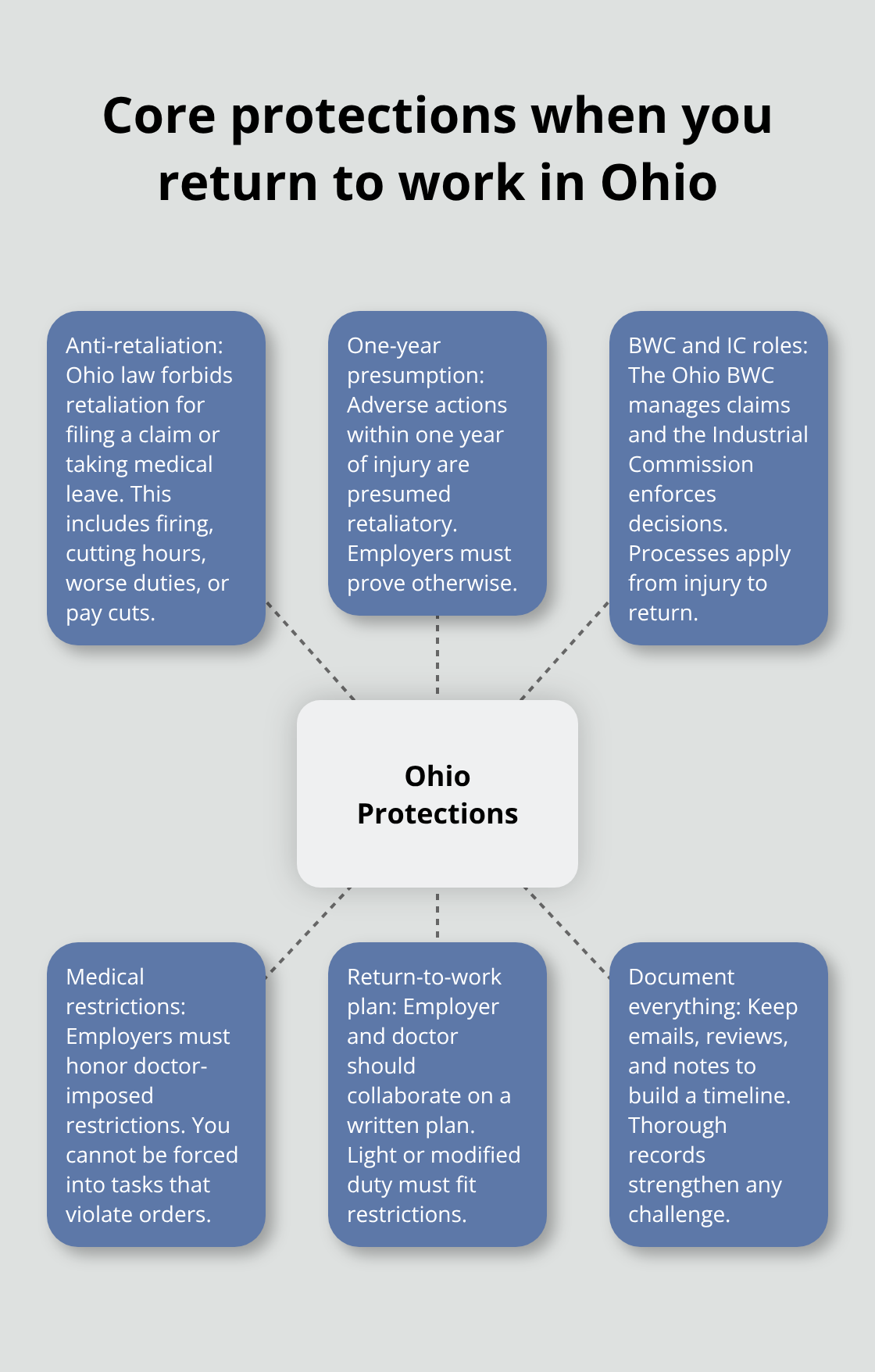
Many injured workers don’t realize how strong this protection is, which is why you should document everything. Keep records of performance reviews, emails, and conversations with supervisors before and after your injury to establish a clear timeline if you need to challenge retaliatory actions later.
What Your Employer Must Provide
Your employer must report your injury to the Ohio Bureau of Workers’ Compensation within 14 days of the incident. This deadline matters because delays in reporting affect your claim approval timeline and benefit payments. Once your claim receives approval-which typically happens within 2 to 3 weeks for straightforward injuries-your employer must work with you and your doctor to develop a return-to-work plan. Light duty and modified work arrangements solve many situations, but your employer cannot force you into work that violates your doctor’s restrictions. If your medical provider states you cannot lift more than 10 pounds, your employer cannot assign you to a position requiring 25-pound lifts. The National Institute for Occupational Safety and Health found that beginning rehabilitation within the first eight weeks of injury correlates with significantly higher return-to-work rates, which means your employer’s early participation in planning your return matters substantially.
When Disputes Arise Over Work Capacity
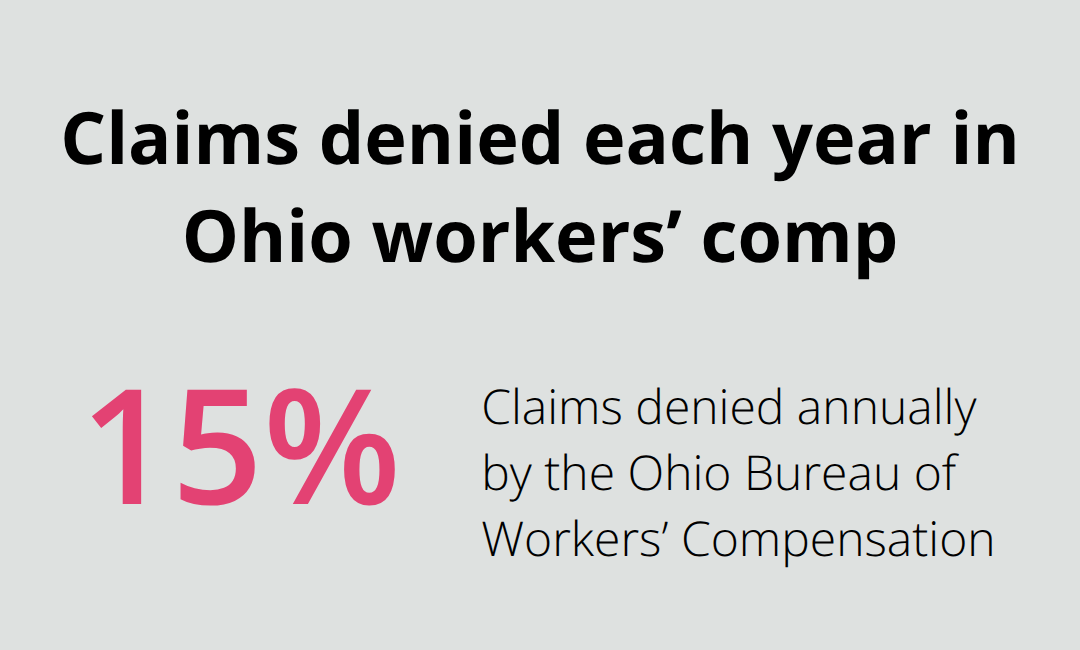
Not every return-to-work situation requires an attorney, but disputes over work capacity, vocational rehabilitation decisions, or claims denials absolutely do. The Ohio Bureau of Workers’ Compensation denies approximately 15 percent of claims annually, often due to improper reporting, disputes about whether the injury occurred at work, or pre-existing condition complications. If your claim receives denial, you have 14 days to file an appeal with the Industrial Commission of Ohio. Successful appeals require complete documentation (medical records, coworker statements, and employment records).
If your employer disputes your work capacity or the BWC challenges your vocational rehabilitation benefits, the situation becomes complex quickly. An attorney experienced in Ohio workers’ compensation law can help you navigate the Industrial Commission process and fight for the benefits you’ve earned. As you move forward with your return-to-work plan, understanding how to communicate effectively with your employer about accommodations becomes your next priority.
Preparing for Your Return to Work
Your doctor’s medical restrictions form the foundation of your entire return-to-work plan, so you need clarity before your first day back. Schedule a specific conversation with your physician about what you can and cannot do physically. Ask for concrete limitations: Can you lift more than 10 pounds? How many hours can you stand continuously? Are there movements you must avoid? Get these answers in writing from your doctor because your employer will need them, and you’ll want documentation if disputes arise later. The Ohio Bureau of Workers’ Compensation requires employers to honor medical restrictions, but those restrictions only work if they’re clearly defined. Many workers return to work without this clarity and end up aggravating their injuries, which delays recovery and creates liability issues for their employer.
Communicating Your Needs to Your Employer
Approach your employer with a specific accommodation proposal, not just a list of problems. Instead of saying “I can’t do my old job,” bring documentation from your doctor that outlines your restrictions and then propose how your role could change. For example, if you cannot lift heavy items, propose that a coworker handle that task while you manage administrative duties. Employers respond better to solutions than complaints.
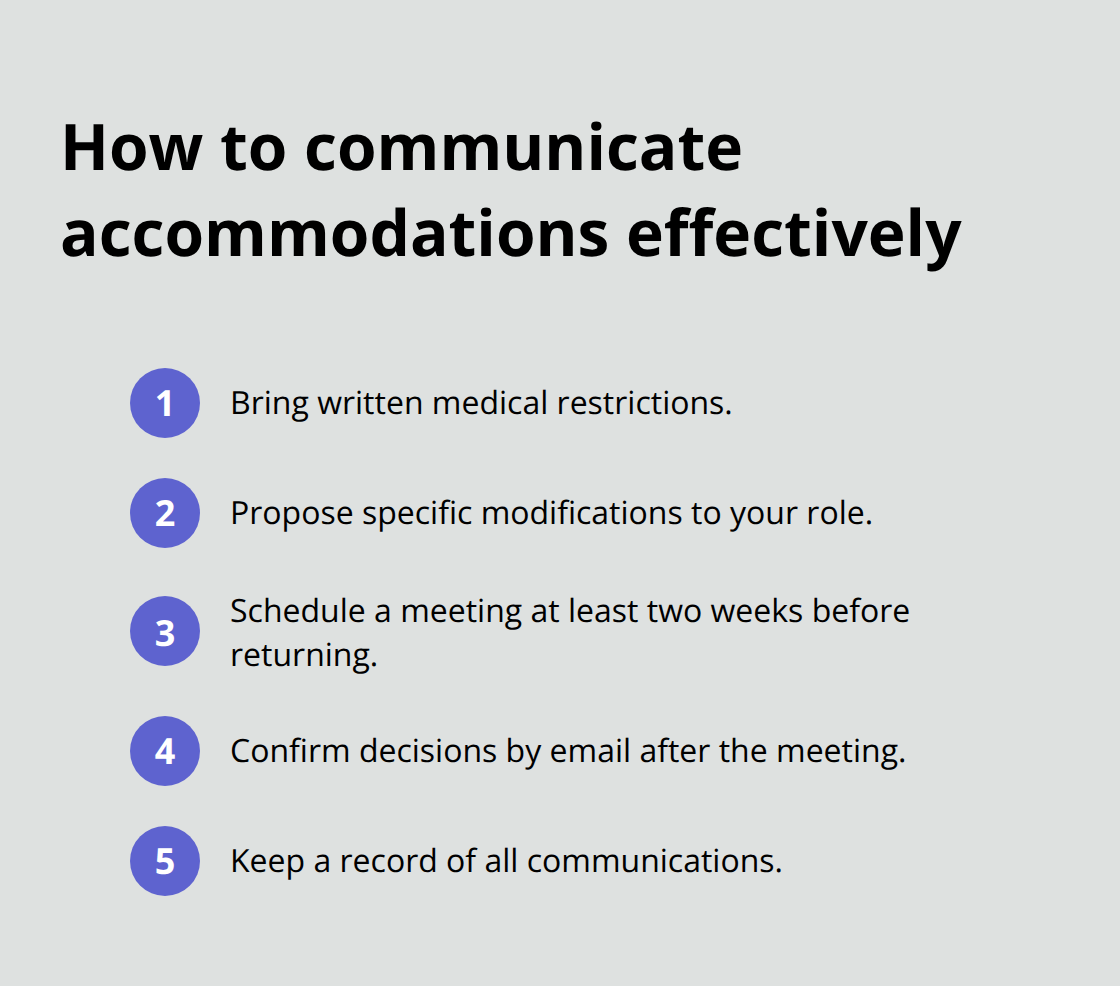
Schedule a formal meeting with your supervisor or HR department at least two weeks before your return date, and bring your medical documentation. The National Institute for Occupational Safety and Health research shows that employers who actively participate in return-to-work planning see faster recovery outcomes, which means your employer benefits from this conversation as much as you do. Put your accommodation requests in writing through email after the meeting, confirming what was discussed and what modifications have been approved. This creates a paper trail that protects you if your employer later claims they didn’t know about your restrictions.
Light Duty and Modified Work Reality
Light duty isn’t punishment-it’s a temporary bridge between injury and full duty. Ohio’s workers’ compensation system recognizes that many workers can perform modified tasks while they heal, which keeps you earning and speeds your return to normal work. Light duty typically involves the same employer but different tasks that fit your medical restrictions. Your employer cannot force you into light duty work that violates your doctor’s orders, but they can offer it as an option. If your employer offers light duty at a lower wage rate, the Ohio Bureau of Workers’ Compensation supplements the difference through temporary total disability benefits, so your income doesn’t take a hit. The key is understanding that light duty has an expiration date. Your doctor should establish a timeline for progression-when you might move from light duty to transitional duty to full duty. Without this timeline, you risk getting stuck in light duty indefinitely. If your employer cannot accommodate your restrictions with light duty, vocational rehabilitation services become your next step, which the BWC funds for approved programs. Document every conversation about light duty arrangements, including what tasks you assign yourself and any modifications your employer makes.
Moving Into Vocational Rehabilitation
Vocational rehabilitation services begin after your claim receives approval, and a rehabilitation counselor assesses your capabilities and creates a realistic return-to-work plan. The counselor may recommend healthcare-support roles, administrative positions, or skilled trades based on your medical restrictions and current job market conditions. Vocational services include classroom retraining, on-the-job training, and apprenticeships; the BWC covers tuition and related expenses for approved programs. Beginning rehabilitation within the first eight weeks of injury correlates with significantly higher return-to-work rates according to the National Institute for Occupational Safety and Health, which means timing matters. Regular communication with your supervisor or HR during recovery helps you discuss modified-duty options that can keep you financially active while you heal. As you move through these preparation steps, you’ll encounter situations where your employer disputes your work capacity or the BWC challenges your vocational rehabilitation benefits-situations that require you to understand your rights and responsibilities effectively.
Overcoming Common Challenges When Returning to Work
Managing Pain and Physical Limitations on the Job
Pain management on the job demands a different strategy than pain management at home, and most injured workers underestimate this challenge. Your body feels different when you move through work tasks than when you rest, which means your doctor’s restrictions need real-world testing during your first week back. Start with a pain journal from day one: record what tasks trigger discomfort, when pain peaks during your shift, and how your body responds after work ends. This information matters because it shows patterns that your doctor needs to adjust your restrictions. If you notice that standing for more than two hours increases swelling, that’s actionable data that changes your work setup.
Many workers push through pain to prove they’re capable, which only extends recovery time and creates documentation that your employer can use against you later if disputes arise. The National Institute for Occupational Safety and Health research confirms that workers who manage pain proactively through modified duty see faster return-to-work rates than those who ignore symptoms. Talk to your supervisor immediately if your current light duty assignment triggers pain beyond what your doctor anticipated. Your employer must modify the work further if your restrictions prove inadequate, and documenting this conversation protects you if the employer later claims you’re unable to work.
Recognizing and Documenting Retaliation
Retaliation happens, and Ohio law takes it seriously, but you need to recognize it when it occurs. Your employer cannot reassign you to undesirable duties, cut your hours, reduce your pay, or create a hostile work environment because you filed a claim or took medical leave. The law presumes retaliation if your employer takes adverse action within one year of your injury, which means the burden shifts to your employer to prove the action wasn’t retaliatory. However, proving retaliation requires documentation that shows the timing and pattern.
Keep copies of your performance reviews before your injury, your job description, and any communications about your role. If your employer suddenly assigns you to a different department, lower-paying position, or reduced hours shortly after your return, that timing becomes evidence. Email your supervisor after any conversation about your accommodations, summarizing what was discussed and what was agreed upon. If your employer later denies that conversation happened, your email creates a record that protects your interests.
Resolving Disputes Over Work Capacity
Disputes over work capacity often involve disagreements about what you can physically do, and these disputes escalate quickly without clear medical documentation. The Ohio Bureau of Workers’ Compensation requires employers to honor medical restrictions, but many employers push workers beyond those restrictions, claiming the restrictions are outdated. Your doctor should establish specific timelines for progressing from light duty to full duty, with clear benchmarks for when progression happens.
If your employer claims you’re capable of full-duty work but your doctor disagrees, request a functional capacity evaluation from an independent medical professional. This evaluation provides objective data about your actual capabilities and carries significant weight in disputes. If the BWC or your employer continues pressuring you beyond your medical restrictions, that’s when legal representation becomes necessary. An attorney experienced in Ohio workers’ compensation law can help you navigate these disputes through the Industrial Commission of Ohio.
Final Thoughts
Your return to work in Ohio happens within a legal framework that protects you at every stage, and understanding those protections transforms how you approach your recovery. The Ohio Bureau of Workers’ Compensation provides medical benefits, temporary disability payments, and vocational rehabilitation services specifically designed to support your transition back to work. Your employer cannot retaliate against you for filing a claim, and the law presumes retaliation occurred if adverse action happens within one year of your injury.
The resources available to you extend far beyond what most workers realize. The BWC offers an online claim-status database that lets you monitor your case without repeated phone calls, while vocational rehabilitation counselors create realistic return-to-work plans tailored to your medical restrictions and job market conditions. When you combine these resources with clear communication with your employer and thorough documentation of every conversation, you build a strong foundation for your recovery.
Legal guidance becomes necessary when disputes arise over work capacity, when the BWC denies your claim, or when your employer pressures you beyond your medical restrictions. We at Robin J Peterson Company, LLC represent injured workers throughout the Cleveland, Akron, and Canton areas, and we fight for the benefits and compensation you’ve earned (contact our firm at rjplawohio.com to discuss your options if your situation involves complex disputes or claim denials).