
Work injuries happen fast, but understanding your rights in Ohio shouldn’t be complicated. We at Robin J Peterson Company, LLC created this Ohio workers comp overview to cut through the confusion and give you straightforward answers.
Whether you’ve been injured or you’re trying to understand what coverage means for your business, this guide walks you through the system step by step.
How Ohio’s Workers’ Comp System Actually Works
Ohio’s workers’ compensation system operates as a no-fault program, which means injured workers receive benefits regardless of who caused the accident. This fundamental design protects employees from having to prove employer negligence, and it shields employers from lawsuits in most cases. The Ohio Bureau of Workers’ Compensation, or BWC, administers this entire system and maintains offices at 30 W. Spring St., Columbus, OH 43215-2256.
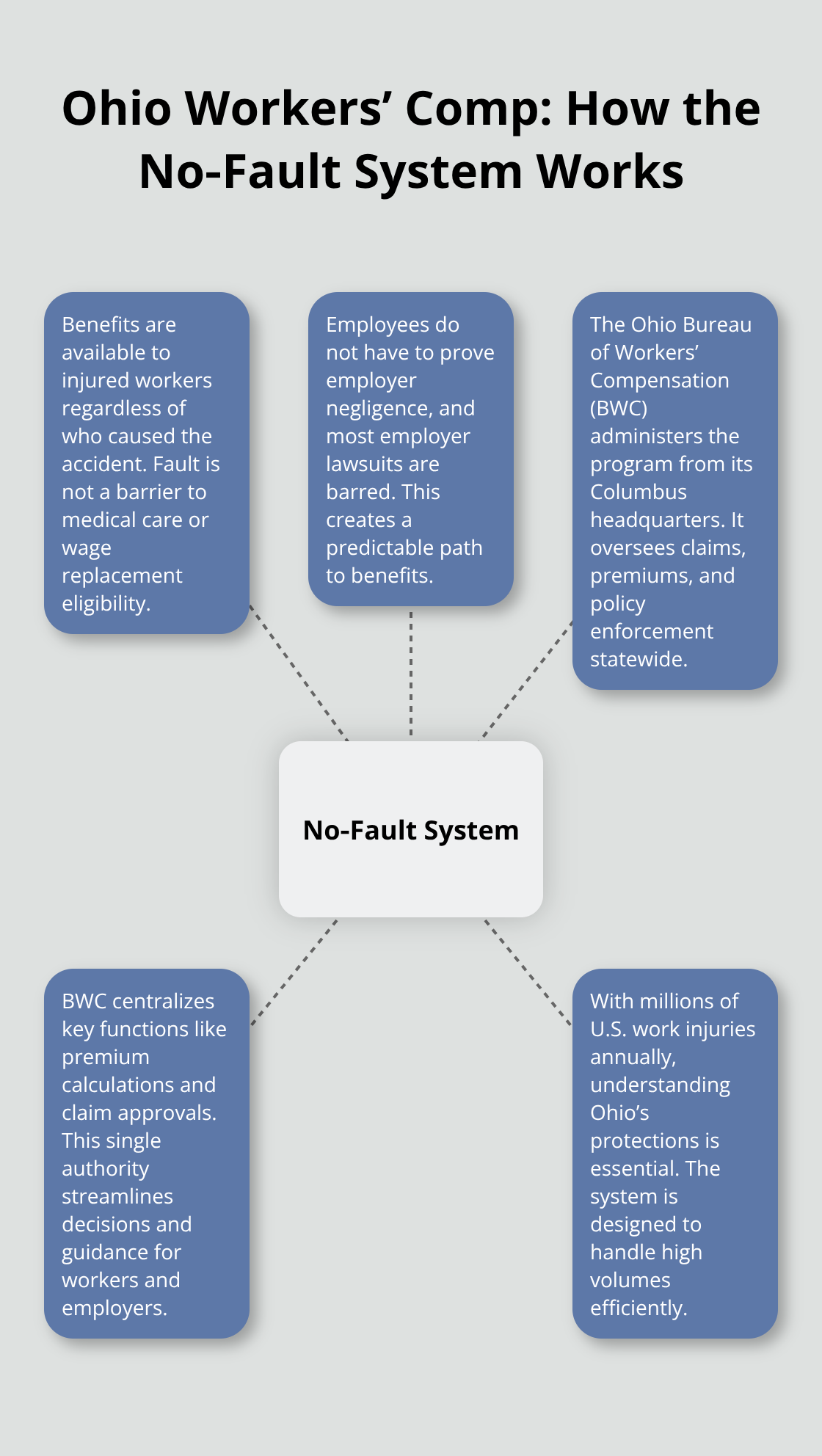
The BWC handles everything from premium calculations to claim approvals, making it the central authority for workers’ comp in the state. Over four million on-the-job injuries occur annually across the United States according to the U.S. Bureau of Labor Statistics, so understanding how Ohio’s system protects you matters whether you’re an injured worker or a business owner.
What Coverage Actually Includes
Ohio’s workers’ comp covers medical treatment, lost wages, and rehabilitation services when an injury happens during work duties. The system recognizes common workplace injuries like lower back strains, rotator cuff tears, fractures from falls or equipment accidents, and traumatic brain injuries from being struck by objects or vehicle collisions. Ohio also maintains a scheduled list of occupational diseases that qualify for coverage, including cancers, infections, and poisonings from substances like asbestos, lead, mercury, and arsenic. Jobs with higher exposure to these hazards increase the likelihood that occupational diseases receive compensation. The critical requirement is establishing a clear causal link between your job duties and the injury, plus demonstrating that medical treatment or time away from work is necessary.
Getting Coverage and Filing Claims
Employers must apply for coverage through the BWC to participate in Ohio’s workers’ compensation program, and staying current with premium payments avoids late payment penalties. When an injury occurs, you should report it promptly because delays can complicate your claim. The BWC provides an online application system to file claims, and authorized representatives have dedicated tools to manage claims efficiently on behalf of workers or employers. If your claim faces denial or delays, a workers’ compensation attorney protects your rights and fights to secure the benefits you deserve from the BWC and the Industrial Commission of Ohio.
The Claims Process in Ohio
Filing a workers’ comp claim in Ohio requires speed and accuracy. Report your injury to your employer immediately after it happens, because delays create documentation gaps that the BWC uses to deny claims. Once you report the injury, your employer must provide you with a claim form or direct you to file online through the BWC’s system. The BWC accepts claims filed up to one year after the injury occurs, but waiting that long weakens your case significantly. When you file, include specific details about how the injury happened, which body parts were affected, and the names of any witnesses present. The BWC will assign your claim a number and begin reviewing whether your injury meets the no-fault coverage requirements.
Steps to File a Workers’ Comp Claim
Start the filing process by notifying your employer verbally and in writing about your injury. Your employer then provides the claim form or directs you to the BWC’s online application system. You must complete the form with accurate information about the incident, your job duties at the time, and any medical treatment you received.
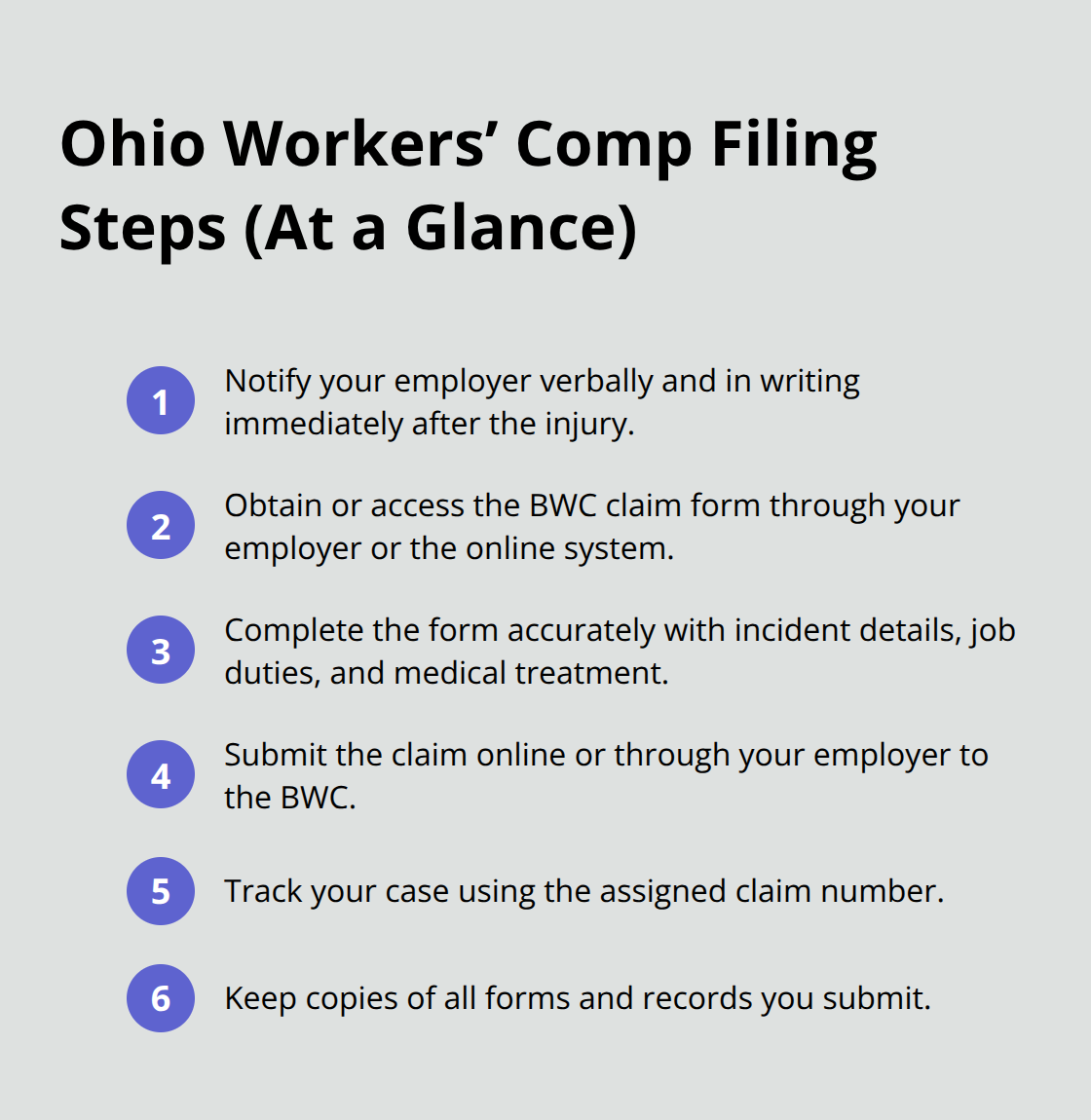
Submit your completed claim to the BWC either online or through your employer. The BWC assigns your claim a number once they receive it, and this number tracks your case throughout the entire process. Keep copies of everything you submit for your records.
Timeline for Getting Approved and Receiving Benefits
The BWC typically makes an initial decision on your claim within 28 days of filing, though complex cases can extend beyond this timeframe. Once approved, benefits begin accumulating from the date of injury, not from the date you file. Medical treatment starts almost immediately for approved claims, with the BWC covering authorized healthcare providers from the start. Lost wage benefits, called temporary total disability, begin after a waiting period of seven calendar days if you miss work due to the injury. This means your first week without pay comes from your pocket, but the BWC reimburses weeks two and onward at a rate based on your average weekly wage. If your injury requires ongoing treatment or extended time away from work, the BWC continues benefits throughout your recovery period as long as medical evidence supports the need for treatment.
Why Claims Get Denied and What to Do About It
The BWC denies claims primarily when the injury fails to establish a clear connection to job duties. An injury that happens during work hours but unrelated to your actual job responsibilities falls outside coverage, such as a personal argument that turns physical or a self-inflicted wound. Pre-existing conditions and natural deterioration of the body also receive denials unless you can prove the job accelerated or worsened the condition significantly. Mental health conditions face particularly strict scrutiny and rarely qualify unless they result directly from a specific traumatic workplace event. Missing medical evidence ranks among the top denial reasons, so document everything from the moment of injury.
Appealing a Denied Claim
If the BWC denies your claim, you have appeal rights through the Industrial Commission of Ohio. You must file your appeal within a specific timeframe, so act quickly after receiving a denial notice. The appeal process involves submitting additional evidence, medical records, and witness statements that support your case. An attorney can challenge the denial, gather additional medical evidence, and present your case to the Industrial Commission during a hearing, substantially improving your chances of overturning the decision. This is where legal representation becomes valuable in protecting your rights and securing the benefits you deserve.
Your Rights and Benefits as an Injured Worker in Ohio
What Ohio Workers’ Comp Actually Pays You
Ohio workers’ compensation delivers three core benefits when your claim receives approval: medical treatment, wage replacement, and rehabilitation services. Medical benefits cover all authorized healthcare providers, hospital stays, surgical procedures, medications, and ongoing therapy related to your work injury. The BWC pays these medical bills directly to your providers, so you avoid out-of-pocket costs for covered treatment.
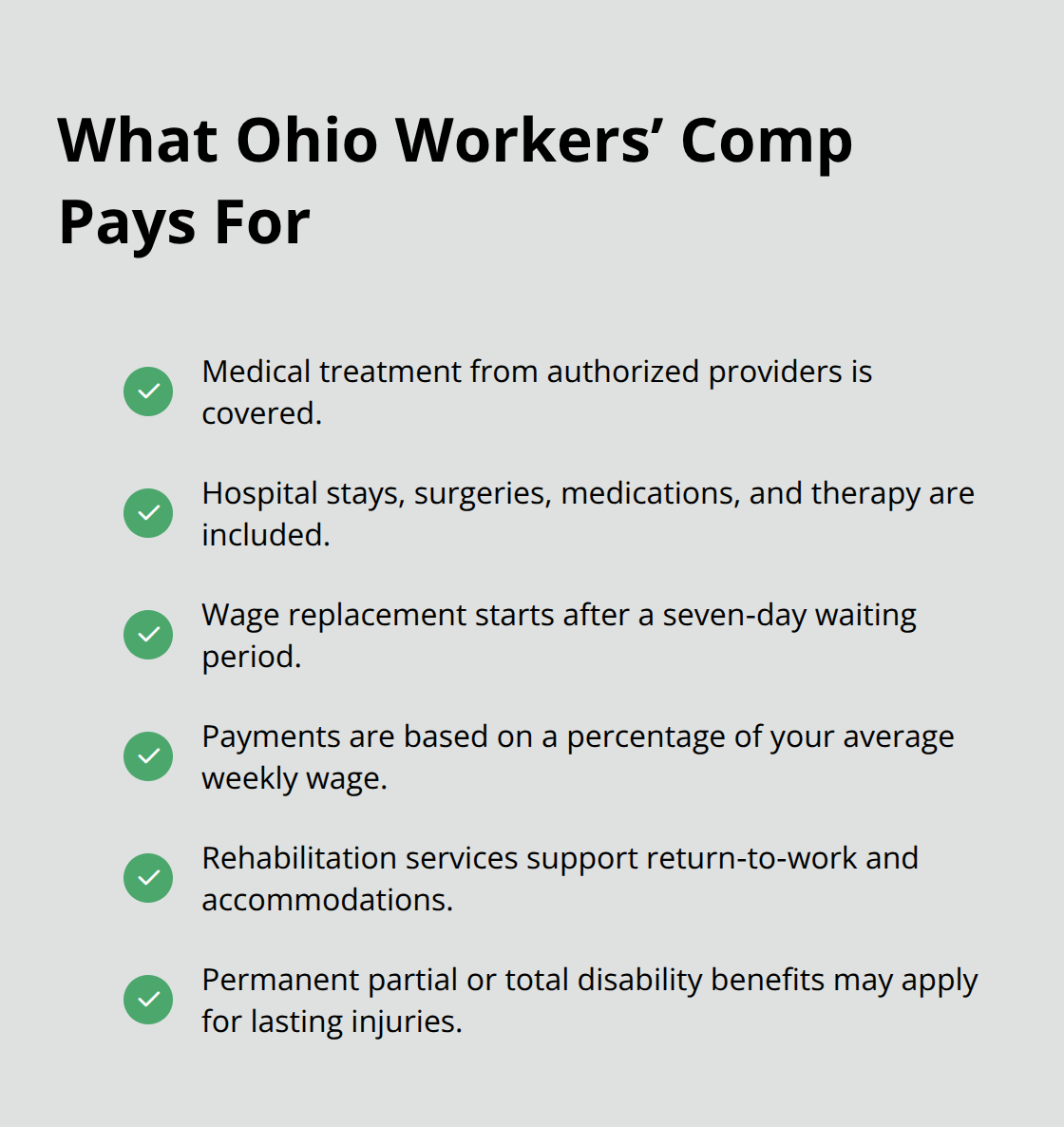
Wage replacement, formally called temporary total disability, starts after a seven-day waiting period and reimburses you at a percentage of your average weekly wage while you cannot work. If your injury becomes permanent, you may qualify for permanent partial disability or permanent total disability benefits that continue indefinitely. Rehabilitation services help you return to work through retraining programs, job placement assistance, or equipment modifications if you have lasting limitations.
Acting Fast When the BWC Denies Your Claim
The Industrial Commission of Ohio handles appeals when the BWC denies your claim, and you must file within a limited window after receiving the denial notice. Act immediately upon receiving the denial because Ohio enforces strict deadlines for appeals. Gather additional medical evidence, witness statements, and documentation that shows how your injury connects to your job duties. The Industrial Commission oversees disputes and provides an independent review separate from the BWC’s initial decision. An attorney fights to overturn denials by presenting evidence at a hearing before an Industrial Commission representative, which substantially increases your odds of winning benefits compared to handling the appeal alone.
Getting Help From the Ombuds Office and Legal Representation
The Ombuds Office at the Ohio Industrial Commission offers non-adversarial assistance if you need help navigating the system without immediately escalating to a formal hearing. Hiring legal representation becomes necessary when claims face denial, when the BWC delays benefits beyond reasonable timeframes, or when your employer retaliates against you for filing. Many injured workers attempt to handle appeals independently and lose because they lack medical evidence or fail to establish the job duty connection clearly. An attorney knows exactly what evidence the Industrial Commission requires and how to present your case persuasively. The investment in legal help proves worthwhile when your livelihood depends on winning your appeal.
Final Thoughts
Ohio’s workers’ compensation system protects you through a no-fault framework that covers medical treatment, lost wages, and rehabilitation when you suffer an injury on the job. The BWC administers this system with clear rules about what qualifies for coverage, making the process predictable once you understand the basics of this Ohio workers comp overview. Report injuries immediately, file your claim within the required timeframe, and gather documentation that proves your injury connects to your job duties.
The BWC will deny your claim if you fail to establish the job duty connection or lack proper medical evidence, but you retain the right to appeal through the Industrial Commission of Ohio. Many workers lose benefits they deserve simply because they don’t fight back or lack proper legal guidance during the appeal process. The Ombuds Office provides free assistance for navigating disputes, and legal representation becomes invaluable when claims face denial or when your employer retaliates against you for filing.
At Robin J Peterson Company, LLC, we represent injured workers throughout Cleveland, Akron, and Canton who need help securing the benefits they deserve from the BWC and the Industrial Commission. Our experience fighting for workers’ rights means we know exactly what evidence the system requires and how to present your case persuasively. Contact us to discuss your situation and learn how we can help protect your rights during this critical time in your recovery.