
Filing a workers’ compensation claim in Ohio can feel overwhelming, especially when you’re dealing with an injury and trying to understand what happens next. At Robin J Peterson Company, LLC, we’ve helped countless injured workers navigate BWC claim processing in Ohio and understand their rights.
This guide walks you through each stage of the process, from filing your initial report to handling approvals or denials. You’ll learn what documentation matters, why claims get delayed, and what options you have if something goes wrong.
How Ohio’s BWC System Works
The No-Fault Foundation
Ohio operates a no-fault workers’ compensation system through the Bureau of Workers’ Compensation, which means you receive coverage for work-related injuries regardless of who caused the accident. This differs fundamentally from private insurance models where fault determines coverage. The BWC handles everything: it processes your claim, manages medical authorization, distributes benefits, and sets premium rates for employers. When you file a claim, you deal with a state agency that follows strict procedures outlined in the Ohio Revised Code, not a private company making coverage decisions based on profit margins.
What the BWC Covers
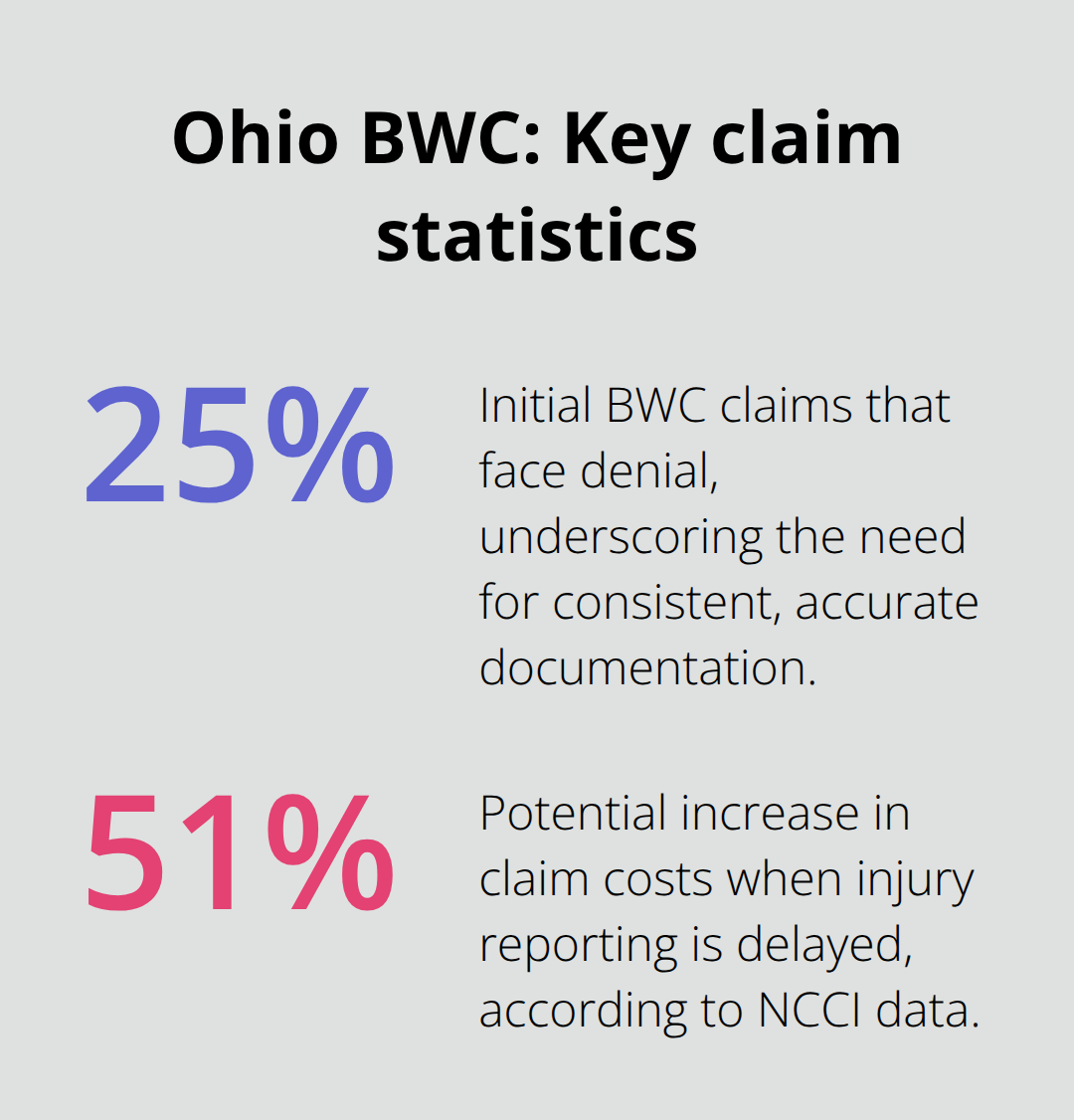
The system covers traumatic injuries like fractures from falls or machinery accidents, as well as occupational diseases such as cancers, infections, and poisonings from substances like asbestos, lead, mercury, and arsenic. About 25% of initial claims face denial by the BWC according to claim data, which means understanding how the system works before you file makes a real difference in your outcome. The BWC’s no-fault approach protects workers across Ohio’s manufacturing sector (which employs nearly 700,000 people and accounts for over 17% of the state’s GDP) and other industries.
The Industrial Commission’s Role in Appeals
The Industrial Commission of Ohio serves as your appeal authority when the BWC denies your claim. If you disagree with a denial decision, you file an appeal with the Industrial Commission, and an administrative law judge reviews the evidence and makes a final determination. This separation of powers matters: the BWC processes claims first, but the Industrial Commission provides independent oversight. You typically have 14 days after a denial to request a hearing, and missing this deadline can waive your right to challenge the decision entirely.
Medical Care and Provider Networks
The BWC operates a Medical Care Organization system that helps coordinate which providers you see, and all providers must be BWC-certified for medical bills to receive payment. The key difference from private insurance is speed and predictability: the BWC maintains a 28-day investigation window after you submit your claim, and the process follows a defined timeline rather than depending on negotiation. For injured workers in manufacturing hubs like Cuyahoga County, where dense industrial facilities operate, understanding these rigid procedural requirements becomes especially important because delays compound quickly.
With the BWC system’s structure now clear, the actual filing process demands immediate action and careful attention to detail.
Filing Your Claim: Speed and Accuracy Matter Most
Act Within 24 Hours of Your Injury
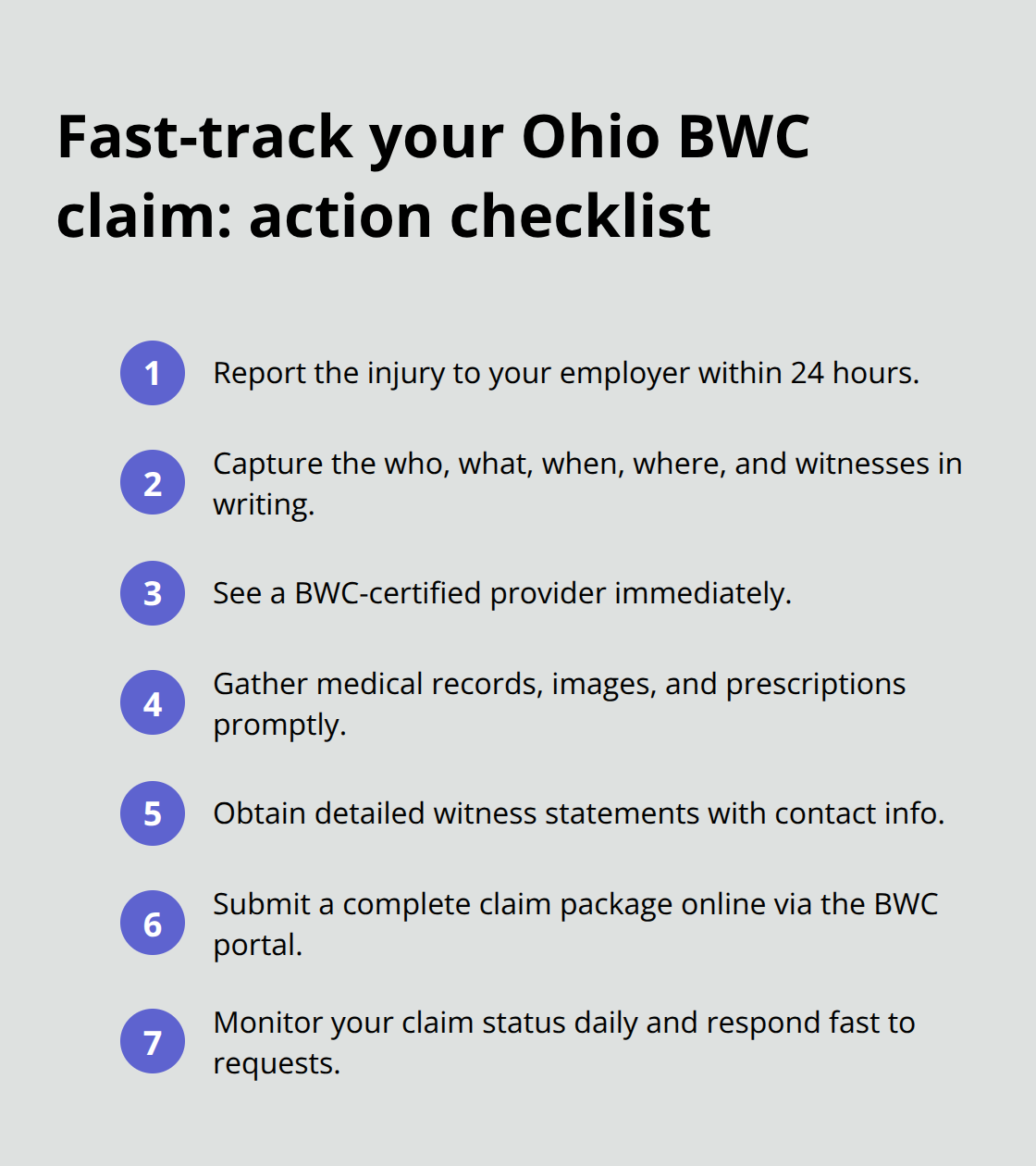
The moment an injury happens at work, you have a narrow window to act. Report the injury to your employer within 24 hours-this action triggers the First Report of Injury filing requirement with the BWC, which is the mandatory starting point for every claim. Your employer or their managed care organization must file this FROI, but you should confirm directly with the BWC that a claim has been filed rather than assuming it happened. Missing this early step creates immediate risk: NCCI data shows that delaying injury reporting can raise workers’ compensation claim costs by up to 51 percent.
Document Everything in Writing
Write down exactly what happened-the time, location, equipment involved, and any witnesses present-and provide this information to your employer in written form, whether through email or a formal accident report. This contemporaneous documentation becomes your foundation. The BWC gives itself 28 days to investigate after you submit your claim and may request additional information during this window, so anything you can provide upfront accelerates the process. Attend every medical appointment with a BWC-certified provider and report your symptoms with precision rather than vague descriptions; claims with unclear injury narratives face longer processing times and higher denial risk.
Gather Medical Records and Witness Statements
Documentation separates approved claims from denied ones. Collect copies of all medical records immediately-diagnoses, treatment notes, imaging results, lab work, prescriptions, and how the injury affects your daily activities. Obtain written witness statements from coworkers who saw the incident, including their names, job titles, contact information, and specific observations about what happened. Take photographs of the incident location and any equipment involved. If you have a pre-existing condition, disclose it honestly and explain how your job duties aggravated it; honesty strengthens credibility with the BWC far more than omission ever will.
Submit Your Complete Claim Package
Store all documents securely with backups because you will need them for submission and potentially for appeals later. Submit your complete claim package through the BWC online portal rather than by mail or phone-incomplete submissions restart the clock and delay processing significantly. The BWC typically acknowledges receipt within about 10 business days, and you will receive an assigned claim number that you must use for all future communications.
Monitor Your Claim and Respond Promptly
Monitor your claim status continuously via the BWC online portal where you can upload additional documents, view payment activity, and review official notices. If the BWC requests more information, respond immediately; vague injury descriptions and slow responses are the primary reasons claims extend beyond necessary timelines. The investigation period that follows your submission determines whether the BWC approves or denies your claim, and your responsiveness during those 28 days directly influences that outcome.
Why Claims Get Denied or Delayed
Inconsistencies Between Your Accident Report and Medical Records
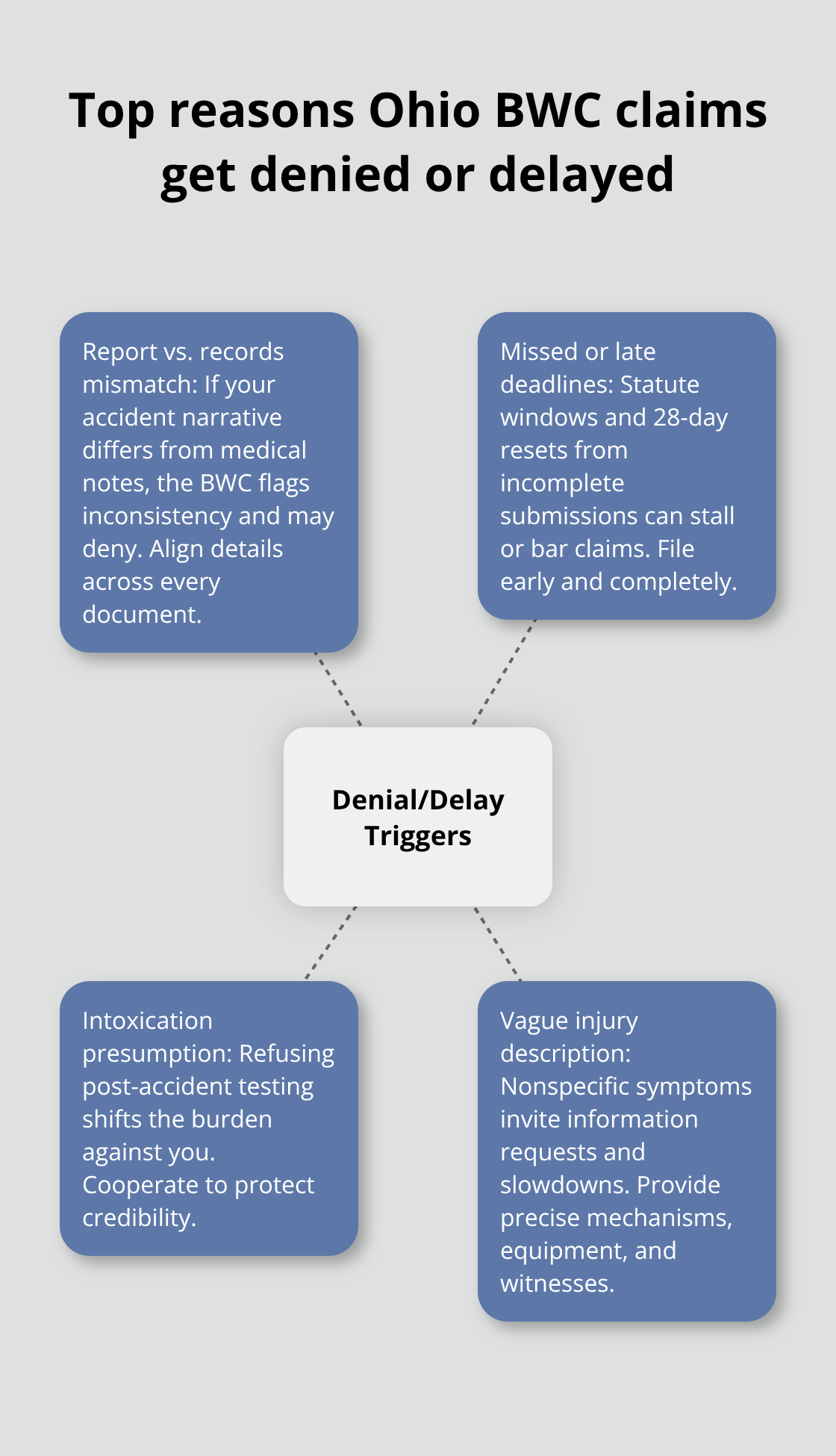
Discrepancies between your accident report and medical records are the primary reason the BWC denies claims, according to claim processing data reviewed across Ohio. If you tell your employer the injury happened when you stepped off a ladder but your medical records describe a different mechanism of injury, the BWC sees inconsistency and denies the claim. This happens because the BWC cross-references everything you submit, and even small contradictions trigger denial.
The solution is straightforward: ensure your written incident description matches exactly what your medical provider documents. When you see a BWC-certified provider, bring notes about exactly when, where, and how the injury occurred. Have the provider document these specifics in their initial assessment. If you wait weeks after the injury to see a medical provider, that gap itself creates a denial trigger because the BWC questions whether the injury truly happened at work or developed gradually from non-work causes.
Timing Problems That Trigger Automatic Denial
Missing deadlines creates another category of denial that is entirely preventable. Ohio law sets specific filing deadlines: within 1 year of a work-related accident, 2 years for occupational diseases, and 1 year for death claims. Missing these deadlines results in automatic claim denial with no exceptions. You must report your injury to your employer and have the First Report of Injury filed within days, not weeks.
If your employer delays filing the FROI, contact the BWC directly at 30 W. Spring St., Columbus, OH 43215-2256 or through their online portal to confirm filing status yourself. Incomplete submissions also restart the clock, meaning if you submit documents but leave out medical records or witness statements, the BWC resets its 28-day investigation window. The timing matters as much as the accuracy.
Intoxication and Post-Accident Testing
Intoxication creates a rebuttable presumption that intoxication caused the injury, so refusing post-accident drug or alcohol testing significantly weakens your claim even if the injury genuinely happened at work. This legal presumption shifts the burden to you to prove the injury occurred independent of any substance use. Cooperation with testing procedures protects your claim’s credibility.
Vague Descriptions That Extend Processing
Vague injury descriptions extend processing time and raise denial risk substantially. Instead of writing that your back hurts, specify which movement caused the injury, what equipment was involved, and which coworkers witnessed it. Precise language in your initial report prevents the BWC from requesting clarification during its 28-day investigation window.
Workers who provide insufficient detail during initial reporting often lose legitimate claims. Proactive documentation and immediate filing eliminate most denial and delay scenarios before they start.
What Happens Next
When the BWC approves your claim, you receive medical benefits covering all authorized treatment from BWC-certified providers, along with wage replacement benefits if you cannot work. The payment schedule depends on your specific situation: temporary total disability payments begin after a waiting period, while permanent partial disability awards are calculated based on your injury type and severity. Monitor the BWC online portal continuously to track payment deposits and review official notices about your benefits.
If the BWC denies your claim, you have exactly 14 days from the denial notice to request a hearing with the Industrial Commission of Ohio. This deadline is strict and non-negotiable; missing it waives your right to appeal entirely. When you file your appeal, gather all supporting evidence including medical records showing work-relatedness, witness statements from coworkers, wage documentation from before your injury, and a clear timeline of your treatment.
An administrative law judge from the Industrial Commission reviews your appeal evidence and makes a final determination. Many injured workers benefit from legal representation during this process because an attorney understands how to present evidence effectively and navigate BWC claim processing Ohio appeals. Contact an experienced workers’ compensation attorney early-even before filing an appeal-to strengthen your position and prevent costly mistakes during the critical 14-day window after denial.