
If you’ve been injured at work in Ohio and can’t return to your job, temporary total disability benefits can help replace your lost wages while you recover.
At Robin J Peterson Company, LLC, we know that navigating Ohio’s workers’ compensation system feels overwhelming. This guide walks you through what temporary total disability in Ohio actually means, how to file your claim, and what obstacles you might encounter along the way.
What Temporary Total Disability Actually Means in Ohio
Temporary total disability in Ohio is straightforward: it’s the temporary inability to return to your former position of employment due to a work-related injury. Under Ohio Revised Code 4123.56, this benefit activates when you lose eight or more calendar days of work because of your injury. The key word here is temporary. TTD isn’t meant to last forever-it covers you during recovery until you reach Maximum Medical Improvement, which is when your condition stabilizes and further treatment won’t improve your condition. During this period, the state replaces a portion of your lost wages, typically between 66 and 72 percent, though amounts can vary based on your specific situation. Medical expenses related to your injury are covered separately and don’t depend on how many work days you’ve missed, which means hospital stays, surgery, medications, and rehabilitation costs are handled outside the wage replacement calculation. A 2013 study by the National Academy of Social Insurance found that roughly 72 percent of wage compensation cases involved temporary total disability benefits, showing just how common TTD claims are across Ohio workplaces.
How TTD Differs from Other Ohio Disability Benefits
Ohio’s workers’ compensation system includes four main compensation types, and TTD is only one piece. Permanent total disability applies when you can’t return to any work and the Industrial Commission of Ohio declares you permanently disabled-this is a much higher bar than TTD and requires formal determination. Permanent partial disability covers residual impairment after you’ve recovered enough to return to some form of work, and an independent medical examiner rates the level of impairment to determine benefits. Wage loss compensation applies if you find work elsewhere but at lower pay, or if you can’t find work within your medical restrictions (though this only applies to injuries occurring after August 22, 1986). TTD is specifically for the period when you cannot work at all while recovering from your injury.
The Direct Result Standard for TTD Eligibility
The Ohio Supreme Court clarified in State ex rel. AutoZone Stores, Inc. v. Indus. Comm., 2024-Ohio-5519, that TTD requires your wage loss to be the direct result of your work-related impairment, not due to other factors like misconduct or termination unrelated to the injury. This means if your employer terminates you for a policy violation before surgery, the wage loss may not qualify for TTD even though you were injured. Your inability to work must stem directly from the injury itself, not from circumstances that would have ended your employment anyway. This ruling creates a clearer standard for what counts as TTD-eligible wage loss and affects how claims are evaluated going forward. Understanding this distinction matters because it shapes whether you’ll qualify for benefits during your recovery period. If you face a denied claim or dispute over whether your wage loss qualifies, the direct result test becomes the central issue in your case.
How to File for Temporary Total Disability Benefits in Ohio
Submit the C-84 Form to the Ohio Bureau of Workers’ Compensation
The C-84 form (Request for Temporary Total Compensation) is your official entry point into Ohio’s TTD system. You submit this form to the Ohio Bureau of Workers’ Compensation at 30 W. Spring St., Columbus, OH 43215-2256. Your employer may file on your behalf, but you don’t need to wait for them to act-you can submit the paperwork yourself. The form is available as an open form online and opens in a new tab when accessed. Speed matters significantly here. The sooner you submit this paperwork after your injury, the sooner the BWC can process your claim and calculate your eligibility date.
Gather Medical Evidence That Links Your Injury to Work Loss
Medical documentation forms the backbone of any TTD claim. You must obtain records from your treating physician that show the specific work restrictions they’ve imposed and the expected duration of those restrictions. Hospital discharge summaries, surgical reports, and ongoing treatment notes strengthen your case considerably. The Ohio Supreme Court’s ruling in State ex rel. AutoZone Stores, Inc. v. Indus. Comm., 2024-Ohio-5519, established that your wage loss must be the direct result of the injury itself, not other employment circumstances. This means the BWC will scrutinize whether your job loss stemmed from your impairment or from unrelated factors like policy violations or performance issues. Collect any communication from your employer about your work status, medical restrictions, and the reasons for any separation. If you remain employed but medically unable to perform your duties, that distinction strengthens your position considerably.
Understand the Timeline and Wage Replacement Calculation
The processing timeline typically moves within weeks once the BWC receives complete documentation, though incomplete submissions cause delays. According to the National Academy of Social Insurance, roughly 72 percent of wage compensation cases involved temporary total disability benefits, indicating the BWC processes thousands of claims regularly.
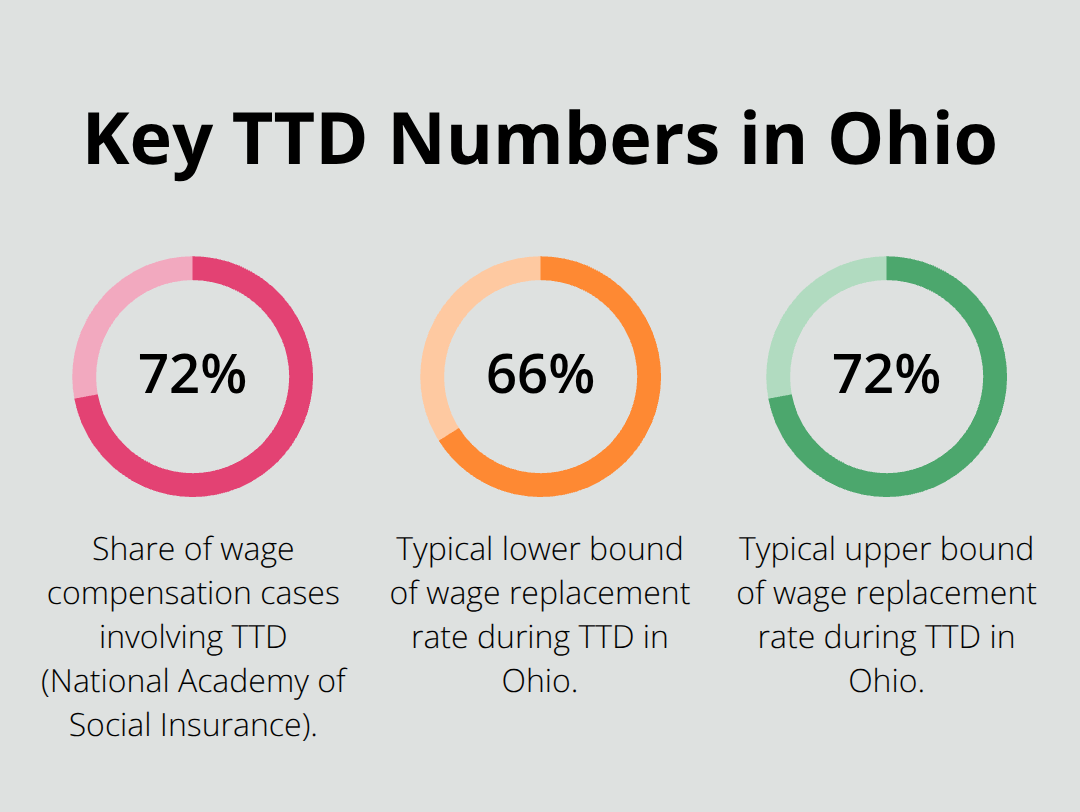
Your wage replacement calculation begins on day 8 of missed work if you’ve lost seven or fewer days, but if you miss more than 14 days, payments retroactively cover those initial seven days as well. The percentage of your wages replaced typically falls between 66 and 72 percent, though your actual amount depends on your specific earnings history and case circumstances.
Challenge Incorrect Determinations Through the Appeals Process
The BWC’s first determination is not necessarily final. If the agency denies your claim or calculates your benefits incorrectly, you have the right to appeal. The Ohio Industrial Commission handles disputes over TTD eligibility and benefit amounts. An experienced workers’ compensation attorney can review your claim before submission, catch errors, and strengthen your position significantly. When the BWC makes a determination that doesn’t reflect your actual situation, appealing that decision becomes your next critical step.
What Stops TTD Claims and How to Fight Back
The Ohio Bureau of Workers’ Compensation denies roughly 15 to 20 percent of initial TTD claims, and delays stretch timelines far beyond the weeks you’d expect. Incomplete medical documentation ranks as the primary culprit-the BWC needs explicit work restrictions from your physician, not vague statements about recovery time. If your doctor hasn’t clearly documented that you cannot perform your job duties, the BWC will request clarification, which adds weeks to processing.
The 2024 AutoZone Ruling Changes Everything
The 2024 Ohio Supreme Court ruling in State ex rel. AutoZone Stores, Inc. v. Indus. Comm., 2024-Ohio-5519 created a major obstacle for many workers. If your employer terminated you before you filed for TTD, the BWC now scrutinizes whether your wage loss stems directly from your injury or from the termination itself. This distinction matters enormously-workers separated for policy violations face uphill battles proving their impairment caused the job loss, not their conduct. The court established that your wage loss must be the direct result of your work-related impairment, not other employment circumstances.
Verify Your Wage Records Before the BWC Calculates Benefits
Wage replacement calculations generate frequent disputes between workers and the BWC. The agency calculates your benefits using your average weekly wage, but if your employer reported incorrect earnings history, the BWC uses flawed numbers. You must verify that your gross wages, overtime, and bonuses are accurately reflected in the BWC’s records before they calculate your percentage. Request your wage file from the BWC and cross-check it against your pay stubs immediately after you file your claim. Errors in this stage compound throughout your entire benefit period.
Protect Yourself When You Return to Work
When you return to work, benefit termination happens automatically, but employers sometimes pressure injured workers to return before they’re medically cleared. The BWC terminates TTD when you can work for any employer at any job within your medical restrictions, not just your original position. If you attempt work and it worsens your condition, you should document this thoroughly with your physician and notify the BWC immediately-you may qualify for reinstatement. An attorney experienced in Ohio workers’ compensation can identify errors in wage calculations, challenge improper terminations, and appeal denials effectively.
Final Thoughts
Temporary total disability in Ohio protects your income when a work injury prevents you from returning to your job. You file the C-84 form with the Ohio Bureau of Workers’ Compensation, and the state replaces 66 to 72 percent of your wages while you recover. The 2024 Ohio Supreme Court ruling in State ex rel. AutoZone Stores, Inc. v. Indus. Comm., 2024-Ohio-5519 added complexity by requiring that your wage loss stem directly from your injury, not from other employment circumstances like termination for misconduct.
Real challenges emerge when claims face denial, wages get calculated incorrectly, or the BWC misinterprets whether your job loss qualifies as TTD-eligible. Roughly 15 to 20 percent of initial claims face denial, and incomplete medical documentation causes most delays. Wage record errors compound throughout your entire benefit period, making verification critical before the BWC calculates your percentage.
An experienced workers’ compensation attorney identifies errors before they damage your claim and challenges improper denials when the BWC gets it wrong. We at Robin J Peterson Company, LLC represent injured workers throughout Ohio’s workers’ compensation system, fighting to secure the benefits you’re entitled to. Contact our firm today to discuss your claim.