
Work injuries happen fast, but filing a BWC claim in Ohio doesn’t have to be complicated. We at Robin J Peterson Company, LLC have helped countless workers navigate this process successfully.
This guide walks you through each step, from reporting your injury to your employer through submitting your claim to the Bureau of Workers’ Compensation. You’ll also learn which mistakes to avoid so your claim gets processed without delays.
Understanding Ohio Workers’ Compensation and the BWC
What the Bureau of Workers’ Compensation Does
The Bureau of Workers’ Compensation is Ohio’s public insurance system that covers medical expenses and lost wages for workers injured on the job. It operates as a state agency, not a private insurance company, which means the rules and processes are standardized across the state. The BWC processes over 200,000 claims annually according to their operational data, and the system exists specifically to provide protection to workers and employers alike. Understanding how the BWC functions is your first step toward getting your claim processed efficiently.
Who Can File a Claim
Eligibility to file a claim depends on your employment status and the nature of your injury. Most private employees, public employees, and certain self-employed workers can file, but independent contractors typically cannot. Your injury must be work-related, meaning it occurred during employment or resulted from job duties. The BWC distinguishes between acute injuries (sudden incidents like falls or equipment accidents) and occupational diseases (conditions that develop over time from workplace exposure).
The Critical First 24 Hours
Reporting your injury to your employer within 24 hours is essential because delays can increase claim duration and lost workdays according to Sedgwick Managed Care Ohio data from 2020 to 2024. Once your employer receives notice, they have the responsibility to file the First Report of Injury with the BWC, triggering the official claims process. You cannot file directly with the BWC yourself; the employer or their managed care organization must initiate the claim. If you’ve already received medical care for your work injury, verify with the BWC that a claim has been filed rather than assuming your employer handled it automatically.
Filing Deadlines You Cannot Miss
The filing timeline in Ohio is strict and unforgiving. You have one year from the date of injury to file a claim for acute injuries, two years for occupational diseases, and one year from the date of death for fatal claims. These deadlines are absolute, and missing them results in claim denial with no exceptions. The BWC then has 28 days to investigate your claim after submission, during which they review medical records, interview witnesses, and examine the circumstances of your injury.

This 28-day window is where most claims succeed or fail, making the completeness of your initial submission essential.
What Happens After Investigation
After the investigation concludes, the BWC issues a formal decision notifying you of approval or denial. If denied, you have approximately 14 days to request a hearing with the Industrial Commission of Ohio to challenge the decision. The next section covers the specific steps you must take to move your claim forward and avoid the mistakes that derail so many applications.
How to File Your BWC Claim in Three Critical Phases
Report Your Injury in Writing Immediately
The moment you report your injury to your employer, the clock starts ticking toward the deadlines that will determine whether your claim succeeds or fails. Your employer must file the First Report of Injury with the BWC, but you cannot sit passively waiting for them to act. Contact your employer’s human resources or safety department immediately and confirm in writing that you have reported the injury. Verbal reports to a supervisor do not count as official notice-you need written confirmation from your employer acknowledging receipt of your injury report.
If your employer claims they never received your report, that denial becomes a serious problem later, so document everything. Some workers make the mistake of assuming a verbal conversation satisfies the reporting requirement, but it does not. If your employer resists or delays, contact the BWC directly at 30 W. Spring St., Columbus, OH 43215-2256 to verify whether the First Report of Injury has been filed. Do not wait more than two business days to make this verification call.
Compile Medical Records and Witness Statements
Gathering documentation is where most claims either gain momentum or stall completely. You need medical records from every healthcare provider who has treated your injury, including exact dates of visits, diagnoses, treatment notes, imaging results, and medication prescriptions. Request these records immediately and maintain copies in a secure location with backups. Obtain witness statements from coworkers who saw the incident happen, including their full name, job title, contact information, and a detailed description of what they observed.
Photographs of the injury scene, hazardous conditions, or equipment involved carry significant weight during the BWC’s 28-day investigation window. Create your own injury log with the exact time, location, tools involved, safety conditions at the moment of injury, and your immediate symptoms. These contemporaneous notes are far more credible than recollections written weeks later. Review your employer’s safety records and personnel file for context about workplace hazards or prior similar incidents.

Submit Everything at Once to the BWC
Once you have compiled all documentation, submit everything to the BWC online through their portal in a single complete package rather than sending pieces separately over weeks. Incomplete submissions reset the investigation timeline and cause unnecessary delays. The BWC adjuster assigned to your case will contact you after submission (so keep your contact details current) and respond promptly to every request for information or clarification.
Your next move depends on the BWC’s decision during their 28-day investigation period. If the agency approves your claim, you will receive notice of benefits eligibility and can begin accessing medical care and compensation. If the BWC denies your claim, you have limited time to challenge that decision through the appeals process.
Common Mistakes That Reset Your Claim Timeline
The 24-Hour Reporting Rule You Cannot Ignore
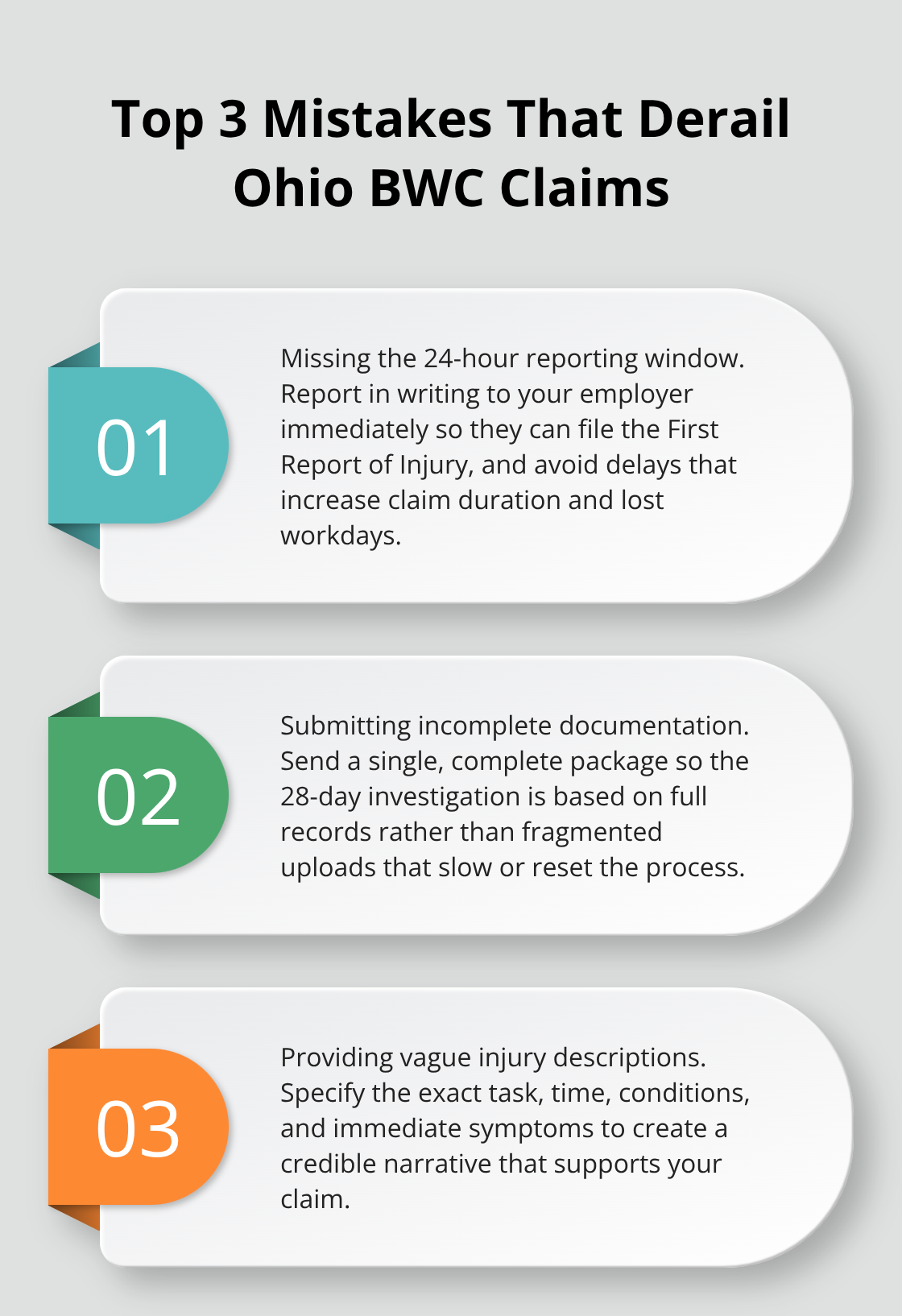
The difference between a claim that moves forward and one that stalls comes down to execution, not luck. Most rejections trace back to three preventable errors that workers make during the filing process. The first and most damaging mistake is failing to report your injury to your employer within 24 hours. Sedgwick Managed Care Ohio data from 2020 to 2024 shows that delays in initial reporting increase claim duration and lost workdays significantly. Your employer cannot file the First Report of Injury without knowing about the incident, and the BWC’s 28-day investigation window begins only after that report reaches them.
If you wait three days or a week to mention your injury, you have already lost time that cannot be recovered. Some workers believe they can report an injury months later and still qualify, but Ohio’s filing deadlines are absolute. One year for acute injuries means one year from the date of the incident, not one year from when you decide to file. Waiting to see if the injury improves on its own is a gamble that almost always fails. The moment you experience a work-related injury, contact your employer’s human resources or safety department in writing and request written confirmation that they received your report. Do not rely on verbal communication with a supervisor.
Incomplete Documentation Kills Your Chances
The second critical mistake is submitting incomplete documentation to the BWC. Workers often send medical records without witness statements, or they upload photographs without treatment notes, expecting the BWC to request missing pieces later. This approach is backwards. The BWC’s 28-day investigation window is your single opportunity to present a complete factual record. When documentation arrives in fragments over weeks, the investigation clock keeps running, and incomplete submissions force the adjuster to make decisions with incomplete information.
Medical records alone are insufficient; you need exact dates of all healthcare visits, diagnoses, treatment notes, imaging results, and medication prescriptions. Witness statements must include the observer’s full name, job title, contact information, and a specific description of what they saw during the incident, not general observations about workplace conditions. Photographs of the injury scene, hazardous equipment, or unsafe conditions add credibility that written descriptions cannot match. Your own contemporaneous injury log (documenting the exact time, location, tools involved, safety conditions, and immediate symptoms) carries more weight than recollections written weeks later.
Vague Descriptions Invite Denial
The third mistake is providing vague or inaccurate descriptions of how your injury occurred. Stating that you experienced back pain at work tells the BWC almost nothing. Instead, specify that you lifted a fifty-pound box at 2:15 p.m. on the packaging line while standing on a wet floor, felt immediate sharp pain in your lower left back, and could not straighten up afterward. This level of detail creates a credible narrative that supports your claim.
Vague injury descriptions give the BWC room to doubt your account and deny your claim based on insufficient evidence. Compile all documentation in one secure location with backups, organize everything chronologically, and submit the entire package to the BWC online in a single submission rather than sending pieces separately over time. The adjuster assigned to your case will contact you after submission (so keep your contact details current) and respond promptly to every request for information or clarification.
Final Thoughts
Filing a BWC claim in Ohio succeeds when you act fast, document thoroughly, and stay organized throughout the process. The three mistakes that derail most claims are preventable: report your injury within 24 hours, submit complete documentation in a single package, and describe your injury with specific details rather than vague statements. Speed matters because the BWC’s 28-day investigation window is your only chance to present a complete factual record, and once that window closes, missing information becomes a permanent gap in your case.
After you file a BWC claim in Ohio, monitor your claim status regularly through the online portal and respond immediately to any requests from the assigned adjuster. Keep copies of everything you submit and maintain current contact information so the BWC can reach you without delay. If the BWC approves your claim, you will receive notice of benefits eligibility and can access medical care and compensation.
If the agency denies your claim, you have approximately 14 days to request a hearing with the Industrial Commission of Ohio to challenge that decision. An experienced workers’ compensation attorney can help you present evidence effectively, cross-examine BWC witnesses, and navigate the appeals process (many firms offer free consultations and work on a contingency basis). We at Robin J Peterson Company, LLC represent injured workers throughout Ohio and have extensive experience challenging BWC denials, so contact us for a free consultation if you need guidance navigating your claim or appealing a denial.