
Factory workers in Ohio face unique challenges when injuries happen on the job. At Robin J Peterson Company, LLC, we’ve helped countless workers navigate the workers’ compensation system and secure the benefits they deserve.
This factory worker claim guide walks you through your rights, the filing process, and why having proper legal support matters. Understanding these steps can make the difference between a denied claim and fair compensation.
What Ohio’s Workers’ Compensation System Actually Covers
Factory workers in Ohio operate under a specific legal framework that protects them when injuries occur on the job. The Ohio Bureau of Workers’ Compensation administers this system, and understanding what falls under coverage matters because not all workplace situations qualify equally. Ohio law requires employers to carry workers’ compensation insurance, and this coverage applies from your first day of employment whether you work full-time, part-time, or seasonally. The system covers medical treatment for work-related injuries, a portion of your lost wages during recovery, and disability benefits if the injury causes temporary or permanent impairment. However, the system only covers injuries and illnesses that arise from your job duties or the work environment itself. If you sustain an injury during a lunch break unrelated to work or if horseplay causes the injury, coverage becomes questionable. Ohio’s General Duty Clause requires employers to maintain workplaces free from serious recognized hazards, and OSHA reports more than 10,000 severe factory-related injuries each year, making this protection especially important in manufacturing environments.
Medical Coverage and Wage Benefits Work Together
Your right to medical treatment stands as one of the strongest protections in Ohio’s system. Employers must cover all reasonable and necessary medical care related to your work injury, and you can seek treatment from a physician of your choice initially. The wage replacement portion typically provides 60 to 70 percent of your lost wages while you cannot work, though this amount has a statutory cap that varies based on your earnings. If your injury requires extended recovery, temporary total disability benefits continue as long as your doctor certifies you cannot return to work. Permanent partial disability applies when you sustain lasting impairment even after maximum recovery, and permanent total disability covers workers unable to return to any gainful employment. Workers’ compensation does not require you to prove fault-you receive benefits regardless of who caused the accident, which removes the burden of proving negligence and speeds up the claims process significantly.
Retaliation Protection Has Real Legal Teeth
Ohio law explicitly prohibits employers from retaliating against workers who file claims or report safety violations. If your employer fires you, cuts your hours, demotes you, or takes any adverse action because you filed a workers’ compensation claim, that action violates state law and creates grounds for legal action. Many workers hesitate to file claims because they fear losing their jobs, but this fear lacks legal foundation. The protection extends to reporting hazards to OSHA or your supervisor, requesting safety equipment, or refusing to work in dangerous conditions. If retaliation occurs, you have the right to file a complaint with the Ohio Bureau of Workers’ Compensation or seek legal counsel immediately. Employers test these boundaries regularly, and workers need to understand that the law stands firmly on their side when retaliation happens.
What Triggers Your Right to File
Work-related injuries and occupational illnesses both qualify for coverage under Ohio’s system. Contact with machinery, overexertion during job tasks, slips and falls on factory floors, and exposure to harmful substances all fall within the scope of compensable claims. The injury must connect directly to your employment-either through a specific accident or through conditions created by your work environment. Once an injury occurs, the clock starts on your obligation to report it to your employer, which leads directly into understanding the filing process and the steps you must take to protect your claim.
How to Report and File Your Workers’ Compensation Claim in Ohio
Report Your Injury Immediately
The moment an injury happens at your factory, timing becomes everything. You must report the injury to your employer immediately-most Ohio employers require notification within 24 hours, though some have stricter internal policies. Verbal notification counts, but follow it with written documentation the same day if possible. Your employer then has specific obligations: they must provide you with a workers’ compensation claim form, report the injury to their insurance carrier, and file paperwork with the Ohio Bureau of Workers’ Compensation within a defined timeframe.
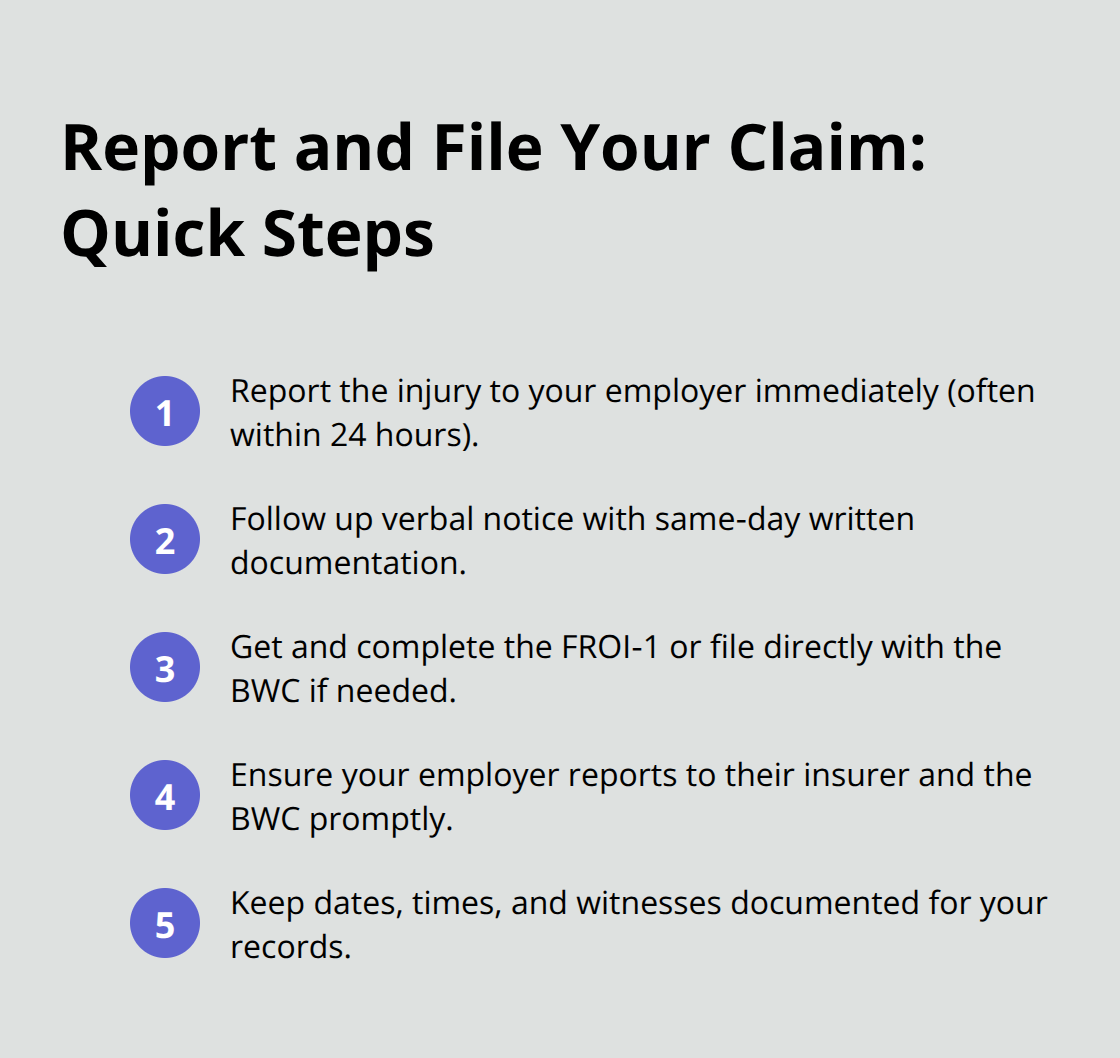
Many employers drag their feet on this step, hoping minor injuries resolve without filing. Do not accept this delay. The longer you wait to initiate the formal process, the harder it becomes to establish that your injury connects to work. Write down the date, time, and exact circumstances of your injury. Include names of witnesses who saw what happened. This documentation protects you if your employer later claims the injury occurred differently or outside of work.
Complete the BWC Forms Accurately
Filing with the BWC requires completing specific forms, and accuracy matters far more than speed. Your employer should provide form FROI-1 within a certain window, but if they don’t, contact the BWC directly at 1-800-644-6292 to request forms or file independently. The BWC will investigate your claim, and during this phase, you’ll receive requests for medical records, witness statements, and additional information about how the injury occurred.
Respond to every request promptly and completely. Incomplete submissions give the BWC reasons to delay decisions or deny claims outright. The investigation typically takes 28 days from filing, though complex cases take longer.
Understand the Investigation Process
Your employer’s insurance company will also investigate, and their goal differs from yours-they want to minimize or deny the claim. This is precisely why many injured workers benefit from legal guidance during investigation. An attorney can ensure your medical evidence supports your claim, that you answer investigative questions strategically, and that you don’t inadvertently damage your case through casual statements.
The BWC will issue an order granting, denying, or modifying your claim once the investigation concludes. If approved, benefits begin flowing. If denied or limited, you have appeal rights and a limited window to challenge the decision. Understanding what happens next-and knowing when mistakes in your claim filing can cost you-requires attention to the common pitfalls that derail many workers’ compensation cases.
Mistakes That Kill Your Claim Before It Starts
Factory workers lose compensation they deserve because they make preventable errors during the filing process. The first and most damaging mistake is waiting too long to report your injury. Ohio employers often pressure workers to handle minor injuries without filing, suggesting the injury will heal quickly and there’s no need to create paperwork. This approach backfires immediately.
Report Your Injury Within 24 Hours
The moment you delay reporting, you weaken your claim’s credibility. Investigators will question why you waited days or weeks to mention an injury that supposedly happened immediately. Your employer’s insurance company uses these delays as ammunition to argue the injury occurred outside of work or wasn’t work-related at all. Report your injury within 24 hours, even if it seems minor.
Write down exactly what happened, where it happened, and who witnessed it. This documentation becomes your shield against claims that you’re misremembering details or exaggerating the circumstances. The BWC investigates claims based on contemporaneous evidence, and the closer your report is to the actual injury date, the stronger your position becomes.
Keep Thorough Medical Records
Documentation of medical treatment is equally critical and equally neglected by many workers. After you file your claim and start treatment, maintain detailed records of every medical visit, every procedure, every prescription, and every conversation with your healthcare provider about your work injury. Workers often assume the medical provider or the BWC will maintain all necessary records, but gaps in documentation create opportunities for claim denials.
If your doctor’s records don’t clearly connect your treatment to the work injury, the BWC may question whether your condition actually stems from your job. Bring medical records to every follow-up appointment and ensure your physician documents how your injury affects your ability to work. Request copies of all medical reports and file them in a safe location separate from your claim paperwork.
Never Accept Settlement Offers Alone
Insurance companies present settlement offers as final opportunities, creating artificial urgency to pressure you into accepting less than you deserve. A settlement that seems reasonable today may prove inadequate if your condition worsens or recovery takes longer than expected. An attorney can evaluate whether a proposed settlement actually covers your medical needs and lost wages fairly.
We at Robin J Peterson Company, LLC regularly see workers who accepted settlements only to face uncovered medical bills months later, and those decisions cannot be reversed once signed. Settlement agreements are permanent, so treat any offer with appropriate caution and seek professional review before you sign anything.
Final Thoughts
The Ohio workers’ compensation system protects factory workers, but only if you navigate it correctly. Filing a claim involves strict deadlines, specific forms, and investigative procedures that trip up workers acting alone. Insurance companies employ experienced adjusters trained to minimize payouts, and the BWC processes thousands of claims annually with limited resources.
An attorney from Robin J Peterson Company, LLC understands Ohio’s BWC regulations inside and out and has handled denied claims, disputed benefit amounts, and settlement negotiations across Cleveland, Akron, and Canton. When the BWC denies your claim or offers inadequate benefits, an attorney knows which appeals to file, what evidence strengthens your position, and how to present your case effectively. Many workers don’t realize they have appeal rights or that denied claims can be overturned with proper legal strategy.
Fighting a denied or disputed claim alone means navigating complex procedural rules while managing your injury recovery. An experienced workers’ compensation attorney handles these details while you focus on healing and also evaluates settlement offers objectively, ensuring any agreement actually covers your medical needs and wage loss fairly. This factory worker claim guide emphasizes documentation and timely reporting, but legal representation transforms those steps into a winning strategy.