
Knee injuries sustained at work can disrupt your life and leave you uncertain about your next steps. Filing a knee injury claim in Ohio involves specific procedures and deadlines that you need to understand.
We at Robin J Peterson Company, LLC help injured workers navigate the workers’ compensation system and secure the benefits and medical care they deserve. This guide walks you through each stage of the process.
Knee Injuries at Work and Ohio Workers’ Compensation
Knee injuries sustained at work can disrupt your life and leave you uncertain about your next steps. Filing a knee injury claim in Ohio involves specific procedures and deadlines that you need to understand. We at Robin J Peterson Company, LLC help injured workers navigate the workers’ compensation system and secure the benefits and medical care they deserve.
Types of Knee Injuries Common in Workplace Settings
Knee injuries account for one in eight workplace injuries across all industries, but construction, manufacturing, transportation, and healthcare workers face the highest risk. These aren’t minor sprains you can walk off. Common workplace knee injuries include ACL tears, meniscus tears, MCL and PCL sprains, fractures, and dislocations. The way these injuries happen matters significantly for your claim.
Slips and falls on wet or uneven surfaces, heavy lifting with poor technique, kneeling on hard surfaces for extended periods, and equipment failures cause most workplace knee injuries. Construction workers experience the highest rate of knee injuries at approximately 13.2 per 10,000 full-time employees annually, according to the Bureau of Labor Statistics. The severity varies dramatically-an ACL tear from a fall on a construction site differs fundamentally from a meniscus tear sustained while lifting materials. Each injury type follows different recovery timelines and treatment paths, which directly affects your benefits and the medical care you’ll receive.
How Ohio’s Workers’ Compensation System Works for Knee Injuries
Ohio’s workers’ compensation system requires that your knee injury arise out of and occur during the course of employment. This means the injury must connect to your job duties, not simply happen while you’re at work. The Ohio Bureau of Workers’ Compensation evaluates your claim using medical records, your job description, incident reports, and witness statements to determine whether a genuine work connection exists.
Insurers commonly challenge claims aggressively. They dispute causation, deny treatment requests, demand excessive paperwork, and pressure you to return to work prematurely. You need medical evidence that explicitly states your knee injury is work-related-your doctor’s statement carries significant weight with the BWC.
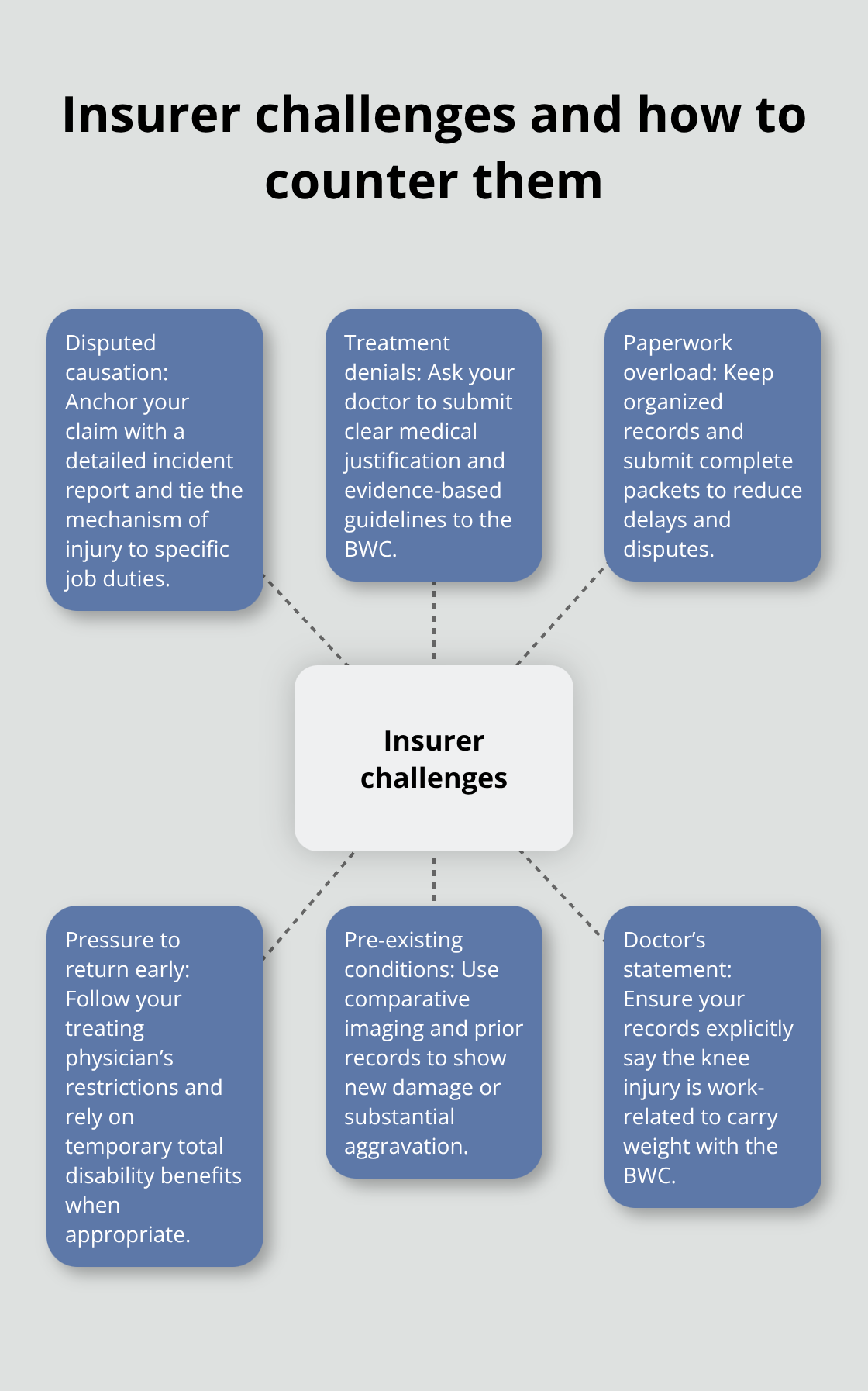
If you have a pre-existing knee condition, you must demonstrate that the current injury caused new damage or substantially aggravated the existing problem. Prior knee treatment records become essential in these situations.
The system provides three primary benefits: temporary total disability benefits equal to two-thirds of your average weekly wage while you recover, medical benefits covering all reasonable and necessary treatments with no dollar limits or copays, and permanent partial disability compensation based on your impairment rating assigned after you reach maximum medical improvement.
Filing Timeline and Notification Requirements
Speed matters in Ohio workers’ compensation claims. You must notify your employer within 30 days of your knee injury, though notifying them immediately strengthens your position.
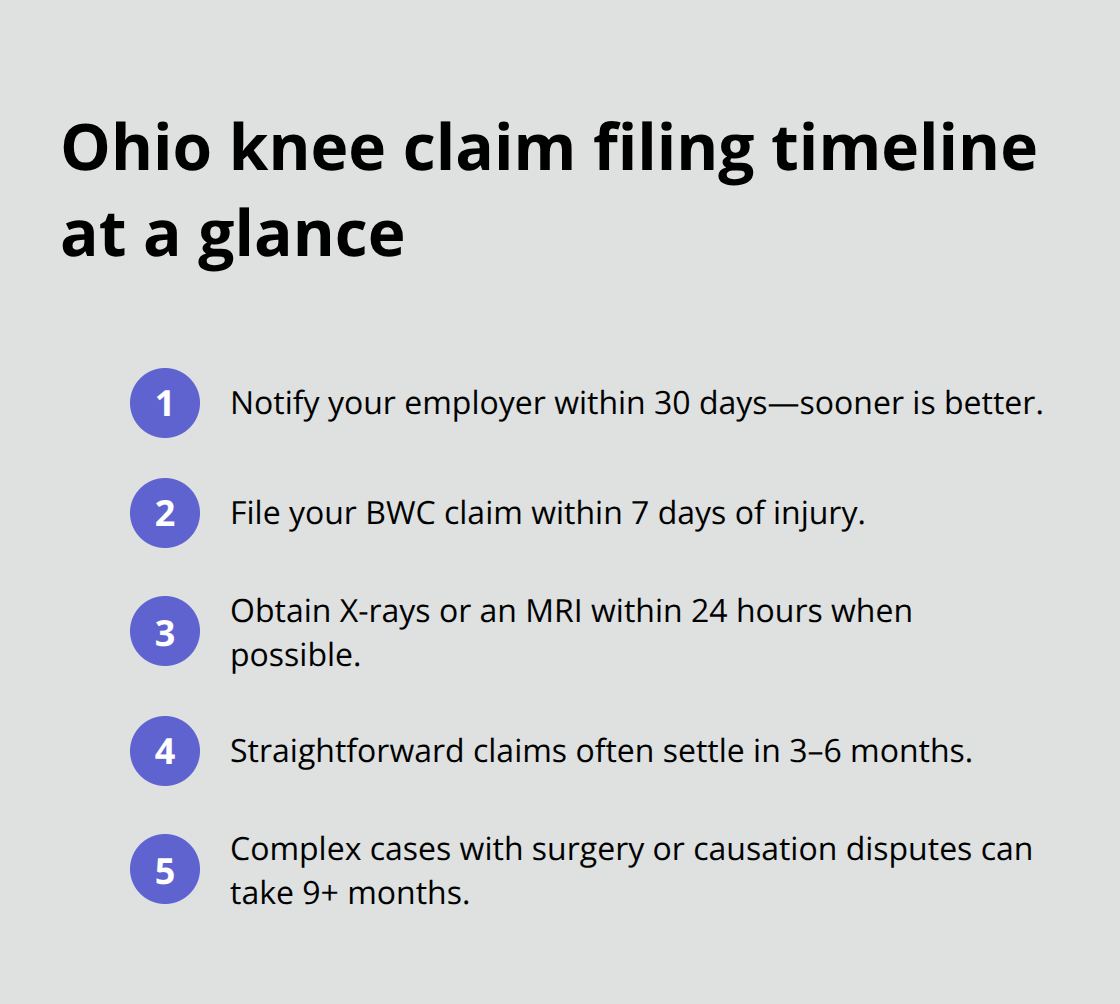
File your claim with the Ohio Bureau of Workers’ Compensation within 7 days of the injury. Missing these deadlines can jeopardize your entire claim.
Straightforward knee injury claims typically settle within 3 to 6 months, but complex cases involving surgery or causation disputes extend to 9 months or longer. Seek immediate medical treatment after your injury occurs. Obtain diagnostic tests like X-rays or MRIs within 24 hours when possible-this rapid documentation strengthens your claim considerably.
Building Strong Documentation From the Start
Create detailed incident reports that document exactly how the injury happened. Gather witness statements from coworkers who saw the incident, and photograph or video the hazardous conditions that caused your injury. Keep wage records showing your earnings during the 52 weeks before the injury, as these determine your benefit calculations. Medical records should include imaging results, surgical reports if applicable, and physical therapy notes.
The Industrial Commission of Ohio oversees dispute resolution if the BWC denies your claim or if you need to escalate a causation dispute. Having organized documentation from the start prevents delays and strengthens your position against insurer resistance. Once you understand the types of injuries covered and the system’s requirements, the next critical step involves taking action to report your injury and begin the formal filing process.
How to File Your Knee Injury Claim in Ohio
Report your injury to your employer within 30 days, but waiting even a week weakens your position significantly. Call your supervisor immediately and follow up with written notification via email or certified mail so you have documented proof of the report. Include the date, time, location, and exact circumstances of how the injury occurred. Your employer must then notify the Ohio Bureau of Workers’ Compensation, but don’t assume they will do this correctly or promptly. File your claim directly with the BWC within 7 days of the injury regardless of what your employer does. This 7-day window is absolute-missing it can result in claim denial. Contact the BWC at 30 W. Spring St., Columbus, OH 43215-2256 or use their online filing system to submit Form C-87, the Application for Workers’ Compensation Benefits. Simultaneous reporting to your employer and the BWC creates overlapping documentation that protects you if either party fails to act.
Obtain Medical Evidence Within Hours
Seek medical treatment on the day of your injury or the next morning at the latest. Obtain X-rays or MRI scans within 24 hours when possible because imaging obtained this quickly carries substantially more weight than tests performed weeks later. The medical records must explicitly state that your knee injury is work-related. If your doctor’s initial notes lack this work-related statement, schedule a follow-up appointment and request the doctor add it to your chart. Request copies of all diagnostic imaging, surgical records if applicable, physical therapy notes, and any recommendations for ongoing treatment.
Pre-existing knee conditions require special attention. Obtain records of any prior knee injuries, treatments, or surgeries you received before this work injury. Your medical team needs to compare old imaging with new imaging to show that the current injury caused additional damage beyond what existed previously. This comparison is essential when insurers challenge your claim by arguing the injury was pre-existing.
Compile and Submit Complete Documentation
The BWC requires specific documents to process your claim efficiently. Include the incident report describing exactly how the injury happened, witness statements from coworkers present at the scene, photographs or video of the hazardous conditions that caused the injury, and your wage records from the 52 weeks before the injury. Medical documentation should contain imaging results, surgical reports, and treatment plans. Incomplete submissions delay processing by weeks or months.
Insurers use these delays strategically to pressure you into accepting lower settlements or returning to work prematurely. Submit everything at once rather than sending documents piecemeal. Use the BWC’s online portal or mail everything certified to create a paper trail. Keep copies of everything you submit. When you contact the BWC or insurers, reference submission dates and specific documents included in your filing. This documentation discipline prevents disputes over what was actually submitted and when.
Access Support When You Need It
The Ohio Industrial Commission Ombuds Office offers free assistance navigating this process if you encounter resistance from the BWC or your employer’s insurer. Contact them through the BWC website if the claim process stalls or you receive denials that seem unreasonable. An experienced workers’ compensation attorney can also guide you through these initial steps and help you avoid costly mistakes. With your claim filed and documentation submitted, you now face the critical task of selecting the right medical providers and understanding what treatments the BWC will cover.
Navigating Medical Care and Treatment Options
Once your claim is filed, selecting the right medical provider and understanding what treatments the Ohio BWC covers become your immediate priorities. The BWC maintains a network of certified physicians and orthopedic specialists, but you have the power to select your treating doctor rather than accept whoever your employer’s insurer recommends. Start by using the Enhanced Care Program physician locator tool on the BWC website to find knee-injury specialists near you. This tool identifies providers specifically trained in workplace knee injuries and familiar with BWC requirements, which matters significantly because your doctor’s documentation directly influences your benefits.
Selecting Your Treating Physician
Your initial treating physician establishes whether your injury is work-related in their medical records, and this statement carries substantial weight throughout your claim. If your first doctor fails to explicitly document the work-related nature of your injury, schedule a follow-up visit and request they add this notation to your medical chart. You can switch physicians if your current doctor isn’t responsive or dismisses your symptoms, but you must obtain BWC approval before changing providers.
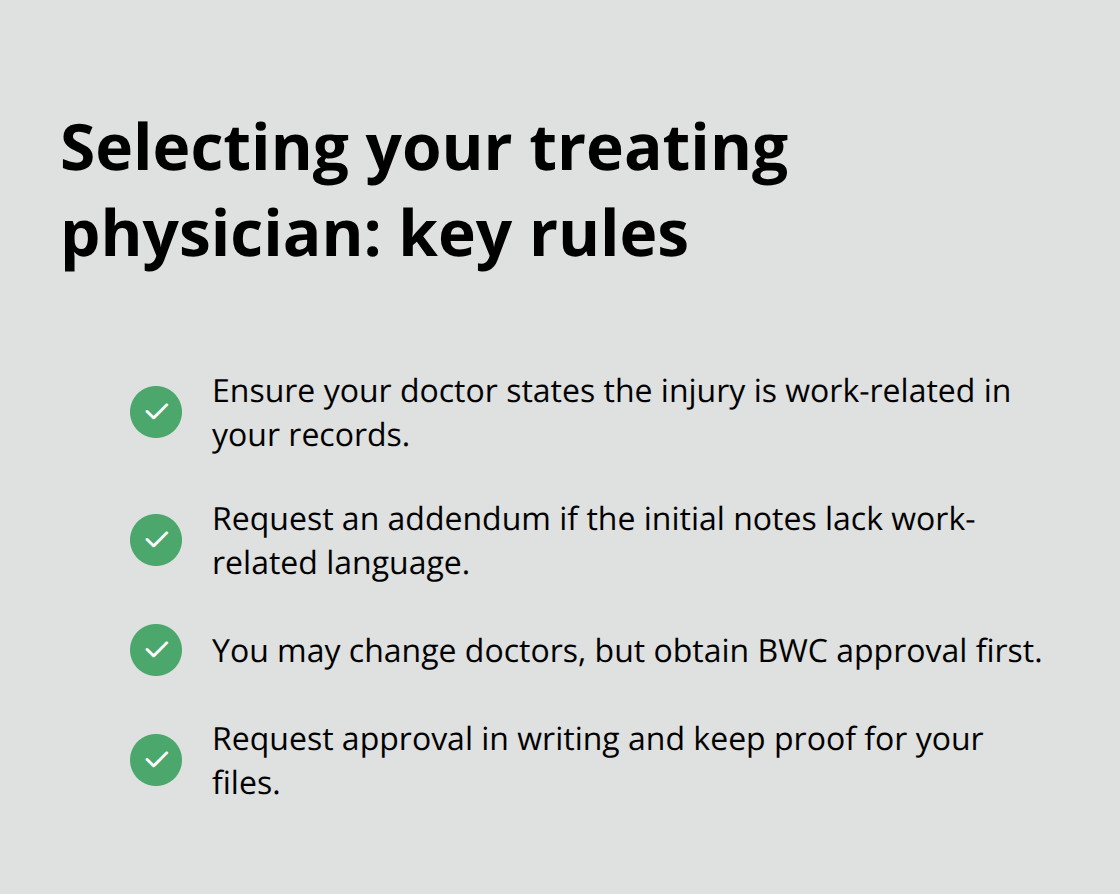
Request this approval in writing and keep documentation of your request.
Understanding Your Medical Coverage
Medical benefits under Ohio’s system cover all reasonable and necessary knee treatments with no dollar limits and no copays, which means the insurer cannot deny treatment based on cost alone. This coverage includes physical therapy, imaging studies, surgical interventions, and ongoing rehabilitation. However, insurers frequently deny treatment requests or demand excessive documentation before approving care. When your doctor recommends treatment, request that they submit the treatment plan to the BWC with clear medical justification explaining why the treatment is necessary for your recovery.
Countering Treatment Denials
If the insurer denies a recommended treatment, your doctor should provide medical literature supporting the treatment’s necessity and challenge the denial in writing. For complex cases or surgeries, consider working with an experienced workers’ compensation attorney who understands how to counter insurer resistance and escalate disputes to the Industrial Commission of Ohio when appropriate. An attorney can help you navigate these obstacles and protect your right to necessary care.
Managing Your Recovery Timeline
Long-term care and rehabilitation timelines vary dramatically depending on your injury severity-straightforward meniscus tears might require 3 to 6 months of physical therapy, while ACL reconstruction demands 6 to 12 months of intensive rehabilitation before returning to physical duties. The BWC covers vocational rehabilitation if your knee injury prevents you from returning to your prior job duties, which can include retraining costs and job placement assistance. Document every treatment session, every symptom change, and every conversation with medical providers because this documentation strengthens your position if the insurer later disputes the necessity of ongoing care or attempts to close your claim prematurely.
Final Thoughts
Filing a knee injury claim in Ohio demands immediate action, thorough documentation, and persistence against insurer resistance. You must notify your employer within 30 days, file with the Ohio Bureau of Workers’ Compensation within 7 days, obtain medical imaging within 24 hours, and compile complete documentation from the start. Your medical records must explicitly state the work-related nature of your injury, and you have the right to select your treating physician rather than accept whoever the insurer recommends.
The Ohio workers’ compensation system protects injured workers, but insurers routinely challenge causation, delay approvals, and pressure you into accepting inadequate settlements. Medical benefits cover all reasonable and necessary treatments with no dollar limits or copays, yet you’ll need to counter treatment denials aggressively when insurers resist. Long-term recovery timelines vary by injury severity, and the BWC covers vocational rehabilitation if your knee injury prevents return to your prior duties.
We at Robin J Peterson Company, LLC represent injured workers throughout the Cleveland, Akron, and Canton areas, fighting against employers and insurers to secure the benefits you deserve. Our experience with Ohio’s workers’ compensation system means we understand the tactics insurers use and how to counter them effectively. Contact us for a free consultation to review your documentation strategy and evaluate your knee injury claim Ohio strength.