
Construction work carries real dangers. Falls, equipment accidents, and chemical exposure happen every day on job sites across Ohio.
At Robin J Peterson Company, LLC, we know that understanding your construction site injury rights makes a difference when you’re hurt on the job. This guide walks you through what protections exist, how to file a claim, and what obstacles you might face.
Types of Construction Site Injuries on Ohio Job Sites
Falls remain the leading cause of death
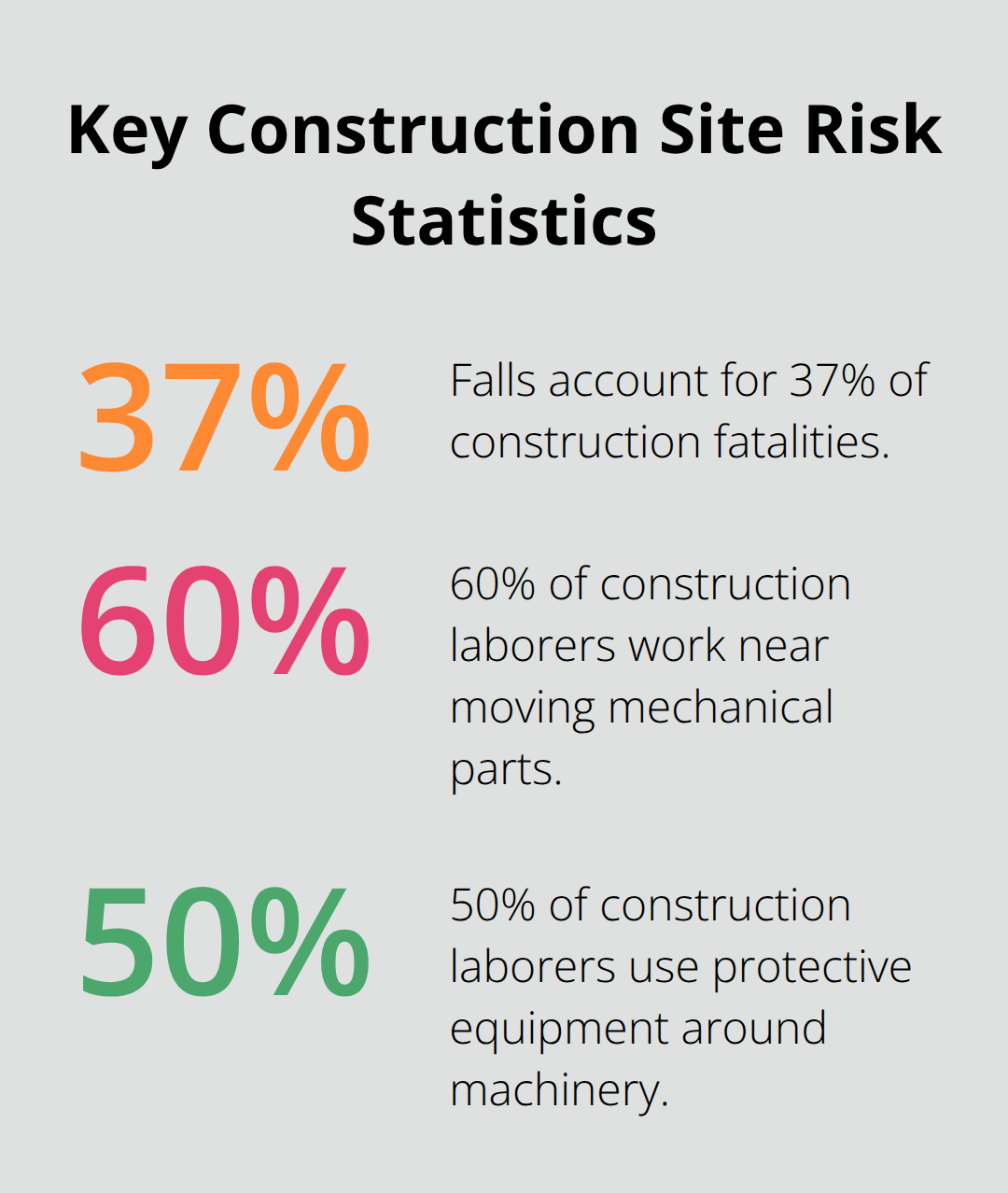
Falls account for 37% of construction fatalities according to the U.S. Bureau of Labor Statistics. For construction laborers specifically, falls or trips caused 31.2% of all deaths that year. The nonfatal injury picture shows the same pattern: construction laborers experienced a fall, slip, or trip incidence rate of 52.5 per 10,000 full-time workers in 2020, significantly higher than the overall construction rate of 41.1 per 10,000. Height exposure affects most Ohio job sites-62.2% of construction laborers work at heights, yet only about 31.2% actually use protective equipment to reduce that risk. This gap between exposure and protection explains why falls remain a persistent problem on construction sites.
Equipment and machinery hazards create immediate danger
Being struck by falling objects or caught in machinery represents the second major threat on construction sites. About 60% of construction laborers work near moving mechanical parts, but only 50% use protective equipment. Of those using PPE, just 3.8% have full protection against machinery incidents.
Transportation-related fatalities spiked in 2020 with 75 deaths among construction laborers-the highest in five years-making vehicle and equipment accidents a leading cause of death in the industry.
Electrocution and chemical exposure cause acute injuries
Electrocution and chemical exposure round out the acute injury spectrum on Ohio job sites. Construction sites expose workers to hazardous contaminants regularly: 25.5% of construction laborers face exposure to hazardous materials, with only 21.4% using protective equipment. These exposures cause injuries ranging from chemical burns and respiratory damage to electrocution from faulty wiring or improper grounding.
Document everything immediately after an injury
When you suffer any of these injuries on an Ohio job site, report the incident to your contractor or property owner immediately, then seek medical attention. Take photos of the accident scene, your injuries, and any safety violations you observed. Collect contact information from witnesses. This documentation becomes critical evidence if you need to pursue a claim with the Ohio Bureau of Workers’ Compensation or if third-party liability exists beyond your employer’s responsibility.
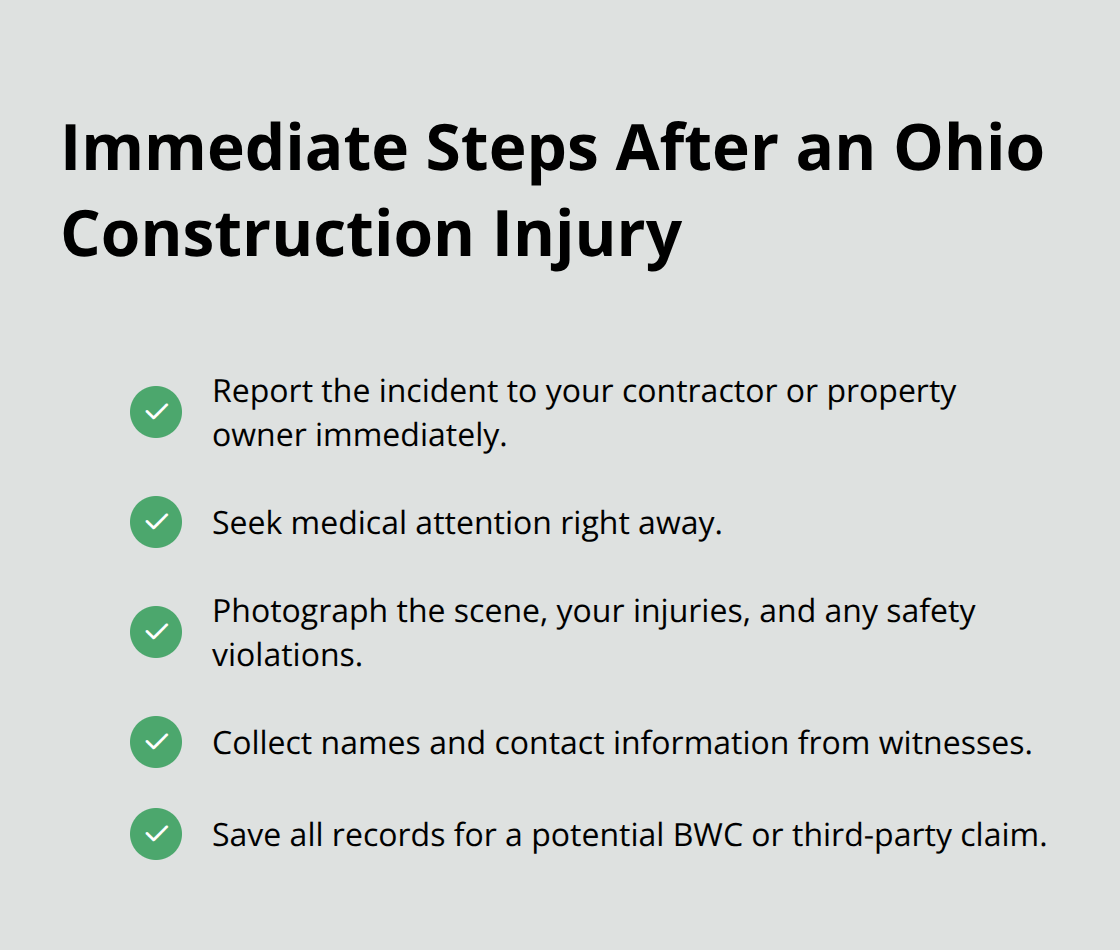
The steps you take in the first hours after an injury directly impact your ability to recover full compensation.
Your Legal Rights After a Construction Injury
File your claim with the Ohio BWC immediately
Filing a workers’ compensation claim with the Ohio Bureau of Workers’ Compensation starts the moment you report your injury to your employer. Ohio law requires you to notify your employer within 30 days of the injury, though reporting immediately protects your rights and creates a documented record. Your employer must then file a claim form with the BWC within 14 days of learning about the injury.
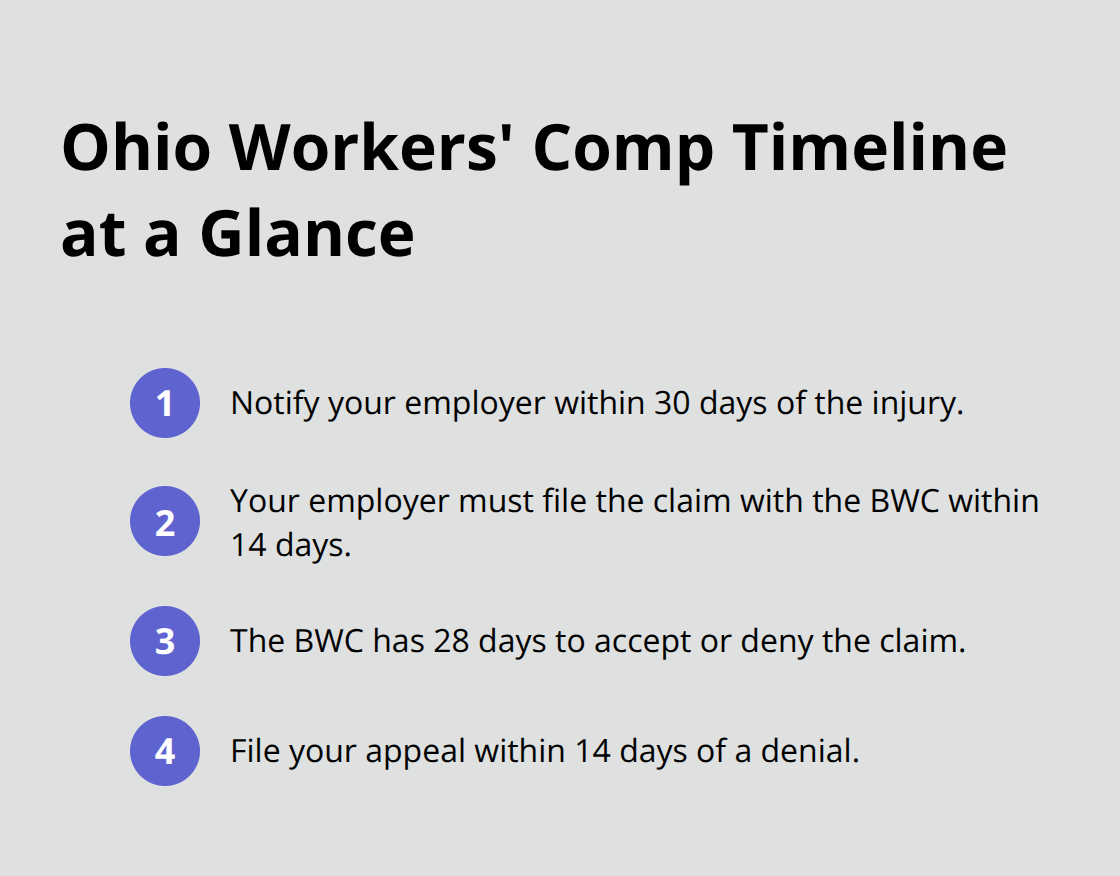
This timeline matters because delays in reporting can complicate your case and give employers room to dispute causation.
Know what the BWC will cover and what it won’t
After your employer files, the BWC has 28 days to accept or deny the claim. During this waiting period, continue documenting everything: medical records, prescription receipts, and any communication from your employer or the BWC. If the BWC accepts your claim, you gain access to medical treatment for your injury without paying out of pocket, and you receive wage replacement benefits equal to 66.67% of your lost wages. These benefits continue for up to 104 weeks if you cannot return to work. The BWC also covers rehabilitation services and vocational training if your injury prevents you from returning to your previous job. However, Ohio’s workers’ compensation system does not compensate for pain and suffering or punitive damages, which is why understanding third-party liability becomes critical when someone other than your employer contributed to the dangerous conditions that caused your injury.
Recognize retaliation and act fast
Ohio law explicitly prohibits employers from firing, suspending, or demoting you because you filed a workers’ compensation claim or reported a workplace injury. This protection exists under Ohio Revised Code Section 4123.90, but retaliation still occurs regularly. Employers sometimes claim poor performance or restructuring as the reason for termination when the real cause is your injury claim. If you experience retaliation within one year of filing your claim, you can file a complaint with the BWC’s Wage Loss Division. Document everything: emails, performance reviews, witness statements, and the timeline of your employment changes. If you believe retaliation occurred, contact an attorney experienced in Ohio workers’ compensation law immediately, as the burden of proof shifts to your employer once you establish a prima facie case showing you filed a claim and suffered an adverse employment action shortly afterward.
Understand when third-party claims matter
Beyond workers’ compensation benefits, you may hold other parties liable if they created or failed to correct the dangerous conditions that injured you. General contractors, subcontractors, property owners, or equipment manufacturers can face liability when their negligence or safety violations contributed to your injury. Third-party claims allow you to recover full lost wages (present and future), medical costs, and non-economic damages like pain and suffering-compensation that workers’ comp alone cannot provide. This distinction between workers’ comp and third-party recovery shapes your overall recovery strategy and determines whether you have grounds to pursue additional compensation beyond your employer’s insurance.
Common Obstacles in Construction Injury Claims
Causation disputes block many valid claims
The Ohio BWC does not automatically approve every claim that arrives at its office. Disputes over causation rank among the most common rejections we see. The BWC requires clear medical evidence that links your injury directly to your job duties. If you suffered a fall from height but have a pre-existing back condition, the BWC may argue your pain stems from the old injury, not the new incident. This distinction matters enormously because it determines whether you receive benefits at all.
Obtain detailed medical documentation immediately after your injury. Your doctor’s report should explicitly state that your job duties caused or aggravated your condition. Include witness statements from coworkers who saw the accident happen. The more specific your evidence about what occurred and how it injured you, the harder it becomes for the BWC to deny causation. Many workers lose claims not because they lack valid injuries, but because they failed to document the connection between their work and their medical condition.
Processing delays leave you without income
The BWC has 28 days to accept or deny your claim, but that timeline often stretches beyond what workers can afford. During this waiting period, you have no wage replacement benefits. If you cannot work, you face mounting bills while waiting for approval. Some claims get stuck in limbo for months when the BWC requests additional medical records or clarification on job duties.
Your employer may also resist filing the claim form promptly, which creates further delays. When the BWC denies your claim, you have the right to request reconsideration or appeal to the Industrial Commission of Ohio, but this process takes additional months. Meanwhile, your medical bills accumulate and your financial situation deteriorates.
Take action to accelerate your claim
Stay in constant communication with the BWC claims examiner assigned to your case. Call every two weeks to check status. Request written confirmation when you submit documents. If processing stalls beyond 30 days, escalate to a supervisor. Denied claims require immediate action-do not wait passively. File your appeal within 14 days of the denial letter (missing this deadline can permanently bar your recovery).
At Robin J Peterson Company, LLC, we help injured workers navigate these procedural requirements because the steps you take directly affect your outcome. Missing deadlines or failing to follow proper appeal steps can eliminate your chance at recovery entirely.
Final Thoughts
Construction site injury rights in Ohio protect you when accidents happen on the job, but these protections only work if you act on them. The 30-day reporting window, the 28-day claim decision period, and the 14-day appeal deadline move forward whether you’re ready or not-missing even one deadline can eliminate your recovery entirely. Causation disputes, processing delays, and employer pushback create real obstacles that injured workers face while recovering from serious injuries.
An experienced attorney handles the procedural requirements, communicates with the Ohio Bureau of Workers’ Compensation on your behalf, and identifies whether third-party defendants exist beyond your employer. They know which medical documentation the BWC will accept, file appeals before deadlines pass, and escalate claims that stall in processing. They fight for the full compensation you’re entitled to receive when construction site injury rights apply to your situation.
Contact Robin J Peterson Company, LLC to discuss your rights and your options for recovery if you’ve been injured on a construction site in Ohio’s Cleveland, Akron, or Canton areas. We represent injured construction workers throughout the region and understand how to secure the benefits you deserve.