
Filing a BWC claim in Ohio involves specific steps and deadlines that many people get wrong. Missing even one requirement can delay your benefits or result in a denied claim.
We at Robin J Peterson Company, LLC have helped countless workers navigate BWC claim filing in Ohio successfully. This guide walks you through the exact process, common pitfalls, and what to do if your claim gets denied.
How the Ohio BWC System Works
The Ohio Bureau of Workers’ Compensation is a state agency that administers all work-related injury claims in Ohio, not a private insurance company. This distinction matters because the BWC operates under a monopoly system-employers cannot buy workers’ compensation coverage from private insurers. Instead, they pay into the state fund, which then pays benefits to injured workers. The BWC handles everything: claim processing, benefit payments, medical authorization, and dispute resolution. Unlike private insurance where claim decisions vary based on the insurance company’s policies, the BWC follows a standardized set of rules established by Ohio law and the Industrial Commission of Ohio. This creates consistency across claims but also means you’re dealing with a government bureaucracy that moves on its own timeline.
Processing Times and What to Expect
The Ohio BWC maintains a 28-day investigation window after you submit your claim. During this period, the assigned adjuster contacts your employer, your healthcare provider, and potentially you to gather information and verify the work-related nature of your injury. Sedgwick Managed Care Ohio data from 2020–2024 shows that delays in reporting injuries correlate directly with longer claim durations and more lost workdays overall. If you submit a complete claim package with all required medical documentation and witness statements upfront, the investigation moves faster because the adjuster doesn’t need to request additional information repeatedly. Incomplete submissions restart the clock, so a missing medical record or vague injury description adds weeks to the timeline. After the 28-day window, the BWC either approves your claim, denies it, or requests more information.
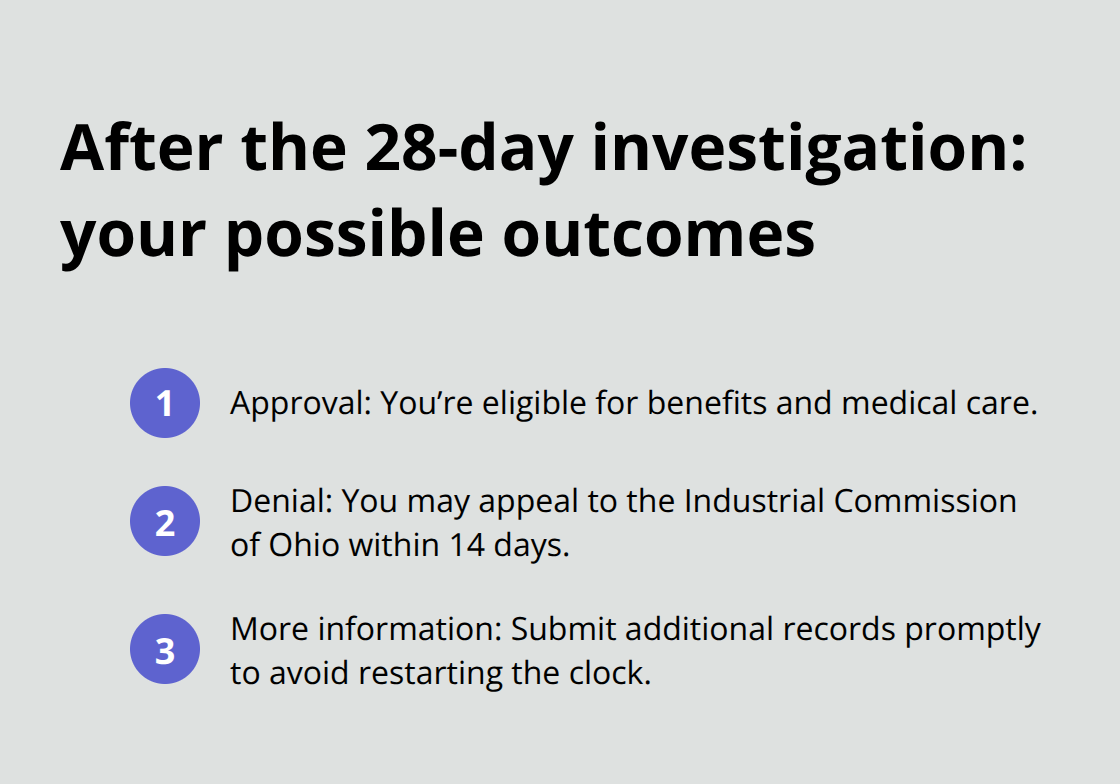
Approval means you receive a notice of benefits eligibility and can access medical coverage and wage replacement benefits. A denial triggers your right to appeal through the Industrial Commission of Ohio within 14 days.
Why Delays Cost You Real Time and Benefits
The National Council on Compensation Insurance reports that delaying injury reporting raises claim costs by up to 51 percent. This happens because late reporting triggers additional investigations, more scrutiny of your medical records, and increased skepticism about the work-related connection. The BWC adjuster questions why you waited to report if it was truly a workplace injury. Employers who file the First Report of Injury within 24 hours of your report avoid this penalty. Medical documentation becomes your evidence, so you must obtain all treatment records, imaging, lab results, prescriptions, and notes about how the injury affects your daily activities. These materials strengthen your position immediately. Proactively upload these records through the online portal before the adjuster requests them-this demonstrates thoroughness and prevents the back-and-forth that extends timelines. Witness statements from coworkers who observed the incident (including their name, job title, and detailed description of what happened) add credibility to your claim and reduce the adjuster’s questions.
Building a Strong Claim Package From the Start
You strengthen your claim significantly when you compile all supporting materials before submission. Photograph the incident site if possible to show hazards or unsafe conditions, then combine photos with witness statements to create a strong factual record. Create your own contemporaneous incident log that documents the time, location, tools involved, weather conditions, and safety measures in place. Obtain your employer’s records (safety training, incident reports, job descriptions, safety logs, personnel files) to illustrate the work environment. Organize all documents chronologically in a secure location with backups, and prepare to share them with an attorney if needed. Submit your complete claim package online-online submissions process faster than paper submissions. The BWC adjuster will contact you, your employer, and your medical providers after submission, so respond to every request promptly and keep your contact information current.
Filing Your BWC Claim: The Actions That Matter
Report your injury to your employer within 24 hours of it happening. This is not a suggestion-it’s the single most important action you can take to protect your claim. When you wait, the BWC adjuster becomes suspicious about whether the injury was truly work-related. The National Council on Compensation Insurance reports that delaying injury reporting raises claim costs by up to 51 percent, and Sedgwick Managed Care Ohio data from 2020–2024 confirms that late reports correlate with longer claim durations and significantly more lost workdays. Your employer then files the First Report of Injury (FROI) with the BWC, which officially starts your claim. If your employer hasn’t filed within a few days, contact the BWC directly to confirm a claim has been opened. Once filed, you receive a claim number and an assigned adjuster-write down both immediately and use them for every future communication.
Seek Treatment and Gather Medical Records Immediately
Seek medical treatment from a BWC-authorized provider right away. Delaying treatment weakens your claim because the adjuster questions the severity of your injury and whether it was truly work-related. Obtain copies of every medical report, imaging result, lab test, and treatment note from your first appointment onward. Include prescriptions and written notes from your doctor about how the injury affects your daily activities-these details matter far more than vague descriptions. Upload all medical records through the online BWC portal before the adjuster requests them. This proactive approach prevents the endless back-and-forth that extends timelines by weeks.
Build Your Evidence Package
Gather witness statements from coworkers who saw the incident happen. Include their name, job title, contact information, and a detailed description of exactly what they observed, including the time and specific actions involved. Photograph the incident site if safely possible to show hazards or unsafe conditions. Create your own incident log that documents the time, location, equipment involved, weather conditions, and any safety measures in place. Obtain your employer’s records-safety training logs, previous incident reports, job descriptions, and personnel files-to establish the work environment and context. Organize all documents chronologically in a secure folder with digital backups.
Submit Everything Online and Stay Responsive
Submit your complete claim package online through the BWC portal. Online submissions process significantly faster than paper submissions because adjudicators access everything immediately without manual filing delays. The BWC adjuster has 28 days to investigate, during which they contact your employer, medical providers, and potentially you for additional information. Respond to every request promptly. Ignoring a request or missing a deadline restarts the investigation clock and adds weeks to your timeline. Keep your contact information current throughout the process and monitor your claim status continuously through the online portal.
What happens after the 28-day investigation window closes determines your next move-whether you receive approval, face a denial, or need to provide additional evidence to strengthen your position.
Mistakes That Sabotage Your Claim
Most workers lose their BWC claims not because they lack evidence but because they make preventable errors during filing. The first mistake is waiting too long to report your injury. The National Council on Compensation Insurance reports that delaying injury reporting raises claim costs by up to 51 percent, and this happens because the BWC adjuster becomes skeptical when weeks pass between the incident and your report. If you were truly injured at work, why would you wait? This suspicion triggers deeper investigations and more scrutiny of your medical records. Report your injury within 24 hours of it occurring-this single action eliminates the adjuster’s most common reason to question your claim’s legitimacy.
File the First Report of Injury on Time
Your employer must file the First Report of Injury within the same timeframe, so contact the BWC directly to confirm a claim has been opened if your employer hasn’t notified you within a few days. Missing the filing deadline entirely proves catastrophic: you have one year from the date of a work-related accident to file, two years for occupational diseases, and one year for death claims. The Industrial Commission of Ohio enforces these deadlines strictly, and exceeding them results in automatic denial with no exceptions.
Provide Complete and Accurate Information
The second major mistake is submitting incomplete or inaccurate information. Vague injury descriptions slow processing dramatically because the adjuster must request clarification, restarting the 28-day investigation window each time. Instead, explain precisely what you were doing, what equipment was involved, whether witnesses saw it, and your symptoms both immediately and afterward. Medical documentation forms the backbone of your claim-obtain copies of all medical reports, imaging, lab results, treatment notes, prescriptions, and written descriptions of how the injury affects your daily activities. Upload these proactively through the online portal before the adjuster requests them. Incomplete submissions restart the clock, so a missing medical record or unsigned form extends your timeline by weeks.
Respond Promptly to All BWC Requests
The third mistake is ignoring follow-up requests from the BWC. After you submit your claim, the adjuster contacts your employer, healthcare providers, and sometimes you for additional information during the 28-day investigation window. Respond to every request promptly and keep your contact information current. Ignoring a request or missing a deadline causes the adjuster to mark your file as uncooperative, which strengthens their justification for denial.
Track Your Claim Status Continuously
The fourth mistake is failing to track your claim status. Monitor your claim continuously through the BWC online portal and maintain detailed records of all communications (emails, letters, phone call notes, and dates). This documentation protects your interests if you need to appeal a denial, and it demonstrates to the Industrial Commission of Ohio that you acted responsibly throughout the process. Many workers discover their claims were denied weeks after the decision was made because they never checked the portal. This delay eliminates your ability to request a hearing within the required 14-day window.
Final Thoughts
Filing a BWC claim in Ohio succeeds when you act fast, document thoroughly, and respond to every request from the adjuster. Report your injury within 24 hours, submit complete medical records and witness statements upfront, and monitor your claim status continuously through the online portal. These actions eliminate the most common reasons claims get denied or delayed. The 28-day investigation window moves quickly when you provide everything the adjuster needs from the start.
If your claim gets denied, you have 14 days to request a hearing with the Industrial Commission of Ohio-this deadline is absolute. At the hearing, present your medical documentation, witness testimony, and incident evidence to an Administrative Law Judge who can overturn the BWC’s decision based on what you prove. Many workers win on appeal because they gather stronger evidence after the initial denial and present it more persuasively than they did in their original submission.
We at Robin J Peterson Company, LLC represent injured workers throughout the Cleveland, Akron, and Canton areas who face BWC claim filing Ohio denials or need guidance navigating the claim process. Whether you’re filing your initial claim and want to avoid mistakes, or you’ve received a denial and need to appeal, contact our firm to discuss your situation and learn how we can help you secure the benefits you deserve.