
Filing a workers’ compensation claim in Akron can feel overwhelming, especially when you’re dealing with an injury and trying to navigate Ohio’s system. The Bureau of Workers’ Compensation has specific rules, deadlines, and documentation requirements that many claimants overlook.
We at Robin J Peterson Company, LLC have helped countless Ohio workers understand their rights and strengthen their claims. This guide covers essential Akron BWC claim tips to help you avoid costly mistakes and protect your benefits.
How the Ohio BWC Actually Works
The Ohio Bureau of Workers’ Compensation operates differently than private insurance companies, and understanding these differences matters when you file a claim. Ohio is a monopolistic state, meaning the BWC is the sole provider of workers’ compensation coverage for most employers.
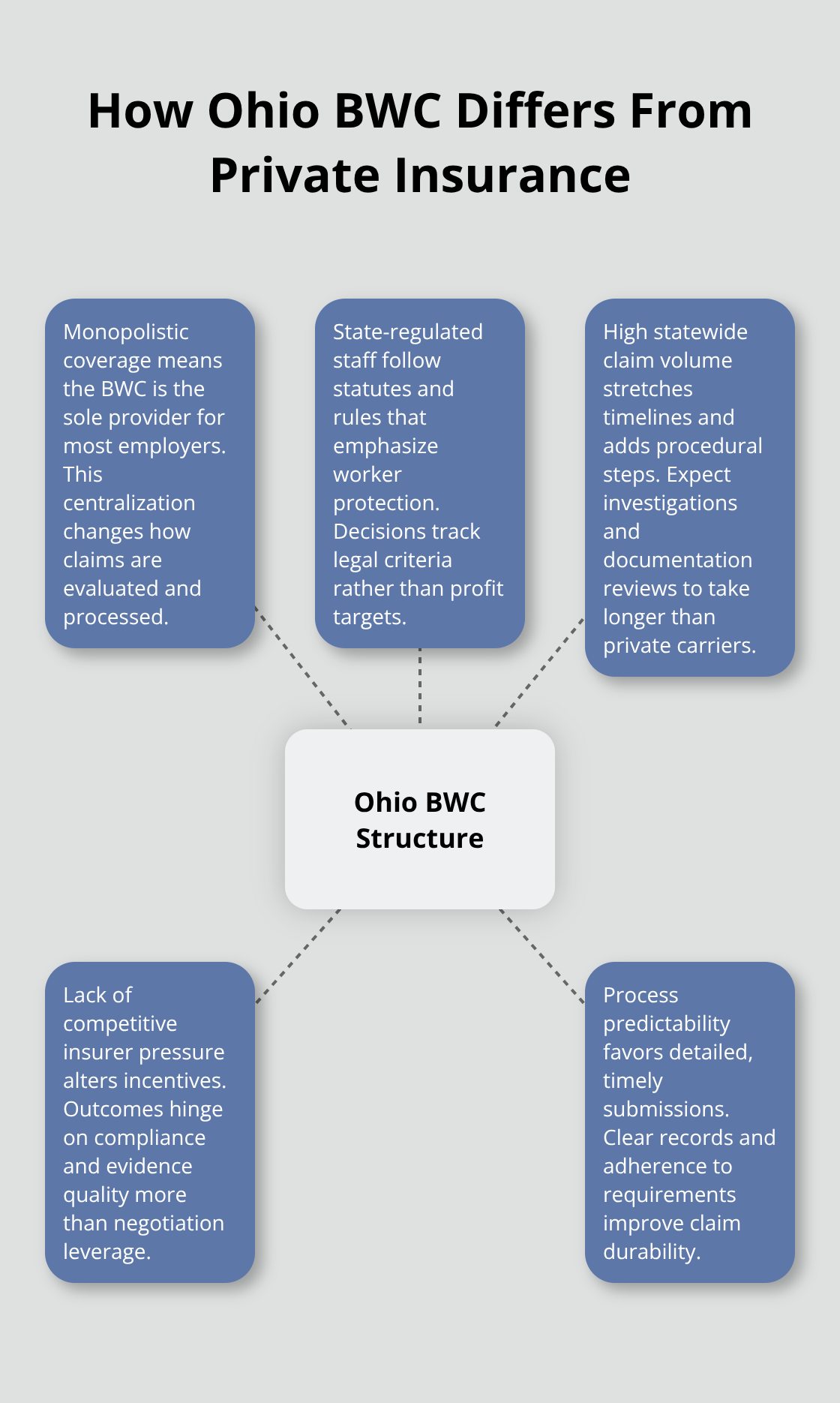
This structure eliminates the competitive pressure you’d find with private insurers, which has real consequences for how claims move through the system. The BWC processes roughly 1.2 million claims annually across Ohio, and the sheer volume means timelines stretch longer than many claimants expect. Unlike private insurance adjusters who answer to profit-driven companies, BWC staff follow state regulations that prioritize worker protection, but that doesn’t mean the process moves quickly or in your favor automatically.
The Critical First 30 Days
Your injury report must reach your employer within the first seven days of the incident, though many Akron workers don’t realize this deadline is stricter than they think. Some employers claim they never received notification, which is why written communication-email, text message with confirmation, or a signed document-beats a casual conversation every time. The BWC then has 30 days to accept or reject your claim once your employer files it. During this window, the BWC investigates whether your injury qualifies as work-related under Ohio law. If you miss the initial reporting window or fail to document your injury properly, the BWC can deny your claim outright, and fighting that denial costs time and money you don’t have while recovering.
Medical Treatment and Network Restrictions
You cannot simply choose any doctor and expect the BWC to cover treatment. The BWC maintains an approved provider network, and you must receive care from network physicians to guarantee coverage. If you see an out-of-network provider without authorization, you risk paying out of pocket. Many claimants in Akron don’t check the provider network before their first appointment, then face billing problems months later. Request a list of approved providers in your area before seeking treatment, and confirm your chosen doctor actively participates in the BWC network. The BWC processes all bills directly, eliminating the need for you to handle payment arrangements with hospitals or surgical centers.
Why Documentation Determines Your Outcome
The BWC bases its decisions on the evidence you submit, not on what you remember or what your employer claims happened. You must document every detail of the incident-the date, time, location, witnesses present, and exactly what caused your injury. Write down these facts immediately after the injury occurs, while details remain fresh. Medical records form the backbone of your claim, so obtain copies of all treatment notes, test results, and provider assessments. The BWC reviews this documentation to determine whether your injury meets the legal definition of a compensable work injury under Ohio law. Gaps in your records give the BWC reasons to question your claim or deny benefits altogether.
Moving Forward With Your Claim
The foundation of a strong claim rests on understanding these operational realities and acting within Ohio’s strict timelines. Your next step involves gathering the specific medical evidence and communications that transform a basic claim into one that withstands scrutiny.
Mistakes That Derail Your Akron Claim
Akron claimants lose benefits and face denied claims because they misunderstand Ohio’s strict procedural requirements. The most damaging mistake happens before the BWC even receives your claim.
The Seven-Day Notification Rule You Cannot Ignore
You must notify your employer of the injury within seven days, but many workers assume a conversation with their supervisor counts as official notice. It doesn’t. The BWC treats written notification as the legal standard, which means email, text message with confirmation, or a signed incident report protects you. Verbal reports disappear into he-said-she-said disputes that the BWC resolves against the worker.
Employers sometimes claim they never received notification, and without documentation proving otherwise, your claim sits in limbo while you lose income. One Akron worker delayed reporting a back injury by nine days because he thought the company nurse’s verbal acknowledgment satisfied the requirement. The BWC rejected his claim on procedural grounds alone, regardless of whether the injury was legitimate. The seven-day window is absolute-missing it means fighting an uphill appeal battle instead of receiving immediate benefits.
How Incomplete Information Kills Your Claim
Your initial claim document determines whether the BWC accepts or rejects your case before any investigation even begins. Incomplete information on the claim form gives the BWC grounds to deny you outright. You must include the exact date and time of the injury, the specific location where it occurred, the names of witnesses present, and a detailed description of what caused the injury.
Vague statements like “I hurt my back at work” provide almost no useful information for the BWC investigator. Instead, write “I slipped on wet floor near the loading dock at 2:45 p.m. on July 8, with John Martinez and Sarah Chen present.” This specificity demonstrates credibility and prevents the BWC from requesting clarification that delays your claim by weeks.
Medical documentation must match your injury description. If your claim says you fell and hit your head, but your medical records show no head trauma, the BWC questions whether your account is accurate. Inconsistencies between your incident report and your medical evidence create reasonable doubt that leads to denials.
Pre-Existing Conditions and Why Honesty Matters
Missing information about pre-existing conditions weakens your position during the appeals process. If you had a prior back problem and fail to disclose it, the BWC later argues your current injury stems from the old condition, not work. You face denials when the truth emerges during investigation (a scenario that occurs frequently in Akron cases where workers omit medical history to strengthen their claim).
Transparency about your medical history actually strengthens your claim because it shows you have nothing to hide. The BWC expects you to disclose prior injuries or conditions, and your medical providers will reveal them anyway through their records.
The Appeals Deadline That Eliminates Your Rights
The appeals process itself confuses many claimants because they don’t realize the BWC’s initial decision isn’t final. You have the right to challenge a denial through the Industrial Commission of Ohio, but the appeals deadline is strict. You must file within 14 days of receiving the denial letter. Missing this deadline eliminates your right to appeal entirely.
Many workers don’t understand that the appeals process requires new evidence or legal arguments, not simply restating what you already submitted. The next section covers how to gather the medical evidence and documentation that transforms a weak claim into one that survives scrutiny and appeals.
Practical Steps to Strengthen Your Akron BWC Claim
Collect Medical Records That Support Your Injury
Medical records form your strongest weapon in an Akron BWC claim, yet most workers treat them as an afterthought. Start collecting records immediately after your injury, not weeks later when memory fades and documents disappear in office files. Request copies from every provider who treats you, including initial urgent care visits, follow-up appointments, imaging results, and specialist evaluations. The BWC investigator will cross-reference your incident description against your medical documentation, and gaps create doubt.
If you report a shoulder injury on July 8 but don’t seek treatment until July 22, the BWC questions whether the injury was truly work-related or if something else caused the delay. Medical records must show continuous treatment aligned with your injury type. A worker who claims a knee injury but receives only one physical therapy session appears less credible than one with consistent treatment over weeks. Keep a personal file of all records you receive, organized by date, because the BWC system sometimes loses documents in their queue.
Photograph or scan each record as you receive it, creating a backup in case originals go missing. When you request records from medical providers, ask specifically for operative reports, diagnostic test results, and physician notes that detail your symptoms and functional limitations. These documents carry more weight than billing statements alone.
Document Every Communication in Writing
Communication with your employer and the BWC must be documented in writing from the moment you report your injury. Email every notification, even if you also speak directly to your supervisor, because written records prove you met the seven-day reporting deadline. Create a simple spreadsheet tracking the date, time, method of communication (email, certified letter, text with screenshot), and person contacted for every interaction related to your claim. Include the subject matter and outcome of each contact.
When the BWC or your employer requests information, respond in writing within 48 hours, keeping copies of everything you submit. Do not rely on phone calls or verbal agreements with claim adjusters, as these conversations disappear when disputes arise. If a BWC representative tells you something over the phone, send a follow-up email summarizing what they said and ask them to confirm it in writing. This practice protects you if their position later changes.
Protect Yourself Through Written Evidence
Ohio law requires the BWC to follow its own procedures, and written documentation forces them to remain consistent. When your claim reaches the appeals stage, your communication log becomes evidence that demonstrates you acted promptly and followed every requirement while the system delayed or failed you. Workers who lose appeals often cannot prove what the BWC promised verbally, leaving them without recourse when circumstances change.
Final Thoughts
The Akron BWC claim tips covered in this guide address the real obstacles workers face when navigating Ohio’s system. Meeting the seven-day reporting deadline, documenting your injury with precision, and maintaining written communication with the BWC and your employer form the foundation of a claim that survives scrutiny. These steps separate workers who receive their full benefits from those who lose claims on procedural grounds alone.
Your injury is legitimate, but the BWC requires proof to award benefits. The system does not automatically favor workers simply because an injury occurred at work-you must actively build your case by following Ohio’s strict requirements and submitting evidence that demonstrates your claim meets the legal standard for a compensable work injury. Waiting passively while your claim sits in the BWC queue costs you income and weakens your position if complications arise.
We at Robin J Peterson Company, LLC understand the pressure you face when an injury disrupts your life and income. Our firm represents injured workers throughout the Cleveland, Akron, and Canton areas, fighting to secure the benefits you deserve, and if your claim has been denied or you’re uncertain whether you’re receiving fair treatment, contact our office for a consultation to discuss your specific situation.