
Workplace injuries happen fast, but the process to get workers’ compensation shouldn’t be complicated. At Robin J Peterson Company, LLC, we’ve helped countless injured workers in Northeast Ohio navigate their BWC claims successfully.
Filing a claim involves specific steps and deadlines that are easy to miss on your own. This guide walks you through exactly what you need to do.
What You Need to Know About Ohio Workers’ Compensation
The Ohio Bureau of Workers’ Compensation Explained
The Ohio Bureau of Workers’ Compensation is a state agency that manages workplace injury claims for most private employers in Ohio. Unlike private insurance companies that operate for profit, the BWC functions as a government system designed to process claims and distribute benefits to injured workers. Nearly all employers in Ohio must carry BWC coverage, with only narrow exceptions for certain religious organizations, sole proprietors without employees, and officers of family firms. This mandatory system means that if you suffer an injury on the job in Ohio, your employer’s BWC coverage protects you-not a traditional insurance policy. The BWC handles both the approval of claims and the payment of medical bills and wage replacement benefits, making it the central authority for workplace injury claims across the state.
How BWC Coverage Differs From Private Insurance
The critical difference between BWC coverage and private insurance lies in how claims are processed and what you receive. Private insurance companies are profit-driven and often look for reasons to deny or minimize claims, but the BWC operates under a no-fault system. This means you don’t have to prove your employer was negligent to receive benefits. However, this doesn’t mean the BWC automatically approves every claim. The agency processes claims based on whether your injury occurred during work activities and whether medical evidence supports a connection between your job and your condition. According to the Bureau of Labor Statistics, approximately 2.8 million nonfatal workplace injuries and illnesses occurred in private industry in 2019, underscoring how common workplace injuries are and why understanding your rights matters.
Who Qualifies for BWC Coverage
To be eligible for BWC coverage, you must be an employee-independent contractors, volunteers, and informal workers are generally not covered. Your injury must also occur while you perform work-related activities or result from occupational exposure connected to your job. This distinction is important because injuries that happen outside work hours or during personal activities fall outside BWC protection, even if they occur at your workplace. Understanding whether your situation qualifies for BWC benefits is the first step toward securing the compensation you deserve. If you work in the Cleveland, Akron, or Canton areas and need guidance on eligibility and claim requirements, Robin J Peterson Company, LLC can help you determine whether your situation qualifies for BWC benefits and what steps to take next.
How to File Your BWC Claim in Three Key Stages
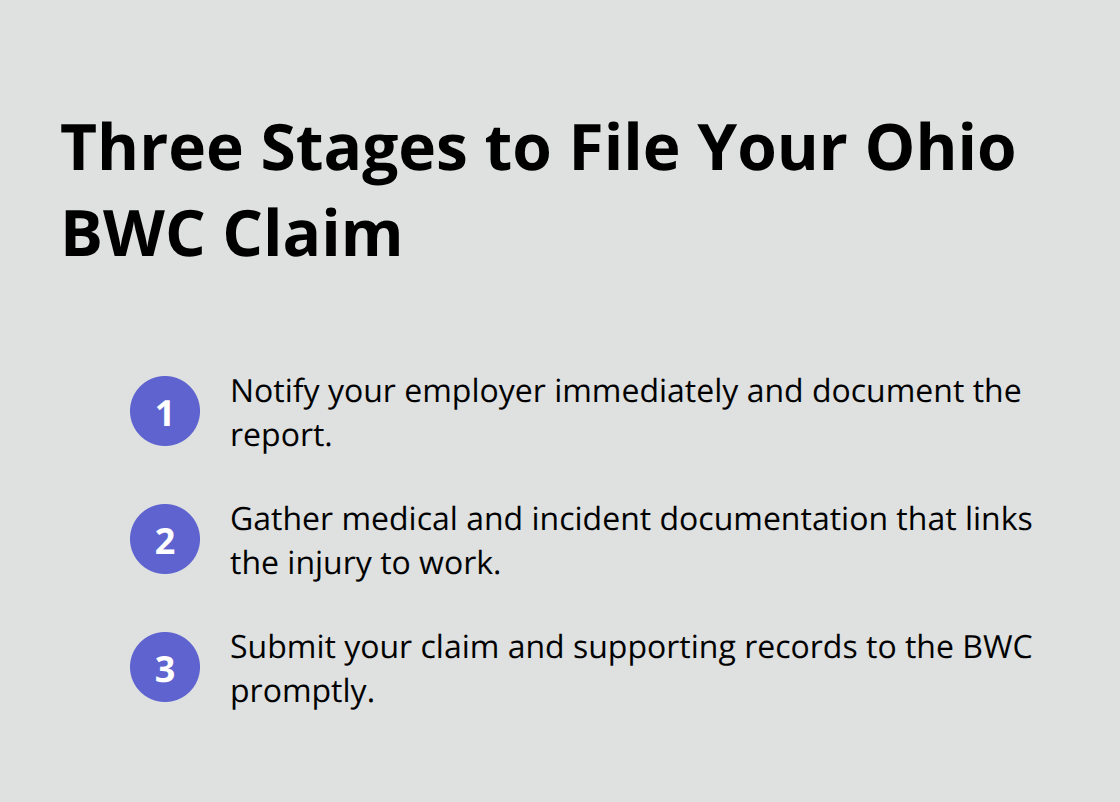
The moment an injury happens at work, time becomes your enemy. Ohio’s one-year statute of limitations means you have exactly 12 months from the injury date to file a claim with the BWC-a deadline that many injured workers miss because they don’t understand the urgency. The filing process itself has three distinct stages that must happen in the right order: notifying your employer, gathering the medical and incident documentation, and submitting everything to the BWC. Each stage has specific requirements and deadlines that vary based on your situation.
Report the Injury Immediately to Your Employer
Your employer must file the First Report of Injury (FROI) with the BWC, but you cannot rely on them to do this correctly or on time. Many employers delay filing or submit incomplete reports, which then causes delays or denials on your end. You need to take control of this process immediately after the injury occurs.
Report the injury to your employer the same day it happens, ideally in writing or with a witness present. Document exactly what you told them, when you told them, and who heard you say it. This written record protects you if your employer later claims they never received notification.
Gather Medical Documentation and Incident Evidence
Seek medical treatment from a doctor who will clearly link your treatment to the work injury in their medical records. This connection between your job and your medical diagnosis is what the BWC uses to approve or deny your claim. The agency typically makes a determination within 28 days after receiving the FROI, based on four factors: the accident description, your medical diagnosis, medical documentation linking treatment to the work injury, and your disability outlook.
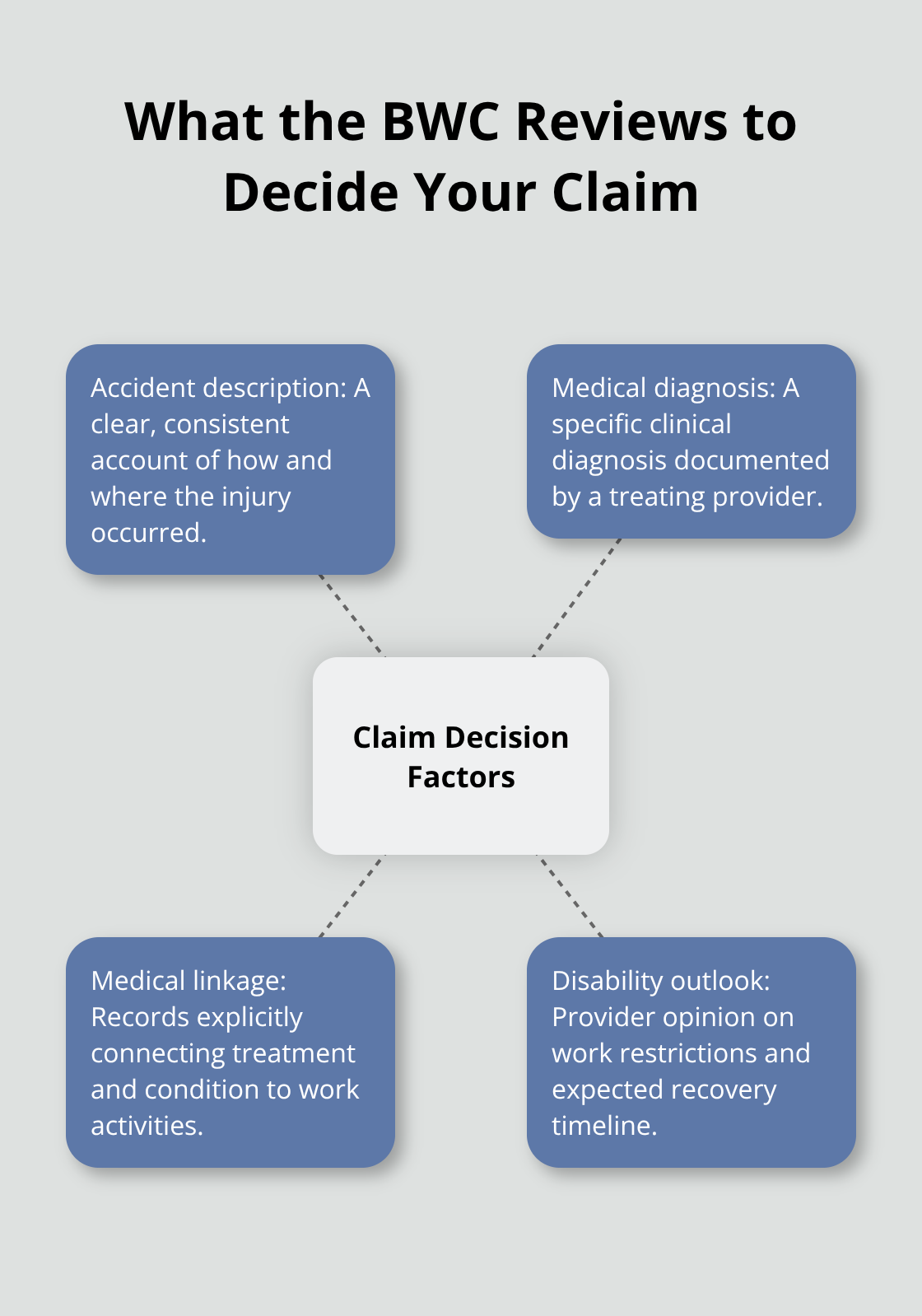
Without solid medical records that explicitly state the injury is work-related, the BWC will deny your claim even if the injury genuinely happened at work. Gather evidence immediately: photos of the injury or hazard, written statements from witnesses, your own incident notes describing what happened and when, and any safety reports your employer filed. Keep all medical receipts, appointment summaries, and prescription records in one organized location.
Submit Your Claim to the BWC
Once you have your medical documentation, file the Employee’s Claim form with the BWC using their online portal or by mail. Create an account on the BWC portal and upload your documents securely so you have proof of submission. Do not wait for your employer to file the FROI or assume they will handle everything for you.
The BWC online filing system allows you to track your claim status in real time, and you should check it regularly for updates or requests for additional information. If the BWC requests more documentation, respond within their timeframe to avoid automatic denial. Many injured workers lose their claims because they miss these follow-up deadlines or fail to provide requested medical records.
What Happens Next in the Claims Process
The BWC will review your submission and issue a determination based on the strength of your medical evidence and the clarity of your incident description. If approved, you move forward with benefits. If denied, you have the right to appeal-a process that requires understanding the specific reasons for denial and gathering additional evidence to challenge the decision.
Mistakes That Cost You Your Claim
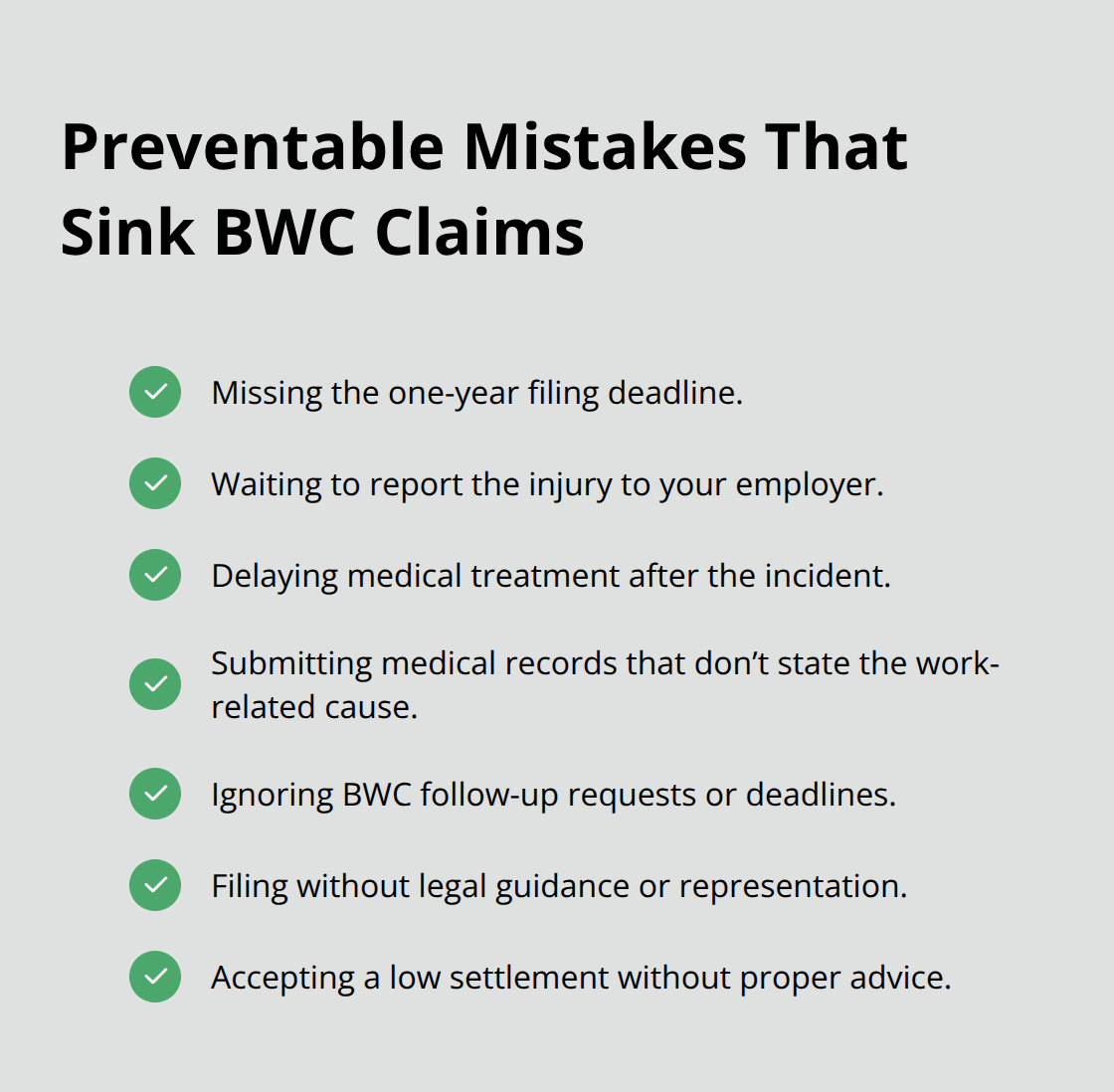
Most injured workers don’t lose their claims because their injuries aren’t legitimate. They lose because they make preventable procedural mistakes that the BWC uses as grounds for automatic denial. The one-year filing deadline is real and unforgiving. If you file your claim on day 366 after your injury, you have zero recourse. The Industrial Commission of Ohio will not hear your appeal, and you cannot recover benefits. This deadline applies to death-benefit claims as well, meaning families of workers killed on the job face the same rigid timeline.
Missing the One-Year Filing Deadline
The calendar is your enemy after a workplace injury. Ohio law gives you exactly 12 months from the injury date to file a claim with the BWC. Many injured workers miss this deadline because they don’t understand the urgency or assume their employer will handle the filing. Once day 366 arrives, the BWC rejects your claim automatically. The Industrial Commission of Ohio will not hear appeals for late filings, and you cannot recover any benefits. This applies equally to death-benefit claims, so families of workers killed on the job face the same unforgiving timeline.
Incomplete Medical Documentation Destroys Claims
Incomplete medical documentation destroys more claims than any other single factor. The BWC doesn’t care if your injury is genuine if your doctor’s records don’t explicitly state the injury is work-related. A treatment note that says you have shoulder pain is worthless; one that says you have shoulder pain from repetitive lifting at your job is what secures approval. Many workers see their own doctors, receive treatment, and then file the claim months later, only to discover the medical records lack any connection to the workplace.
The gap between injury and claim filing also signals problems to the BWC. If you wait three months to report an injury that supposedly happened immediately, the agency assumes you either weren’t that hurt or you’re fabricating the claim. Delayed reporting combined with delayed medical treatment creates a narrative of dishonesty that’s nearly impossible to overcome in an appeal. Your medical records must establish the work connection from the first visit.
Representing Yourself Against the System
The third critical mistake is filing without legal guidance. You’re competing against an employer who likely has counsel and a system designed to minimize payouts. The Ohio Bureau of Workers’ Compensation exists to manage claims and control costs, not to maximize your benefits. Injured workers who represent themselves often don’t understand what evidence they need, miss follow-up deadlines when the BWC requests additional documentation, or accept settlement offers far below what they’re actually entitled to.
A workers’ compensation attorney catches these problems before they become permanent denials. If your claim is denied, you have 14 days to appeal to the Industrial Commission of Ohio, but many workers don’t realize this deadline exists or don’t know what documents to bring to their hearing. An experienced workers’ compensation lawyer knows exactly which evidence shifts the outcome and how to present it effectively. We at Robin J Peterson Company, LLC represent injured workers throughout Northeast Ohio who initially tried to handle their claims alone, only to face denials they could have prevented with early legal involvement.
Final Thoughts
Filing a BWC claim requires you to meet strict deadlines, gather solid medical documentation, and understand how the system actually works. The one-year filing window is absolute, incomplete medical records will sink your claim, and representing yourself against an employer with legal counsel puts you at a disadvantage from the start. These three factors account for the majority of denied claims in Northeast Ohio workers compensation cases, yet all three are preventable with the right approach and guidance.
An experienced workers’ compensation attorney catches problems before they become permanent denials and knows which evidence the BWC actually needs to approve your claim. Your lawyer handles follow-up requests that many injured workers miss, ensures you meet every deadline, and prevents you from accepting a settlement offer far below what you’re actually entitled to receive. If your claim is denied, your attorney understands the appeal process to the Industrial Commission of Ohio and knows how to present evidence effectively at a hearing.
We at Robin J Peterson Company, LLC represent injured workers throughout the Cleveland, Akron, and Canton areas who face BWC denials or need guidance navigating the claims process from the beginning. If you’ve been injured on the job or your claim has been denied, contact our firm for a free consultation to discuss your situation and learn what options are available to you.