
A wrist injury in Ohio can leave you confused about what benefits you’re entitled to and how they’re calculated. At Robin J Peterson Company, LLC, we’ve helped countless workers understand their compensation rights and navigate the system effectively.
This guide walks you through how the Ohio Bureau of Workers’ Compensation determines your benefits, what medical expenses are covered, and how to challenge decisions if needed.
How Ohio Calculates Your Wrist Injury Benefits
The Ohio Bureau of Workers’ Compensation does not use a one-size-fits-all formula for benefit calculations. Your compensation depends on three concrete factors: your average weekly wage before the injury, your disability classification, and medical documentation that proves work causation. Understanding how each piece fits together prevents surprises and helps you spot calculation errors early. Most workers significantly underestimate what they’re owed because they don’t grasp how the BWC stacks different benefit types together.
Your Average Weekly Wage Sets the Foundation
The BWC calculates your average weekly wage by taking your total earnings from the 52 weeks before your injury and dividing by 52. This includes overtime, bonuses, paid time off, and gratuities you actually earned at the time of injury. If you were hired within the past year, the BWC prorates based on weeks actually worked. For hourly employees, this creates a straightforward calculation. For salaried workers, your annual salary simply divides by 52.
The most common mistake workers make is assuming the BWC uses their current paycheck. They don’t. They use historical earnings, which matters enormously if you received a raise or worked significant overtime before your injury. If your employer fails to report accurate wage history to the BWC, your benefits shrink. Request a wage verification form from the BWC immediately after filing your First Report of Injury, then cross-check it against your tax records and pay stubs. Errors here directly reduce every benefit payment you receive.
Disability Status Determines Your Payment Rate
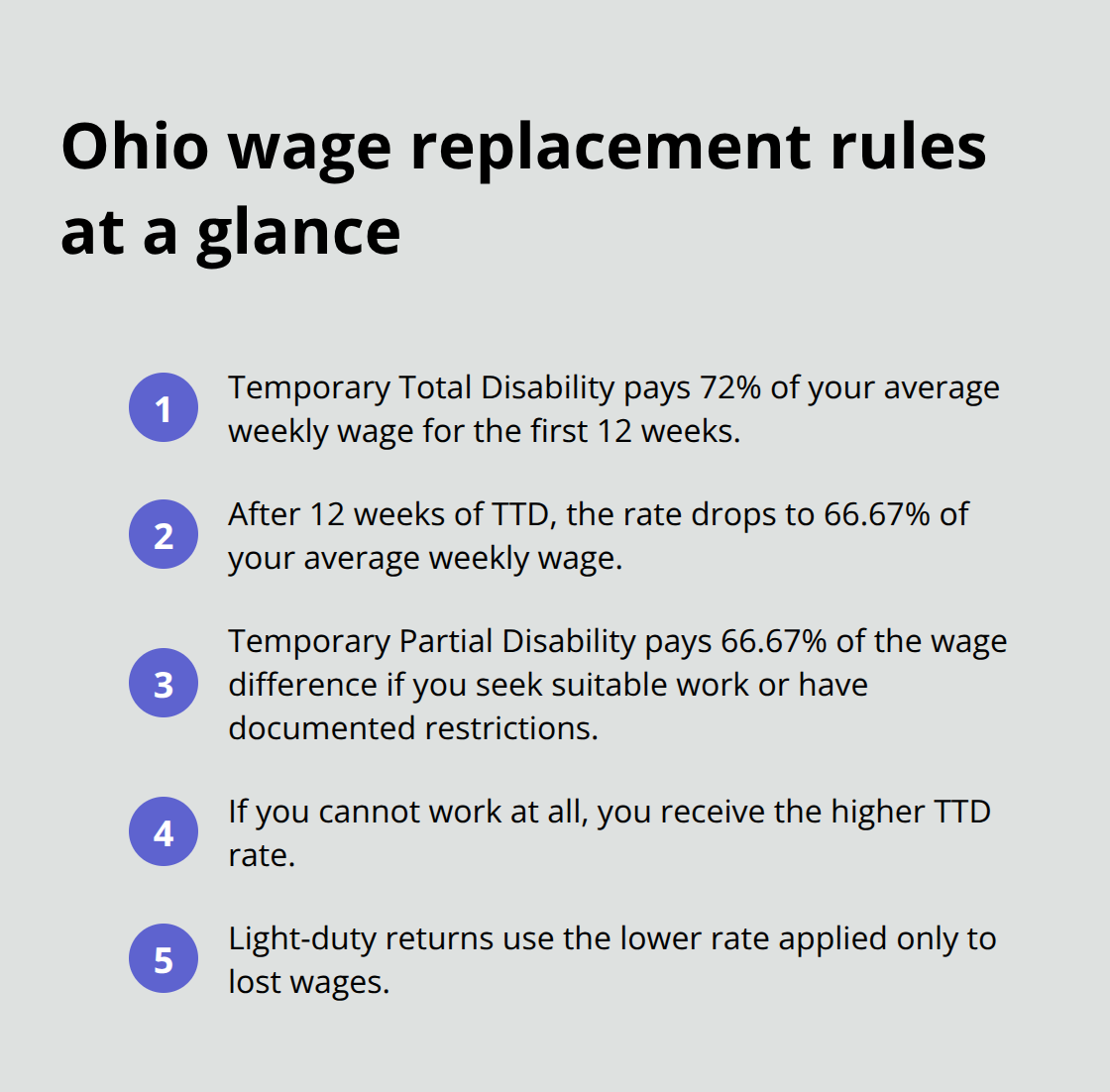
Once the BWC establishes your average weekly wage, your disability classification determines what percentage of that wage you receive. Temporary Total Disability pays 72% of your average weekly wage for the first 12 weeks of total inability to work, then drops to 66.67% thereafter. Temporary Partial Disability pays 66.67% of the wage difference between what you earned before injury and what you earn in a lighter-duty role, but only if you actively search for suitable work or have documented medical restrictions.
The distinction matters: if you cannot work at all, you receive the higher rate. If you return to lighter work, you receive the lower rate applied only to lost wages. Permanent Partial Disability applies once you reach maximum medical improvement, and the amount depends on your impairment rating assigned by the Industrial Commission.
This rating often relies on brief independent medical examinations lasting 15 to 20 minutes, which is why comprehensive medical documentation and legal representation improve your outcome. Workers represented by an attorney experience about a 35% reversal rate when challenging unfavorable ratings, compared to unrepresented workers who rarely succeed.
How Medical Documentation Strengthens Your Claim
The Industrial Commission uses your medical records to assign an impairment rating that directly affects your Permanent Partial Disability amount. Detailed documentation of your diagnosis, treatment history, and functional limitations carries far more weight than minimal medical notes. When your physician explicitly connects your wrist condition to your work duties and describes how it limits your ability to perform job tasks, the Commission has concrete evidence to work with.
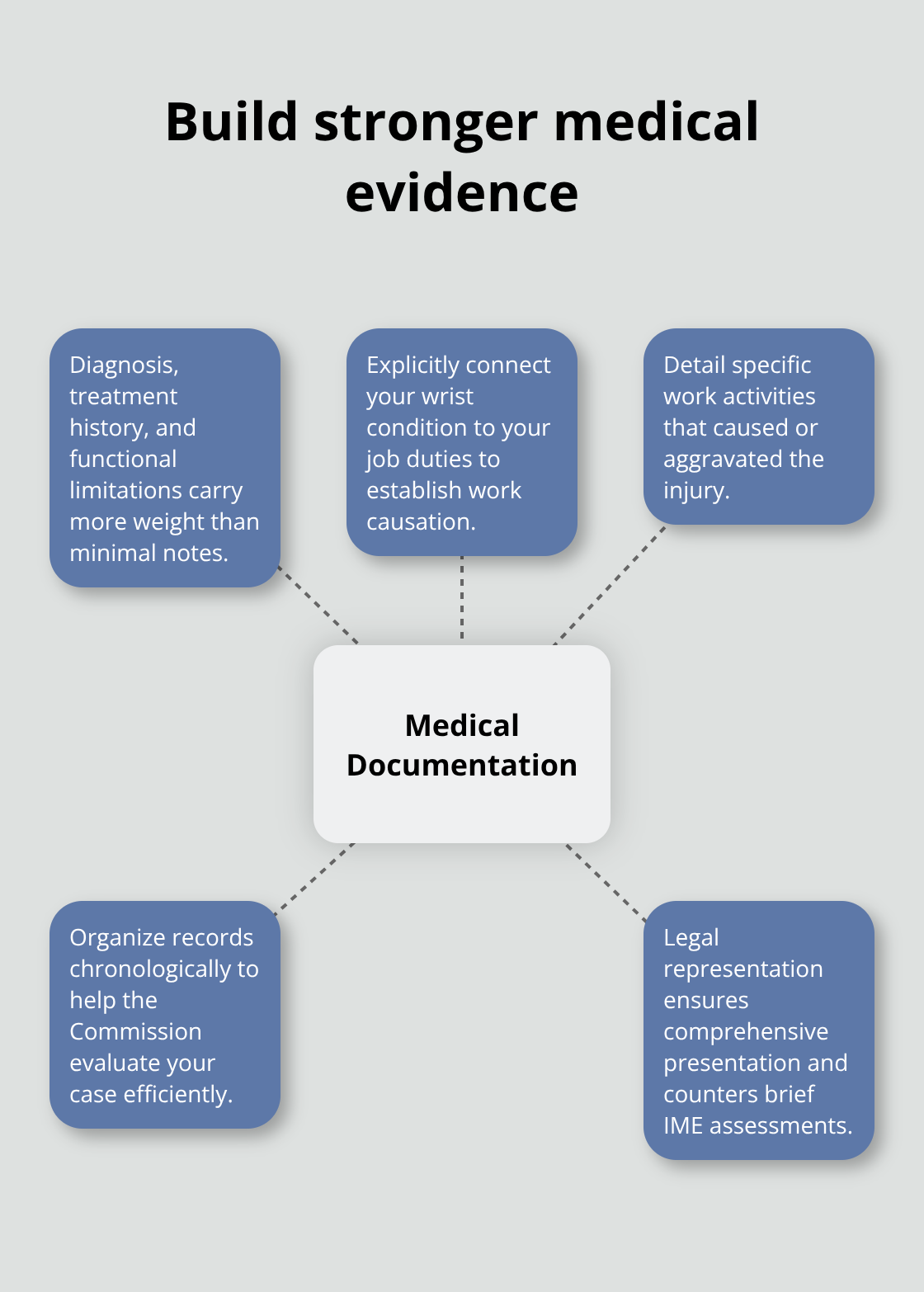
Your medical provider should document the specific work activities that caused or aggravated your injury. This connection between your job and your condition is what separates approved claims from denied ones. If your medical records lack this work-related causation language, the Commission struggles to justify a favorable rating. This is where legal representation becomes invaluable-an experienced workers’ compensation attorney ensures your medical evidence is presented comprehensively and persuasively to the Industrial Commission.
Medical Treatment Coverage and Reimbursement
The Ohio BWC Only Pays Authorized Providers
The Ohio Bureau of Workers’ Compensation covers all medically necessary treatment for your wrist injury, but only if you receive care from an authorized BWC network provider. This is non-negotiable. Going to an out-of-network doctor means the BWC will deny payment, leaving you responsible for the bill. When you file your First Report of Injury, the BWC assigns you a claims administrator who provides a list of approved providers in your area. Contact that administrator immediately and ask for providers who regularly handle workers’ compensation cases and understand Ohio’s causation documentation standards.
Some providers lack familiarity with how to document work-related causation in their medical records, which weakens your case later. Your covered treatments include emergency care, diagnostic imaging, ongoing medical appointments, injections, physical therapy, ergonomic workstation evaluations, and surgery if conservative treatment fails. Medications prescribed for your wrist condition are covered.
What Expenses the BWC Will and Won’t Pay
The BWC will not pay for treatments unrelated to your injury, treatments that exceed what is medically necessary, or care from providers outside the authorized network. Request itemized bills from your provider and verify each charge against your treatment records. If you spot charges for unrelated services, contact your claims administrator to dispute them before they’re processed.
How to File for Medical Bill Reimbursement
Your authorized provider submits claims directly to the BWC on your behalf, so you typically do not handle billing yourself. However, if you pay out of pocket for any authorized treatment, keep all receipts and submit them to your claims administrator with a written request for reimbursement within 30 days of payment. Include your claim number, the provider’s name, the date of service, the treatment provided, and the amount paid.
The BWC processes these requests slowly, often taking 6 to 8 weeks, so do not expect immediate reimbursement. If the BWC denies reimbursement for an authorized treatment, request a written explanation of the denial. Denials frequently occur when documentation is incomplete or when the provider failed to establish work causation in their records.
Why Medical Documentation Determines Your Reimbursement Success
Your original medical records must contain explicit work-related causation language. If they lack this connection, reimbursement claims suffer. When disputes arise over covered versus non-covered expenses, the Industrial Commission of Ohio can resolve them, though this adds time and complexity to your case. The strength of your medical documentation during your initial claim directly impacts whether the BWC approves or denies reimbursement requests months later.
This foundation of solid medical evidence becomes even more important when you face a benefits decision you believe is wrong. The next chapter explains when you should challenge a decision and how the appeals process works.
Navigating Appeals and Disputes
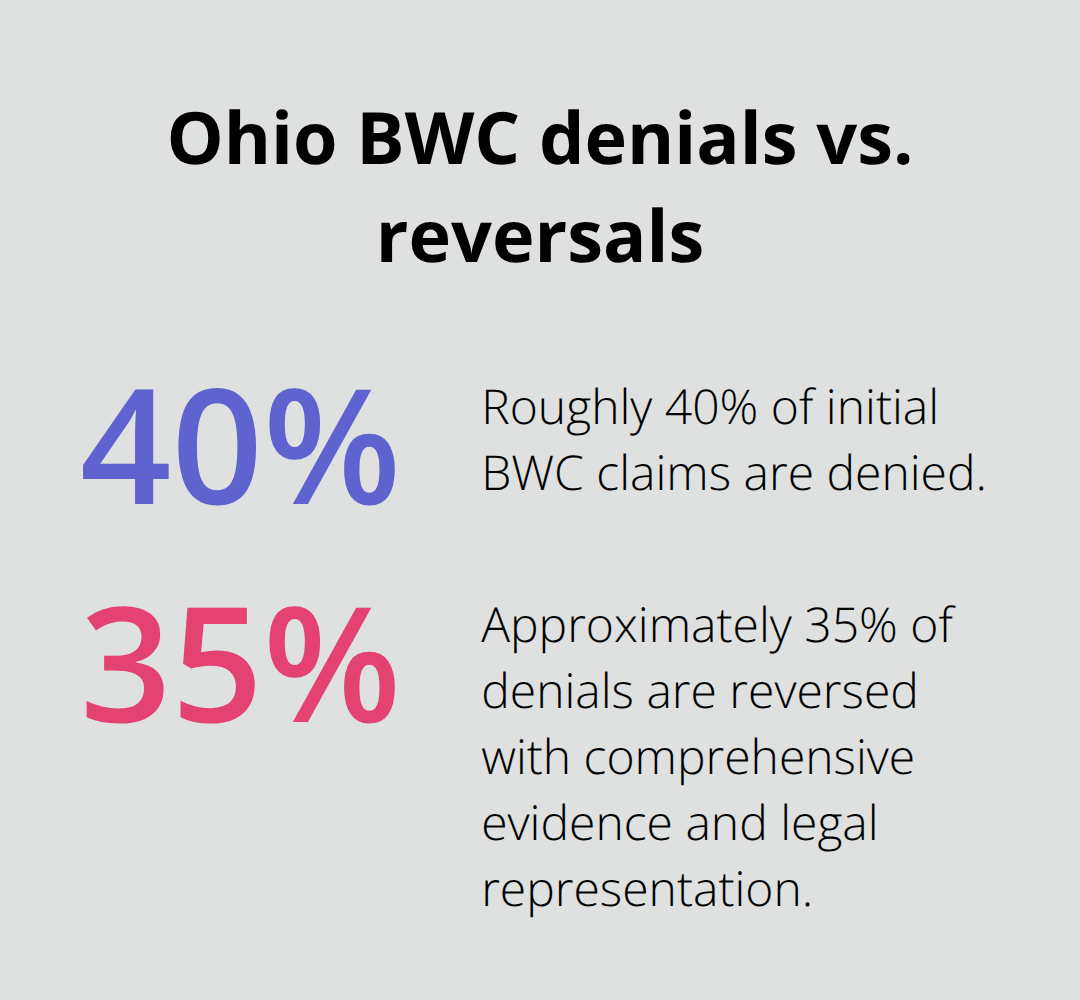
The Ohio Bureau of Workers’ Compensation denies roughly 40% of initial claims, and many of those denials stem from incomplete medical documentation or wage calculation errors rather than legitimate ineligibility. If the BWC denies your claim, reduces your benefits unexpectedly, or assigns an impairment rating that drastically undervalues your wrist injury, you have the right to challenge that decision through the Industrial Commission of Ohio. Most workers assume a denial is final and give up, which is a costly mistake. The Industrial Commission reverses approximately 35% of denials when workers present comprehensive medical evidence and proper legal representation.
Determine Whether Your Denial Warrants an Appeal
Your first step is determining whether the denial or decision actually warrants an appeal. A denial for working outside the state or for an injury that genuinely occurred off-the-job is difficult to overturn. A denial based on missing medical causation language, however, can be reversed if your provider submits amended records explicitly connecting your wrist condition to your work duties.
Contact your claims administrator in writing and request a detailed explanation of why your claim was denied. The explanation should cite specific reasons tied to Ohio workers’ compensation law. If the reason is insufficient medical documentation, you can often fix this by having your physician submit a supplemental report addressing the gaps. If the reason is wage miscalculation, request a wage verification form and compare it against your actual pay records. Errors in wage history happen frequently and are straightforward to correct. Do not assume the BWC’s calculation is accurate simply because it came from an official source.
File Your Request for Hearing with the Industrial Commission
Once you determine an appeal is justified, file a request for hearing with the Industrial Commission of Ohio within one year of the BWC’s decision. Submit this request in writing to the Industrial Commission office located at 30 West Spring Street, Columbus, Ohio 43215-2256, or contact the Ohio Industrial Commission Ombuds Office for guidance on the filing process. The Ombuds Office provides independent assistance to injured workers and can clarify whether your situation qualifies for appeal.
Your hearing will be scheduled before a district hearing officer who reviews your medical records, wage documentation, and any other evidence you submit. This is not a quick process; hearings typically occur three to six months after filing.
Prepare Comprehensive Evidence for Your Hearing
Prepare for the hearing by organizing all medical records chronologically, obtaining written statements from coworkers about your job duties and how the injury occurred, and gathering any photographs or documentation of your workstation and tools. These materials form the foundation of your case before the hearing officer.
If the hearing officer rules against you, you can appeal to the Industrial Commission itself, and if you disagree with that decision, you can pursue further legal action. The process is lengthy and complex, which is precisely why legal representation matters significantly.
Why Legal Representation Strengthens Your Appeal
Workers represented by an attorney at the hearing stage achieve substantially better outcomes than unrepresented workers. An experienced workers’ compensation attorney understands exactly what evidence the Industrial Commission weighs most heavily and knows how to present your medical records and wage history in the most compelling way. Legal counsel fights to ensure the Commission has complete information and addresses every weakness in the BWC’s original decision.
Final Thoughts
Understanding how the Ohio Bureau of Workers’ Compensation calculates your wrist injury Ohio compensation removes the guesswork from your claim. Your average weekly wage, disability classification, and medical documentation work together to determine what you receive, and errors in any of these areas directly reduce your benefits. The BWC denies roughly 40% of initial claims, yet the Industrial Commission reverses approximately 35% of those denials when workers present solid evidence and proper representation.
An experienced workers’ compensation attorney ensures your medical records contain explicit work-related causation language, verifies your wage calculations against actual pay history, and presents your case to the Industrial Commission in a way that addresses every weakness in the BWC’s original decision. Workers represented by counsel achieve substantially better outcomes at the hearing stage than those who navigate the process alone. The complexity of Ohio’s system, combined with the financial stakes of your claim, makes professional guidance invaluable.
If you have already filed a claim and received a decision you believe is incorrect, contact the Ohio Industrial Commission Ombuds Office for independent guidance on whether an appeal makes sense. If you have not yet filed, gather your medical records and wage documentation now, then file your First Report of Injury with the BWC immediately. Contact our firm for a consultation if you need guidance on your wrist injury claim or want to discuss whether an appeal is worthwhile.