
Filing a BWC claim in Ohio involves specific steps and deadlines that many injured workers find confusing. We at Robin J Peterson Company, LLC understand the frustration of navigating this process while recovering from an injury.
This guide walks you through each stage, from reporting your injury to your employer through the BWC review process. You’ll learn what information matters, which deadlines you can’t miss, and how to strengthen your claim.
Report Your Injury Immediately After It Happens
Act Fast: Report on the Day of Your Injury
The moment an injury occurs at work, you must notify your employer. The Ohio Bureau of Workers’ Compensation emphasizes that reporting on the same day creates a credible paper trail linking the incident directly to your health issues. When you wait days or weeks to report, you weaken your claim significantly because the BWC scrutinizes the timeline between the injury and when you told your employer. If you delay reporting, the insurer investigating your claim will question whether the injury actually happened at work or if you’re misrepresenting the facts.
Provide Exact Details to Your Employer
Your employer needs specific information when you report the injury. You must communicate the exact time the injury occurred, the precise location where it happened, the machinery or equipment involved, and the specific task you were performing. Write this information down and provide it to your HR department in writing rather than just telling a supervisor verbally. Request written confirmation that they received your report.

This documentation becomes essential evidence that protects your claim later.
Document Everything Immediately
You should seek medical attention right away and inform the healthcare provider that your injury is work-related, as this establishes the connection in medical records from day one. Keep detailed records of every medical visit, test result, prescription, and doctor’s recommendation. Start a daily symptom journal showing how your condition changes over time, which supports your claim during the investigation phase. The BWC processes approximately 100,000 claims annually, and those with complete, accurate initial information typically receive a decision within 28 days, while incomplete submissions can extend processing to 60 days or longer.
Collect Supporting Evidence
You should collect witness statements from coworkers who saw the injury happen, photographs of the accident scene or equipment involved, and any accident reports your employer completed. Store copies of all these materials in one organized folder (medical records, witness statements, photographs, and accident reports) because you will need them when filing your First Report of Injury. This organized approach to documentation sets the foundation for the next critical step: completing and submitting your claim form to the Ohio Bureau of Workers’ Compensation with precision and accuracy.
File Your Claim with the Ohio Bureau of Workers’ Compensation
Complete the First Report of Injury Form Accurately
Now that you’ve reported your injury and gathered documentation, you must file your claim with the Ohio Bureau of Workers’ Compensation. This step determines whether you receive benefits, so accuracy matters more than speed. The First Report of Injury form, known as the FROI, is your official claim document, and the BWC has specific requirements for what goes on this form. You must include your exact pay rate, the number of hours you worked per week, the nature and extent of your injury, and the precise date you first reported the injury to your employer. The form also requires the exact machinery or equipment involved, the specific task you performed when injured, and all affected body parts.
Submit Your Claim Through the Right Channel
File your claim online through the BWC portal for the fastest processing. The system processes digital submissions immediately, whereas mailed documents can delay processing by weeks. When you submit online, the BWC begins its investigation right away and assigns a service specialist to your case.

You will receive a notification letter with your claim number, which you use to track progress throughout the entire process. The BWC has 28 days from receiving a complete submission to issue a decision on your eligibility, but incomplete or inaccurate information resets that clock. According to the Ohio Bureau of Workers’ Compensation, claims with errors often trigger manual review and can add two to four weeks or more to processing time.
Provide Complete Medical Documentation
Your medical evidence forms the foundation of your claim, so you must submit your doctor’s diagnosis, treatment records, and any test results that confirm the work-related nature of your injury. The provider’s signature is required on the FROI, and you must sign authorizations allowing the BWC to retrieve your complete medical records and your past 52 weeks of wage data. This documentation (combined with your detailed injury report) creates a strong foundation that prevents denials requiring an expensive appeal to the Industrial Commission of Ohio.
Meet the Filing Deadline
Missing the one-year filing deadline from your injury date permanently bars you from receiving benefits, so file immediately after reporting your injury to your employer. Even though Ohio’s system is no-fault (meaning you qualify regardless of who caused the injury), the BWC scrutinizes submissions carefully to prevent fraud. Thorough, precise documentation supports your claim and demonstrates that you meet all eligibility requirements. The BWC processes approximately 100,000 claims annually, and those with complete, accurate initial information typically receive a decision within 28 days.
Once you submit your FROI and medical evidence, the investigation phase begins. Understanding what happens next-and how the BWC evaluates your claim-helps you prepare for potential approval or denial and positions you to respond effectively if the BWC requests additional information.
Navigate the BWC Review Process
The Investigation Phase Begins Immediately
After you submit your FROI, the BWC investigation starts right away. The agency assigns a service specialist to your case and reviews your medical records, accident reports, and employment history to verify that your injury qualifies as work-related. The Ohio Bureau of Workers’ Compensation has 28 days to issue a decision if your submission was complete and accurate. However, this timeline only holds if you provided everything they requested on the first try. If the BWC finds gaps or inconsistencies in your documentation, they send you a request for additional information, and that 28-day clock resets. The investigation phase typically involves the BWC contacting your employer, your medical provider, and sometimes witnesses to corroborate your account of what happened.
Respond Quickly to Information Requests
Stay accessible during the waiting period and respond to any information requests within 48 hours. Delays in responding to the BWC extend your processing time significantly, and every week you wait for a decision is a week without wage replacement benefits if your claim qualifies for them. The BWC may ask for clarification on specific details, additional medical records, or wage documentation. Treat these requests as urgent because the clock resets each time you fail to respond promptly.
Understand Approval and Denial Outcomes
When the BWC issues a decision, you receive one of two outcomes: approval or denial. An approved claim means the BWC determined your injury is work-related and you qualify for medical benefits and wage replacement. Your medical provider then becomes a BWC-certified provider, and your treatment costs are covered. If the claim is denied, you have exactly 14 days from the date you receive the denial letter to file an appeal with the Industrial Commission of Ohio. This 14-day window is absolute-missing it eliminates your right to appeal. File your appeal immediately after receiving a denial because the Industrial Commission schedules hearings weeks or months out, and waiting until day 13 to file leaves you no time to prepare.
Present Your Case at the Industrial Commission Hearing
At the Industrial Commission hearing, you present your case before a hearing officer who reviews your medical evidence, listens to your testimony, and examines your documentation. These hearings typically last 15 minutes for straightforward cases, though complex injuries can extend to 60 minutes. The hearing officer’s decision is not final-if you disagree, you can request further review by the Industrial Commission itself, which makes the ultimate determination. An experienced workers’ compensation attorney can represent you at this hearing and significantly strengthen your presentation.
Maintain Strong Medical Documentation Throughout
Your medical provider plays a critical role throughout this entire process. Stay in close communication with your doctor and ensure they document every symptom, treatment adjustment, and prognosis change. The medical evidence is what convinces the BWC or the Industrial Commission that your injury is genuine and work-related. If your doctor questions the work-relatedness of your injury, address this concern head-on by providing detailed information about how the injury occurred and its connection to your job duties. Medical providers sometimes need clarification to understand the mechanism of injury, so do not assume silence means agreement. Request written confirmation from your provider that they support your claim, and bring this documentation to any hearing.
Final Thoughts
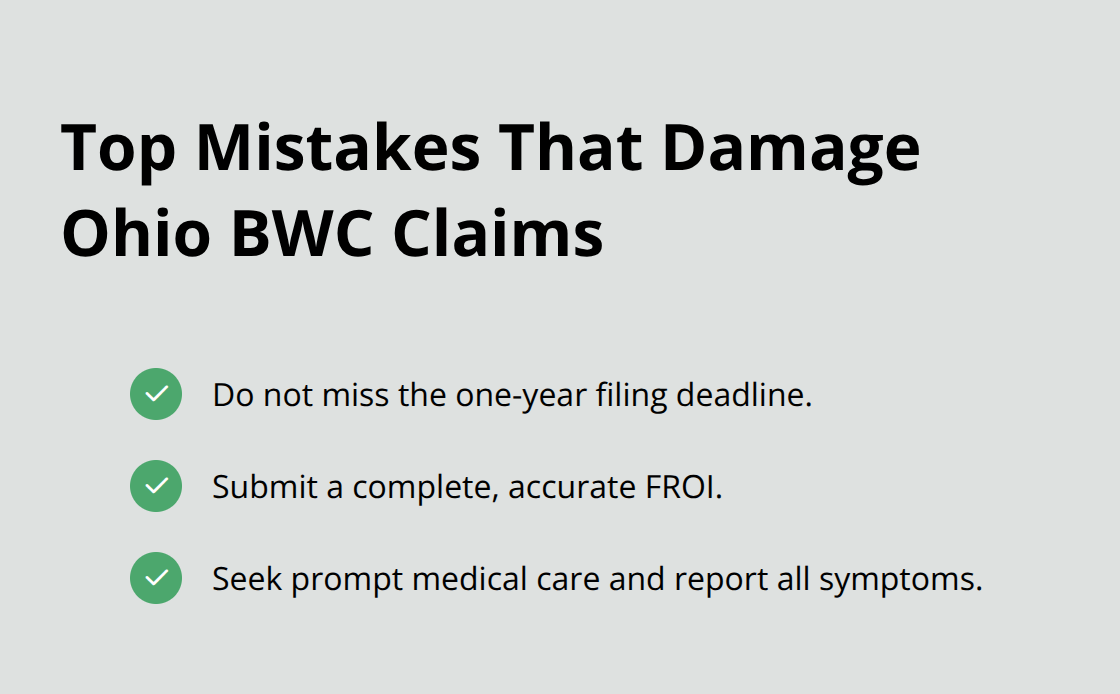
Filing BWC claim steps correctly from the start prevents costly delays and denials that force you into appeals. The three mistakes that damage claims most are missing the one-year filing deadline, submitting incomplete information on your FROI, and delaying medical treatment or downplaying symptoms to your doctor. You now understand how to avoid each of these pitfalls by reporting immediately, gathering precise documentation, and submitting a complete claim form with full medical evidence.
After you file your claim, monitor your status through the BWC portal and respond to any information requests within 48 hours. The 28-day decision window only applies when your submission is complete and accurate, so treat follow-up requests as urgent. If the BWC approves your claim, your medical provider becomes certified and your treatment is covered.
An experienced workers’ compensation attorney makes a significant difference in your outcome, especially if your claim is denied or if the investigation becomes complex. Contact Robin J Peterson Company, LLC to discuss your claim and learn how legal representation protects your rights during this critical process.