
Work injuries in Canton happen fast, but the claims process doesn’t have to be complicated. When you’re hurt on the job, you need someone who understands both Ohio’s workers’ compensation system and the local landscape.
A Canton area injury attorney from Robin J Peterson Company, LLC knows how to fight for the benefits you deserve. We’ll walk you through everything in this guide.
How Ohio’s Workers’ Compensation System Actually Works
Ohio’s workers’ compensation system operates as a no-fault program, which means you receive benefits regardless of who caused the injury. The Ohio Bureau of Workers’ Compensation administers this system, and it functions differently than what many injured workers expect. When you get hurt on the job in Canton, your employer’s insurance carrier pays your medical bills and a portion of lost wages-not your employer directly. This separation matters because it removes the need to prove fault, but it also means the system enforces strict rules about documentation, timing, and medical evidence. According to the Ohio Bureau of Workers’ Compensation, the initial claim determination takes around 10 to 14 days on average, though complex cases extend beyond that timeline. The speed of your claim depends entirely on how thoroughly you document your injury and how quickly you report it to your employer.
Injuries That Trigger Canton Claims Most Often
Manufacturing, construction, and healthcare dominate Canton’s workplace injury landscape. Manufacturing facilities in the area generate the highest volume of claims, with back injuries, fractures, and crush injuries appearing most frequently. Construction workers face different hazards-falls, electrical injuries, and equipment-related trauma show up regularly in claims. Healthcare workers in Canton hospitals and clinics experience needle sticks, lifting injuries, and exposure incidents. The U.S. Bureau of Labor Statistics reports that Ohio averages 3.5 serious workplace injuries per 100 full-time workers annually, above the national average of 2.6, which reflects the state’s industrial base. For your claim to succeed, the injury must arise out of and occur in the course of employment-meaning it happened because of your job duties or during work hours on company premises. Injuries that occur during breaks, personal activities, or commuting typically don’t qualify, and the Ohio Bureau of Workers’ Compensation applies this standard strictly.
Why Claims Get Denied or Underpaid in Ohio
The most common reason for claim denial is failure to report the injury promptly. Ohio law requires you to notify your employer immediately or within 30 days, but delays beyond a few days create suspicion and documentation gaps. Insufficient medical evidence ranks second-the BWC needs clear documentation that your injury is work-related, not a pre-existing condition or personal health issue. Many injured workers lose benefits because their medical records fail to explicitly connect the injury to job duties. Third, some claims get underpaid because workers accept the initial offer without understanding their full entitlement. The BWC calculates wage replacement at two-thirds of your average weekly wage, but many workers never verify this calculation. Employers sometimes misreport wage history or the BWC’s calculation contains errors that reduce your benefits. Fourth, failing to follow the authorized medical provider list results in denied treatment claims-the BWC only covers providers it approves, and going outside that network leaves you responsible for bills. Understanding these pitfalls positions you to protect your claim from the start and sets the stage for effective legal support when you need it most.
Getting Your Claim Filed and Protected
File Your Claim With Precision and Speed
Filing a workers’ compensation claim in Ohio requires precision, not just paperwork shuffling. The moment you report your injury to your employer, the clock starts ticking on critical deadlines that determine whether you receive full benefits or face denial. You have 30 days to notify your employer, but waiting even a week creates documentation problems that haunt your case later. Within that same window, your employer must file a claim form with the Ohio Bureau of Workers’ Compensation, though many employers drag their feet hoping claims disappear. The BWC then has 10 to 14 days to issue an initial determination, but this timeline only works if your medical evidence is solid from day one.
Gather Evidence That Protects Your Claim
Get medical treatment immediately from a BWC-authorized provider, not your personal doctor. Request that your medical provider submit a report explicitly stating your injury arose from your work duties, not a pre-existing condition. Write down the exact date, time, location, and circumstances of your injury while details are fresh. Collect the names and contact information of any witnesses before they scatter. Keep every medical record, wage stub, and communication with your employer in a dedicated folder. Many workers fail at this stage because they assume the employer or insurance company will handle documentation, but they won’t. An attorney reviews your file immediately to identify missing evidence, catches calculation errors in wage replacement, and ensures your medical providers submit reports in the format the BWC actually accepts. Without this early intervention, underpayment becomes the default outcome.
Navigate the Appeals Process With Legal Strategy
When the BWC denies your claim or offers less than you deserve, the appeals process begins, and this is where most injured workers stumble without representation. The Ohio Industrial Commission handles appeals, and the process involves multiple stages with strict filing deadlines that the commission enforces without mercy. You have 14 days from denial to request reconsideration, then 30 days to appeal to the Industrial Commission if reconsideration fails. Missing these windows means losing your right to appeal entirely, and the BWC counts days strictly.
Prepare for the Hearing and Settlement Negotiations
The hearing before a district hearing officer requires presenting evidence that your injury is work-related, that your medical condition is real, and that your wage calculation is accurate. Many workers show up unprepared, contradicting their own medical records or failing to explain how their job caused the injury. An attorney prepares you for testimony, organizes medical evidence chronologically, and cross-examines the BWC’s witnesses to expose inconsistencies. The hearing officer then issues an order, but either party can appeal to the full Industrial Commission for a second hearing. This escalation matters because district hearing officers sometimes misinterpret medical evidence or apply outdated interpretations of work-relatedness. At the Industrial Commission level, your case gets fresh eyes and stronger procedural protections.
Settlement discussions often happen during appeals, and accepting an early offer without legal review is the biggest mistake injured workers make. An attorney calculates your full entitlement (including future medical needs, permanent impairment ratings, and vocational rehabilitation costs) before negotiating any settlement. The BWC counts on workers accepting low offers out of desperation or confusion, but proper representation shifts that dynamic entirely. Local counsel with experience in Canton’s industrial landscape understands how the Industrial Commission evaluates cases in your area and what settlement ranges actually reflect fair value for your injury and lost wages.
Why Local Representation Changes Your Case
How Canton’s Industries Shape Your Claim
Canton’s manufacturing and construction sectors operate under specific safety protocols, injury patterns, and employer relationships that differ from other Ohio regions. Manufacturing workers filing claims face different scrutiny than healthcare workers, and construction injuries trigger different medical provider expectations. A local attorney knows which employers in the area have histories of delayed reporting, which medical facilities the BWC trusts most, and which wage calculation disputes appear frequently in local cases. The dominant industries in Canton shape how the BWC evaluates your specific injury claim, and an attorney unfamiliar with this industrial base may miss critical details that affect your outcome.
Understanding Local Hearing Officer Patterns
The Industrial Commission of Ohio’s Canton-area hearing officers have individual tendencies in how they weigh evidence and evaluate work-relatedness arguments. An experienced local attorney has appeared before them multiple times, understanding their questioning style and what documentation they demand before approving claims. This familiarity matters enormously when you prepare testimony or decide whether to accept a settlement offer. Hearing officers in Canton may scrutinize wage calculations more closely than their counterparts in Columbus or Cincinnati, and an attorney new to the area cannot replicate this knowledge without years of local practice.
Building Relationships That Accelerate Results
When your attorney has worked with the same claims adjusters and hearing officers for years, communication becomes more efficient, deadlines receive proper attention, and disputes get resolved faster because trust already exists. An attorney new to Canton’s legal landscape must establish credibility from scratch, wasting time and potentially missing opportunities to strengthen your case during critical early stages.
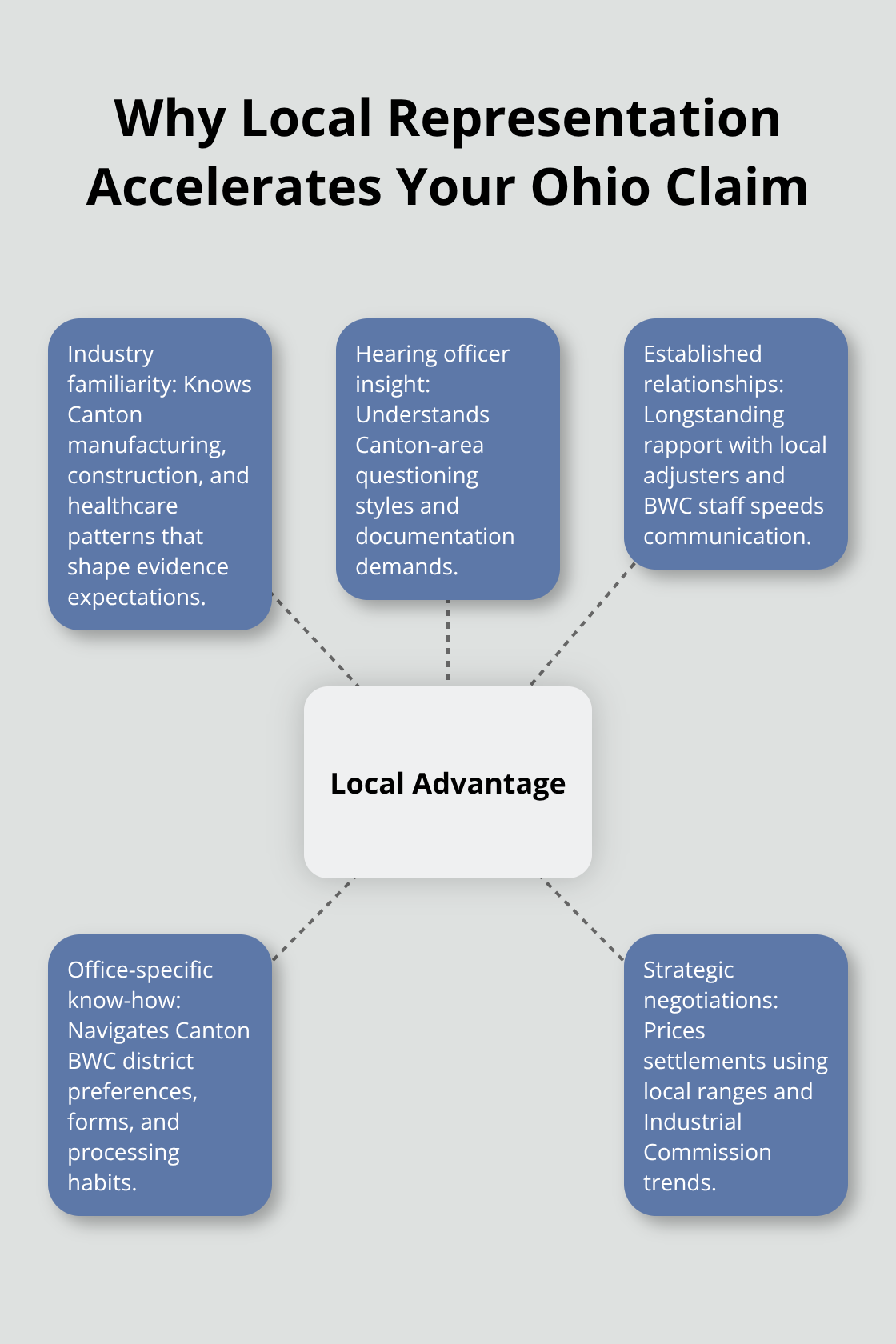
We at Robin J Peterson Company, LLC have built our practice around understanding these local dynamics because they matter when your benefits are on the line. The relationships we maintain with local BWC staff and Industrial Commission officials create practical advantages that outside counsel simply cannot replicate.
Why the BWC District Office Location Matters
The BWC district office in Canton processes claims differently than offices in Columbus or Cincinnati, and the specific procedures they follow affect how quickly your claim moves through the system. Local counsel understands which medical providers the Canton office prefers, how they typically evaluate manufacturing injuries versus construction injuries, and what documentation formats they accept without delay. An attorney familiar with Canton’s operations knows the staff patterns, the seasonal fluctuations in claim volume, and the specific requirements that this particular office enforces. This operational knowledge prevents costly mistakes that delay benefits and frustrate injured workers who simply want their claims resolved fairly.
Final Thoughts
Workers’ compensation claims in Canton succeed when you act fast, document thoroughly, and secure legal support early. The Ohio BWC system protects you from proving fault, but it enforces strict deadlines and documentation requirements that trip up unrepresented workers. Manufacturing and construction injuries dominate Canton’s claims landscape, and understanding your industry’s specific hazards helps you anticipate what evidence the BWC will demand.
We at Robin J Peterson Company, LLC represent injured workers throughout the Cleveland, Akron, and Canton metropolitan areas, fighting for the benefits you deserve. A Canton area injury attorney from our firm knows the local BWC district office, the hearing officers who decide appeals, and the specific procedures that affect how your claim moves forward. We identify calculation errors before they cost you benefits and prepare you for hearings with confidence that comes from years of local practice.
Contact Robin J Peterson Company, LLC for a free consultation to review your case and understand your options. We’ll explain what your claim is worth, what the BWC owes you, and how we can accelerate your path to benefits. Don’t accept denial without fighting back.