
If you’ve been injured at work in Ohio, understanding your Ohio workers’ comp benefits is the first step toward getting the support you need. The system can feel overwhelming with its calculations, timelines, and eligibility rules.
At Robin J Peterson Company, LLC, we’ve helped countless injured workers navigate these benefits and avoid costly mistakes. This guide breaks down exactly what you’re entitled to and how the state determines your award.
What Ohio Workers’ Comp Actually Covers
Temporary Total Disability Benefits
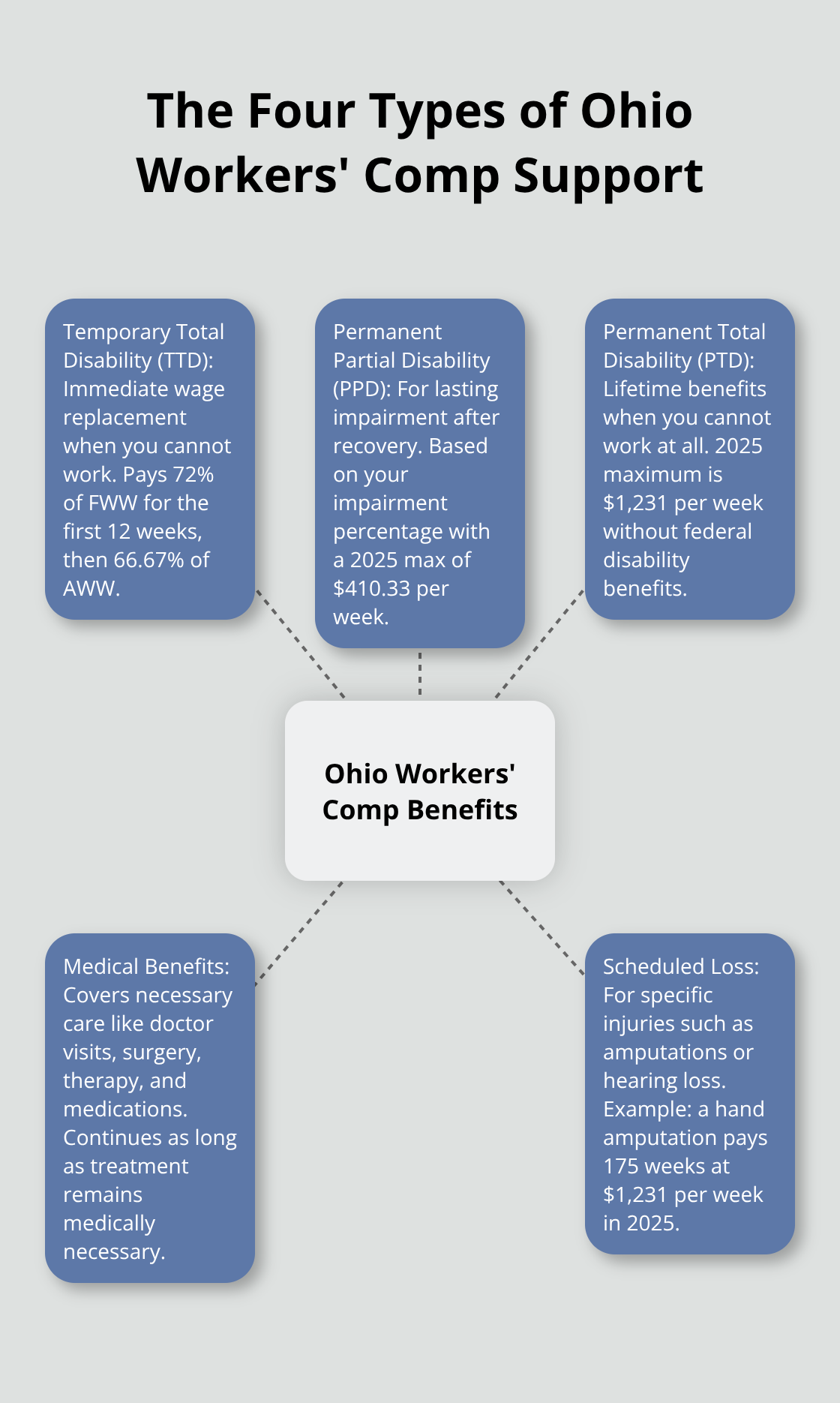
Ohio’s workers’ compensation system provides four main categories of financial and medical support, and understanding what each one covers prevents you from leaving money on the table. Temporary Total Disability (TTD) kicks in immediately when you cannot work due to your injury. During the first 12 weeks, TTD pays 72% of your full weekly wage-the higher of your gross earnings in the six weeks before injury or your average earnings in the seven days before injury. After 12 weeks, the calculation shifts to 66.67% of your average weekly wage across the 52 weeks before injury. In 2025, the maximum TTD weekly rate sits at $1,231 if you do not receive Social Security retirement benefits, though you will receive actual wages if they exceed the minimum of $410.33 per week according to the Ohio Bureau of Workers’ Compensation. This shift from full weekly wage to average weekly wage matters significantly-many injured workers fail to realize their benefit amount changes at the 12-week mark and miss opportunities to challenge incorrect calculations.
Permanent Partial and Total Disability
Permanent Partial Disability (PPD) applies when you recover but retain lasting effects from your injury. The Ohio Bureau of Workers’ Compensation assigns an impairment percentage based on medical evidence, and your benefit uses that percentage and the PPD rate, which maxes out at $410.33 weekly in 2025. Permanent Total Disability (PTD) provides lifetime benefits when you cannot work at all-the 2025 maximum is $1,231 weekly without federal disability benefits, with a minimum of $615.50 weekly. These two categories operate under different rules and timelines, and missing the nuances costs injured workers thousands in unclaimed benefits.
Medical Benefits and Scheduled Loss Coverage
Medical benefits cover all necessary treatment for your work injury, including doctor visits, surgery, physical therapy, and medications-these are paid separately from wage replacement and continue as long as treatment remains medically necessary. Scheduled Loss benefits apply to specific injuries like amputations or hearing loss; a hand amputation, for example, provides 175 weeks of benefits at the $1,231 weekly rate in 2025 according to the Ohio Bureau of Workers’ Compensation. Understanding how the Ohio Bureau of Workers’ Compensation calculates your specific award requires knowledge of the wage figures and classifications that determine your final payment amount.
How the Ohio BWC Calculates Your Award
The Two Wage Figures That Determine Your Benefits
The Ohio Bureau of Workers’ Compensation uses a formula that hinges on two wage calculations, and getting these numbers right is the difference between receiving your full entitlement and accepting underpayment. Your Full Weekly Wage (FWW) is the higher of your gross earnings in the six weeks before injury or your average earnings in the seven days before injury.
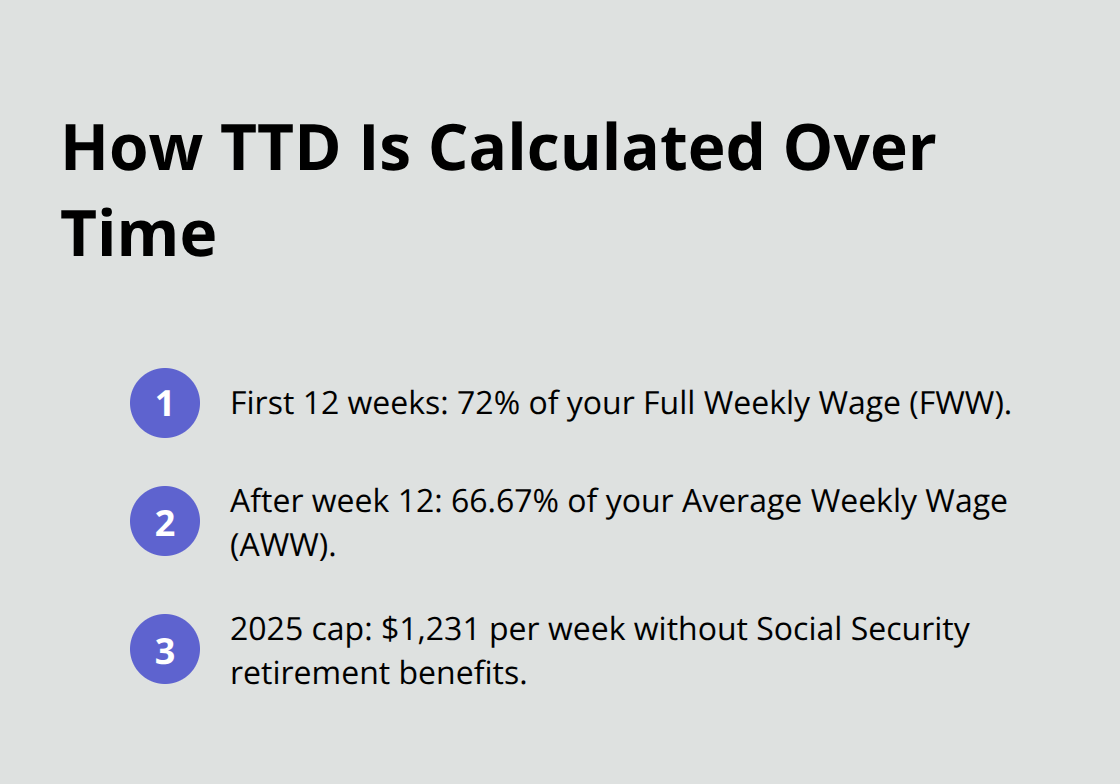
This matters because FWW determines your Temporary Total Disability rate for the first 12 weeks-72% of that amount. Your Average Weekly Wage, calculated from all wages earned during the 52 weeks before injury, takes over after week 12, dropping your TTD rate to 66.67% of AWW. Many injured workers never realize this shift happens automatically and fail to verify the calculation is correct, meaning they accept lower payments without question.
How the Annual Compensation Chart Affects Your Payment
The Ohio Bureau of Workers’ Compensation publishes annual compensation charts that govern these calculations, and the chart changes yearly to reflect benefit maximums. In 2025, the TTD maximum sits at $1,231 weekly without Social Security retirement benefits, but the minimum of $410.33 weekly applies only if your actual wages fall below that threshold-if you earned more, you receive actual wages instead. This protection prevents low-wage workers from being penalized by the system. The shift from full weekly wage to average weekly wage at the 12-week mark matters significantly, and many injured workers miss opportunities to challenge incorrect calculations when this transition occurs.
How Your Injury Classification Shapes Your Benefits
Your injury classification directly affects which benefit category applies and how long you receive payments. Permanent Partial Disability benefits depend entirely on the impairment percentage assigned by medical evaluation, with the 2025 maximum rate at $410.33 weekly, meaning a 10% impairment award calculates differently than a 25% impairment. Scheduled Loss benefits for specific injuries like amputations bypass the impairment percentage system entirely-a hand amputation provides 175 weeks of benefits at the $1,231 weekly rate regardless of how well you recover functionally. The Industrial Commission of Ohio reviews disputed classifications and impairment ratings through a formal hearing process if you disagree with the BWC’s determination.
Challenging Your Impairment Rating and Initial Payment Timeline
Injured workers often accept the first impairment rating without challenge, but medical evidence can support a higher rating if treatment records show greater functional loss. Your initial payment typically arrives within two weeks of the BWC approving your claim and establishing your wage calculations, though delays occur when documentation is incomplete or injury classification requires additional medical review. The Industrial Commission of Ohio handles appeals when you dispute the BWC’s classification or rating, and understanding how to present medical evidence strengthens your case. Errors in wage calculations or injury classifications happen frequently, and workers who fail to understand how these figures were derived often miss the chance to correct them before payments begin.
How Injured Workers Sabotage Their Own Claims
Most injured workers in Ohio lose thousands of dollars not because the system is rigged against them, but because they make preventable mistakes in the first days and weeks after injury. The decisions you make immediately after getting hurt directly determine whether you receive your full benefit amount or accept a reduced award that you cannot later challenge.
Report Your Injury Without Delay
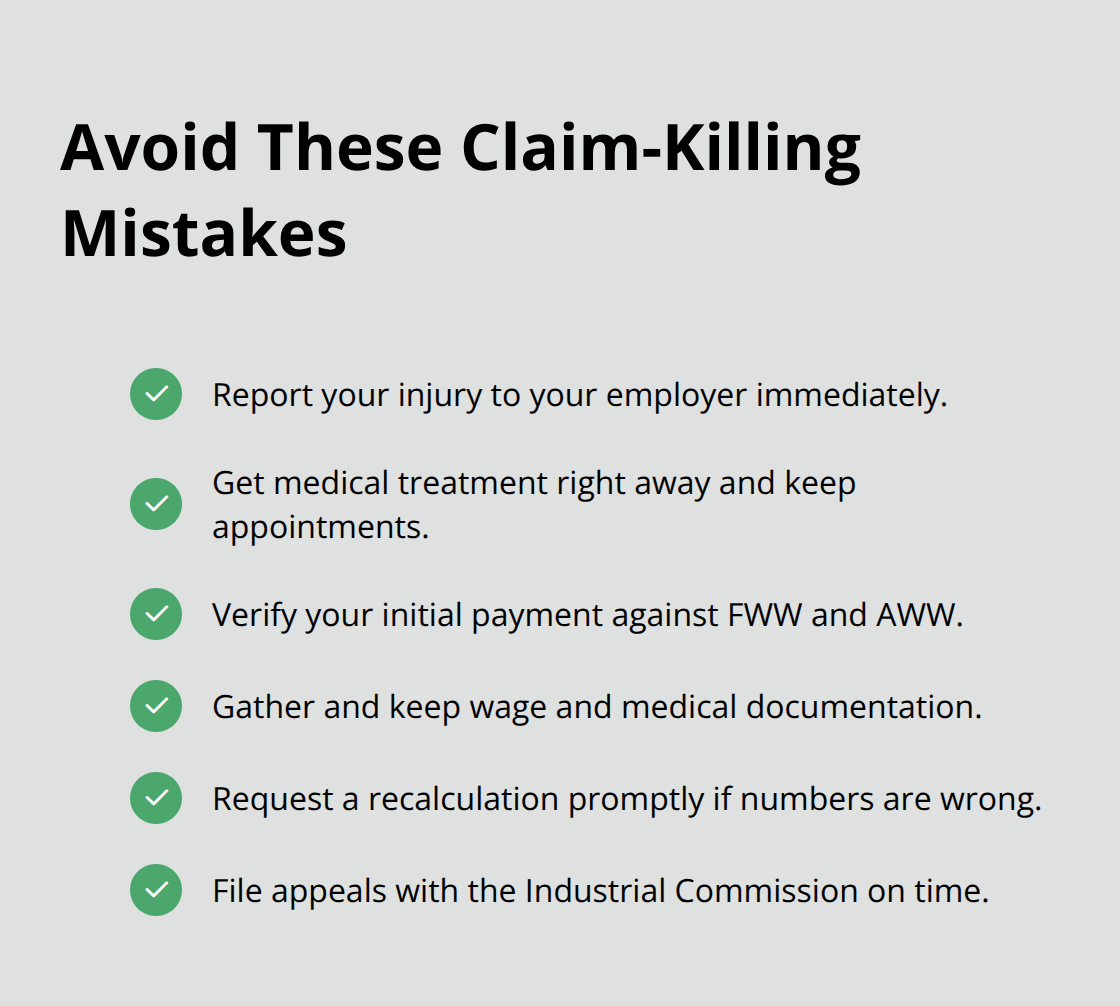
Reporting your injury to your employer within the timeframe required by Ohio law is non-negotiable. Delays give employers and the BWC reasons to question the legitimacy of your claim, and some workers wait days or even weeks before notifying their supervisor, thinking minor injuries will resolve without intervention. Once you report, the clock starts for your claim eligibility and benefit calculations. The Ohio Bureau of Workers’ Compensation uses your injury report date to establish your full weekly wage and determine your benefit category, so postponing this step costs you from day one.
Seek Medical Treatment Immediately
Medical treatment immediately after injury establishes the injury date and severity, which the BWC uses to calculate your full weekly wage and determine your benefit category. The Ohio Bureau of Workers’ Compensation bases your entire award on medical evidence from the date of injury forward, meaning gaps in treatment create opportunities for the BWC to argue your injury was less severe than claimed or that subsequent medical problems are unrelated to work. Workers who delay treatment by two weeks often find the BWC reduces their impairment percentage based on that gap in the medical record. Treatment documentation becomes your strongest evidence when disputes arise later.
Verify Your Initial Payment Before Accepting It
The second critical mistake happens when injured workers accept the first settlement offer or initial benefit calculation without verification. Your initial payment from the BWC should match the compensation chart calculations based on your FWW and AWW, but errors in wage calculation occur regularly (employers sometimes report incorrect earnings history, and the BWC’s administrative staff occasionally misapply the formula). Before you accept any settlement or initial payment, verify that the FWW used for your first 12 weeks of TTD matches your actual gross earnings from the six weeks before injury, and confirm that your AWW calculation includes all 52 weeks of earnings. If the numbers do not match your records, request a recalculation immediately; waiting months makes corrections harder.
Meet All Appeal Deadlines with the Industrial Commission
The third fatal mistake is missing appeal deadlines with the Industrial Commission of Ohio. If you disagree with your impairment rating, your injury classification, or how the BWC calculated your wage figures, you have a limited window to request a hearing-missing that deadline means accepting the BWC’s determination permanently and forfeiting any opportunity to challenge it later. The Industrial Commission reviews disputed claims through a formal hearing process, and workers who come prepared with medical records, wage documentation, and evidence of functional limitations frequently secure higher impairment ratings than the initial BWC determination. These mistakes compound because one error often leads to another (delayed reporting weakens your medical documentation, weak medical documentation reduces your impairment rating, and accepting that rating without challenge locks in an underpayment for life if you have a permanent injury). Making the right attorney choice early in the process can help you avoid these costly errors.
Final Thoughts
Ohio workers’ comp benefits protect you when injury strikes, but the system only works if you understand how it operates and take action to defend your rights. The wage calculations, benefit categories, and timelines throughout this guide form the foundation of your claim, and mistakes in any of these areas reduce what you receive. Administrative systems make errors-wage calculations get miscalculated, impairment percentages get underestimated, and injury classifications get misapplied-yet thousands of injured workers in Ohio fail to maximize their benefits because they don’t verify calculations or challenge incorrect determinations from the BWC.
When you’re recovering from an injury, you lack the bandwidth to fight these battles alone while also managing medical treatment and financial stress. The Ohio Bureau of Workers’ Compensation processes claims administratively, and that administrative process creates opportunities for underpayment that workers often miss. Legal representation becomes the difference between accepting underpayment and securing your full entitlement, especially when disputes arise with the Industrial Commission of Ohio.
Contact Robin J Peterson Company, LLC to discuss your claim and protect your Ohio workers’ comp benefits. The consultation costs nothing, and understanding your options removes the guesswork from defending your rights.