
A knee injury claim in Ohio involves navigating the state’s workers’ compensation system, which has specific rules and timelines you need to follow. At Robin J Peterson Company, LLC, we help injured workers understand what steps matter most when filing with the Bureau of Workers’ Compensation.
This guide walks you through the process from injury reporting to claim approval, covering what the BWC looks for and how to avoid common pitfalls that delay or deny claims.
Understanding Knee Injuries and BWC Coverage
What Knee Injuries Does Ohio Workers’ Compensation Actually Cover
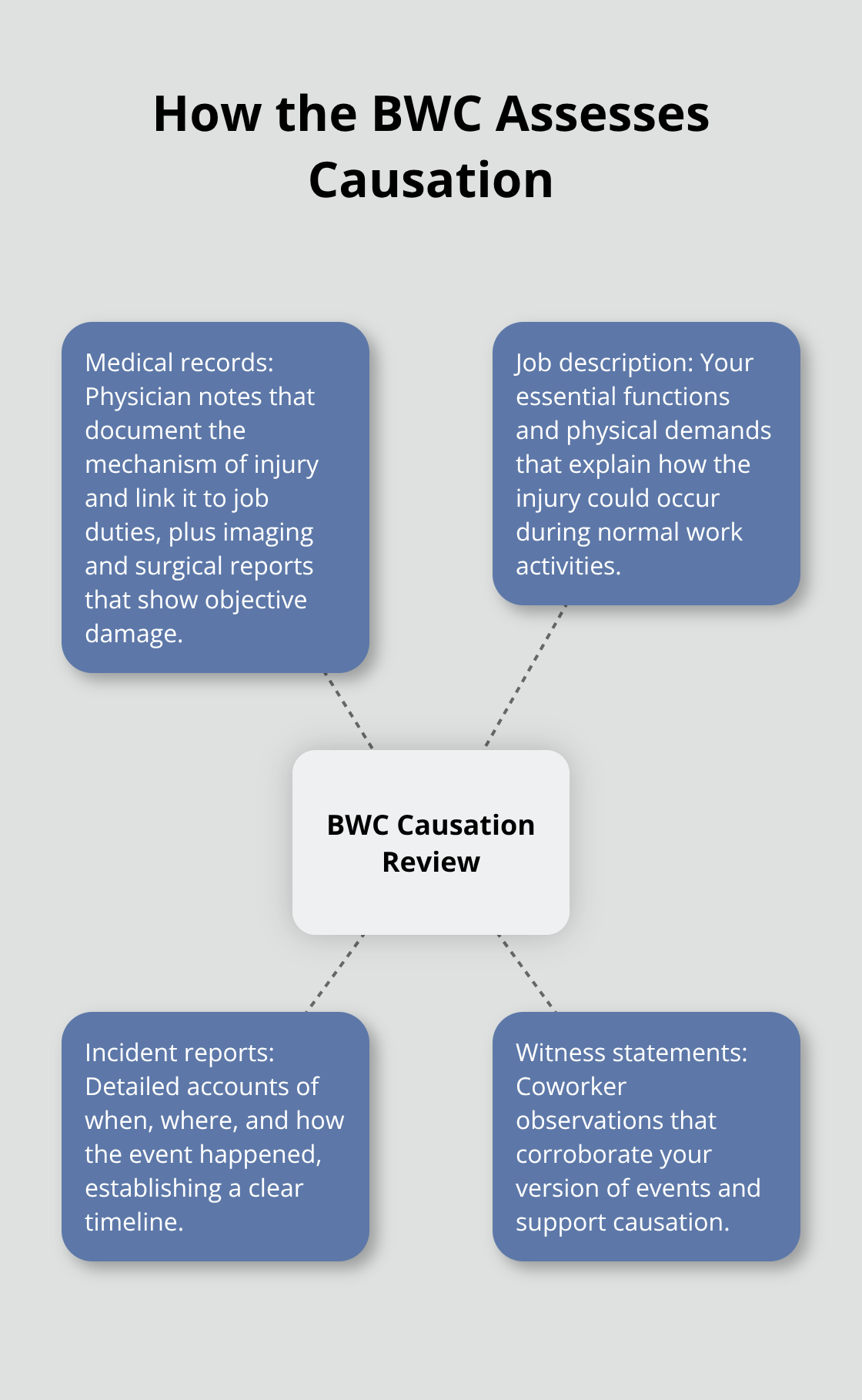
The Ohio Bureau of Workers’ Compensation covers knee injuries that arise out of and occur in the course of employment. This means the injury must have a direct connection to your job duties or workplace conditions. The BWC evaluates causation using medical records, your job description, incident reports, and witness statements. If you can show the injury happened at work or resulted from your work activities, you have a legitimate claim.
Common qualifying injuries include ACL tears, meniscus tears, MCL and PCL sprains, knee fractures, and dislocations that occur during work. Workers in construction, manufacturing, transportation, and healthcare face higher injury risk because these jobs involve heavy lifting, squatting, kneeling, or prolonged standing. Even if you had a pre-existing knee condition, you can still qualify if the work injury caused new damage or substantially aggravated the existing problem. The key is documentation that clearly separates the old condition from the new work-related injury.
Why the BWC Denies Claims and How to Avoid It
Denials occur in roughly one-quarter of initial knee injury claims in Ohio. The most common reason is weak or missing documentation that links the injury to work. If your initial medical records don’t explicitly state how the injury happened at work, the BWC will question causation. Timing gaps between the injury and your first medical visit create suspicion. If you wait weeks to seek treatment, the BWC assumes the injury wasn’t serious or wasn’t work-related. Undisclosed pre-existing knee conditions also trigger denials because the BWC views them as attempts to hide relevant medical history.
Building Your Documentation Package
Report the injury to your employer immediately in writing (email or accident report both work). Seek medical care within days and ensure your treating physician documents the work connection explicitly in their initial notes. Gather X-rays, MRIs, surgical records, physical therapy notes, incident reports, and witness statements from coworkers who saw what happened. Photograph the work area, equipment involved, and any hazards. This documentation package makes denial much harder for the BWC to justify. Strong evidence from day one determines whether the BWC approves or denies your claim, which is why the first steps after your injury matter most.
Steps to File Your Knee Injury Claim in Three Critical Actions
Report Your Injury to Your Employer Immediately
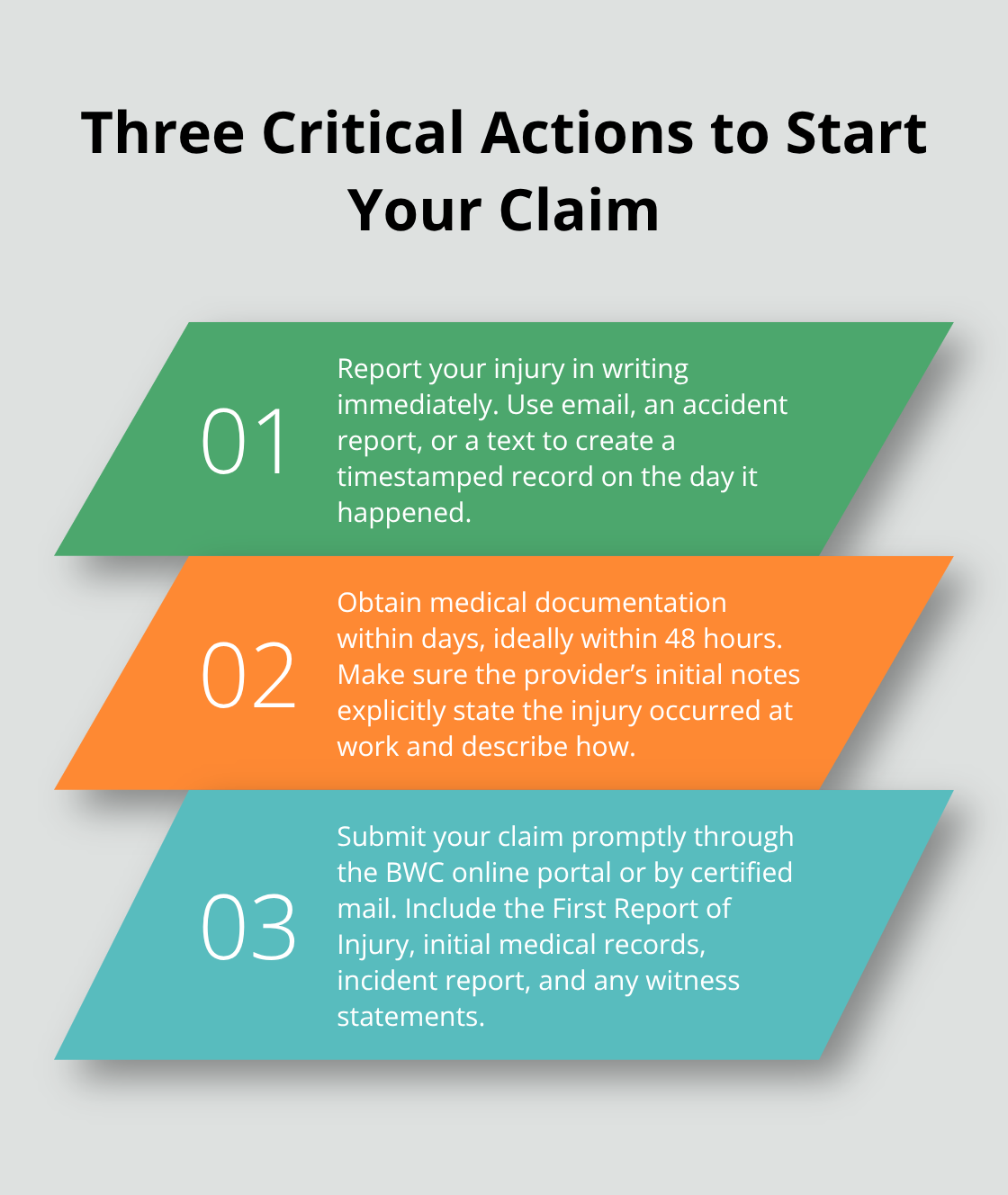
Your first action after a knee injury must be written notification to your employer. Email works, a signed accident report works, even a text message to your supervisor works-what matters is creating a timestamped record that you reported the injury on the day it happened. The BWC views delayed reporting as a red flag. If you wait a week or longer to tell your employer, the BWC questions whether the injury was truly work-related or serious enough to matter. Write exactly what happened, where it happened, and which body part was injured. Keep a copy for yourself.
This single step prevents the BWC from later claiming they had no notice of your injury.
Obtain Medical Documentation Within Days
Medical documentation within the first few days determines whether your claim succeeds or fails. Schedule an appointment with a BWC-certified provider immediately-ideally within 48 hours of the injury. The provider’s initial notes must explicitly state that the injury occurred at work and describe how it happened. If the notes say only that you have knee pain without connecting it to your work activity, the BWC will deny the claim. Tell your physician the exact mechanism of injury: did you fall, did something strike your knee, did you twist it while lifting, did you land wrong stepping off equipment? The more specific you are, the stronger your medical record becomes. If you cannot see a BWC-certified provider due to emergency circumstances, get treated at an urgent care or emergency room, but then transfer to a certified provider for ongoing care. Non-certified providers create billing complications that can delay or reduce your benefits.
Submit Your Claim Within the Required Timeframe
Your claim submission deadline is strict and non-negotiable. You have a reasonable time to file after your injury-the BWC typically expects claims within one year, but filing sooner protects you. Submit your claim through the Ohio BWC online portal if possible, as this creates an immediate electronic record with a claim number assigned to you. If you mail your claim, use certified mail and keep the receipt. Include your First Report of Injury form, your initial medical records from your treating provider, your incident report, and any witness statements. The BWC acknowledges receipt within about 10 business days. If your employer has not filed the First Report themselves, you must file it yourself-do not assume your employer will handle it. Many injured workers lose benefits because they waited for their employer to file and missed the filing window. Take control of the process yourself.
Once you submit your claim, the BWC begins its evaluation process, which involves reviewing your medical evidence and determining whether your injury qualifies for coverage. Understanding what happens next helps you prepare the documentation that strengthens your position.
Maximizing Your Medical Evidence and Provider Relationships
Build Objective Medical Documentation
Medical records form the foundation of your claim, and weak records lead to denial regardless of how legitimate your injury is. You need imaging studies that show structural damage: X-rays documenting fractures, MRIs revealing ligament or meniscus tears, or surgical reports confirming what was repaired. Without these objective findings, the BWC treats your claim as unproven. Your treating physician must explicitly connect each treatment recommendation to your work injury in their notes. If your doctor documents that you need physical therapy three times weekly but never states why, the BWC questions whether the treatment is truly work-related or just routine care.
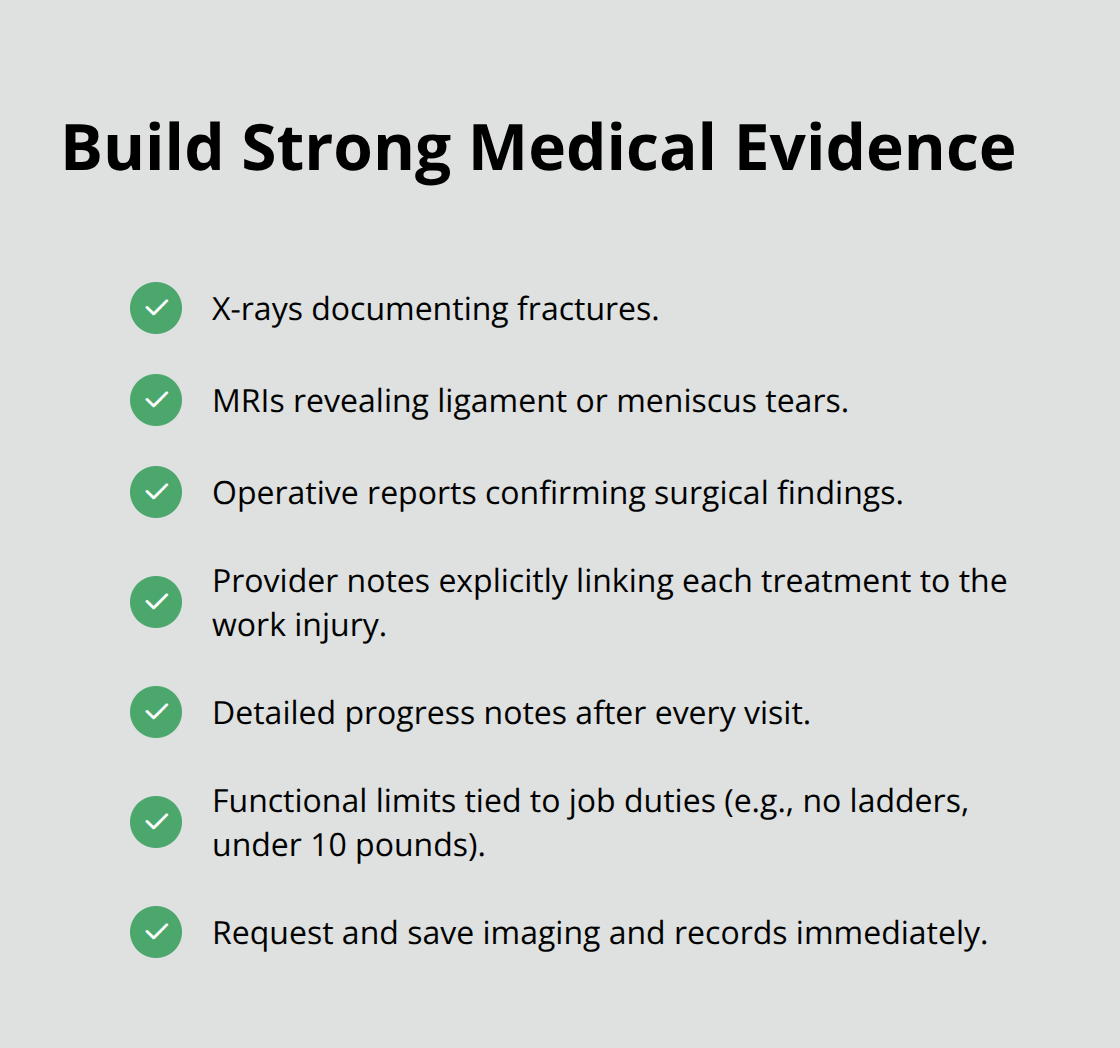
Demand that your provider write detailed progress notes after each visit, noting your functional limitations, pain levels during specific movements, and how the injury prevents you from performing your job duties. When your doctor states you cannot lift over 10 pounds or cannot climb ladders, the BWC understands the injury’s impact on your work capacity.
Prioritize Surgical Records and Imaging
Surgical records carry substantial weight because they provide objective evidence of internal damage. If you undergo knee surgery, the operative report must explicitly describe the injury mechanism and confirm it matches your account of what happened at work. Request copies of all imaging and surgical records immediately after they are created, not months later when memory fades and documents become harder to retrieve. These records establish that your knee sustained real structural damage, not just soft tissue irritation or temporary pain.
Select Providers Who Understand Workers’ Compensation
Your choice of healthcare provider determines whether the BWC accepts or rejects your treatment plan. Stick exclusively with BWC-certified providers for ongoing care because non-certified providers create billing disputes that delay or reduce your benefits. When selecting a provider, ask specifically whether they have experience with workers’ compensation cases and understand Ohio BWC documentation requirements. Providers unfamiliar with workers’ comp often write generic medical notes that omit the work-relatedness statement the BWC demands. This single oversight can tank an otherwise legitimate claim.
Respond Promptly to All BWC Requests
When the BWC requests additional information or medical clarification, respond within five business days, not weeks. The BWC interprets slow responses as evasion or lack of urgency. If the BWC requests wage records, employment documents, or additional medical information, provide everything requested plus any supplemental documentation that strengthens your position. If you cannot locate a document, state that in writing rather than ignoring the request. Silence signals uncooperativeness and gives the BWC justification to deny your claim. If the BWC’s request seems unreasonable or asks for information unrelated to your knee injury, consult with an attorney before responding, as your answers can be used against you in future disputes.
Final Thoughts on Your Knee Injury Claim in Ohio
After you submit your claim to the Ohio Bureau of Workers’ Compensation, the review process typically takes three to six months for straightforward cases, though complex claims can extend nine months or longer. The BWC systematically evaluates your medical evidence, job description, and incident documentation to determine whether your injury qualifies as work-related. You’ll receive status updates as your claim moves through their system, and you can track progress through the BWC online portal using your claim number.
Legal representation becomes valuable when the BWC denies your claim or when you face disputes over treatment approval or benefit amounts. An experienced workers’ compensation attorney understands Ohio BWC procedures, knows how to respond to denials, and can escalate your case to the Industrial Commission of Ohio if necessary. If the BWC rejects your knee injury claim in Ohio, you have exactly 14 days to appeal-missing this deadline eliminates your right to challenge the decision.
We at Robin J Peterson Company, LLC represent injured workers throughout Ohio’s workers’ compensation system and focus on helping clients navigate knee injury claims. If your claim has been denied or you’re uncertain about next steps, contact us for a free consultation. We serve the Cleveland, Akron, and Canton areas and work on cases where you pay no fees unless we prevail.