
A workplace injury changes everything, and understanding your injury rights after a job-related incident is the first step toward protecting what you’re owed. At Robin J Peterson Company, LLC, we’ve helped countless workers navigate the complex process of securing their benefits.
The path forward isn’t always clear, but knowing your legal protections under Ohio law makes all the difference. This guide walks you through your rights, the claims process, and how to safeguard your compensation every step of the way.
What Ohio Workers’ Compensation Actually Covers
The No-Fault System Explained
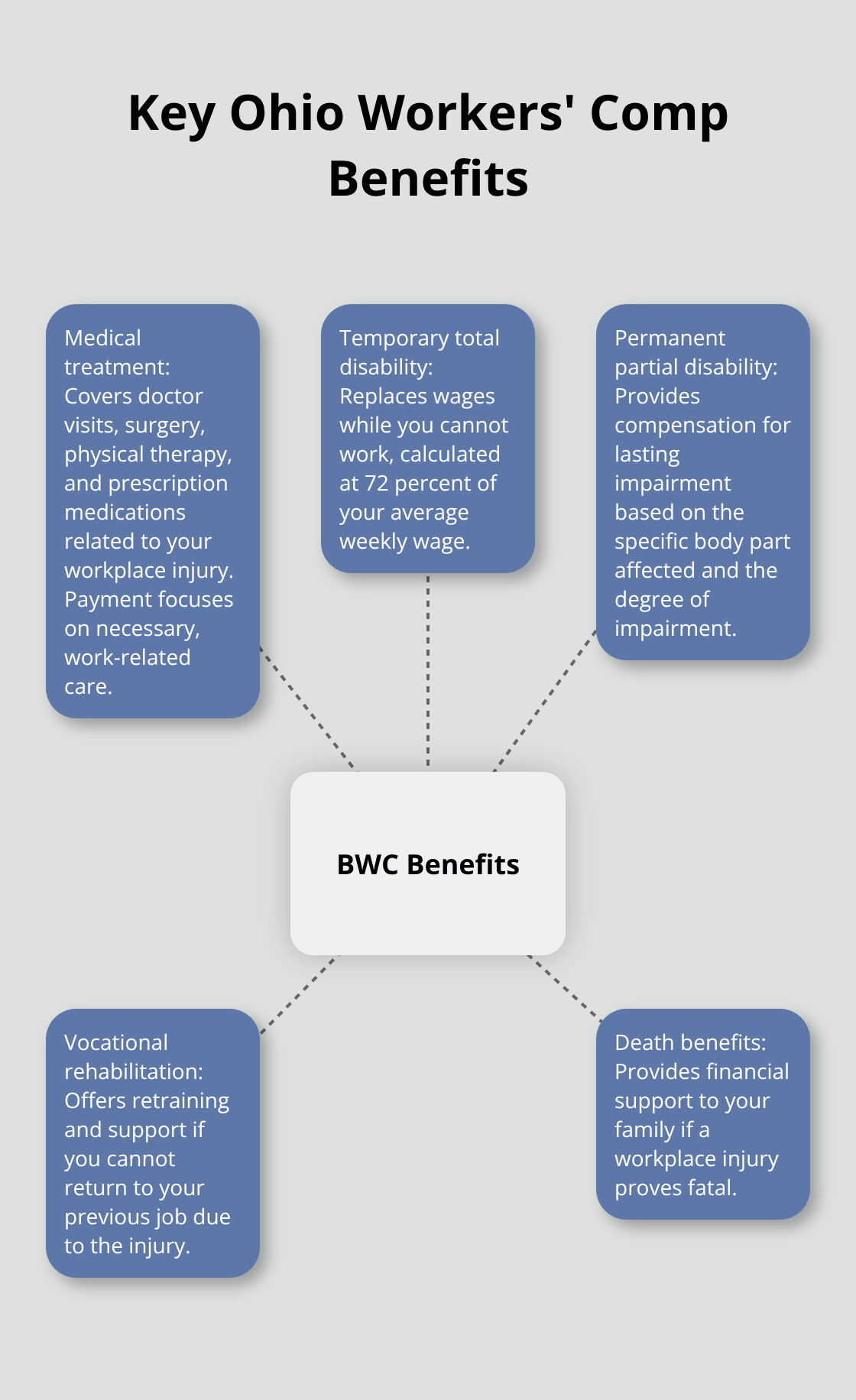
Ohio’s Bureau of Workers’ Compensation operates under a no-fault system, meaning you don’t need to prove your employer was negligent to receive benefits. This differs fundamentally from personal injury lawsuits. If you suffer an injury that arises out of and occurs in the course of your employment, you qualify for coverage. The BWC covers medical treatment related to your workplace injury, including doctor visits, surgery, physical therapy, and prescription medications.
Income and Disability Benefits
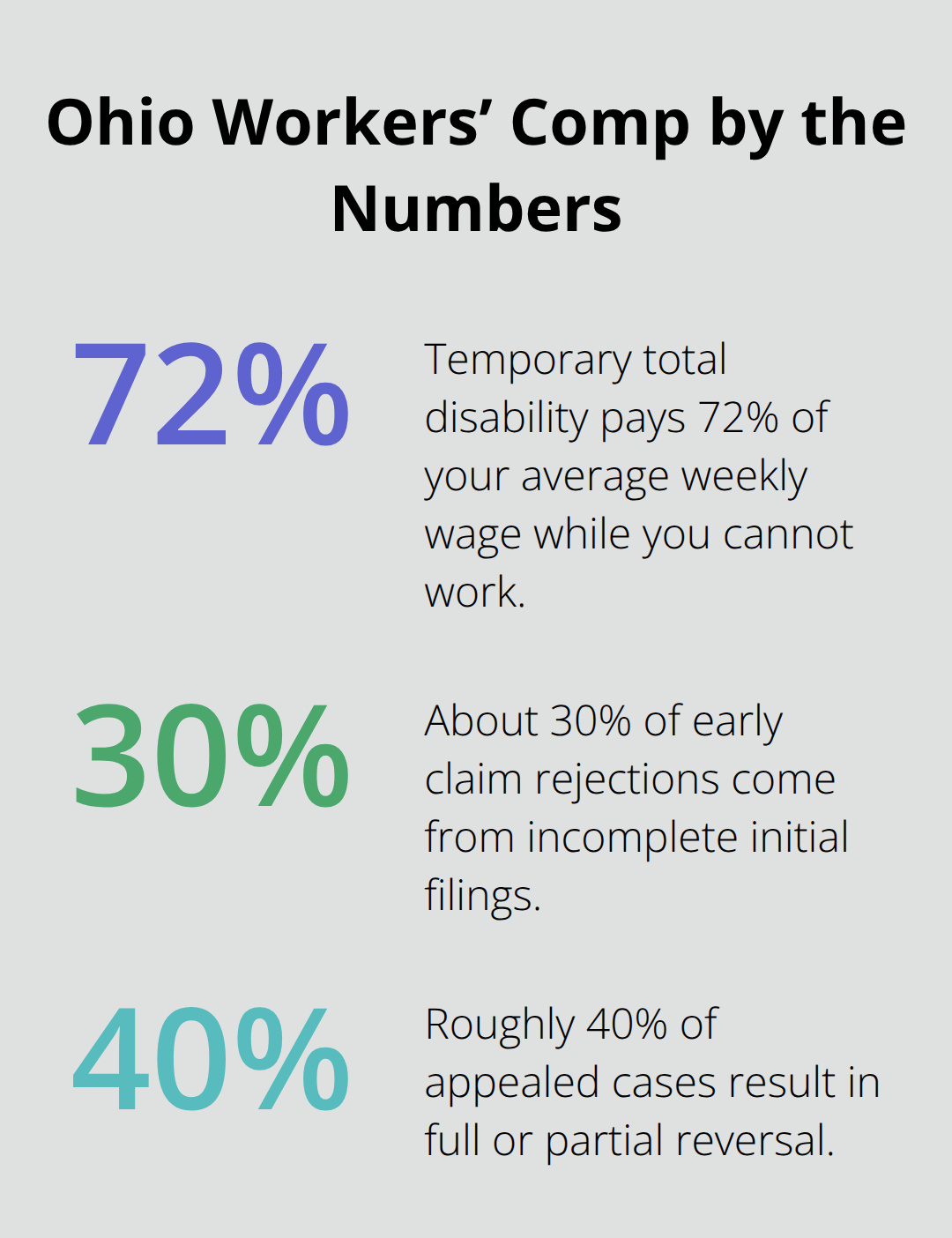
Temporary total disability benefits replace a portion of your lost wages while you cannot work, calculated at 72 percent of your average weekly wage. Permanent partial disability compensation applies when your injury causes lasting impairment, with benefits determined by the specific body part affected and the degree of impairment. If your injury prevents you from returning to your previous job, vocational rehabilitation services help you retrain for different work. Death benefits protect your family if a workplace injury proves fatal.
What the BWC Excludes
The BWC does not cover everything. Self-inflicted injuries, injuries from willful misconduct, or incidents occurring while you violated safety rules typically result in denial. Injuries sustained while under the influence of drugs or alcohol face similar rejection. The injury must have a direct causal connection to your work duties to qualify for benefits.
Correcting Common Misconceptions
Many workers mistakenly believe that any on-the-job incident automatically qualifies for benefits. Another common misconception is that you can sue your employer directly for a workplace injury in Ohio, which the workers’ compensation system prohibits. Your exclusive remedy flows through the BWC. Some injured workers also assume that filing a claim will result in termination, but Ohio law prohibits retaliation for filing a legitimate claim (this protection exists precisely to prevent that outcome).
Moving Forward With Clarity
Understanding these distinctions between what the BWC covers and what it excludes positions you to advocate effectively for your rights from the start. The claims process itself demands careful attention to detail and proper documentation-elements that separate successful claims from those that face rejection.
How to File Your Claim Correctly
Report Your Injury Immediately
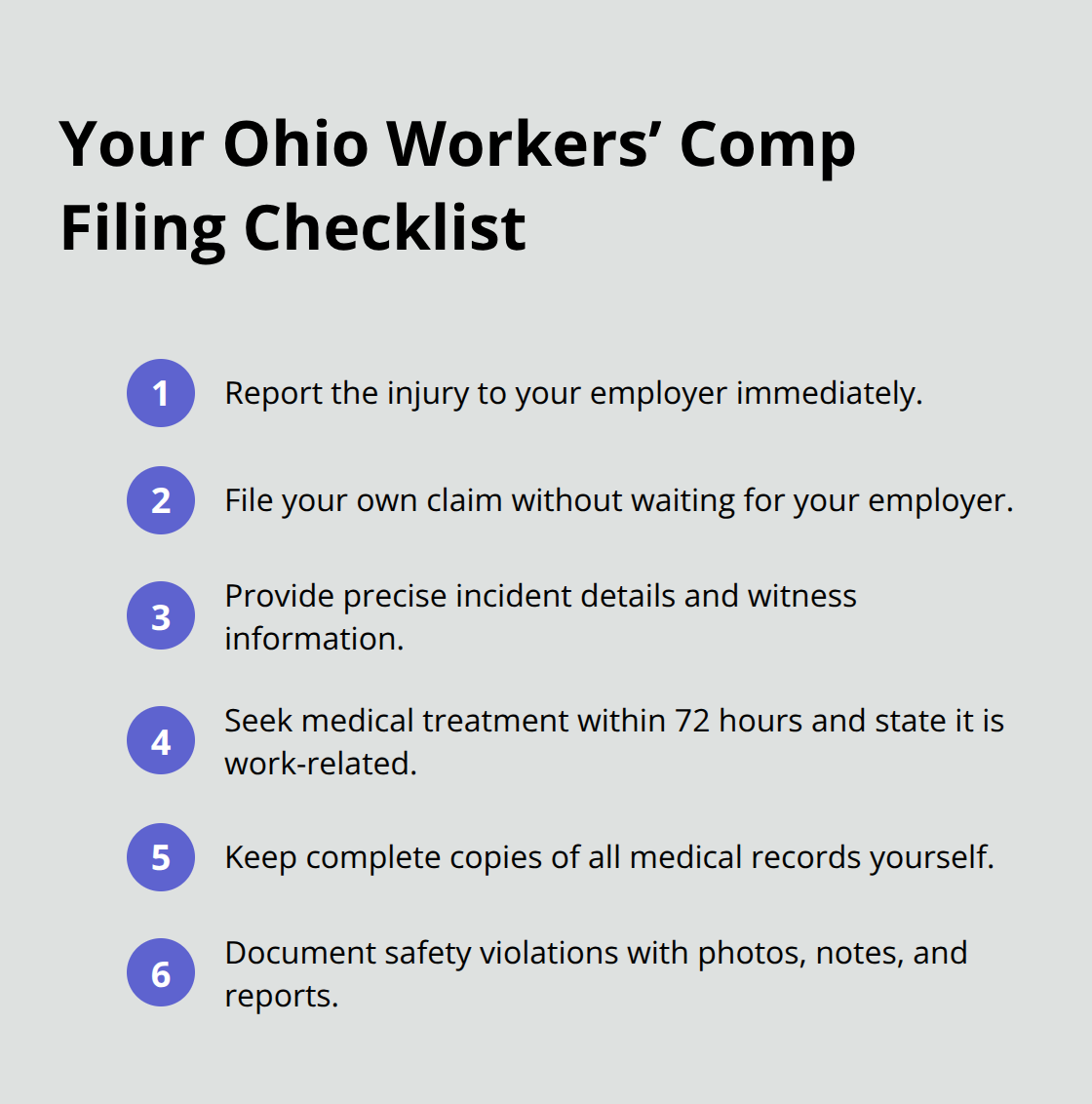
The moment you report your injury to your employer, the clock starts ticking. Ohio law requires employers to report workplace injuries to the BWC within 14 days, but waiting for your employer to act puts your claim at risk. File your own claim immediately after the incident, even if your employer says they’ll handle it. The BWC accepts claims through their online system, by phone at 1-800-644-6292, or through paper forms submitted directly.
Provide Precise Details About What Happened
When you file, provide the exact date, time, and location of the injury, along with a detailed description of what happened and which body parts were affected. Vague descriptions like general back pain without specifics about the incident lead to denials at alarming rates. The Ohio Industrial Commission reports that incomplete initial filings account for roughly 30 percent of early claim rejections.
Your description should answer how the injury occurred mechanically-did you fall, lift something, get struck by an object, or repeat a motion? Include the names and contact information of any coworkers who witnessed the incident, as witness statements strengthen your case substantially. Missing witness information means the BWC relies solely on your account, which invites disputes from your employer.
Secure Medical Documentation Within 72 Hours
Medical documentation becomes your strongest evidence, and you must obtain it immediately. Seek medical treatment within 72 hours of the injury whenever possible, as the BWC views delayed treatment with skepticism. When you see a doctor, explicitly state that the injury is work-related, and request that this be documented in your medical records. Many workers mention the injury casually or let the doctor assume it’s non-occupational, which creates gaps in the medical file.
Your healthcare provider should document the mechanism of injury, your symptoms, and any functional limitations. Keep copies of all medical reports, imaging results, and treatment notes-do not rely on the employer or BWC to maintain complete records. The BWC’s file frequently contains missing pages or incomplete records, and incomplete documentation is a primary reason claims face suspension or denial.
Document Safety Violations and Working Conditions
Report any workplace safety violations related to your injury directly to the Ohio Division of Safety and Health. This action creates an independent government record that corroborates your account. If your employer failed to provide proper equipment, training, or working conditions that contributed to your injury, document these failures in detail (photographs, written notes, and witness accounts all matter here). The BWC considers safety violations as evidence that strengthens your position during disputes and claim reviews.
With your claim filed and documentation in place, you’ve built a foundation that protects your position. The next phase involves recognizing which red flags commonly trigger claim rejections-and how to avoid them.
Protecting Your Benefits During Recovery and Return to Work
Modified Duty and Your Benefit Rights
Returning to work after an injury creates a critical juncture where your benefits can shift dramatically if you’re not careful. Modified duty assignments often seem like a positive step, but they frequently trap workers in a situation where the BWC reduces or terminates benefits based on the assumption that you’ve recovered. When your employer offers modified duty, you’re not obligated to accept it, and declining modified work does not disqualify you from temporary total disability benefits if you genuinely cannot perform your regular job duties.
The BWC distinguishes between refusing suitable work and being medically unable to work, so obtain written documentation from your doctor stating that modified duty exceeds your medical restrictions. Many workers accept modified duty work and then lose benefits without understanding that the BWC views any work activity as evidence of recovery capacity. Document your modified duty restrictions in writing with your employer and provide a copy to the BWC immediately. If your employer pressures you to perform duties beyond your medical restrictions, report this to the Division of Safety and Health, as this creates evidence that modified duty was unsuitable for your condition.
How Wage Loss Benefits Calculate
Wage loss benefits continue only while you meet specific criteria established by the BWC, and the calculation method matters enormously. Your temporary total disability rate equals 72 percent of your average weekly wage before the injury, but the BWC calculates this figure by examining your earnings for the 52 weeks preceding the injury. Inconsistent income, seasonal work, or recent employment changes can result in a lower calculated rate that doesn’t reflect your actual earning capacity.
Request a wage calculation review if the BWC’s figure seems inaccurate, and provide pay stubs, tax returns, or employer records to support your position. The accuracy of this calculation directly affects how much you receive each week, so challenge any figure that underrepresents your true earning capacity.
Appealing Denied Claims and Disputed Decisions
When you appeal denied claims or disputed decisions, the Industrial Commission of Ohio reviews your case independently, and roughly 40 percent of appealed cases result in full or partial reversal according to BWC data. File your appeal within one year of the denial or dispute decision, as missing this deadline eliminates your right to challenge the BWC’s determination.
Your appeal should include new medical evidence if your condition has worsened, documentation showing your employer’s safety violations, or witness statements that contradict the initial denial. Comprehensive documentation (medical records, communication with the BWC, and witness accounts) substantially improves your chances of success. Workers’ compensation law in Ohio is complex, and navigating appeals requires careful attention to deadlines and evidence standards.
Final Thoughts
Protecting your injury rights after a job requires action at every stage, from the initial claim filing through recovery and return to work. The steps you take immediately after your injury determine whether you receive full benefits or face denials that leave you struggling financially. Report your injury to your employer and the BWC without delay, document everything meticulously, and obtain medical treatment within 72 hours. Keep copies of all records yourself rather than relying on the BWC to maintain complete files.
When you return to modified duty, your doctor must provide written restrictions and the BWC must receive documentation of your limitations. Challenge any wage calculation that underrepresents your earning capacity, and don’t hesitate to appeal denied claims within the one-year deadline. Many workers navigate this process alone and make costly mistakes that result in reduced or terminated benefits.
The complexity of Ohio workers’ compensation law means that professional guidance often pays for itself through successful claims and appeals. If your claim faces denial, your employer disputes your injury, or the BWC reduces your benefits without justification, contact Robin J Peterson Company, LLC for a consultation. We represent injured workers throughout Ohio who need someone fighting for their rights.