
Getting a workers’ compensation claim denied by the Ohio BWC is frustrating, especially when you’re dealing with an injury. At Robin J Peterson Company, LLC, we’ve helped many injured workers understand why their claims were rejected and what they can do about it.
The reasons behind BWC denial Ohio claims often come down to preventable mistakes. This guide walks you through the most common denial reasons and shows you how to fight back.
Why the Ohio BWC Rejects Claims
The Ohio BWC rejects thousands of claims annually, and most denials stem from fixable problems rather than legitimate grounds for rejection. Missing documentation ranks as the top reason claims get rejected. The BWC requires specific medical records, incident reports, and witness statements to establish that an injury happened at work and requires treatment. If your employer never filed an initial injury report or your medical provider failed to document the connection between your job duties and your injury, the BWC will likely deny your claim.
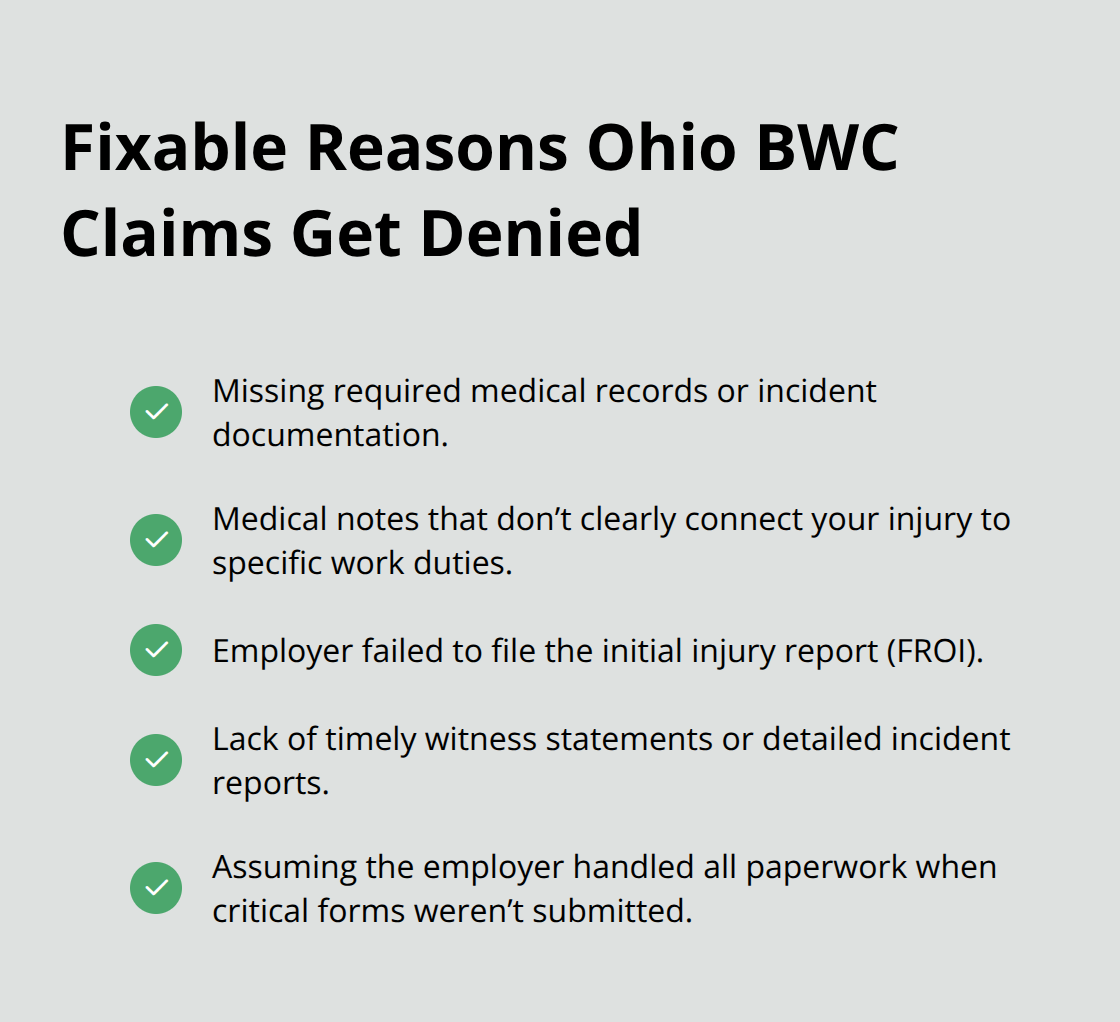
Many injured workers assume their employer handles all paperwork, only to discover months later that critical forms were never submitted.
Verify Your Employer Filed Required Documents
You need to verify that your employer filed the FROI (First Report of Injury) within 10 days of the incident. Request a copy from your employer’s human resources department and confirm the BWC received it. Medical records must specifically reference work-related activities as the cause of injury, not just describe your symptoms. If your doctor’s notes say you injured your back but fail to mention that you were lifting heavy equipment at work, the BWC will question whether the injury truly occurred on the job. Contact your medical provider and ask them to submit an amended report that explicitly connects your injury to your work duties.
Missing the Filing Deadline
Ohio law sets a strict statute of limitations for workers’ compensation claims. You generally have two years from the date of injury to file a claim with the BWC, though this deadline can be extended if your employer concealed the injury or if you failed to recognize the injury was work-related. Many workers miss this window because they assumed they had more time or failed to realize the clock was ticking. Once the deadline passes, the BWC will automatically deny your claim with no exceptions. Occupational diseases follow different rules, with the two-year clock starting from when you first knew or should have known the disease resulted from your work. If you suffered an injury months ago and have not filed yet, act immediately, as the deadline may be approaching fast. The statute of limitations exists to protect employers and insurers from stale claims, but it also means injured workers must act quickly to protect their rights.
Establish That Your Injury Occurred at Work
The BWC frequently rejects claims when they question whether the injury actually occurred at work. This happens most often with injuries that could plausibly happen outside of work, such as back strains or knee injuries. You must prove that your specific job duties directly caused the injury, not just that you happened to get injured while at work. If you slipped and fell in the break room, that’s clearly work-related. But if you claim your back injury happened while lifting at work and your employer says you already had a bad back, the BWC may side with the employer.
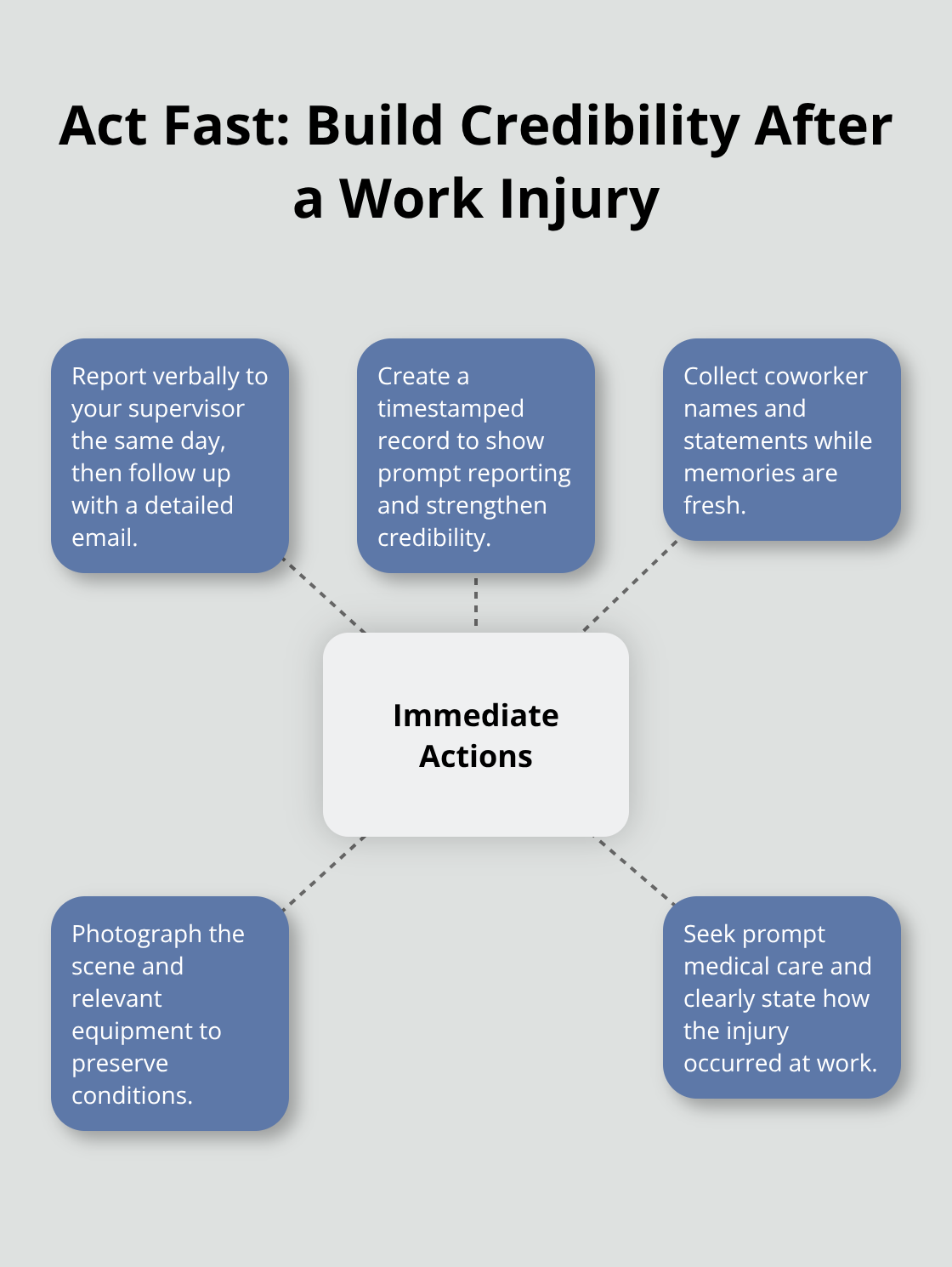
Witness statements matter enormously here. Coworkers who saw the incident or knew about your injury immediately afterward provide credible evidence that supports your claim. You should document everything in the immediate aftermath: take photos of the work area, write down what happened while details are fresh, and collect contact information from anyone who witnessed the injury. If no one saw the incident, your medical records become even more critical. Seek medical attention quickly and explicitly tell your healthcare provider how the injury occurred at work, making sure they document this in your medical file.
The mistakes that lead to denials often compound one another-missing documentation combined with a delayed report and weak medical evidence creates an almost insurmountable challenge. Understanding these common pitfalls positions you to avoid them and strengthens your claim from the start.
How Injured Workers Sabotage Their Own Claims
Report Your Injury Immediately to Your Employer
Timing is everything in a workers’ compensation claim, and most denials happen because injured workers move too slowly. When you get injured at work, you must report it to your employer immediately, ideally on the same day. Ohio law does not set a specific deadline for this initial report, but the BWC interprets delays as suspicious. If you wait a week or two before telling your supervisor about an injury, the BWC questions whether the injury actually happened at work or whether you’re trying to blame work for something that occurred elsewhere. Coworkers will have forgotten details, memories fade, and the employer’s documentation of the incident becomes muddled. The moment an injury occurs, report it verbally to your supervisor and then follow up with a written notification via email. This creates a timestamped record that proves you acted quickly and strengthens your credibility with the BWC.
Provide Specific Details on Your Claim Form
The claim form itself is where precision matters most. The FROI that your employer files must accurately describe exactly what happened, which body part was injured, and how your job duties caused the injury. Vague descriptions like “hurt my back” or “got injured at work” give the BWC ammunition to deny your claim. Instead, the form should state specifically: “I was lifting a 50-pound box from a shelf at shoulder height when I felt a sharp pain in my lower back.” The more specific the description, the harder it is for the BWC to question whether the injury was work-related.
Incomplete information on medical forms creates the same problem. Your doctor needs your complete work history, details about your job duties, and a clear statement about how your work caused the injury. If you tell your healthcare provider only that your back hurts but fail to mention you were operating heavy machinery all shift, the medical records will lack the connection the BWC requires. You must personally verify that every form contains accurate, specific, and complete information before it reaches the BWC.
Attend Every Medical Appointment Without Exception
Refusing medical treatment or skipping appointments is the fastest way to get a claim denied. The BWC views treatment compliance as proof that your injury is genuine and that you’re taking steps to recover. If you skip physical therapy sessions, miss doctor appointments, or refuse recommended treatment without a valid reason, the BWC interprets this as evidence that your injury isn’t serious or that you’re not genuinely injured. Ohio courts have repeatedly upheld claim denials based on treatment non-compliance.
Missing even two or three appointments gives the BWC grounds to suspend or terminate your benefits. You must attend every appointment, complete all prescribed treatments, and follow your doctor’s recommendations exactly as given. If you have a legitimate reason to miss an appointment, notify your medical provider and the BWC in writing before the appointment date, not after. Document that you completed treatment and keep copies of all medical records showing your attendance and progress.
The path forward after a denial requires understanding the formal appeals process and knowing exactly what evidence the BWC needs to reverse its decision.
Fighting a BWC Denial
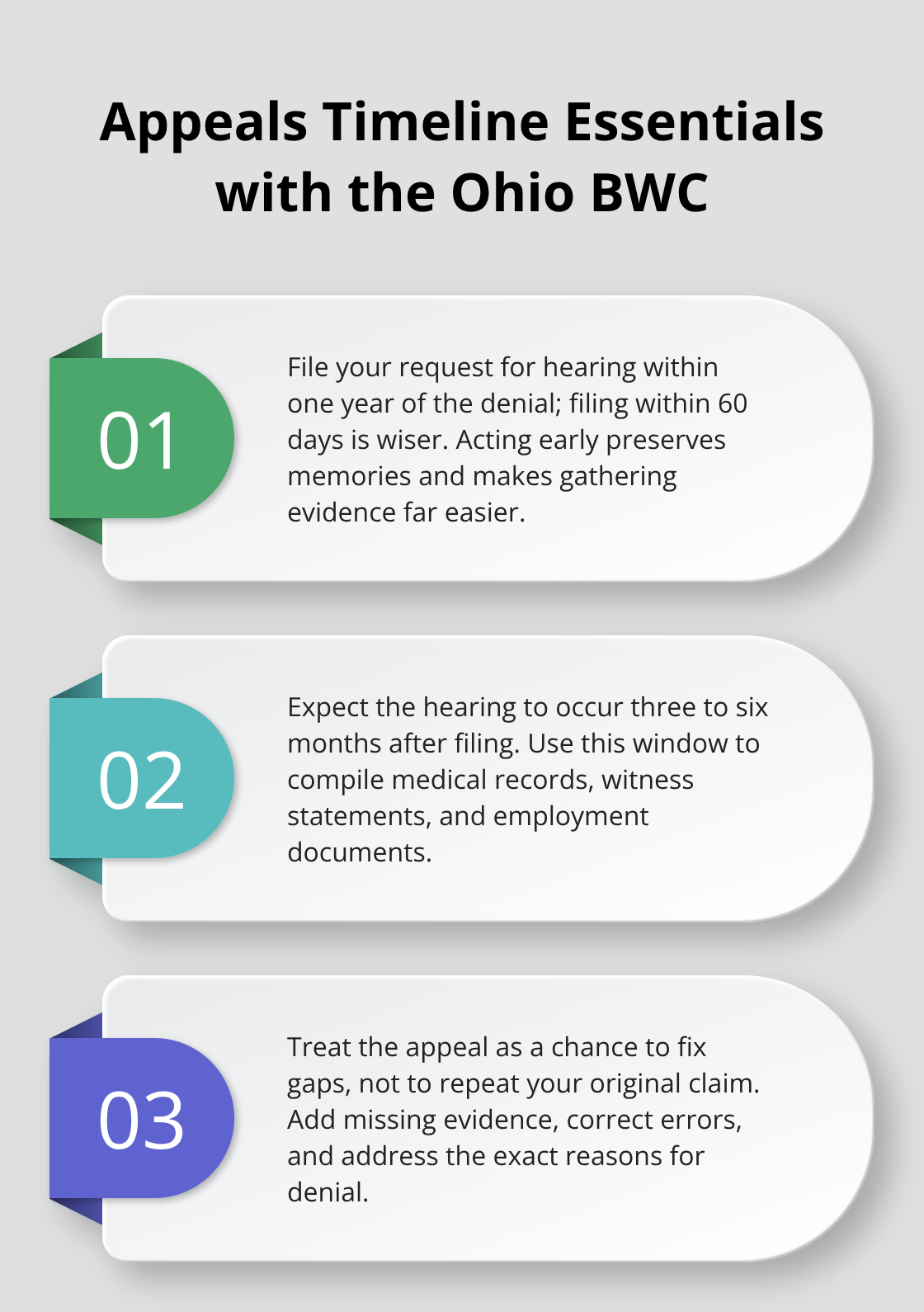
The Ohio BWC’s appeals process exists precisely because initial denials frequently rest on incomplete information or procedural errors that can be corrected. You have the right to challenge any denial, and the timeline to do so is strict. You must file a request for hearing with the Industrial Commission of Ohio within one year of the BWC’s denial letter, though filing within 60 days is far smarter because memories fade and evidence becomes harder to locate. The hearing itself typically occurs three to six months after you file, giving you time to gather materials and prepare your case. The appeals process is not a second chance to make your original case-it’s an opportunity to fill gaps, correct errors, and introduce evidence that was missing the first time around.
Collect Everything the BWC Missed
The evidence you submit on appeal must be substantially different from what led to the initial denial. If the BWC rejected your claim because medical records lacked specificity about how your work caused the injury, obtain a detailed affidavit from your doctor that explicitly connects your job duties to your injury. If witness testimony was absent from your original claim, track down coworkers and have them provide written statements that describe what they saw. Obtain your complete employment file, including job descriptions, safety records, and any prior injuries or complaints about the same task. Request all communications between your employer and the BWC, as these documents sometimes reveal that your employer misrepresented facts about the incident. Photograph the work area where your injury occurred if possible, showing equipment, layout, and conditions. Medical imaging results, physical therapy notes, and specialist evaluations all strengthen your appeal. The more specific and recent the evidence, the more weight it carries-medical records from six months after your injury matter far less than those from the week it happened.
Present Medical Evidence That Establishes Work Connection
Your doctor’s testimony can make or break an appeal. Medical professionals carry significant weight with the Industrial Commission, and a physician who explicitly states that your work duties caused your injury provides the strongest possible evidence. If your original medical records failed to establish this connection, contact your healthcare provider and request an updated report or affidavit that addresses the specific question: did your job cause this injury? The physician should reference your job duties, the mechanism of injury, and medical reasoning that links the two. Specialist evaluations (from orthopedists, neurologists, or other relevant specialists) carry even more weight than general practitioner notes. If you underwent surgery or received advanced imaging, those records demonstrate the severity of your injury and support your claim that the injury was genuine and work-related.
Know When Legal Representation Becomes Necessary
Representing yourself at a hearing is possible but statistically inferior to having an attorney handle your case. Workers who appear alone at Industrial Commission hearings lose their appeals at roughly twice the rate of those with legal representation. An attorney knows how to present evidence effectively, cross-examine employer witnesses, and navigate procedural rules that catch unrepresented workers off guard. An attorney can also identify legal arguments specific to your situation, such as whether your employer violated safety standards or whether the BWC misinterpreted the statute of limitations. Most workers’ compensation attorneys in Ohio work on contingency, meaning you pay nothing upfront and only if you win your case. This arrangement removes financial risk and ensures your attorney has a genuine incentive to succeed on your behalf. The cost of representation is typically a percentage of your awarded benefits, far less than the value of what you’ll receive.
Prepare for the Hearing
The Industrial Commission hearing is formal but not as rigid as a courtroom trial. You will testify about your injury, your work duties, and how the injury occurred. The employer’s representative will also testify and may challenge your account. Your attorney (if you have one) will present your evidence, question your employer’s witnesses, and make legal arguments on your behalf. You should prepare by reviewing all your evidence beforehand, practicing your testimony, and understanding exactly what the Industrial Commission needs to hear. Bring all original documents to the hearing-medical records, photographs, witness statements, and employment records. The Industrial Commission will issue a decision within weeks or months after the hearing concludes. If you win, the BWC must approve your claim and begin paying benefits. If you lose, you have the right to appeal to the Ohio Supreme Court, though this step is rare and requires specific legal grounds.
Final Thoughts
BWC denial Ohio reasons often stem from preventable mistakes that injured workers make early in the claims process. Documentation gaps, missed deadlines, and weak medical evidence represent fixable problems, not permanent barriers to receiving your benefits. A denial from the Ohio BWC is not the end of your claim-it’s a setback that requires a strategic response, and the appeals process exists because initial denials frequently happen due to incomplete information or procedural errors.
The one-year deadline to file an appeal moves faster than you expect, and evidence becomes harder to locate as time passes. Coworkers change jobs, medical records get archived, and memories fade with each passing week. Acting quickly after receiving a denial strengthens your position significantly, and the evidence you gather during an appeal can be substantially stronger than what was submitted initially.
If you’re facing a BWC denial, you don’t have to navigate the appeals process alone. We at Robin J Peterson Company, LLC represent injured workers throughout Ohio who are fighting for the benefits they deserve, and our team understands exactly what evidence the Industrial Commission needs to reverse those denials. Contact our office to discuss your denial and learn what your next steps should be.