
Filing an Ohio BWC claim doesn’t have to be overwhelming. We at Robin J Peterson Company, LLC help injured workers navigate this process every day, and we know the common pitfalls that delay benefits.
This guide walks you through each step, from reporting your injury to submitting your claim. You’ll learn what mistakes to avoid and how to protect your rights from the start.
What Qualifies for Ohio BWC Coverage
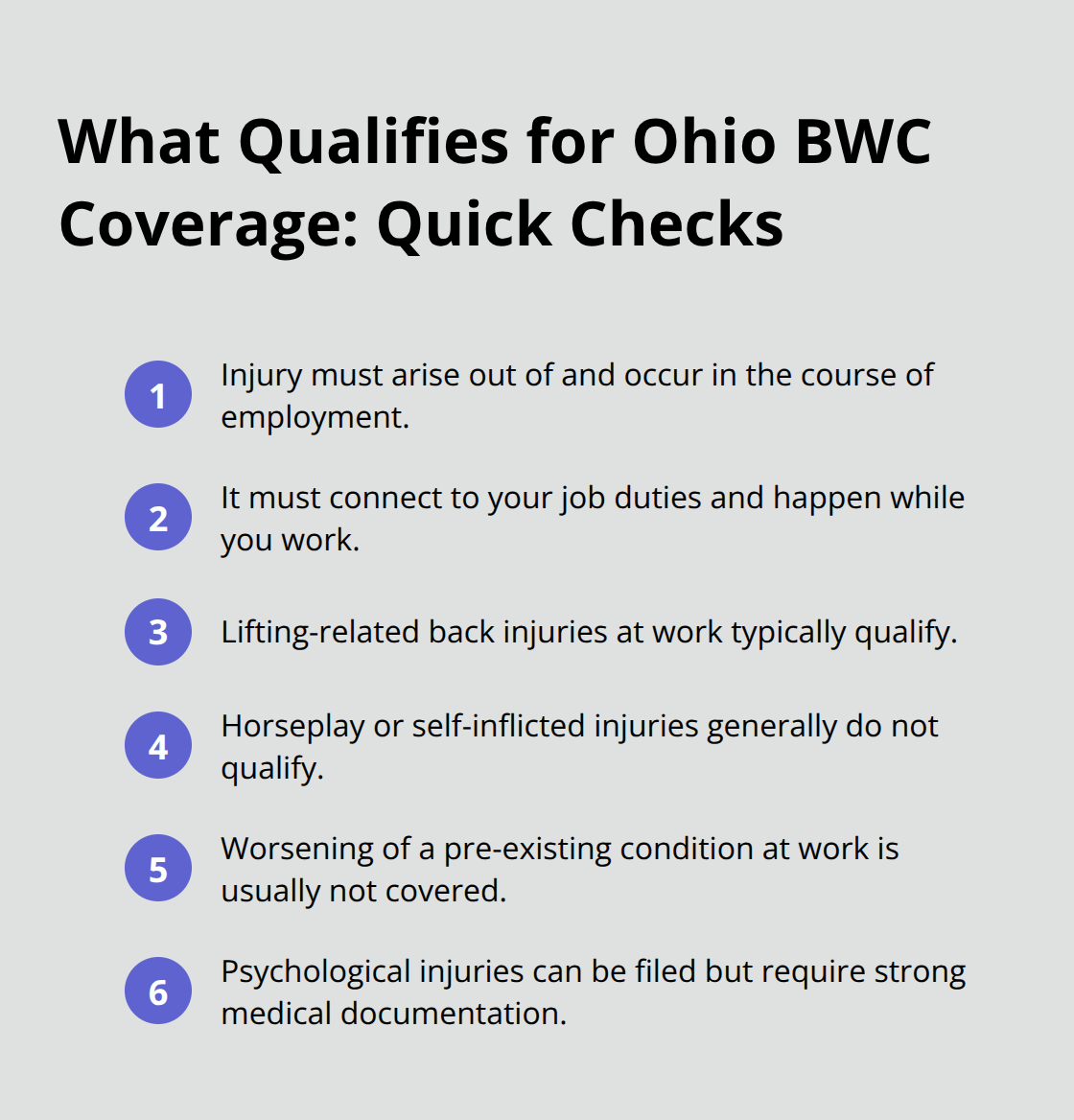
Not every workplace injury qualifies for Ohio BWC benefits, and understanding what does is your first step toward a successful claim. Ohio’s workers’ compensation system covers physical injuries and occupational diseases that arise out of and occur in the course of your employment. The language matters here: your injury must connect to your job duties and happen while you work. A back injury from lifting heavy boxes at work qualifies. An injury from horseplay with coworkers, self-inflicted harm, or a pre-existing condition that worsens at work typically does not.
The No-Fault Framework
The Bureau of Workers’ Compensation established this framework in 1912 to shift away from litigation and toward a no-fault system where benefits flow regardless of who caused the accident. This means you don’t need to prove your employer was careless to receive compensation, but you do need to show your injury arose from work itself. The system prioritizes speed and certainty over fault-finding, which benefits injured workers who might otherwise spend years in court.
Coverage Extends Broadly, But Has Real Limits
Most employees in Ohio are covered under the state-funded system managed by the Bureau of Workers’ Compensation, though some larger employers are self-insured and handle claims directly. Either way, the eligibility rules remain the same. If you suffered a psychological injury from workplace stress or trauma, you can file a claim, though proving these injuries in Ohio is challenging and requires solid medical documentation.
Timing Matters for Your Claim
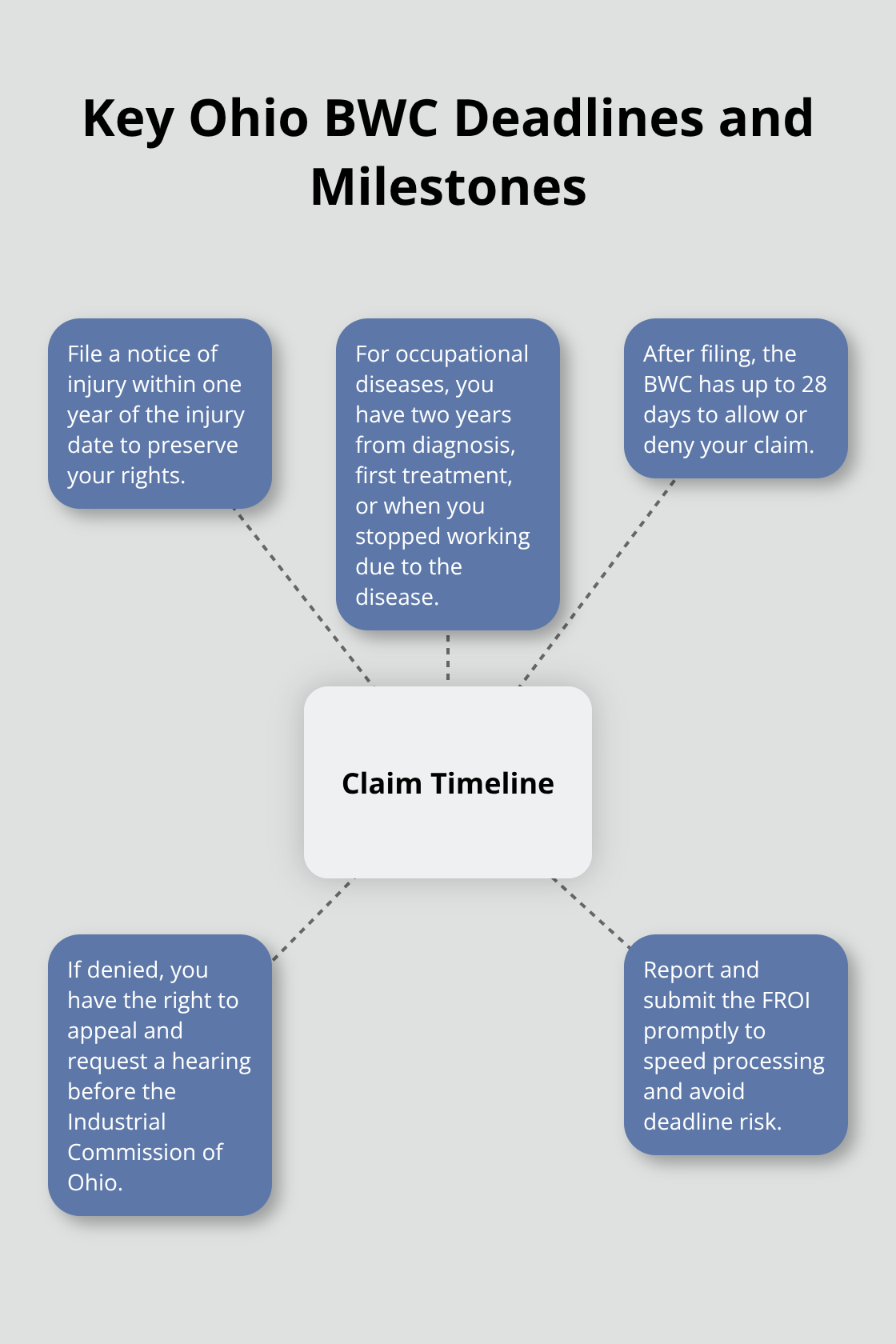
The critical distinction is between work-related causes and personal circumstances. If you were injured while commuting to work or during lunch break away from your workplace, you’re typically not covered. You have one year from the date of injury to file a notice of injury with the BWC or Industrial Commission of Ohio. For occupational diseases (those developing over time), you have two years from the date of diagnosis, first treatment, or when you stopped working due to the disease. Filing quickly matters more than waiting-the sooner you report your injury to your employer and submit your claim, the faster the BWC processes your request and the sooner benefits begin flowing to you while you recover.
How to Report Your Injury and File Your Claim
Report Your Injury Immediately
The moment an injury happens at work, speed becomes your advantage. Report your injury to your employer immediately, even if it seems minor. Ohio law doesn’t require the injury to be severe to qualify for benefits, and early reporting creates a documented record that protects you later. Your employer is legally required to provide you with a First Report of Injury form, known as the FROI. This form is the official document that starts your claim with the Ohio Bureau of Workers’ Compensation.
File the FROI Without Delay
Some employers file the FROI themselves within a few days of learning about your injury, but don’t assume they will. Contact your employer’s human resources or safety department directly and confirm in writing that you’ve reported the injury. If your employer drags their feet, you can file the FROI yourself online through the BWC website, by mail, or in person at a BWC service office. The BWC processes claims filed by injured workers just as seriously as those filed by employers, so don’t wait for your company to act if they’re slow.
Gather Complete Medical Records and Documentation
Seek immediate medical attention and inform your healthcare provider that the injury is work-related, because this notation becomes part of your official record. Collect receipts, photographs of the injury site, witness statements from coworkers, and any written communication with your employer about the incident. The more complete your documentation, the less likely the BWC will request additional information that delays your benefits.
Submit Your Claim and Track the Timeline
When you submit the FROI to the BWC, you’ll receive a claim number and notification of your assigned customer service specialist within a few days. The BWC has up to 28 days to decide whether to allow or deny your claim. If denied, you have the right to appeal and request a hearing before the Industrial Commission of Ohio. Missing this appeal deadline costs you your chance to challenge the decision, so mark your calendar immediately.
Know When to Seek Legal Representation
If you face a denied claim or complications during the process, a workers’ compensation attorney can handle the paperwork, communicate with the BWC on your behalf, and represent you at hearings. The stakes are high enough that professional guidance often makes the difference between a successful claim and a prolonged battle with the system.
What Mistakes Derail Your Ohio BWC Claim
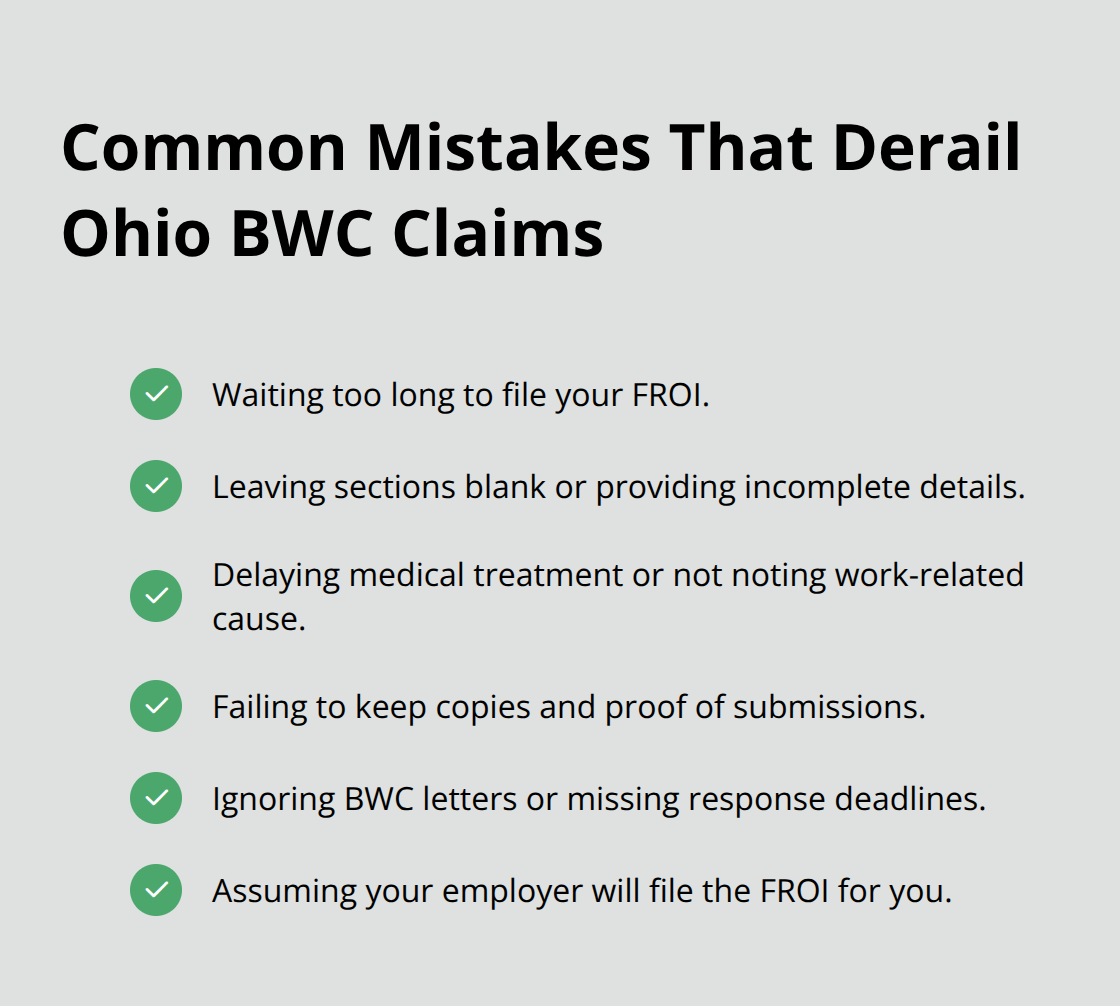
Injured workers lose benefits not because they lack valid claims, but because they stumble on procedural details that the BWC takes seriously. The first mistake is waiting too long to file your FROI. You have one year from the date of injury to submit a notice of injury, but waiting eleven months creates unnecessary risk. If your paperwork gets lost in the mail or the BWC needs clarification, you’re racing against that deadline with no buffer. File within two weeks of your injury whenever possible.
Speed Matters More Than You Think
The BWC processes claims faster when documentation arrives promptly and clearly, so speed directly impacts how quickly you receive benefits while recovering. Waiting creates vulnerability. If complications arise-lost documents, requests for clarification, or administrative delays-you have little time to respond before your filing window closes. Early submission protects you from these risks and signals to the BWC that you take your claim seriously.
Incomplete Information Stops Your Claim Cold
The second critical error is submitting incomplete or inaccurate information on your FROI and supporting documents. The form asks for your job duties, the exact time and location of the injury, and how the injury occurred. Workers sometimes minimize details or leave sections blank, thinking minor information won’t matter. The BWC uses these specifics to determine eligibility. If you write that you lifted boxes but don’t mention the weight or that you felt immediate pain, the BWC requests clarification that delays your claim by weeks.
Include everything, even details that seem obvious to you.
Medical Records Create Your Official Timeline
The third mistake is delaying medical attention or failing to tell your healthcare provider the injury is work-related. Some workers avoid the doctor because they think the injury will heal on its own or they’re worried about missing work. This decision creates a documentation gap that weakens your claim significantly. When you finally seek treatment weeks or months later, the BWC questions whether the injury truly happened when you say it did or whether it worsened from non-work causes. Medical records create the official timeline that supports your claim, so treatment within days of injury matters far more than waiting.
Documentation and Communication Protect Your Rights
Workers also fail when they don’t keep copies of everything they submit to the BWC. You send the FROI, medical records, witness statements, and correspondence, but if the BWC says they never received something, you have no proof you filed it. Use certified mail or file online so you receive confirmation, and maintain a folder with copies of every document and the date you sent it. Another costly mistake is ignoring communication from the BWC. You receive a claim number and the name of your assigned customer service specialist within days of filing. If the BWC sends you a letter requesting additional information or notifying you of a decision, respond quickly. Missing a response deadline or ignoring an appeal notice can result in claim denial that’s difficult to overturn. The BWC sets specific timelines, and the burden falls on you to track them.
When to Seek Professional Help
If you struggle with the process or the BWC denies your claim, consulting with a workers’ compensation attorney becomes essential rather than optional. An attorney handles the paperwork, meets deadlines, and represents you at hearings before the Industrial Commission of Ohio, removing the burden of managing these details yourself while you focus on recovery.
Final Thoughts
Filing an Ohio BWC claim involves navigating deadlines, documentation requirements, and procedural rules that trip up injured workers regularly. We at Robin J Peterson Company, LLC work with injured workers throughout Cleveland, Akron, and Canton who face denied claims, delayed benefits, or confusing BWC decisions. Our experience handling Ohio workers’ compensation cases means we understand exactly where claims go wrong and how to fix them.
When you file your Ohio BWC claim, you enter a system with strict timelines and specific requirements that the BWC enforces consistently. The BWC processes thousands of claims annually, and your case receives attention only when your documentation is complete and your deadlines are met. We represent injured workers by handling the paperwork, communicating directly with the BWC and your employer, and fighting for the benefits you deserve under Ohio law.
The difference between a successful claim and a prolonged battle often comes down to having someone in your corner who knows the system. If you face a denied claim, complications with your current claim, or uncertainty about whether you qualify for benefits, contact Robin J Peterson Company, LLC for a complimentary case evaluation. We’ll review your situation, explain your rights, and guide you through the next steps to protect your benefits and your future.