
Elbow injuries at work can sideline you fast, whether from a sudden fall or repetitive strain. Understanding your elbow injury Ohio rights is the first step toward getting the support you need.
At Robin J Peterson Company, LLC, we help injured workers navigate the workers’ compensation system and secure the benefits they deserve. This guide walks you through the types of injuries, available benefits, and the claims process in Ohio.
What Distinguishes Different Elbow Injuries at Work
Acute Traumatic Injuries vs. Gradual-Onset Conditions
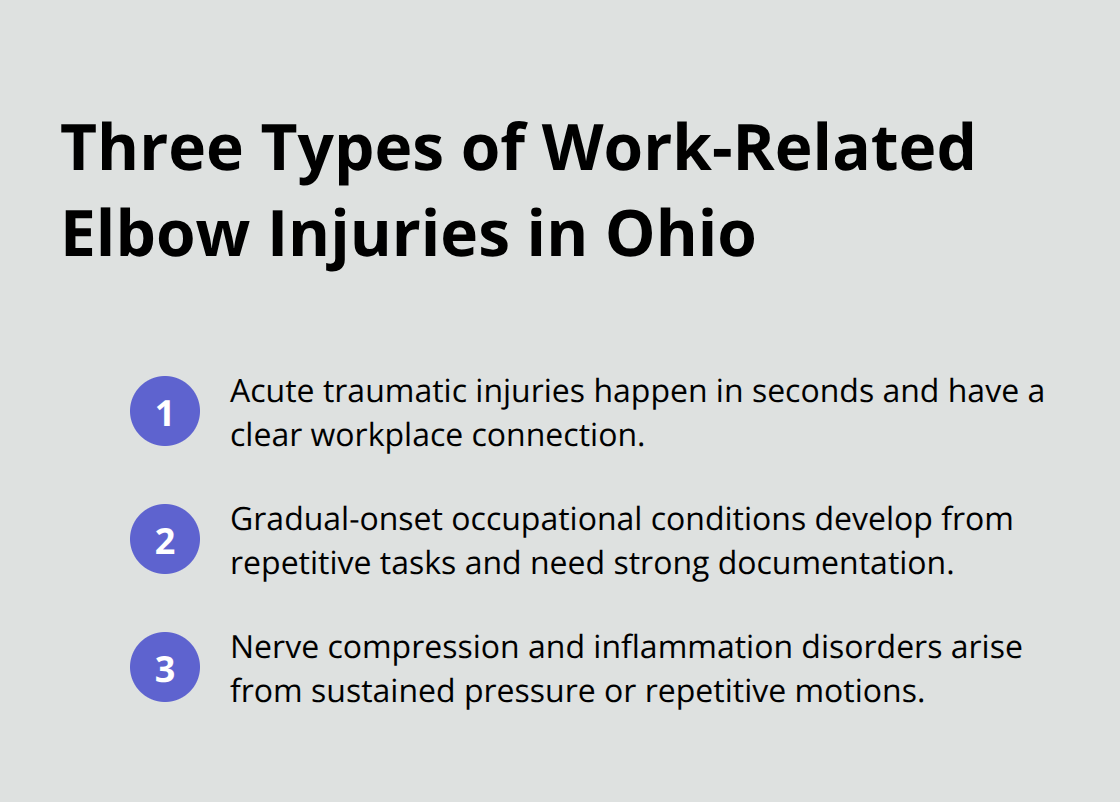
Workplace elbow injuries fall into distinct categories, and how your injury occurred directly affects your workers’ compensation claim. Acute traumatic injuries happen in seconds-a fall from a ladder, a direct blow from equipment, or being struck during a sudden incident. Healthcare and manufacturing workers face the highest risk for these sudden injuries, and they’re straightforward to document because the workplace connection is obvious. The Ohio Bureau of Workers’ Compensation processes acute claims faster because the work-relatedness is clear from the start.
Occupational elbow conditions develop gradually from repeated job tasks. Plumbers, electricians, mechanics, assembly line workers, painters, and retail cashiers commonly develop these conditions from their daily routines. The critical difference is that gradual-onset injuries require stronger medical documentation to prove the workplace caused the problem. Many claims get denied simply because workers and their doctors fail to explicitly connect the elbow symptoms to specific workplace tasks.
The Documentation Challenge
You need medical records showing which job duties aggravate your pain and exactly when symptoms started. Bring a detailed written description of your daily tasks to every medical appointment so your doctor can document the work connection explicitly. Don’t assume your doctor knows what you do all day-spell it out. If you have a gradual-onset condition, document the exact date symptoms began and report it to your employer promptly to establish a solid timeline.
Nerve Compression and Inflammation Disorders
A third category involves nerve compression and inflammation disorders that stem from workplace activities. Conditions such as cubital tunnel syndrome or radial tunnel syndrome result from sustained pressure or repetitive motions affecting the nerves and soft tissues around your elbow. They’re particularly challenging to document because they develop over time and can feel similar to other conditions.
What the Ohio BWC Investigates
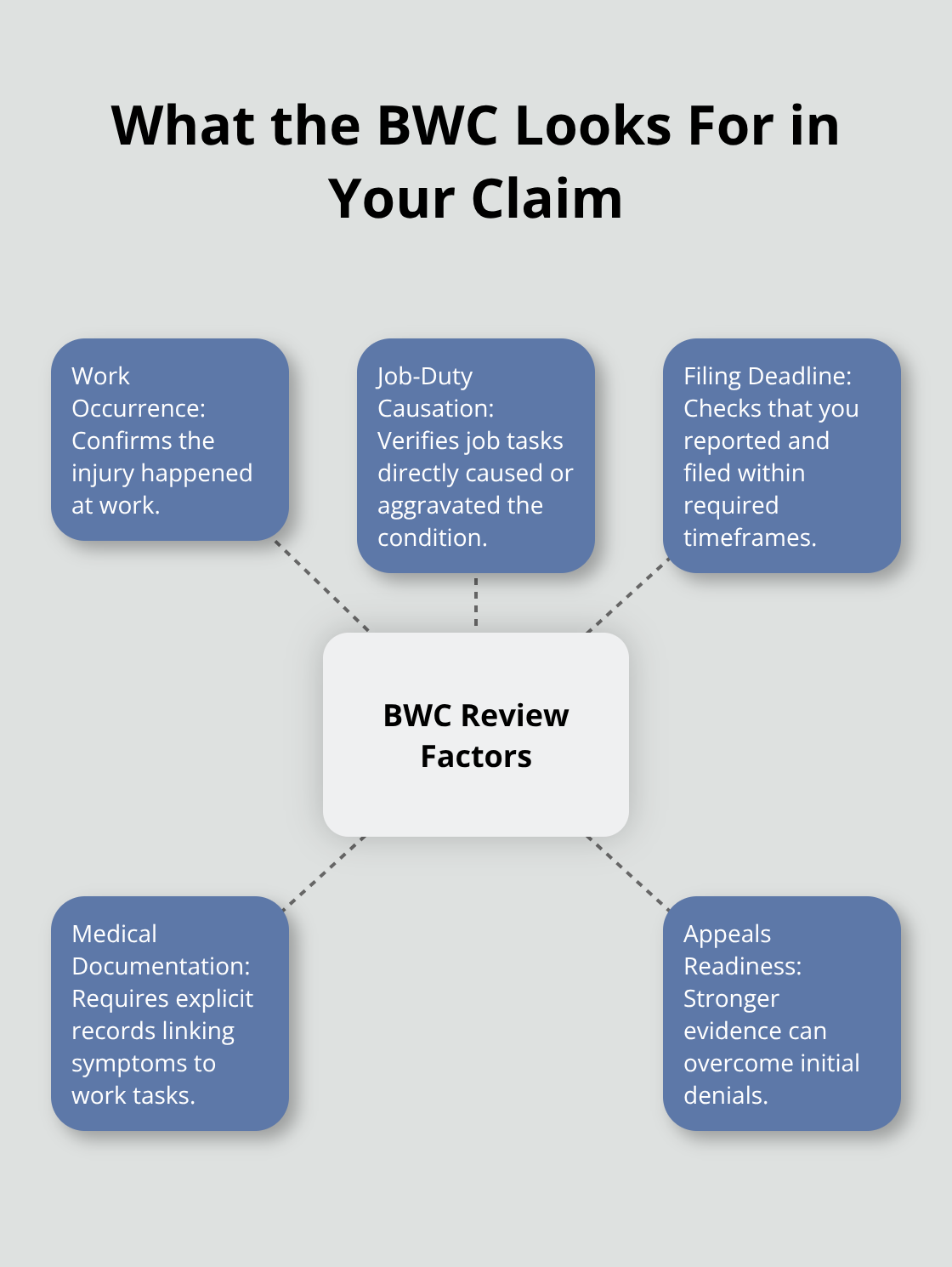
The Ohio BWC investigates all elbow injury claims and assesses three critical factors: whether the injury occurred at work, whether it truly resulted from your job duties, and whether you filed within the required timeframe. For acute injuries, the workplace connection is usually clear, speeding approval. For occupational and nerve-related conditions, medical records must confirm that work tasks directly caused the problem.
Meeting Critical Deadlines
Immediate reporting to your employer is essential; delays in reporting can jeopardize your eligibility for benefits. You must file the First Report of Injury with the BWC within 14 days of the injury, or you risk denial even if the injury is legitimate. For acute injuries, this deadline is straightforward. For gradual-onset conditions, the clock starts when you first notice symptoms and understand they’re work-related. Many workers lose valid claims because they missed this 14-day window or failed to document the work connection in their medical records. Understanding these distinctions and acting quickly sets the foundation for what comes next in your claim.
What Benefits Does Ohio Workers’ Compensation Cover for Elbow Injuries
Medical Treatment the BWC Covers
Once your claim receives approval, the Ohio BWC covers medical treatment directly tied to your elbow injury, including doctor visits, physical therapy, diagnostic imaging, and surgical procedures if conservative treatment fails. You pay nothing out of pocket for approved care, and your employer cannot deny you treatment based on cost. Physical therapy is standard for elbow injuries and typically runs for several weeks to months depending on severity. Anti-inflammatory medications and steroid injections fall under covered treatments.
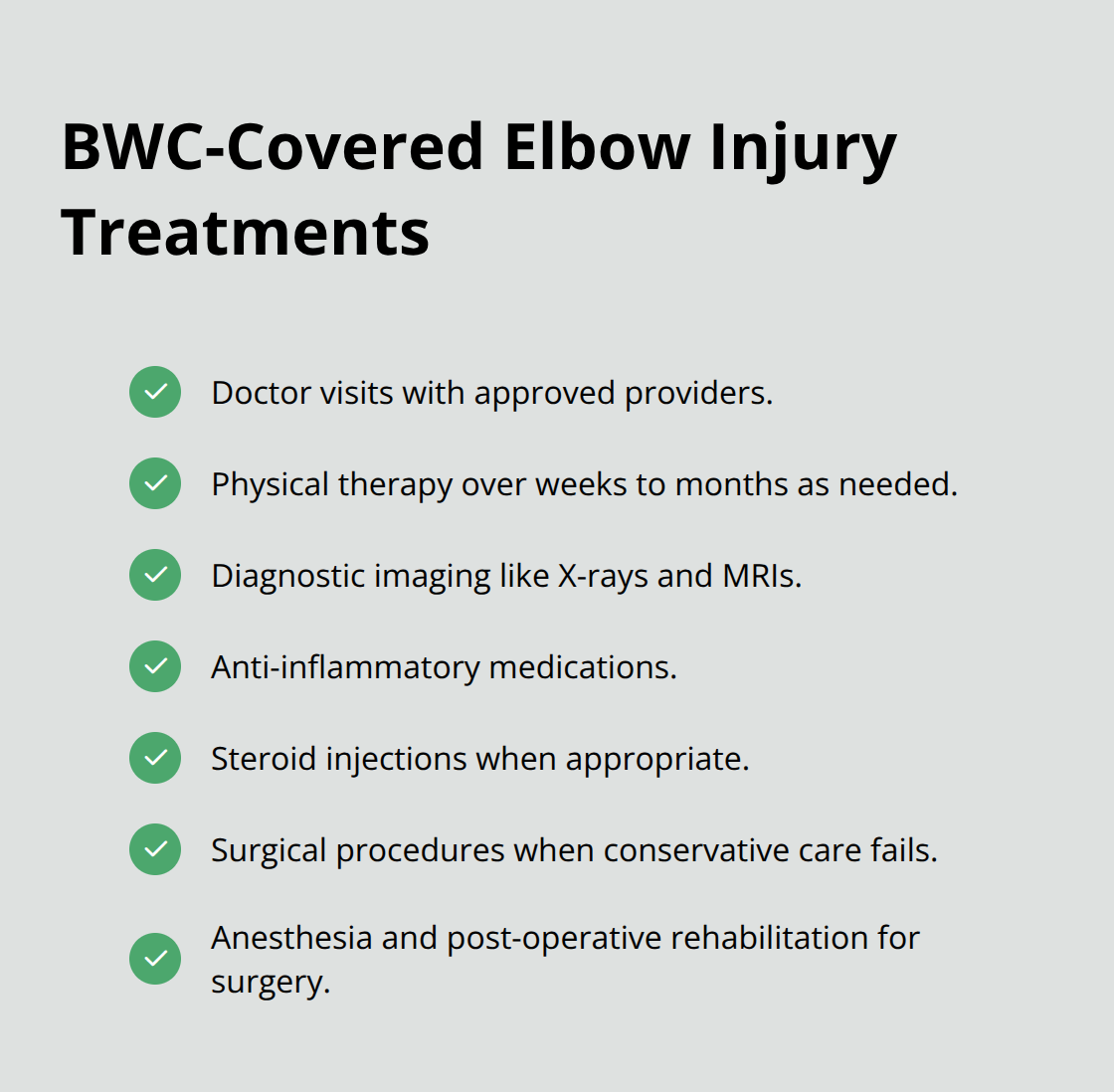
If your condition requires surgery to repair damaged tissue or reattach tendons, the BWC pays for the procedure, anesthesia, and post-operative rehabilitation.
Your treating physician must document the connection between your elbow condition and workplace duties for each treatment request. The BWC will not approve care if medical records lack this explicit work connection. Vague diagnoses without workplace context lead to denials, so work with your doctor to establish this link from your first appointment.
Wage Loss Benefits During Your Recovery
The BWC provides wage loss benefits if your elbow injury prevents you from working during recovery. Temporary total disability benefits replace a portion of your lost wages while you heal, calculated based on your average weekly wage at the time of injury. The amount varies by injury severity and your specific job situation. These benefits continue until you return to work or reach maximum medical improvement, the point at which your condition stabilizes and further treatment produces minimal gains.
Permanent Disability Ratings and What They Mean
Permanent disability ratings apply when your elbow does not fully recover and you face long-term limitations. The BWC assigns a rating based on the extent of permanent loss of function in your arm and hand, which determines your settlement amount. An independent medical evaluation strengthens your position during the rating process because it provides objective evidence of your functional losses. If you disagree with the BWC’s rating, you can appeal and request a hearing before a district hearing officer who may order additional medical testimony.
Many workers underestimate the importance of thorough medical documentation during treatment because they fail to realize it directly affects permanent disability ratings later. Your medical records become the foundation for your rating, so detailed notes about your limitations and functional losses matter significantly. The appeals process requires new or stronger evidence, including independent medical testimony that challenges the BWC’s findings and supports a higher rating.
How to File Your Claim and Navigate BWC Decisions
Filing Your Initial Claim with Speed and Precision
Contact your employer immediately after your elbow injury occurs and request they file the First Report of Injury with the BWC. You have 14 days from the injury date to file this report-missing this deadline results in automatic denial regardless of how legitimate your injury is. The BWC processes acute traumatic injuries faster than gradual-onset conditions because the workplace connection is obvious, but both require the same urgency in filing. When you report to your employer, ask for written confirmation that they received your report and when they submitted it to the BWC. Keep this documentation because the BWC’s investigation can take weeks or months, and you may hear nothing unless you request status updates.
For gradual-onset conditions, establish the exact date symptoms began and report that date to your employer in writing. The stronger your medical documentation from the start, the faster the BWC approves your claim.
What the BWC Investigates During Your Claim Review
The BWC investigates whether the injury occurred at work, whether it resulted from your job duties, and whether you met the filing deadline. Medical records matter enormously during this investigation phase because vague diagnoses without explicit workplace connections lead to denials. Bring detailed written descriptions of your daily work tasks to every medical appointment so your doctor documents how specific job duties caused or aggravated your elbow condition.
Responding to a BWC Denial
If the BWC denies your claim, you have exactly 14 days to appeal to a district hearing officer. Missing this 14-day window bars further appeals, so act immediately. Successful appeals require new or stronger evidence than what the BWC initially reviewed, including independent medical testimony from a physician who testifies that your elbow condition arose from work duties rather than hobbies or outside activities.
Many denials stem from incomplete medical documentation, not from injuries that lack merit. An independent medical expert can strengthen your position significantly by providing objective evidence that contradicts the BWC’s findings. The appeals process moves from the district hearing officer to the staff hearing officer to the Industrial Commission of Ohio, so multiple opportunities exist to present stronger evidence.
Building Your Evidence for Appeals
Maintain written confirmation of all reports, copies of every document you submit, and records of ongoing medical appointments throughout this process because you may need to reference them during an appeal. Robin J. Peterson Company, LLC represents injured workers in the Cleveland, Akron, and Canton areas and helps assemble comprehensive evidence, navigate disputes with the BWC, and advocate during appeals hearings.
Final Thoughts
Your elbow injury Ohio rights depend on acting fast and documenting everything from day one. The 14-day filing deadline is absolute, and missing it eliminates your claim regardless of merit. Report to your employer immediately, get written confirmation, and bring detailed task descriptions to every medical appointment so your doctor explicitly connects your symptoms to workplace duties.
The BWC investigates all claims thoroughly, assessing whether the injury occurred at work, whether it resulted from your job duties, and whether you filed on time. Acute traumatic injuries move faster through the system because the workplace connection is obvious, but gradual-onset conditions require stronger documentation to prove causation. Many valid claims fail simply because workers and their physicians fail to establish this explicit link in medical records.
We at Robin J Peterson Company, LLC represent injured workers throughout the Cleveland, Akron, and Canton areas and understand how the BWC operates. If you face a denial, you have exactly 14 days to appeal to a district hearing officer, and successful appeals require new or stronger evidence, including independent medical testimony that contradicts the BWC’s findings. Contact Robin J Peterson Company, LLC for a complimentary case evaluation to discuss your claim, and we work on a contingency basis, meaning you pay no fees unless you prevail.