
The Ohio Bureau of Workers’ Compensation denies thousands of claims every year, and many workers don’t understand why. Understanding BWC denial reasons in Ohio helps you protect your rights from the start.
At Robin J Peterson Company, LLC, we’ve seen how preventable mistakes lead to rejected claims. The good news is that most denials can be avoided with the right approach.
Why the BWC Rejects Claims Before They’re Reviewed
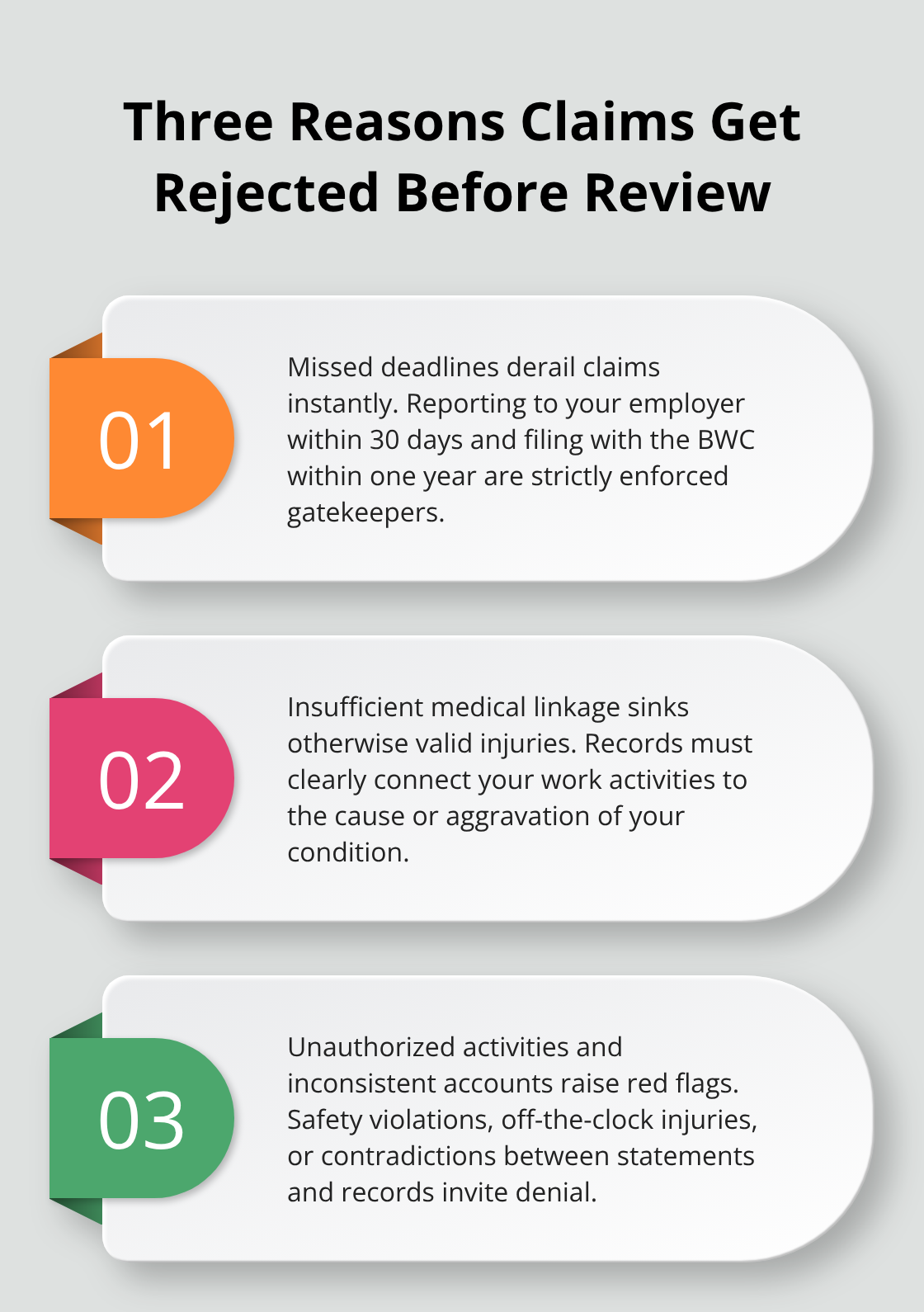
The Ohio Bureau of Workers’ Compensation rejected over 11,000 claims in 2024 alone, and most of these denials happened because workers made procedural mistakes rather than having invalid injuries. Three patterns trigger automatic rejections before the BWC even examines the medical evidence.
Timing Deadlines Create Your First Vulnerability
Ohio law requires you to report your injury to your employer within 30 days, and you must file your claim with the BWC within one year of the injury date. Missing these windows doesn’t eliminate your rights forever, but it makes your claim exponentially harder to defend. The BWC uses these deadlines as a gatekeeping mechanism and enforces them strictly. If you report your injury on day 31, the BWC will question whether your injury was truly work-related or if you delayed reporting because you were hiding something.
Workers often misjudge how much time they have. Some assume their employer will handle the filing, and that assumption costs them their claims. The BWC doesn’t care about your intentions-it cares about compliance with statutory deadlines.
Medical Records Must Establish the Work Connection
The BWC doesn’t deny claims because you were injured; they deny claims because your medical records don’t establish a clear link between your work activities and your injury. A doctor’s note stating you have a shoulder problem isn’t enough. Your medical records need specific details about how the injury occurred at work, what you were doing when it happened, and why work activities caused or aggravated your condition.
Many workers see their personal doctor who has no knowledge of their job duties, and that doctor’s records lack the occupational context the BWC requires. You need medical providers who understand workers’ compensation claims and document accordingly. If your condition existed before your current job, the BWC will scrutinize whether work actually caused the injury or merely aggravated a pre-existing issue. Pre-existing conditions aren’t automatically disqualifying, but you’ll need medical evidence showing that your work duties significantly worsened your condition beyond its natural progression.
Unauthorized Activities and Inconsistent Accounts Trigger Denials
The BWC denies claims when workers are injured during unauthorized activities, while working under the influence, or while violating safety procedures they knew about. If you were injured while doing something your employer explicitly told you not to do, the BWC will likely deny your claim. Injuries that occur during breaks, lunch periods, or while you’re off the clock also create significant obstacles to proving work-relatedness.
The BWC examines the totality of your circumstances, including witness statements, security footage if available, and your employment records. Inconsistencies between what you tell the BWC and what appears in medical records or witness accounts create reasonable doubt that leads to denial. If you told your employer the injury happened one way but later your medical provider documents it differently, the BWC will use that discrepancy against you. These contradictions matter far more than the injury itself-they signal to the BWC that your account lacks credibility.
Understanding these three rejection patterns positions you to avoid them. The next section examines the specific red flags that intensify scrutiny of your claim.
What Makes the BWC Question Your Credibility
The BWC doesn’t just reject claims based on missing paperwork or procedural errors. Once your claim reaches the investigation stage, the agency scrutinizes your account against every piece of evidence in your file. When inconsistencies emerge between what you told your employer, what you told your doctor, and what medical records actually document, the BWC treats those gaps as signals that your story lacks reliability. A worker who describes a sudden shoulder injury during a lifting task on Monday but whose medical records show the problem developed gradually over weeks creates reasonable doubt that work caused the condition. The BWC sees this contradiction and assumes you’re either misremembering the injury or deliberately misrepresenting it.
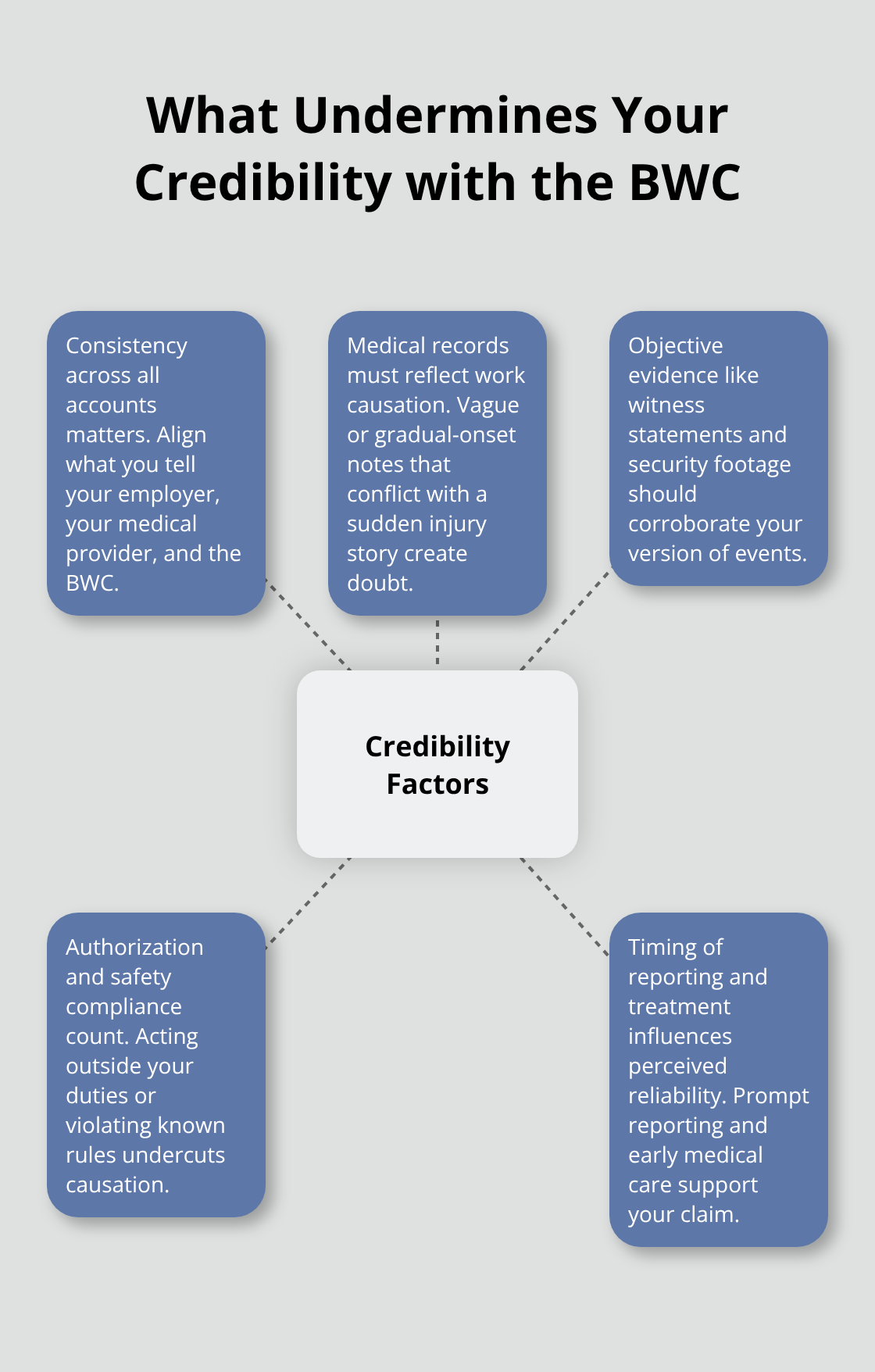
Medical providers often fail to document the occupational context because they focus on symptoms rather than causation. You need to explicitly tell your healthcare provider how the injury occurred at work, what specific movements triggered it, and how your job duties differ from your normal activities. Without this detail in your medical records, the BWC will deny your claim regardless of how severe your condition actually is.
Injuries Outside Your Job Duties Cost You Everything
The BWC denies claims when you sustain injuries while performing tasks your employer explicitly prohibited or while engaging in activities unrelated to your position. If your job description limits you to office work and you sustain an injury while operating machinery without authorization, the BWC will deny your claim. Injuries sustained during breaks, lunch periods, or while socializing with coworkers also face heightened scrutiny because the BWC must establish that you were performing job duties at the moment of injury.
The agency examines witness statements, security footage, and your employment records to determine whether you had authorization to perform the activity that caused your injury. Even if your employer never formally documented the prohibition, the BWC considers standard industry practices and job-specific safety protocols. Injuries occurring while working under the influence of alcohol or drugs provide automatic grounds for denial under Ohio law. The agency also denies claims when workers violate known safety procedures they received training on, treating these violations as negligence that breaks the causal chain between work and injury.
Pre-Existing Conditions Require Medical Evidence of Aggravation
Pre-existing conditions don’t automatically disqualify you, but the BWC demands clear medical evidence that your work duties significantly worsened your condition beyond what would have naturally progressed. If you had a knee problem before your current job and your new position requires standing eight hours daily, you must prove through medical documentation that the increased standing accelerated your condition’s deterioration. The medical records need to show baseline measurements before you started the job and measurable changes after work exposure.
Simply stating that work made things worse isn’t sufficient. The BWC requires your medical provider to explain the mechanism by which your job duties caused aggravation and to quantify how much worse your condition became compared to its natural trajectory. Many workers lose these claims because their doctors lack occupational medicine expertise and fail to establish this causal link. Workers’ compensation cases involving pre-existing conditions succeed when medical evidence demonstrates that work activities imposed demands beyond what the pre-existing condition could tolerate without significant deterioration.
Your medical documentation forms the foundation of your entire claim, which means the next section examines how to build records that withstand BWC scrutiny.
Build Your Claim Before the BWC Examines It
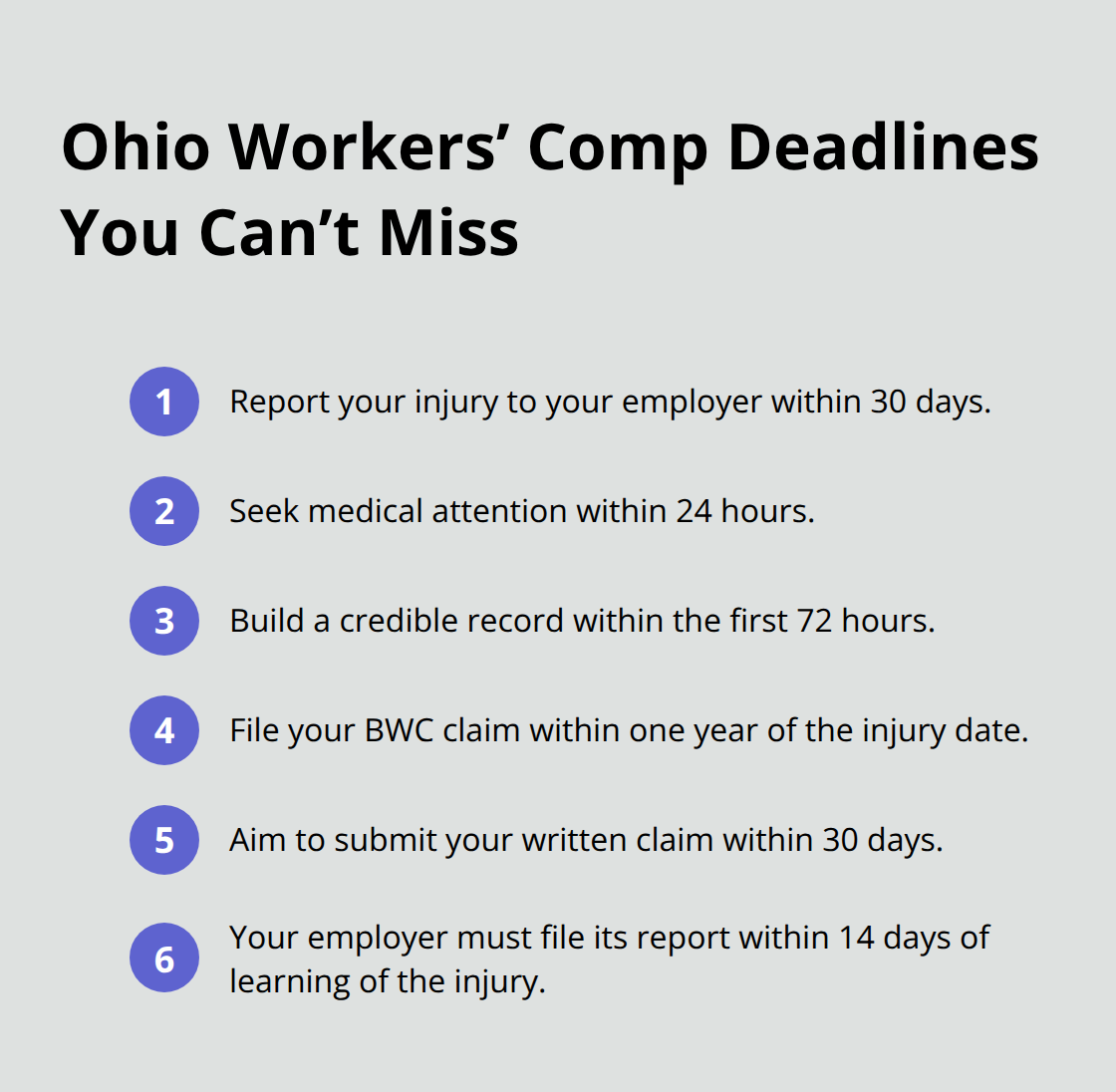
The moment you sustain an injury at work, you have roughly 72 hours to create a record that the BWC will accept as credible. This window is critical because what you document in those first three days determines whether the agency will scrutinize your claim or approve it.
Document the Scene Immediately
Start at the location of your injury and photograph the exact spot, the equipment involved, and any environmental factors that contributed to what happened. If you slipped on a wet floor, photograph the wet floor and any missing warning signs. If machinery malfunctioned, photograph the specific part that failed. These images serve as contemporaneous evidence that corroborates your account later when the BWC investigates.
Write down the names and contact information of every witness present, including coworkers who observed the injury occur. The BWC investigators will contact these witnesses months later, and if those witnesses confirm your version of events, the agency is far less likely to deny your claim based on credibility concerns. If no witnesses were present, document that fact as well.
Review and Correct Your Employer’s Incident Report
Your employer’s incident report becomes part of your permanent file, so review it carefully before submitting it. Many workers allow their employers to mischaracterize what happened because they fail to review the initial report. If the report contains inaccuracies, correct them in writing immediately and submit your corrections to your employer and the BWC.
Obtain Medical Documentation That Establishes Work Connection
Seek medical attention within 24 hours of your injury, and when you see your healthcare provider, explain exactly how the injury occurred, what you were doing at work, and what your job duties typically involve. Medical providers who lack occupational medicine training often fail to document the work connection because they focus narrowly on your symptoms. Tell your doctor that this is a work injury and provide specific details about your job demands.
Request a copy of your medical records immediately after each visit so you can verify that your provider documented the occupational context correctly. If your records lack detail about how work caused your injury, contact your healthcare provider and request an addendum clarifying the causal relationship. The BWC receives thousands of claims with vague medical documentation, and those claims face automatic scrutiny. Your medical records should explicitly state that your job duties caused or significantly aggravated your condition.
File Your Claim Promptly and Completely
File your claim with the BWC within one year of the injury date, but do not wait that long. Submit your claim within 30 days if possible, and submit it in writing rather than relying on verbal notification. Your employer has 14 days to file a report with the BWC after learning of your injury, but that report often minimizes your injury or disputes work-relatedness. Your written claim creates an official record that contradicts any attempt by your employer to downplay what happened.
Include copies of your photographs, witness statements, and medical records with your initial claim submission. The BWC will request these documents anyway, but submitting them proactively demonstrates that you are organized and credible. Workers who submit complete claims face fewer requests for additional information and experience faster processing times. If you face a denial and need assistance navigating the appeals process, Robin J Peterson Company, LLC represents injured workers throughout Ohio’s workers’ compensation system.
Final Thoughts
The BWC denial reasons Ohio workers encounter most often stem from procedural mistakes rather than invalid injuries. Missing reporting deadlines, failing to establish medical causation, and creating inconsistencies between your account and documentation are entirely preventable. You control whether your claim receives approval or denial by acting decisively in those critical first 72 hours after your injury occurs.
Speed matters more than you realize. Every day you delay reporting your injury, photographing the scene, or obtaining medical attention weakens your position. The BWC processes thousands of claims annually, and the agency favors workers who submit complete, organized documentation over those who scramble to gather evidence months later. Your photographs, witness statements, and medical records create a contemporaneous record that the BWC cannot easily dispute.
If you face a denial or need guidance navigating the BWC system, Robin J Peterson Company, LLC represents injured workers throughout Ohio’s workers’ compensation process. The firm serves clients in the Cleveland, Akron, and Canton areas and specializes in fighting denials and securing the benefits you deserve.