
Filing a workers’ compensation claim can feel overwhelming if you’re not familiar with the process. We at Robin J Peterson Company, LLC have helped countless injured workers navigate BWC claim filing basics and understand their rights.
This guide walks you through each step, from notifying your employer to submitting your forms and tracking your claim status. You’ll also learn which mistakes to avoid so your claim moves forward without unnecessary delays.
How the BWC System Works and What You Need to Know
The Ohio Bureau of Workers’ Compensation operates as a no-fault system, meaning you don’t have to prove your employer was negligent to receive benefits. This is fundamentally different from a personal injury lawsuit. If you sustain a work-related injury or illness, the BWC covers medical treatment, wage replacement, and rehabilitation services regardless of who caused the accident. However, the injury must occur within the scope of employment-meaning it happened during work hours, at a work location, or while performing job duties. This distinction matters because the BWC denies claims regularly when workers fail to establish this connection.
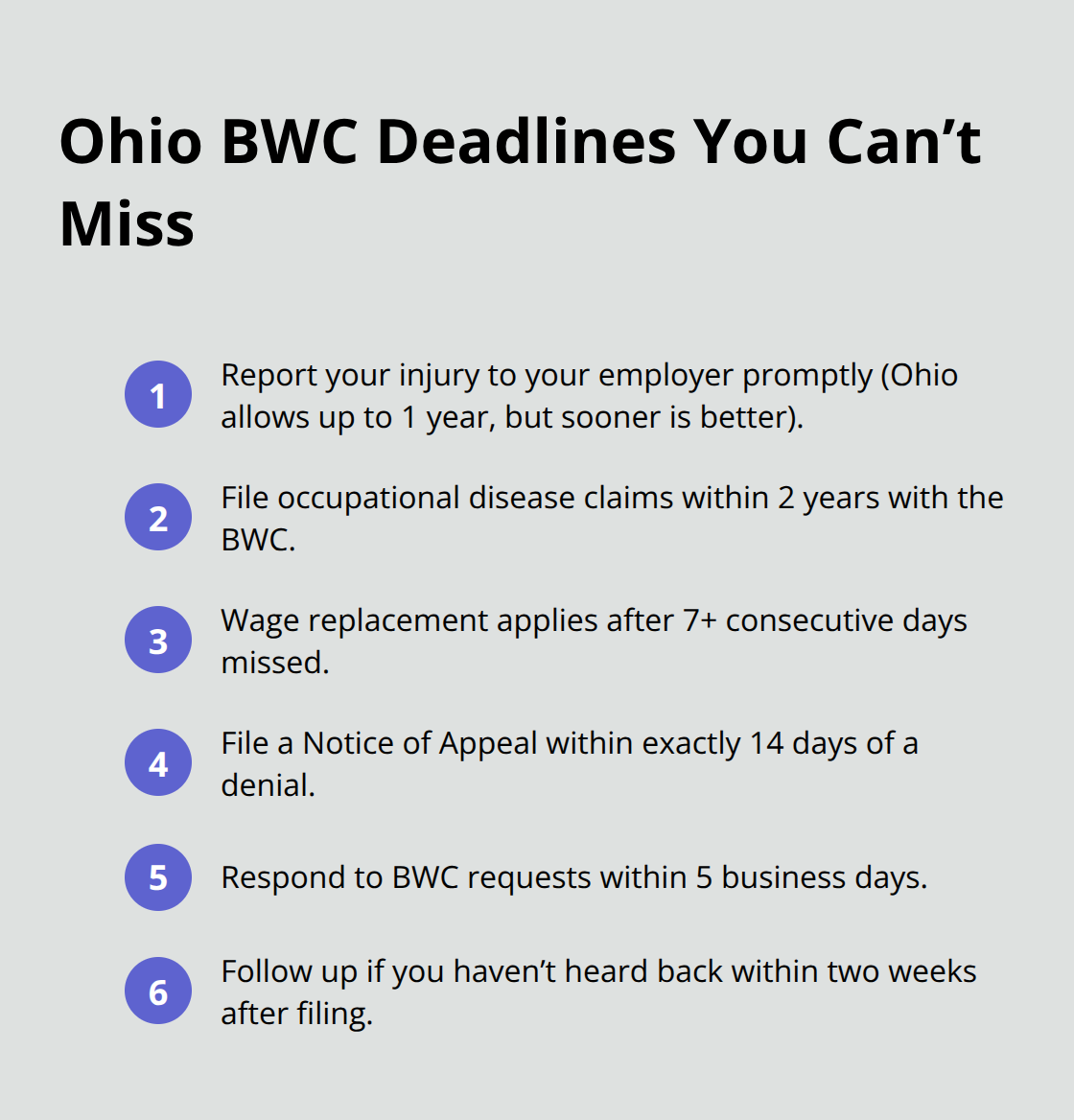
The U.S. Bureau of Labor Statistics reported that in 2023, private industry employers recorded 5.9 million nonfatal workplace injuries and illnesses, yet many workers miss filing deadlines or submit incomplete applications that slow their claims. Ohio law gives you up to one year to report an injury to your employer and two years to file an occupational disease claim with the BWC, but waiting this long creates problems. Delays invite disputes about whether the injury truly occurred at work, and memory fades when you need it most for detailed incident descriptions.
What Benefits Actually Cover
The BWC system provides two core benefit types: medical care and wage replacement. Medical benefits cover all treatment related to your work injury, including doctor visits, physical therapy, surgery, medications, and medical devices-with no copays or deductibles. Wage replacement kicks in if you miss more than seven consecutive calendar days from work due to the injury.
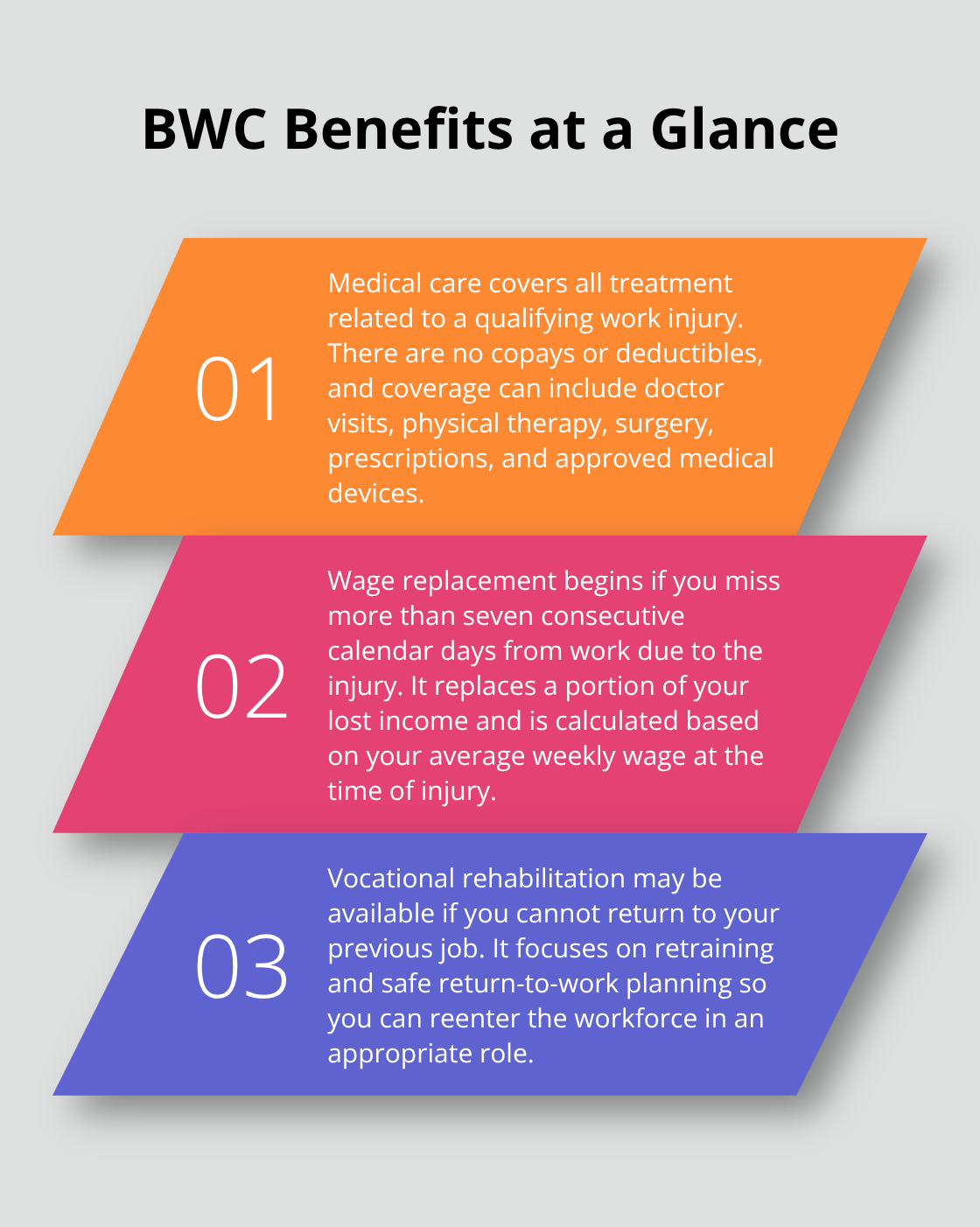
This benefit replaces a portion of your lost income while you recover, calculated based on your average weekly wage at the time of injury.
The system also covers vocational rehabilitation if your injury prevents you from returning to your previous job, helping you retrain for different work. Understanding these benefits prevents the common mistake of thinking the BWC covers everything or nothing-it’s specific and structured.
Why Deadlines Control Your Case
The BWC system is deadline-driven, and missing even one can devastate your claim. Your employer must receive notification of the injury promptly; waiting weeks or months creates skepticism about work-relatedness. The First Report of Injury or Illness form must be filed with the BWC within specific timeframes-your employer, healthcare provider, or you can file it, but someone must initiate the process.
If the BWC denies your claim, you have exactly 14 days to file a Notice of Appeal with the Ohio Industrial Commission. Missing that window typically means losing your right to challenge the denial. Start gathering evidence immediately after an injury occurs: dates, times, location details, witness names, and your own written account while the incident is fresh.
This documentation becomes invaluable if disputes arise later, and it strengthens your position when you move forward with filing your formal claim.
Filing Your Claim Step by Step
Notify Your Employer Without Delay
You must report your injury to your employer quickly-within days of the incident, not weeks. Ohio law permits up to one year to report, but this timeline works against you. The longer you wait, the more your employer and their Third Party Administrator question whether the injury actually occurred at work. When you report, stick to factual details: the date, time, location, which body parts are affected, and exactly what happened. Avoid emotional language or blame. Many workers over-explain or mention workplace frustrations unrelated to the injury, which insurers use to cast doubt on your claim. Document your report in writing through email or a signed statement so you have proof of when and what you communicated. If your supervisor pressures you to delay reporting or claims the injury isn’t serious enough to report, that pressure itself is a red flag worth noting and sharing with an attorney later.
Collect Documentation Immediately
You must start gathering documentation right after the injury occurs, before details fade and before your employer’s narrative solidifies. Write your own account while the incident is fresh, noting sensations, immediate symptoms, and what you were doing when the injury happened. Obtain your medical records from every healthcare provider who treats you, including initial emergency room visits, follow-up appointments, imaging results, and prescription records.
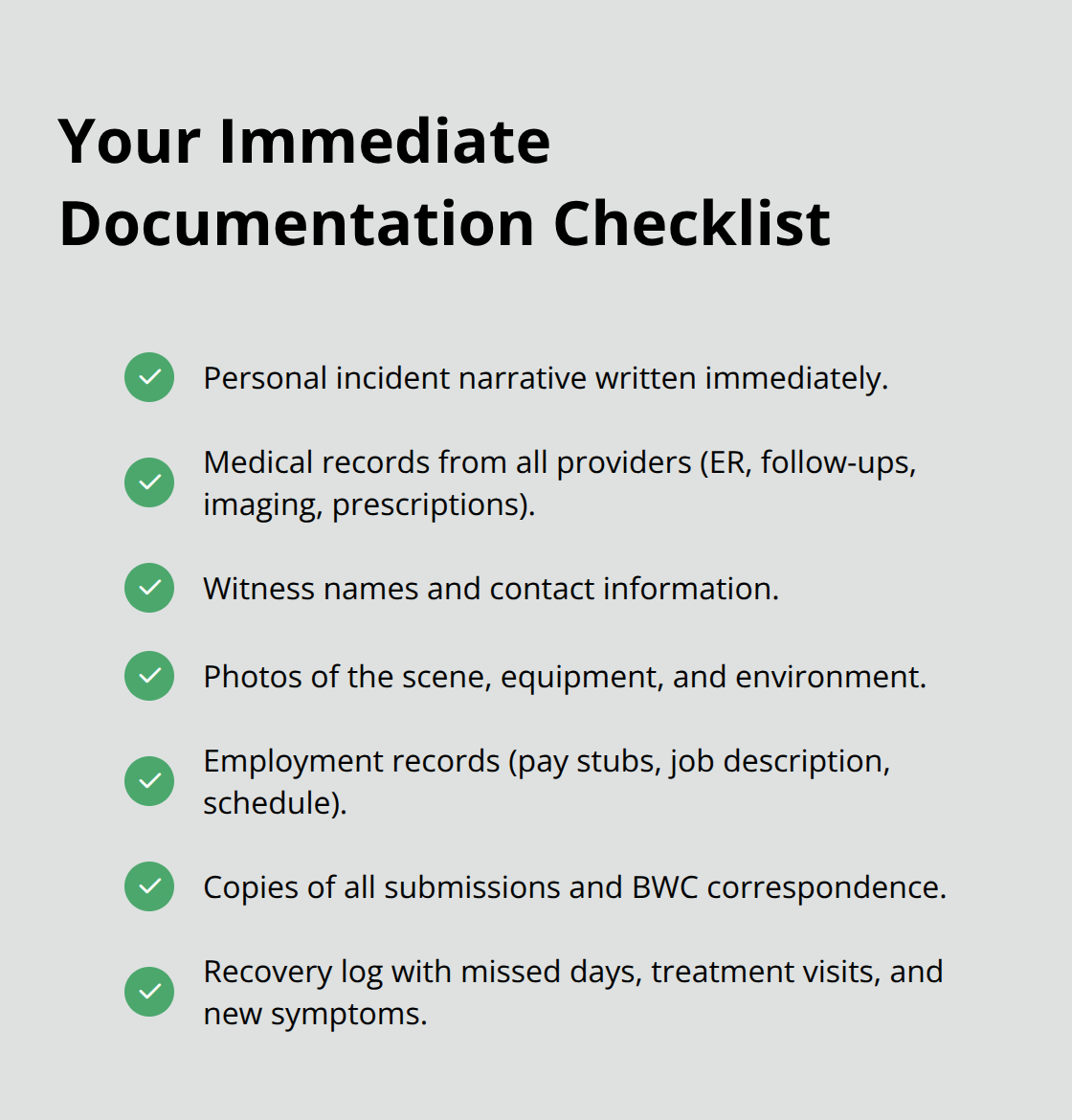
The Ohio Bureau of Workers’ Compensation requires medical evidence linking your condition to the work injury, so gaps in treatment or vague medical notes weaken your position significantly. If you have witnesses, get their names and contact information immediately; coworkers change jobs and memories fade quickly. Take photographs of the location where the injury occurred, any equipment involved, and your work environment if possible. Collect your employment records: recent pay stubs, your job description, work schedule, and any communications with your employer about your duties. Keep detailed personal notes about your recovery (including days you missed work, treatment visits, any new symptoms that emerge, and how the injury affects your daily activities). This documentation becomes your foundation when submitting the First Report of Injury or Illness to the BWC.
Submit Your Claim Through the Official BWC Process
You must use the official BWC application process to initiate your claim. The Ohio Bureau of Workers’ Compensation online application serves as the primary entry point, and you can file it yourself, or your employer or healthcare provider can file on your behalf. However, waiting for your employer to file is risky; they have competing interests and may delay. Filing promptly yourself or having an attorney handle the submission guarantees accuracy and timeliness. The First Report of Injury form must be complete and accurate. Incomplete or inaccurate information triggers delays or denials, forcing you to file corrections later. Include all relevant medical information, detailed descriptions of how the injury occurred, and the names of any witnesses. Submit copies of your supporting documentation alongside the form: medical records, incident reports, pay stubs showing your wage, and any communications about the injury. Keep copies of everything you submit for your records. After filing, track your claim status through the BWC’s online portal or by contacting your assigned adjuster directly. The BWC typically acknowledges receipt within days, but do not assume silence means approval. Follow up if you have not heard back within two weeks, as this step determines whether your claim moves forward or stalls before the next critical phase of the process.
Common Mistakes That Derail Your BWC Claim
The gap between filing a claim and actually receiving benefits is where most injured workers stumble. The Ohio Industrial Commission reports that incomplete documentation and missed procedural deadlines account for a substantial portion of claim denials and delays. Your claim doesn’t move forward on its own momentum. The BWC processes thousands of claims monthly, and yours sits in a queue until you provide exactly what they request, exactly when they request it. Waiting passively guarantees problems.
Missing the 14-Day Appeal Window
The moment you file your First Report of Injury form, you enter a system where every day matters. If the BWC denies your claim, you have exactly 14 days from the denial date to file a Notice of Appeal with the Ohio Industrial Commission. Missing that deadline typically means your right to appeal is gone. Write down the denial date on your calendar and set a phone reminder for day 10. Contact an experienced workers’ compensation attorney immediately if you receive a denial; they know how to build an appeal that addresses the specific grounds the BWC cited and what additional evidence strengthens your position for the hearing before the Industrial Commission.
Submitting Incomplete or Contradictory Information
One small mistake on your form-listing the wrong date for when you reported the injury to your employer, or describing your job duties inaccurately-gives the BWC grounds to request corrections that stretch your timeline. Third Party Administrators hired by your employer actively look for discrepancies between your initial report and later statements. If your first account says you were lifting boxes when you injured your back, but a follow-up medical form says you were pushing equipment, that contradiction becomes ammunition to deny your claim as inconsistent. A two-week delay in submitting medical records can shift your claim into a different review cycle. An email you don’t open from the BWC asking for clarification can expire without response, triggering an automatic denial.
Failing to Track and Follow Up on Your Claim
Create a simple spreadsheet that documents every date: when you reported the injury to your employer, when you filed with the BWC, when you submitted medical records, and when you expect responses. Set phone reminders to follow up 10 days after any submission if you haven’t received acknowledgment. The BWC’s online portal shows your claim status, but do not rely solely on the portal; call your assigned adjuster directly at least monthly to confirm progress and ask what additional information they need before making a decision. Request written confirmation of any phone conversations with the BWC, the adjuster, or your employer’s insurance company.
Responding Too Slowly to BWC Requests
When you receive a form from the BWC requesting more information, respond within five business days, not five weeks. Medical providers often take weeks to compile records, so contact them immediately when the BWC requests documentation rather than waiting until the deadline approaches. If the BWC denies your claim, read the denial letter carefully and identify the exact reason for rejection. The most common reasons include insufficient evidence that the injury occurred at work, late reporting to your employer, or incomplete medical documentation.
Final Thoughts
Filing a BWC claim requires attention to detail and strict adherence to deadlines, but the process becomes manageable when you understand what the Ohio Bureau of Workers’ Compensation expects. The BWC claim filing basics boil down to three core actions: notify your employer promptly, collect complete documentation immediately, and submit your claim through official channels without delay. Each step builds on the previous one, and skipping or rushing any part creates problems that compound later.
After you submit your claim, you must track your claim status actively through the BWC’s online portal and follow up with your assigned adjuster monthly. You should respond to every request for additional information within five business days. If the BWC denies your claim, you have exactly 14 days to file your Notice of Appeal with the Ohio Industrial Commission, so mark that deadline on your calendar immediately upon receiving a denial letter. Third Party Administrators hired to protect employer interests, medical providers who move slowly in compiling records, and the BWC’s requests for clarification all present obstacles that injured workers face regularly, yet these challenges are manageable if you stay organized and proactive.
If your claim has been denied, if you’re unsure whether you’ve followed the correct procedures, or if you want professional guidance from the start, contact our office for a free consultation to discuss your situation and next steps. We at Robin J Peterson Company, LLC represent injured workers throughout Ohio who face complex claims or denials and have extensive experience navigating the Industrial Commission to fight for the benefits you’re entitled to receive.