
Back injuries at work happen fast, and the filing process in Ohio can feel overwhelming. At Robin J Peterson Company, LLC, we help injured workers understand exactly what steps to take after a back injury.
This guide walks you through reporting your injury, getting medical documentation, and navigating the Ohio Bureau of Workers’ Compensation system. You’ll also learn what to do if your back injury Ohio claim gets denied.
What Back Injuries Look Like at Work
Sudden Injuries from Workplace Incidents
Back injuries at work fall into distinct categories, and understanding which type you’ve sustained matters for your claim. Sudden injuries occur when a single incident causes damage-lifting a heavy object incorrectly, falling from height, or getting struck by equipment. These acute injuries produce immediate pain and are usually easier to connect to a specific moment at work. According to the Bureau of Labor Statistics, younger workers file more workers’ compensation claims than older workers, with about 593 claims per 10,000 younger workers versus 261 per 10,000 older workers, and many of these involve acute back trauma from unexpected workplace events.
Gradual Injuries from Work Conditions
Other back injuries develop gradually without a single identifiable incident. Repetitive movements, prolonged poor posture, or working in awkward positions damage your spine over time. The challenge here is proving the work connection-your employer or the Ohio Bureau of Workers’ Compensation might argue your back pain stems from age or personal habits rather than your job. Thorough medical documentation becomes critical in these cases. The education and health services sector in Ohio has the highest injury and illness rate at 3.4 per 100 workers in 2023, higher than manufacturing at 2.7 and transportation at 2.6, meaning healthcare and warehouse workers face particular risk from gradual onset injuries.
Severe Spinal Injuries
Herniated discs and spinal cord damage represent the more severe end of the spectrum. A herniated disc occurs when the soft inner material of a spinal disc pushes through the outer layer, often compressing nerves and causing radiating pain down your legs. Spinal cord damage is rarer but catastrophic, potentially affecting movement and sensation below the injury site. The Ohio BWC framework requires robust medical evidence linking your injury to work activities and conditions to avoid denial. MRI and CT imaging, along with orthopedic or neurologist reports, strengthen your case substantially.
Getting the Right Medical Documentation
If you’ve experienced a back injury at work in Ohio, an approved BWC provider must evaluate you within 48 hours-this first medical record sets the foundation for your entire claim. That initial evaluation must explicitly state work-related causation. Medical documentation that clearly establishes the connection between your work activities and your back injury significantly improves your chances of approval. Strong diagnostic evidence matters because it counters any fraud concerns and provides the objective findings the BWC needs to process your claim fairly. With your medical foundation in place, the next step involves notifying your employer and submitting your claim to the Ohio Bureau of Workers’ Compensation.
Filing Your Back Injury Claim in Ohio
The moment you sustain a back injury at work, the clock starts ticking. You must report it to your employer within 24 hours, and this timing matters more than most injured workers realize. The Ohio Bureau of Workers’ Compensation has a 28-day window to decide whether to approve or reject your claim after filing, so delays in reporting eat into that decision period. Contact your supervisor or HR department immediately and request the First Report of Injury form.
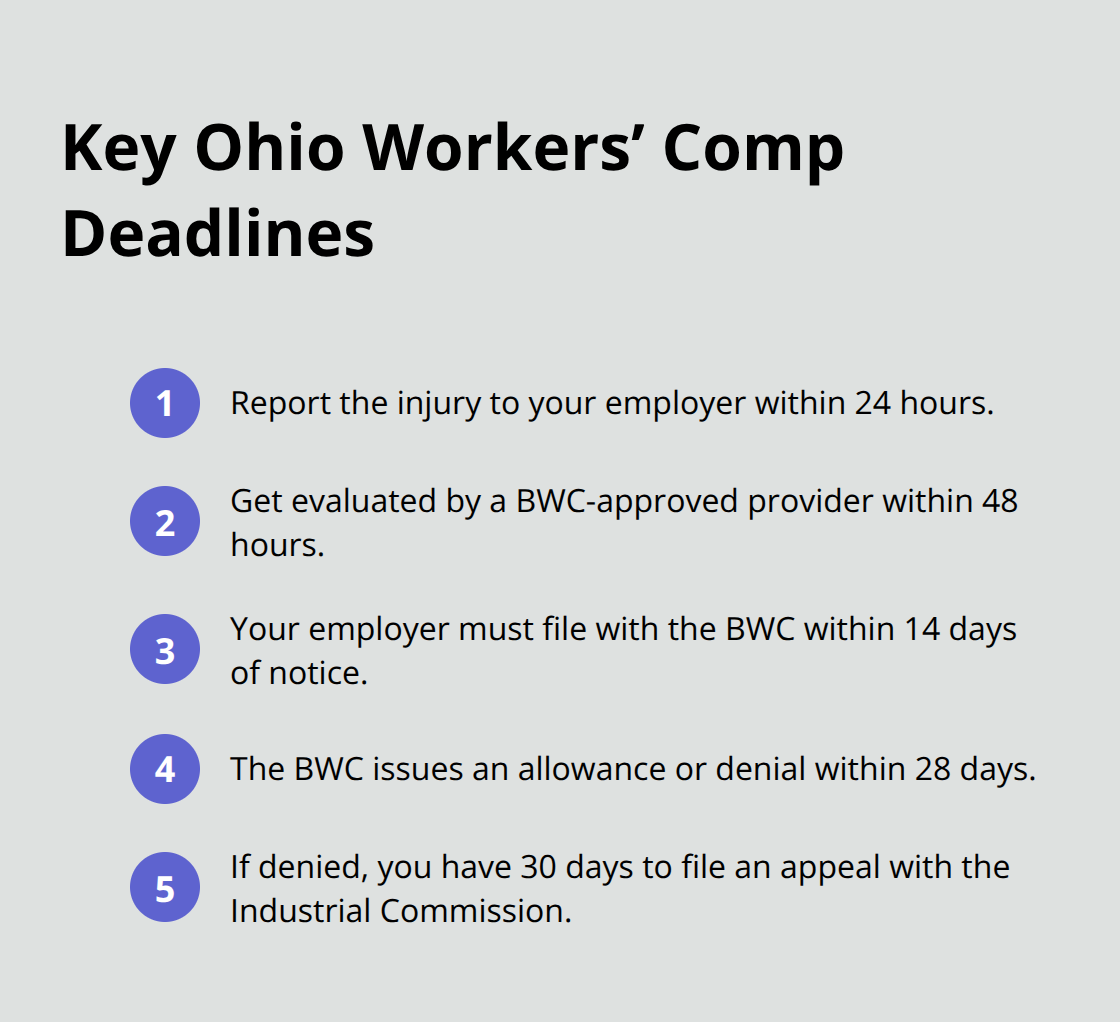
If your employer delays, you can file the claim yourself by calling the Ohio BWC at 1-800-644-6292 or submitting an online application through the OBWC website. The statute of limitations for back injuries runs from the date of injury, and missing deadlines can permanently bar your benefits. Your employer must file with the BWC within 14 days of learning about your injury, but don’t rely on them to move quickly-take control of the timeline yourself.
Obtain Medical Evaluation Within 48 Hours
Seek evaluation from an Ohio BWC-approved provider within 48 hours of your injury, and this step is non-negotiable. The first medical record establishes the foundation for your entire claim, so tell your provider explicitly that this is a workers’ compensation case and that you need the visit documented as work-related. Weak initial medical documentation causes unnecessary denials and delays. Request that your provider document objective findings like imaging results, range-of-motion tests, and neurological exams rather than relying solely on your description of pain. The Ohio Bureau of Workers’ Compensation identifies insufficient medical evidence as a leading reason for denial, so strong diagnostic documentation from the start protects your claim.
Build Your Medical Evidence File
Preserve every medical record, imaging report, and treatment note in a secure, organized location because you will need these documents if your claim faces denial and requires appeal. If you have a pre-existing back condition, gather evidence showing how the new work-related factors aggravated or worsened it-this distinction proves critical for approval. Common reasons for denial include lack of a proven work connection and delayed or missed treatments, so consistent medical follow-up strengthens your position significantly. Document objective findings rather than subjective complaints, as the BWC relies on measurable evidence to validate claims.
Submit Your Claim to the Ohio BWC
Complete the First Report of Injury form with accurate details about when, where, and how the injury occurred. Submit it to the Ohio Bureau of Workers’ Compensation either by mail at 30 W. Spring St., Columbus, OH 43215-2256 or through the online portal on the OBWC website. Include all medical documentation you have gathered so far-the more evidence you provide upfront, the stronger your position. The BWC will send you a notice of allowance or denial within 28 days. If approved, you become eligible for medical treatment coverage and temporary wage loss compensation. If denied, you have exactly 14 days to request a hearing with the Industrial Commission of Ohio, so mark that deadline on your calendar immediately.
Understand What Happens Next
Once you submit your claim, the BWC review process begins. The agency assigns an impairment rating based on medical evidence, and you should receive official notification within the 28-day window. An experienced Ohio workers’ compensation attorney helps you compile medical evidence correctly, meet all deadlines, and avoid common filing mistakes that lead to denials or reduced benefits. If the BWC approves your claim, you move forward with benefits. If the agency denies it, the appeal process with the Industrial Commission of Ohio determines whether your rating gets adjusted based on stronger medical evidence and testimony.
What Happens After You File Your Claim
The Ohio Bureau of Workers’ Compensation takes 28 days to make its initial decision, and understanding what happens during those 28 days helps you avoid costly mistakes. The BWC assigns a claims examiner to your file who reviews your medical documentation, verifies the work connection, and determines whether your injury qualifies for benefits. This examiner isn’t looking for reasons to approve your claim-they’re looking for reasons to deny it. According to the Ohio Bureau of Workers’ Compensation, the agency denies claims at a 14% rate, with common rejection reasons including insufficient medical evidence, lack of proven work-related connection, delayed or missed treatments, and pre-existing conditions cited as contributing factors.
Medical Evidence Determines Your Outcome
If your initial medical records are weak or incomplete, the examiner will likely recommend denial. Strong diagnostic imaging like MRI or CT scans combined with orthopedic or neurologist reports substantially improves approval odds. This 28-day window is when your medical evidence does the heavy lifting-if you haven’t documented objective findings by day 28, approval becomes significantly harder. The BWC relies on measurable, objective data rather than your account of pain or symptoms, so prioritize diagnostic testing and specialist evaluations during this critical period.
The 14-Day Appeal Deadline
When the BWC denies your claim, you have exactly 30 days from the denial notice to file an appeal with the Industrial Commission of Ohio, and missing this deadline permanently bars you from benefits. This deadline isn’t flexible, and the Industrial Commission of Ohio won’t hear your case if you file one day late. The appeal process involves requesting a hearing where medical evidence and testimony determine whether your impairment rating gets adjusted. At this stage, working with an attorney experienced in Ohio workers’ compensation law becomes a practical necessity rather than optional support. An attorney representing you at the Industrial Commission hearing knows how to present medical evidence effectively, cross-examine the BWC’s medical witnesses, and argue why the denial was incorrect.
Presenting Your Case at the Industrial Commission
Many injured workers attempt appeals without legal representation and lose cases they could have won with proper presentation of evidence. An experienced Ohio workers’ compensation attorney understands how to frame your medical records, organize witness testimony, and counter the BWC’s position with compelling documentation. The Industrial Commission considers the strength of your medical evidence alongside procedural arguments about whether the BWC followed proper review standards. Your attorney can identify weaknesses in the examiner’s reasoning and present alternative medical opinions that support your claim for benefits.
Permanent Disability and Vocational Rehabilitation
If your back injury prevents you from returning to your previous job, you may qualify for vocational rehabilitation or permanent disability benefits, but securing these requires clear documentation that your impairment affects your earning capacity. The Industrial Commission considers factors like your age, education, work history, and the specific limitations imposed by your injury when determining whether you’re permanently and totally disabled. This analysis isn’t straightforward-it requires an attorney who understands how the Industrial Commission weighs these factors in practice and can present evidence that demonstrates your reduced earning capacity to the hearing officer.
Final Thoughts
Filing a back injury Ohio claim requires precision, timing, and thorough documentation from the moment the injury occurs. You must report within 24 hours, obtain medical evaluation within 48 hours, and submit your claim before critical deadlines pass. Your medical evidence determines whether the Ohio Bureau of Workers’ Compensation approves or denies your claim, making strong diagnostic documentation non-negotiable (insufficient medical evidence, weak work-connection documentation, and missed treatment appointments all lead to preventable denials).
The appeal process separates injured workers who secure benefits from those who don’t. When the BWC denies your claim, you face a 14-day deadline to request an Industrial Commission hearing, and this deadline is absolute. Many workers attempt appeals alone and lose cases they could have won with proper legal representation.
An attorney experienced in Ohio workers’ compensation law knows how to present medical evidence effectively, challenge the BWC’s reasoning, and argue for adjusted impairment ratings based on stronger documentation. If your back injury Ohio claim has been denied or you’re uncertain about your filing strategy, contact our firm to discuss your situation with an attorney who understands Ohio workers’ compensation law.