
A workers’ compensation claim in Ohio can feel overwhelming when you’re injured and unsure of your rights. The Bureau of Workers’ Compensation has specific rules and timelines that determine whether you receive the benefits you deserve.
We at Robin J Peterson Company, LLC have guided countless injured workers through Akron BWC claim guidance and helped them avoid costly mistakes. This blog walks you through the process step-by-step so you can protect your claim from the start.
How Ohio’s Workers’ Compensation System Actually Works
The Ohio Bureau of Workers’ Compensation operates as a state-administered system separate from private insurance, which means your claim follows a specific pathway that differs from typical liability cases. The BWC handles roughly 300,000 claims annually across Ohio, and understanding how this agency processes your case is the first step toward protecting yourself. When you file a claim in Akron, you enter a system with defined rules about what injuries qualify, how benefits are calculated, and what timeline you must follow. The BWC doesn’t decide your case based on fault-Ohio operates under a no-fault system, meaning you can receive benefits even if your employer wasn’t negligent. This distinction matters because it simplifies your burden of proof, but it also means the BWC applies strict eligibility criteria to determine whether your injury arose from employment.
File Your Claim Before Time Runs Out
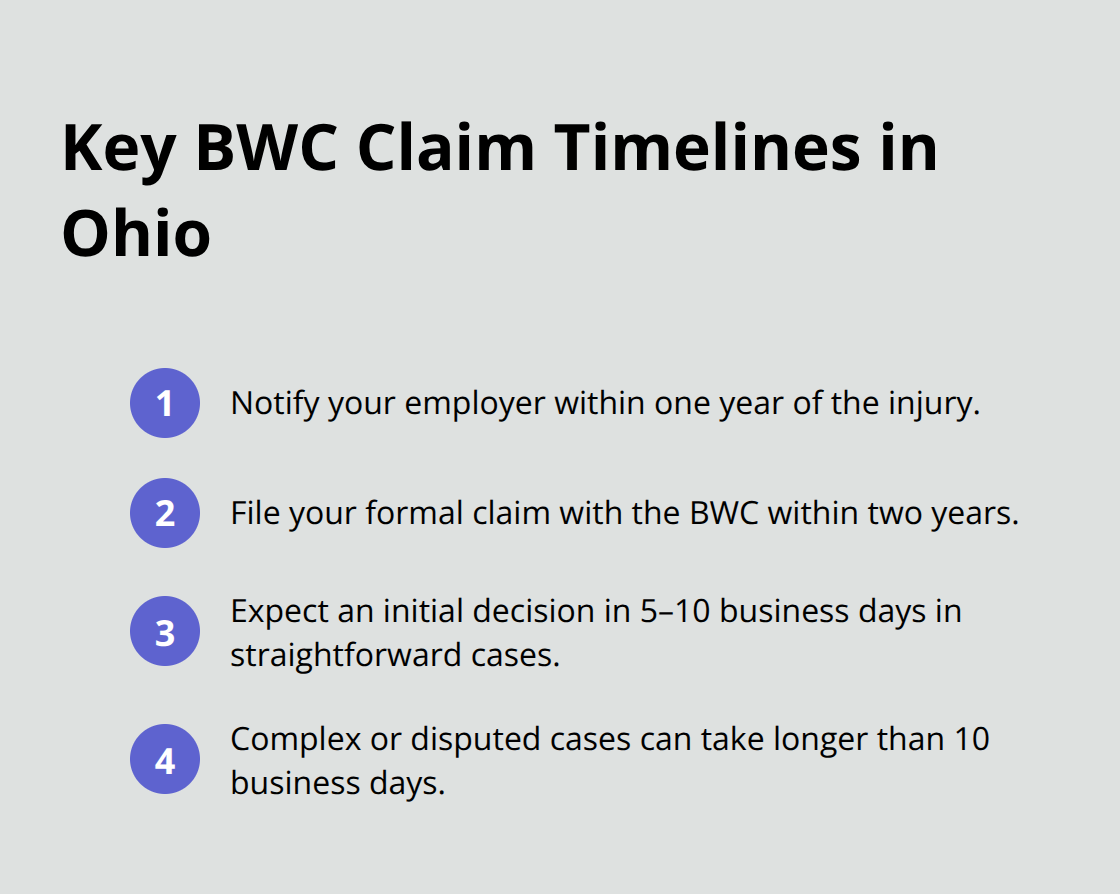
You must report your injury to your employer immediately, ideally in writing, because Ohio law requires you to notify your employer within one year of the injury or you lose your right to benefits. Many workers wait weeks or months, thinking a minor injury will resolve on its own, only to discover the deadline has passed. The BWC itself must receive your formal claim within two years of the injury date, but don’t rely on that extended window-file with your employer right away and request a written acknowledgment. Once the BWC receives your claim, they typically process initial decisions within 5 to 10 business days, though more complex cases involving disputes between your employer and the insurer can take longer. During this processing period, the BWC verifies that your injury meets the definition of a compensable claim: it must arise out of and occur in the course of employment, and it must cause objective medical findings that a licensed physician can document.
Understand What Types of Claims the BWC Approves
The BWC approves claims for acute injuries like fractures, burns, and lacerations, as well as occupational diseases that develop over time through workplace exposure. However, the agency denies claims for pre-existing conditions unless the workplace injury significantly aggravated them, and they scrutinize claims involving mental health conditions or stress-related injuries with particular skepticism. Your medical records become the foundation of your claim’s approval, so you should obtain comprehensive documentation from your treating physician immediately after the injury to strengthen your position. The BWC also requires that your injury prevent you from performing your job duties-minor injuries that don’t affect your ability to work typically don’t qualify for wage-loss benefits, though you may still receive medical benefits. Understanding these standards helps you gather the right evidence from the beginning rather than discovering gaps later when the BWC requests additional information or denies your claim outright.
The next section covers the specific challenges that injured workers in Akron face when the BWC denies or delays their claims, and how you can respond effectively to protect your benefits.
Why Claims Get Denied or Stuck in Processing
Insufficient Medical Documentation Triggers Denials
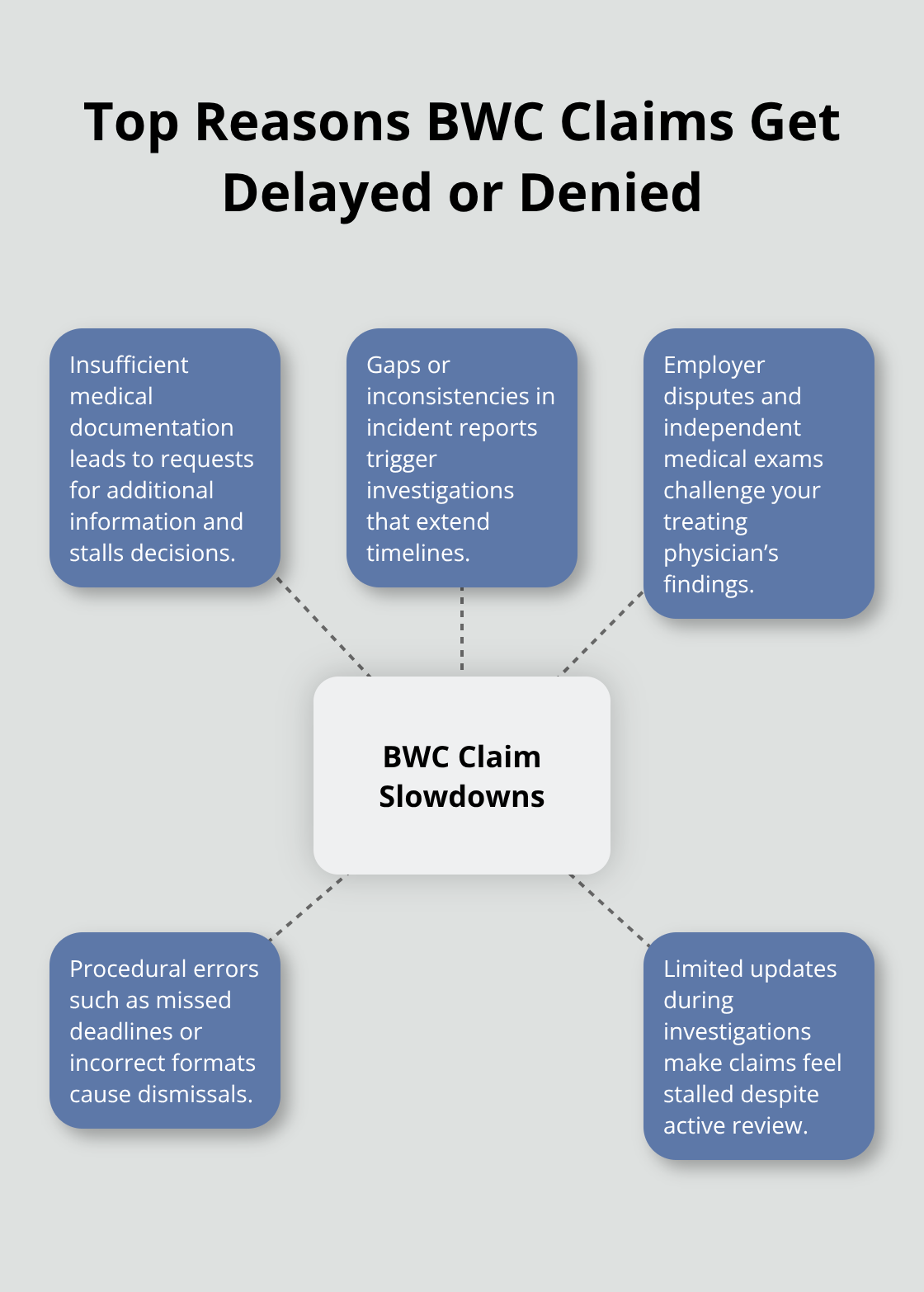
Injured workers in Akron encounter predictable obstacles that delay or derail their BWC claims. The most common reason for denial is insufficient medical documentation-the BWC receives claims where the treating physician has not documented objective findings that meet the agency’s standards, or the medical records lack clear connection between the workplace injury and the documented condition. When this happens, the BWC issues a request for additional information, which restarts the clock on processing time. Your initial response to this request determines whether the claim moves forward or the BWC denies it outright. Comprehensive medical records from your treating physician immediately after the injury strengthen your position and prevent these early denials.
Gaps in Injury Reports Create Investigation Delays
Another frequent problem stems from gaps in the injury report itself: if your employer’s incident documentation does not match your account of what happened, or if ambiguity exists about whether the injury truly arose out of employment, the BWC flags the claim for investigation. This investigation phase extends processing time from days into weeks or months while the BWC contacts witnesses, reviews surveillance footage, or requests clarification from your employer. Workers often feel invisible during this period because they receive no updates, leading them to assume their claim has stalled when the BWC actually conducts active review.
Employer Disputes and Independent Medical Exams Complicate Your Case
The bureaucratic requirements multiply when your employer disputes the claim or when the insurer questions your medical treatment. Ohio employers and their insurers have a financial incentive to challenge claims, and they routinely request independent medical examinations to contradict your treating physician’s findings. If you attend an independent medical examination without understanding your rights, you may inadvertently provide information that weakens your position. Additionally, the BWC requires you to follow specific procedures when you appeal a denial or request a hearing before the Industrial Commission-missing a deadline or filing documents in the wrong format results in dismissal of your appeal regardless of the merits of your case.
Procedural Errors Cost Workers Their Benefits
Workers who navigate this process alone frequently make procedural errors that cost them benefits. The relationship with your employer and insurer also affects claim processing speed: if your employer cooperates fully and the insurer does not dispute causation, your claim moves quickly through approval. Conversely, when tension exists between you and your employer, or when the insurer views your injury skeptically, every step becomes adversarial and slower. Procedural mistakes-missed deadlines, incorrect filing formats, or improper responses to information requests-can sabotage your claim even when the underlying injury clearly qualifies for benefits.
Strategic Representation Protects Your Claim at Every Stage
The stakes of these procedural requirements demand that you handle communications with your employer and insurer strategically. Robin J. Peterson Company, LLC helps injured workers in Akron overcome these obstacles by ensuring your medical documentation meets BWC standards from the start, responding strategically to information requests, and managing all communications with your employer and insurer so procedural mistakes do not sabotage your claim. When you understand how denials and delays occur, you can take action to prevent them-but when disputes arise, experienced representation becomes essential to protect your benefits and move your claim toward resolution.
Representation That Stops Procedural Sabotage
Self-Representation Creates Structural Disadvantage
When you file a BWC claim in Akron without legal representation, you operate at a structural disadvantage. The Industrial Commission of Ohio hears hundreds of cases monthly, and claimants who represent themselves frequently lose not because their injuries lack merit, but because they fail to meet procedural requirements or present evidence in the format the commission expects. An attorney who regularly appears before the Industrial Commission understands exactly which medical documentation the commission scrutinizes, how to respond to employer disputes, and which procedural mistakes trigger automatic dismissal.
Preparation for Independent Medical Examinations Protects Your Position
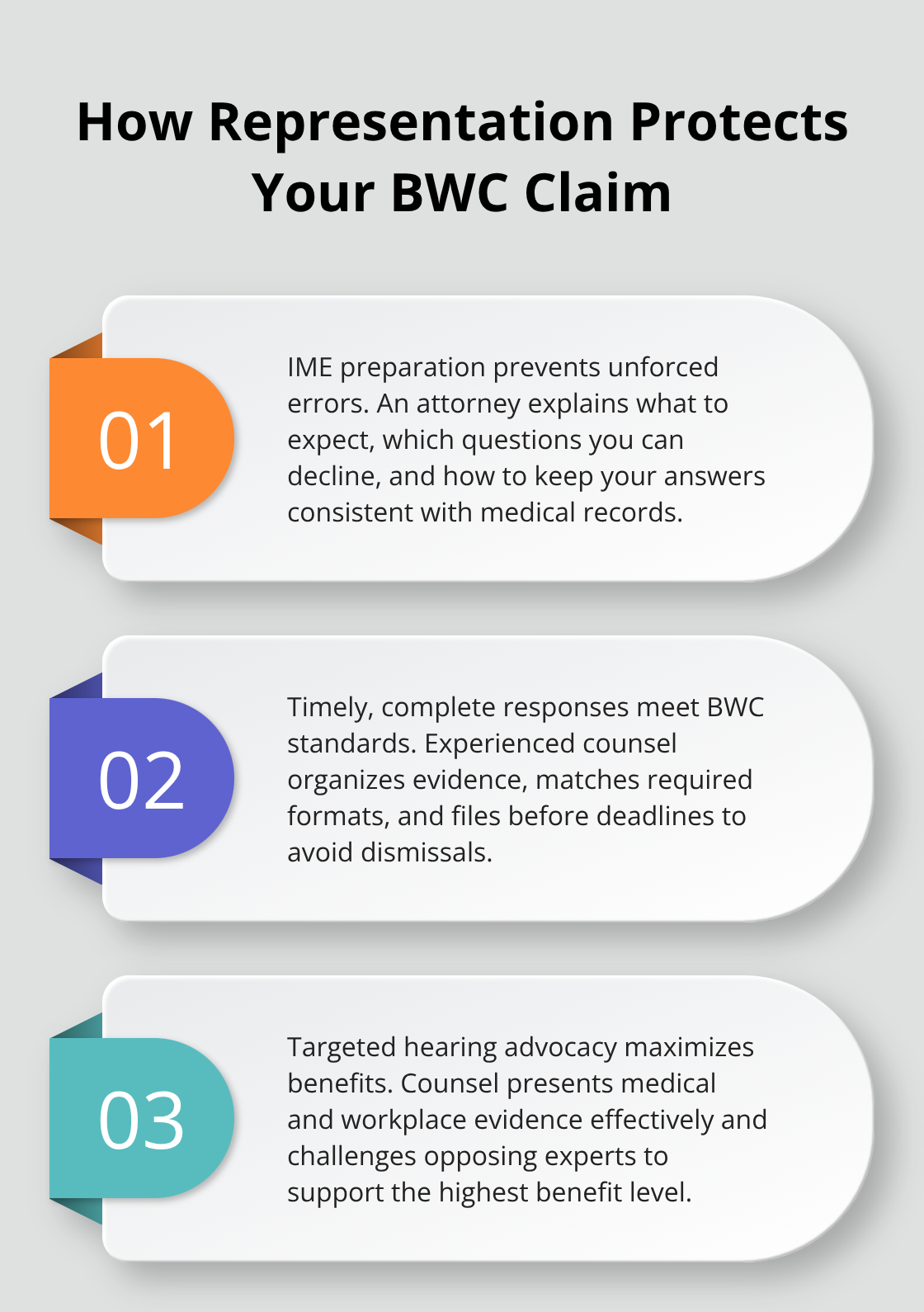
When your employer’s insurer requests an independent medical examination, you should not attend without understanding how to respond to questions that undermine your claim. An experienced representative helps you prepare for this examination, advises which questions you can decline to answer, and ensures the resulting report does not contradict your treating physician’s findings. This preparation phase separates workers whose examinations strengthen their claims from those whose examinations provide ammunition for denial.
Strategic Responses to Information Requests Meet BWC Standards
When the BWC issues a request for additional information, the response requires careful attention to formatting, completeness, and timeliness. Missing a deadline by one day results in dismissal, and submitting incomplete documentation gives the BWC grounds to deny your claim. An attorney who has handled hundreds of Akron and Summit County cases knows precisely what information satisfies the BWC’s standards and submits it before deadlines arrive.
Fighting for Maximum Benefits Requires Strategic Evidence Presentation
The distinction between fighting for maximum benefits and simply accepting what the BWC initially offers separates workers who recover fully from those who struggle financially during recovery. If your claim receives approval, you still face critical decisions about whether to accept the BWC’s calculation of your wage-loss benefits or challenge it through the Industrial Commission. Many workers accept initial benefit amounts without understanding that the commission regularly awards higher benefits when evidence supports increased disability ratings.
Industrial Commission Hearings Demand Experienced Advocacy
When your employer disputes your claim, the burden shifts to you to prove your injury meets the compensability standard. This requires medical testimony, workplace evidence, and witness statements presented in a format the commission understands. An attorney familiar with Industrial Commission hearings structures this evidence strategically, cross-examines the employer’s medical witnesses effectively, and advocates for the highest benefit level supported by your medical condition. The difference between representation and self-representation often determines whether your claim results in approval with full benefits or denial that forces you to file an appeal (which costs months of additional processing time).
Final Thoughts
Your Akron BWC claim guidance starts with understanding that procedural mistakes cost workers their benefits as often as medical documentation gaps do. The Ohio workers’ compensation system operates on strict timelines and formatting requirements that leave no room for error, which means your first decision after an injury determines whether you protect your claim or inadvertently sabotage it. Filing your injury report immediately with your employer, gathering comprehensive medical documentation from your treating physician, and responding strategically to every BWC request separates workers who receive full benefits from those who face denials or delays.
The challenges you face in Akron follow predictable patterns that experienced representation can navigate effectively. Insufficient medical records, gaps in injury reports, employer disputes, and independent medical examinations all create obstacles that you can prevent when you understand how they arise. When disputes emerge, you need an attorney who has handled hundreds of Summit County cases and knows exactly how the Industrial Commission evaluates evidence.
Robin J. Peterson Company, LLC represents injured workers throughout the Cleveland, Akron, and Canton areas and fights against employers and the BWC to ensure your claim receives fair treatment at every stage. Contact the firm for a consultation to review your specific situation and discuss how representation protects your claim from procedural sabotage. Injured workers who act quickly and secure experienced representation move through the claim process faster and recover higher benefits than those who delay or attempt self-representation.