
A work injury in Ohio can turn your finances upside down fast. When you can’t work, bills don’t stop coming-and that’s where wage loss Ohio benefits step in to help.
We at Robin J Peterson Company, LLC know that understanding these benefits matters. This guide walks you through what you’re entitled to, how payments work, and what to do if problems arise.
What Wage Loss Benefits Actually Replace
Wage loss benefits in Ohio exist for one reason: to bridge the income gap when a work injury forces you to earn less. The Ohio Bureau of Workers’ Compensation recognizes two distinct types, and understanding which one applies to your situation changes everything about your financial recovery.
Two Types of Wage Loss
Working wage loss applies when you return to a job but make less money because of medical restrictions from your injury. Nonworking wage loss applies when medical restrictions prevent you from finding suitable work at all. The calculation for working wage loss uses approximately 66.67% of the difference between your average weekly wage before the injury and what you earn now. If you averaged $900 weekly before injury and now earn $600, the difference is $300, and two-thirds of that equals $200 in weekly benefits.
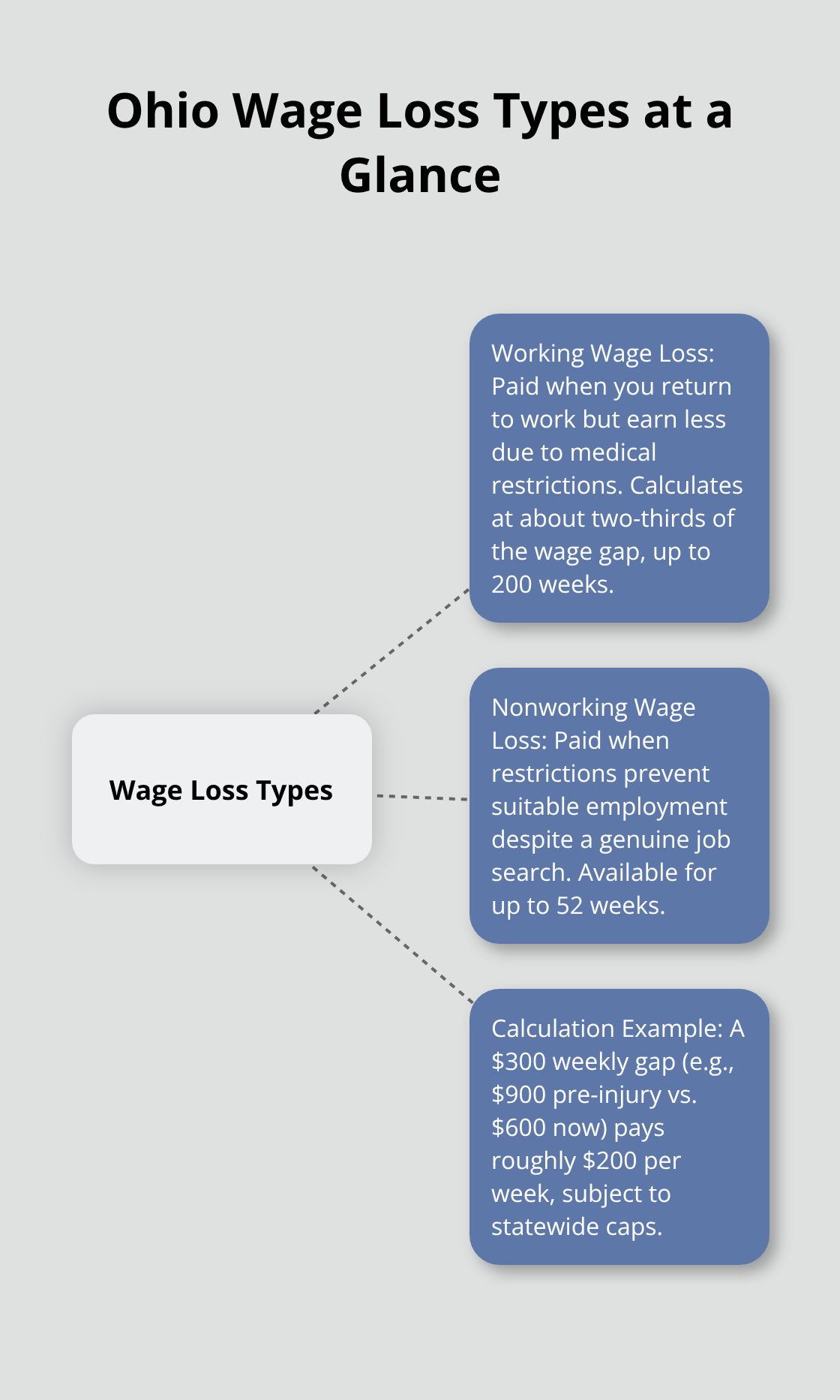
This isn’t theory-it’s how the Ohio Administrative Code 4125-1-01 structures the actual payment formula. Working wage loss covers up to 200 weeks, while nonworking wage loss covers up to 52 weeks.
How Earnings Records Determine Your Payment Amount
Your payment hinges on accurate earnings documentation. The Ohio BWC pulls figures from the year before your injury to establish your average weekly wage, and this calculation includes overtime and bonuses-not just base salary. Pay stubs matter enormously here because they prove what you actually earned. If your records are incomplete or vague, the BWC calculates conservatively, which works against you. The same two-thirds formula applies to nonworking wage loss, but the timing creates a strategic consideration: if you collect nonworking wage loss for more than 26 weeks, those additional weeks reduce your available working wage loss time, capping your total at 226 weeks combined. Tracking every pay stub, bonus, and hour of overtime now prevents disputes later that could delay or reduce your benefits.
Meeting Eligibility Without Shortcuts
Wage loss eligibility requires two hard requirements that the BWC actually verifies. Your allowed workers’ compensation claim must exist and show medical restrictions directly causing your earnings loss-not a business slowdown or unrelated pay cut. Second, you must document a genuine job search if you claim nonworking wage loss. This means you register with the Ohio Department of Job and Family Services job search program and maintain weekly records of contacts, applications, and effort. The BWC reviews these records, and weak documentation results in denial. For working wage loss, you still need to search for comparably paying work unless your employer or the Industrial Commission formally excuses you.
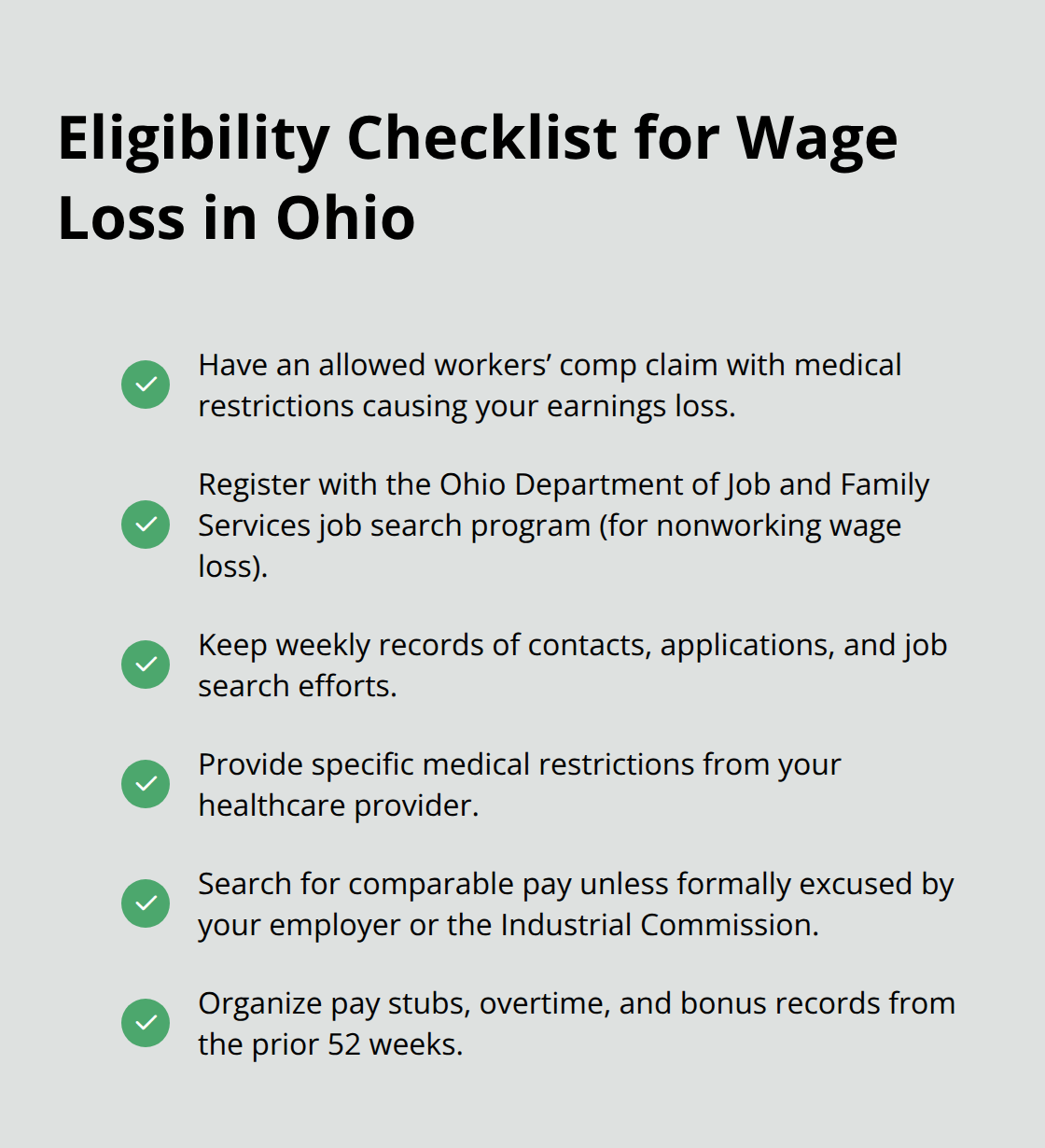
Medical documentation from your provider stating your restrictions and their duration is non-negotiable; a pay record alone won’t satisfy the BWC if questions arise about causation. Once you understand these eligibility rules, the next step involves recognizing how these payments actually function within your household budget.
How Wage Loss Benefits Fill Your Income Gap
Wage loss benefits exist to replace what you actually lose each month when injury forces you to work less or not at all. The Ohio Bureau of Workers’ Compensation bases this replacement on real numbers: if you earned $900 weekly before injury and now earn $600 due to medical restrictions, that $300 weekly gap becomes the foundation for your benefit calculation. Two-thirds of that gap equals $200 per week, which translates to roughly $800 monthly or $9,600 annually. For a family living paycheck to paycheck, this difference determines whether you can cover rent, utilities, and groceries without depleting savings or taking on debt.
How Your Earnings Determine Your Weekly Benefit
The calculation remains constant only if your earnings stay constant. If you move into a better-paying job later, your benefits adjust downward because the gap shrinks. Conversely, if you accept a lower-paying position due to your restrictions, the gap widens and so do your benefits up to the statewide average weekly wage cap. This flexibility means wage loss benefits adapt to your actual financial reality rather than offering a fixed amount that ignores how work situations change.
Your pay stubs from the year before injury become financial proof that the BWC cannot ignore. If you earned overtime or received bonuses, those amounts get included in your average weekly wage calculation, which increases your baseline and potentially increases your weekly benefit. A worker who averaged $950 weekly (including overtime) versus one who averaged $850 weekly will receive meaningfully different benefits over 200 weeks of working wage loss. That difference compounds to thousands of dollars across the benefit period.
Why Documentation Directly Impacts Your Family’s Finances
The practical action here is straightforward: gather every pay stub, bonus documentation, and overtime record from the 52 weeks before your injury occurred and organize them by date. When the BWC calculates conservatively due to incomplete records, families absorb the financial penalty. Medical documentation proves equally critical because it establishes the link between your injury and your earnings loss. Your healthcare provider must specifically document which work activities your medical restrictions prevent, not simply state that you have restrictions. A provider note stating you cannot lift over 25 pounds is actionable; a note stating you have activity limitations is vague and creates an opening for BWC denial or reduction.
The Strategic Timing Between Nonworking and Working Wage Loss
Nonworking wage loss covers you for up to 52 weeks when medical restrictions prevent you from finding suitable employment despite genuine job search effort. However, any nonworking wage loss weeks beyond 26 weeks reduce your available working wage loss time, meaning those extra weeks cost you from your 200-week working wage loss maximum. This creates a genuine financial decision point: accept a lower-paying job sooner to switch to working wage loss and preserve weeks, or continue the nonworking search knowing you sacrifice future benefit weeks.
A worker who collects nonworking wage loss for the full 52 weeks only retains 174 weeks of working wage loss eligibility, not the full 200 weeks. For families, this means the total benefit period potentially shrinks from 226 weeks to 226 weeks only if you make strategic choices about timing. The math shows that accepting work faster often preserves more total compensation than maximizing nonworking benefits, particularly if the available jobs pay reasonably close to your pre-injury wage. The trade-off calculation depends on actual job offers and realistic wage prospects in your labor market rather than hoping for perfect work that may never materialize. Once you understand how these calculations work, the next critical step involves recognizing what happens when disputes arise over how the BWC calculated your benefits.
When the BWC Gets Your Calculation Wrong
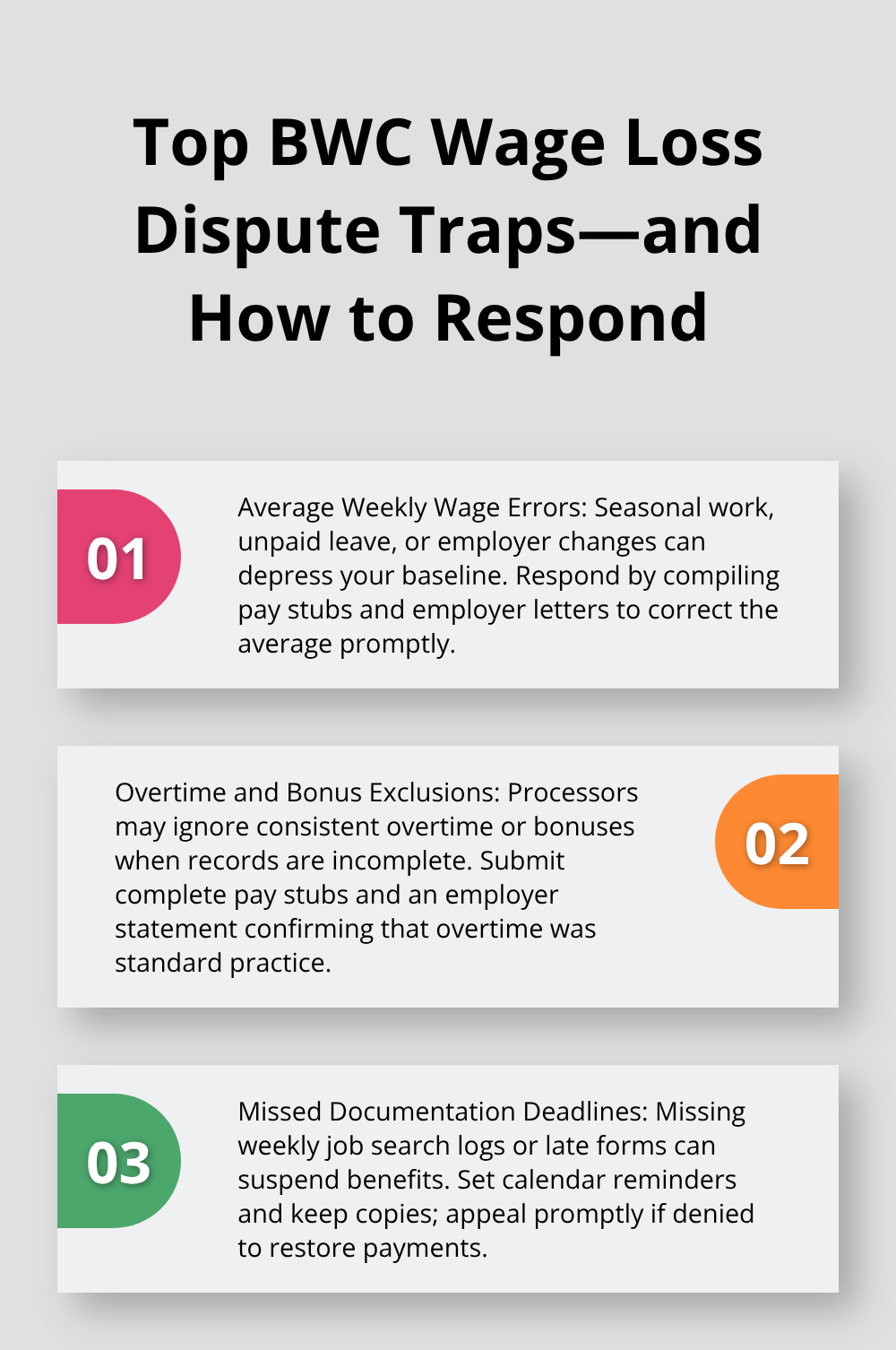
Wage loss calculation disputes happen more often than most injured workers realize, and the Ohio Bureau of Workers’ Compensation makes mistakes that cost you money. The most common error involves how the BWC establishes your average weekly wage from the year before injury. If you worked seasonal jobs, took unpaid leave, or changed employers during that period, the BWC may calculate a lower baseline than what you actually earned. A worker who earned $1,100 weekly for nine months and then took three months unpaid leave might see the BWC average that down to $825 weekly, immediately reducing your benefit by roughly $183 per week.
That’s nearly $10,000 less over 52 weeks of nonworking wage loss.
How to Fix Average Weekly Wage Errors
The fix requires you to submit documentation proving your actual earnings during high-income periods and explaining why unpaid time existed. Gather pay stubs, W-2 forms, and a letter from your employer stating your regular weekly earnings before the injury. The BWC sometimes accepts amended calculations when you provide this evidence, but you must act within 14 days of receiving the initial decision to file a dispute.
Overtime and Bonus Calculation Traps
Another calculation trap involves how the BWC treats overtime and bonuses. If you regularly earned overtime in the year before injury, those hours must factor into your average weekly wage according to Ohio Administrative Code 4125-1-01. Some BWC processors exclude overtime when reviewing incomplete records, which artificially deflates your benefit. A worker who averaged $950 weekly including consistent overtime sees their benefits cut if the processor only counts base pay at $800 weekly. You counter this by providing complete pay stubs showing all hours worked and overtime compensation, plus a statement from your employer confirming overtime was standard practice.
Documentation Deadlines That Cost You Money
Documentation delays cause the second major problem workers face. The BWC requires specific forms submitted within strict timelines: the Application for Wage Loss Compensation (C-140) must be filed while your claim is active, and the Wage Loss Statement for Job Search (C-141) requires weekly submission showing your search efforts. Missing even one week of job search documentation can trigger denial or suspension of nonworking wage loss benefits. Set calendar reminders for weekly submission deadlines and keep copies of everything you send. If the BWC denies your claim citing missing documentation, you have the right to appeal and submit the missing records, but this process adds weeks to payment delays.
Medical Causation and Appeals
When disputes arise over medical causation-whether your earnings loss actually stems from your work injury rather than other factors-the BWC requires specific medical documentation from your healthcare provider. A vague provider note won’t suffice; your doctor must clearly state which work duties your restrictions prevent and why those restrictions directly limit your earning capacity. If the BWC disputes causation, request your provider document the specific connection between your injury and your work restrictions in writing. Appeals and denials follow Ohio’s formal dispute process through the Industrial Commission of Ohio, which reviews the BWC’s decision. You can represent yourself, but the complexity of wage loss calculations makes legal representation valuable. We at Robin J Peterson Company, LLC represent injured workers across Cleveland, Akron, and Canton with experience navigating these disputes, and our firm fights for the full benefits you’re entitled to when the BWC underpays or denies your claim.
Final Thoughts
Wage loss Ohio benefits replace the income your family loses when a work injury forces you to earn less, and the system operates through two distinct paths that serve different situations. Working wage loss applies when you return to lower-paying work, while nonworking wage loss applies when medical restrictions prevent suitable employment entirely. Both types calculate at roughly two-thirds of your earnings gap, capped by the statewide average weekly wage, and both require solid documentation to avoid underpayment or denial.
The calculation process contains traps that cost workers thousands of dollars, as the BWC sometimes excludes overtime, miscalculates your average weekly wage, or misses the connection between your injury and earnings loss. Your immediate action should focus on gathering complete earnings records from the year before your injury, including all pay stubs, overtime documentation, and bonus statements, then submit your Application for Wage Loss Compensation (C-140) promptly while your claim remains active. Medical documentation from your healthcare provider stating specific work restrictions and their duration matters equally, since vague notes create openings for BWC disputes that delay payments your family needs now.
When disputes arise over your wage loss Ohio benefits, you have the right to appeal through Ohio’s formal process, but navigating these disputes alone often results in reduced benefits or prolonged delays. We at Robin J Peterson Company, LLC represent injured workers throughout Cleveland, Akron, and Canton who face wage loss disputes or denials from the BWC, and our firm fights to secure the full benefits you’re entitled to by challenging underpayment calculations and holding the BWC accountable when they get your numbers wrong. Contact our office today to discuss your wage loss claim and learn how we can help your family recover the income you’ve lost.