
A BWC denial can feel like a dead end, but it’s not. You have legal rights and specific steps available to fight back.
At Robin J Peterson Company, LLC, we’ve helped injured workers in Ohio understand how to appeal denial decisions and reclaim the benefits they deserve. This guide walks you through the entire process, from filing your request for hearing to preparing for your case.
Understanding BWC Denial Decisions
Common Reasons the BWC Denies Workers’ Compensation Claims
The Ohio Bureau of Workers’ Compensation denies roughly 8-10% of claims outright, though many more face partial denials or delays. Insufficient medical evidence represents the most common denial reason-the BWC requires clear documentation that links your injury to a work-related incident and proves it’s not a pre-existing condition. Missed deadlines also trigger denials frequently. Ohio law mandates that you report your injury to your employer within one week of the incident; missing this window can result in claim denial even when the injury is legitimate.
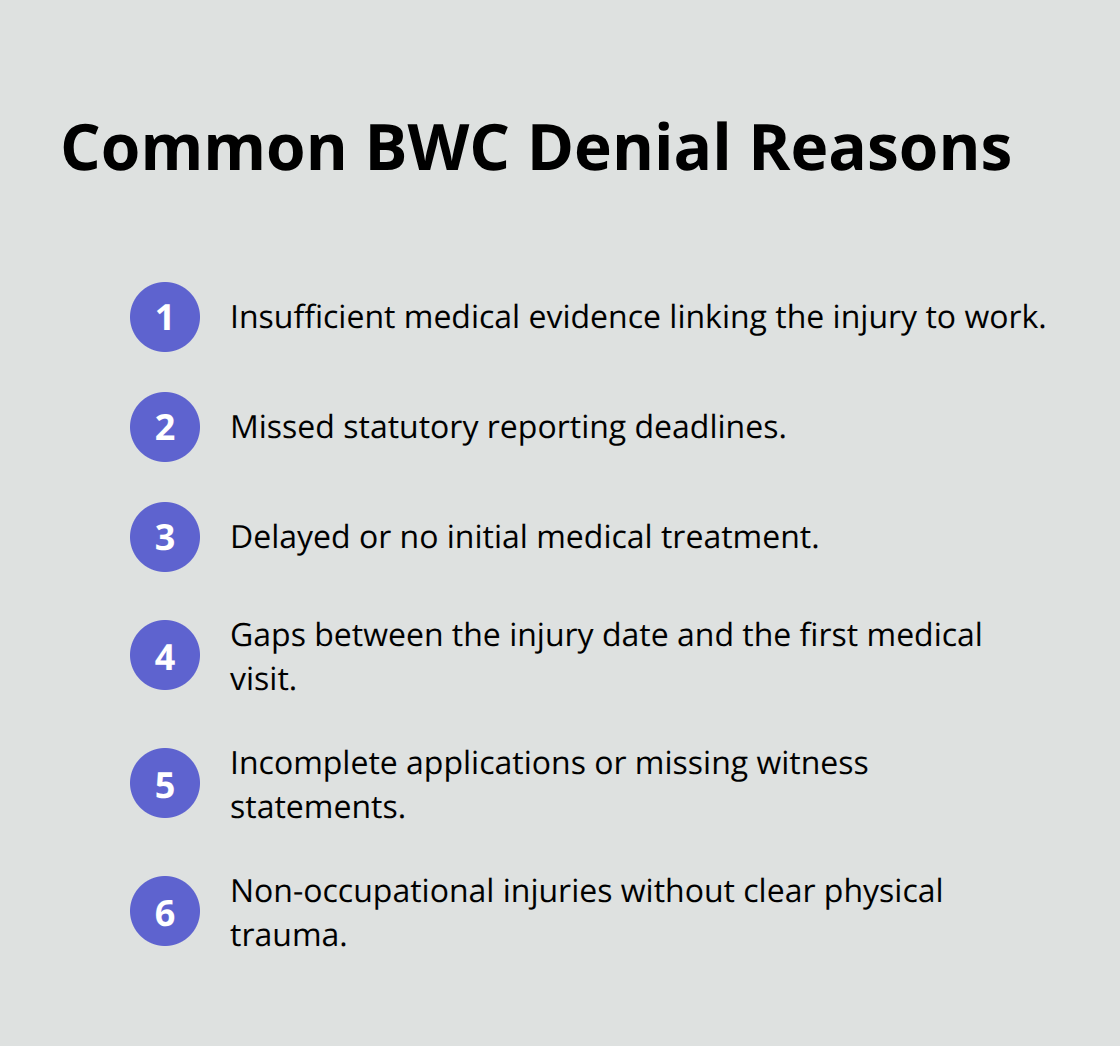
The BWC rejects claims when workers fail to seek immediate medical attention or when gaps exist between the injury date and the first medical visit. The agency interprets these delays as evidence that the injury may not be work-related. Incomplete applications, missing witness statements, and claims involving non-occupational injuries (such as mental health conditions without clear physical trauma) round out the primary denial categories.
Your 14-Day Window to Act
You have 14 days from the date you receive a denial letter to file a request for hearing with the Industrial Commission of Ohio. This deadline is non-negotiable and absolute. Many injured workers miss this window simply because they don’t understand the urgency or they’re waiting to gather more information. Once those 14 days pass, your right to appeal essentially disappears unless you have exceptional circumstances.
Your Rights as an Injured Worker in Ohio
As an injured worker in Ohio, you retain significant rights even after a denial. You can request a hearing before an administrator at the Industrial Commission, present new medical evidence, call witnesses, and challenge the BWC’s findings directly. You’re also entitled to legal representation throughout this process. The appeals process isn’t simple, but it’s absolutely winnable when you have proper documentation and understand the specific reasons the BWC rejected your claim initially. Understanding these rights positions you to move forward with confidence into the next phase of your appeal.
Filing Your Appeal and Building Your Case
Submit Your Request for Hearing Correctly
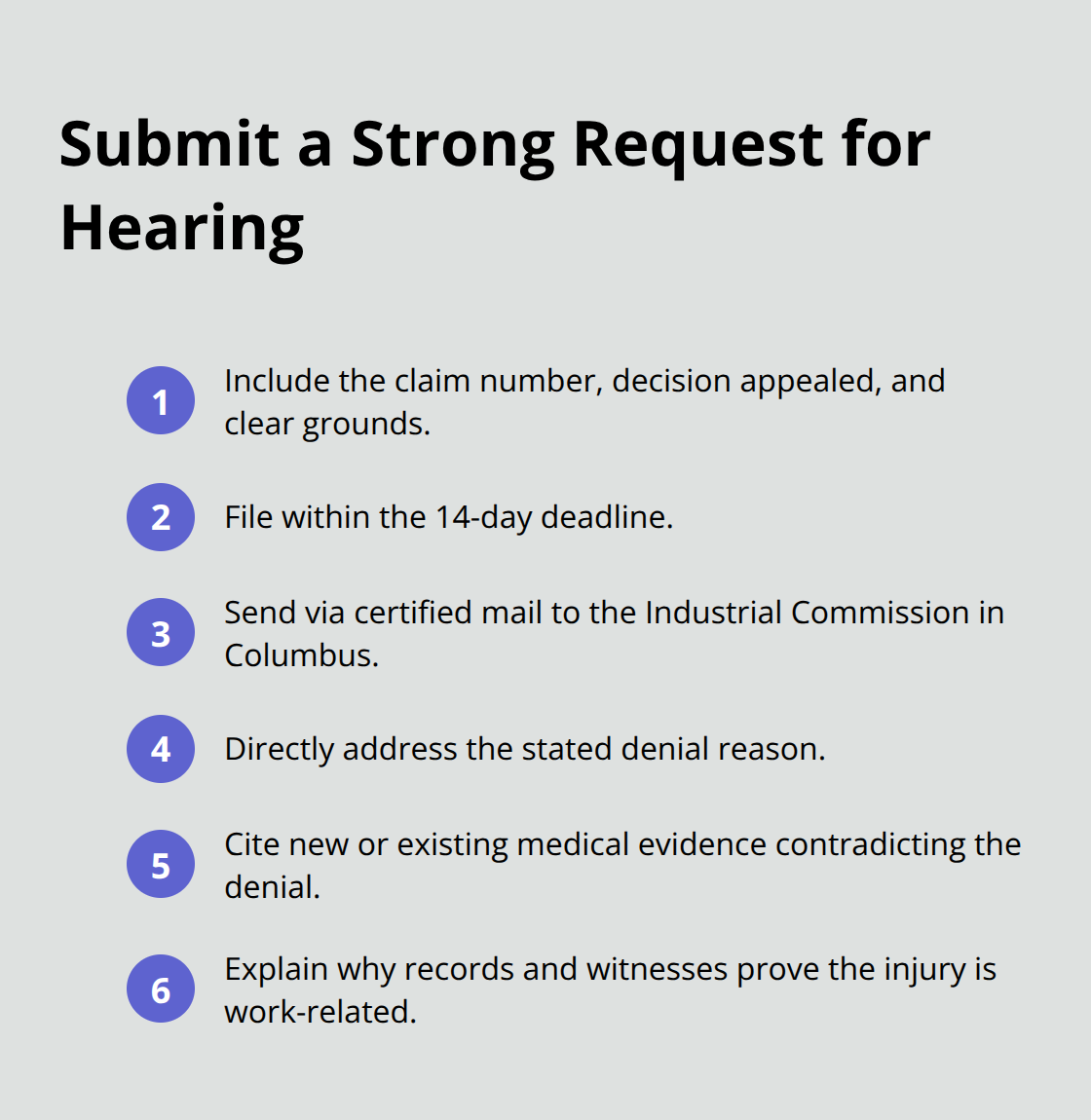
Filing your request for hearing with the Industrial Commission of Ohio requires precision. You must submit Form 22-R or a written request that clearly identifies the BWC claim number, the specific decision you’re appealing, and the grounds for your appeal within that 14-day window. The Industrial Commission processes hundreds of these requests monthly, and incomplete submissions get rejected immediately. Send your request via certified mail to the Industrial Commission of Ohio in Columbus so you have proof of delivery.
Many workers lose their appeals before they even begin because they submit vague requests that don’t explain why the BWC made the wrong decision. Your request should directly address the denial reason. If the BWC claimed insufficient medical evidence, state exactly what new or existing evidence contradicts their position. If they said your injury wasn’t work-related, explain precisely why the medical records and witness testimony prove otherwise.
Gather Aggressive Documentation
Gathering evidence requires you to act fast and comprehensively. Request your complete medical file from every healthcare provider who treated your injury, including initial intake notes, imaging results, and physician statements about work causation. Ohio courts have found that contemporary medical records created immediately after injury carry substantially more weight than retrospective opinions.
Simultaneously, collect written statements from coworkers who witnessed the incident or can attest to your condition changes. Obtain your supervisor’s incident report, safety logs, and any communications about the injury sent to management. If the BWC denied your claim citing a pre-existing condition, obtain medical records from before the injury showing you had no symptoms or functional limitations.
Prepare Your Timeline and Brief Your Witnesses
Prepare a timeline document listing every medical appointment, treatment, and work absence with exact dates. This document becomes your roadmap at the hearing. Brief your medical providers and witnesses beforehand on the specific claims the BWC made so they understand what they’ll face during questioning.
Understand the Shift in Burden at the Hearing
At your hearing before the Industrial Commission administrator, you’ll present this evidence directly. The administrator will question your medical providers and witnesses, so preparation matters enormously. Most importantly, understand that the burden shifts somewhat in your favor at the hearing stage. The BWC must defend its denial decision, not the other way around. This fundamentally changes your position from the initial claim stage-and it’s where many appeals succeed.
When you arrive at your hearing with organized evidence, clear witness testimony, and a solid understanding of why the BWC erred, you position yourself to challenge their decision effectively. The next step involves understanding what happens during the actual hearing and how legal representation can strengthen your case significantly.
Working with a Workers’ Compensation Attorney
Why Legal Representation Transforms Your Appeal
An attorney handling your appeal transforms your position from isolated and reactive to organized and strategic. The Industrial Commission of Ohio administrator reviewing your case processes dozens of appeals monthly, and they’ve seen countless workers arrive unprepared, misunderstand procedural rules, or present evidence ineffectively. Workers without legal representation succeed in approximately 30-40% of appeals, according to data from the Ohio Industrial Commission, while represented workers achieve success rates exceeding 60-70%. This gap exists because attorneys know exactly what evidence the administrator needs to hear, how to present medical testimony compellingly, and which procedural mistakes will sink your case before you even present your strongest evidence.
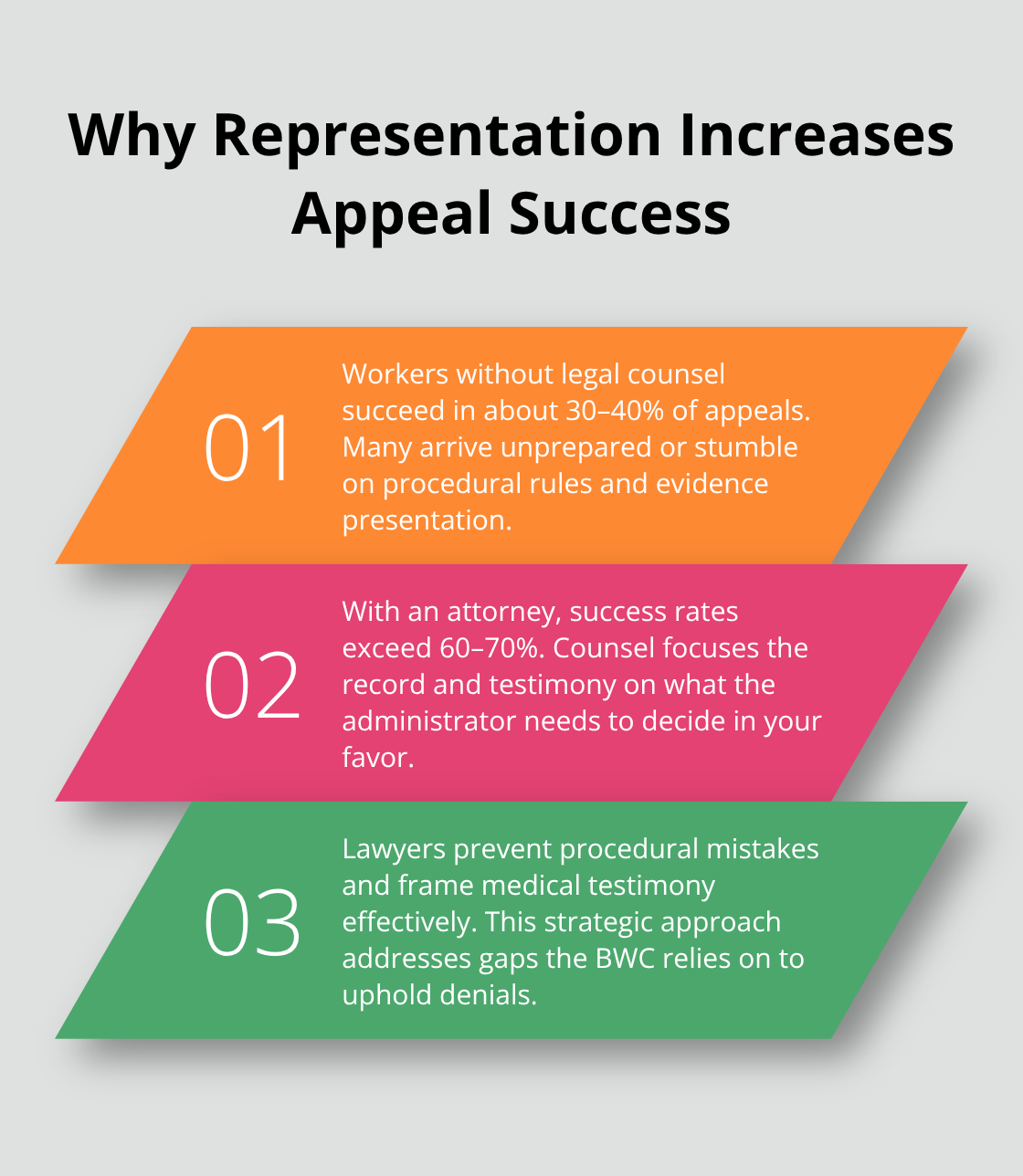
An attorney also handles the critical task of cross-examining the BWC’s witnesses and medical reviewers, exposing inconsistencies in their denial decision that you’d likely miss on your own. At Robin J Peterson Company, LLC, we represent injured workers throughout Cleveland, Akron, and Canton, and we’ve seen firsthand how legal representation shifts the dynamics of these hearings in your favor.
How Attorneys Identify and Exploit Weaknesses
Your attorney immediately identifies weaknesses in the BWC’s reasoning and gaps in their evidence while simultaneously strengthening your presentation. Many denials rest on flawed logic or incomplete file reviews, and an experienced attorney catches these errors and builds your case specifically to address them. You’ll also avoid costly procedural mistakes like missing deadlines for submitting evidence to the Industrial Commission, failing to properly notify the BWC of new medical findings, or presenting witnesses who haven’t been adequately prepared for cross-examination.
Managing Documentation and Procedural Requirements
When you work with an attorney, they handle all communication with the Industrial Commission, submit all required documents with proper formatting and timing, and maintain your case file with every piece of evidence supporting your position. This level of coordination and attention to detail separates appeals that succeed from appeals that fail on technical grounds. Your attorney also negotiates with the BWC’s representatives before the hearing, sometimes securing a settlement or agreed resolution that avoids the hearing process entirely if the evidence clearly supports your position (and this outcome often arrives faster than a formal hearing would).
Final Thoughts
Fighting a BWC denial requires action, documentation, and persistence. The 14-day window to file your request for hearing is absolute, so act immediately once you receive that denial letter. Gather your medical records, witness statements, and incident documentation right away, then submit your request for hearing with precision and clarity about why the BWC made the wrong decision.
Legal representation fundamentally changes your odds when you appeal denial decisions. Workers without attorneys succeed in roughly 30-40% of appeals, while represented workers achieve success rates exceeding 60-70%. An attorney identifies weaknesses in the BWC’s reasoning, handles all procedural requirements, presents your evidence compellingly to the Industrial Commission administrator, and sometimes negotiates settlements before your hearing occurs.
If you’re facing a denial and want to understand your options, contact Robin J Peterson Company, LLC. We represent injured workers throughout Cleveland, Akron, and Canton who are fighting BWC denials, and we know what evidence the Industrial Commission needs to hear and how to expose flaws in the BWC’s logic.