
Returning to work after an injury or illness requires careful planning to protect your health and set yourself up for success. At Robin J Peterson Company, LLC, we understand the challenges of navigating this transition and want to help you do it safely.
This guide walks you through the essential steps: getting medical clearance, requesting workplace accommodations, and recognizing warning signs as you rebuild your strength. You’ll find practical advice to make your back to work transition smoother and more confident.
Medical Clearance and Job Restrictions
Your healthcare provider’s documentation forms the foundation of a safe return to work, and it must be specific enough to guide both you and your employer. A vague note stating you’re cleared to work won’t protect you. You need written documentation that outlines exactly what physical activities you can and cannot do. Ask your provider to specify limitations around lifting weight, standing duration, repetitive motions, climbing, or any other job-related activities. The American College of Occupational and Environmental Medicine recommends that medical clearance documents include functional capacity details rather than just a general approval. This specificity protects you from overextending too soon and gives your employer concrete information to work with when planning your accommodations.
Obtaining Documentation from Your Healthcare Provider
Before you leave your provider’s office, request written documentation that addresses your specific job duties. Don’t settle for a generic clearance form. Ask your provider to address the exact physical demands of your role-if you work in construction, your restrictions look different than those for an office worker. Request that your provider specify whether restrictions apply during work hours only or throughout your entire day. This distinction matters significantly because a lifting restriction of 10 pounds applies to all lifting, not just heavy objects at work. Ask if certain activities can be modified rather than eliminated entirely. For example, can you lift 10 pounds if you use both hands instead of one, or does the restriction stand regardless of technique? These conversations prevent assumptions that could set back your recovery.
Understanding Physical and Functional Limitations
Your physical limitations aren’t just restrictions-they’re a roadmap for your recovery. If your provider says no lifting over 10 pounds for the next four weeks, that applies to commuting, household tasks, and any other activities outside work. Many people misinterpret their limitations because they don’t ask clarifying questions during their medical appointment. You need to understand whether your restrictions are temporary or ongoing, and what milestones might allow you to gradually resume normal activities. Ask your provider what warning signs indicate you’ve pushed too hard (increased pain, swelling, or reduced range of motion). Understanding these signals helps you stay within safe boundaries as you rebuild your strength and endurance.
Communicating Restrictions to Your Employer
Provide your employer with the medical documentation as soon as you have it, not on your first day back. This gives them time to plan accommodations rather than scrambling to figure things out when you arrive. If your employer seems unclear about what your restrictions mean, don’t assume they understand. Many employers, especially in smaller organizations, lack experience interpreting medical limitations. Request a meeting with your supervisor and HR department to walk through your restrictions together and discuss how your role will be modified. Be direct about what you need: if you can’t climb ladders, state that clearly. If you need to alternate between sitting and standing every 30 minutes, specify that exactly.
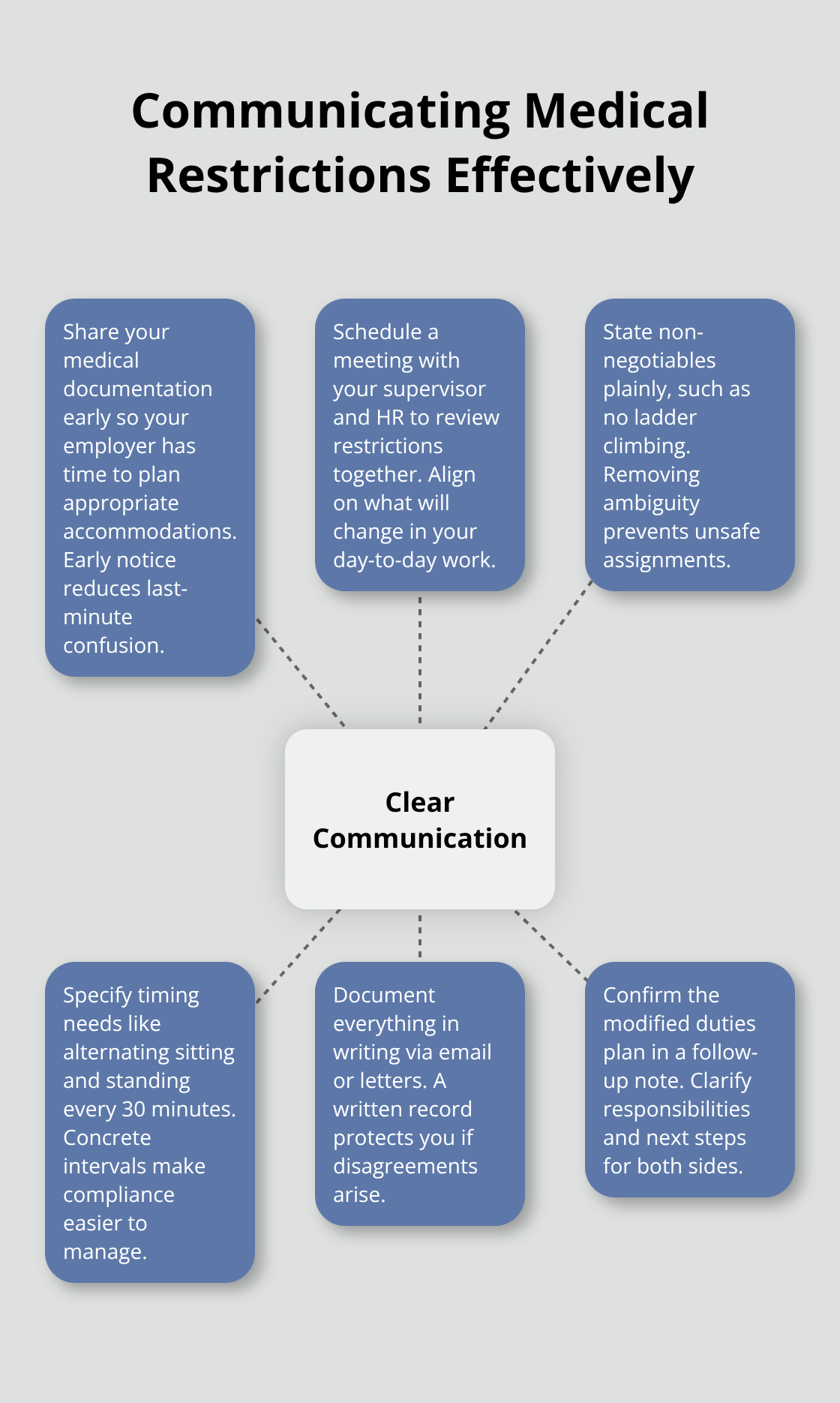
Document all communications with your employer in writing (whether through email or formal letters) so there’s a clear record of what was discussed and agreed upon. With your medical restrictions clearly communicated and documented, you’re ready to work with your employer on the specific accommodations and modified duties that will support your safe return.
Workplace Accommodations and Modified Duties
Your employer’s willingness to accommodate your restrictions means nothing without a concrete plan for how your actual work will change. Many people return to work expecting their employer to figure out the details, then find themselves in roles that contradict their medical restrictions within days. This happens because accommodation requests are often too vague. Instead of saying you need lighter duties, specify exactly what that means: if you normally spend 60 percent of your time on a task that violates your restrictions, you need to know what fills that 60 percent during your recovery.
Requesting Reasonable Adjustments to Your Role
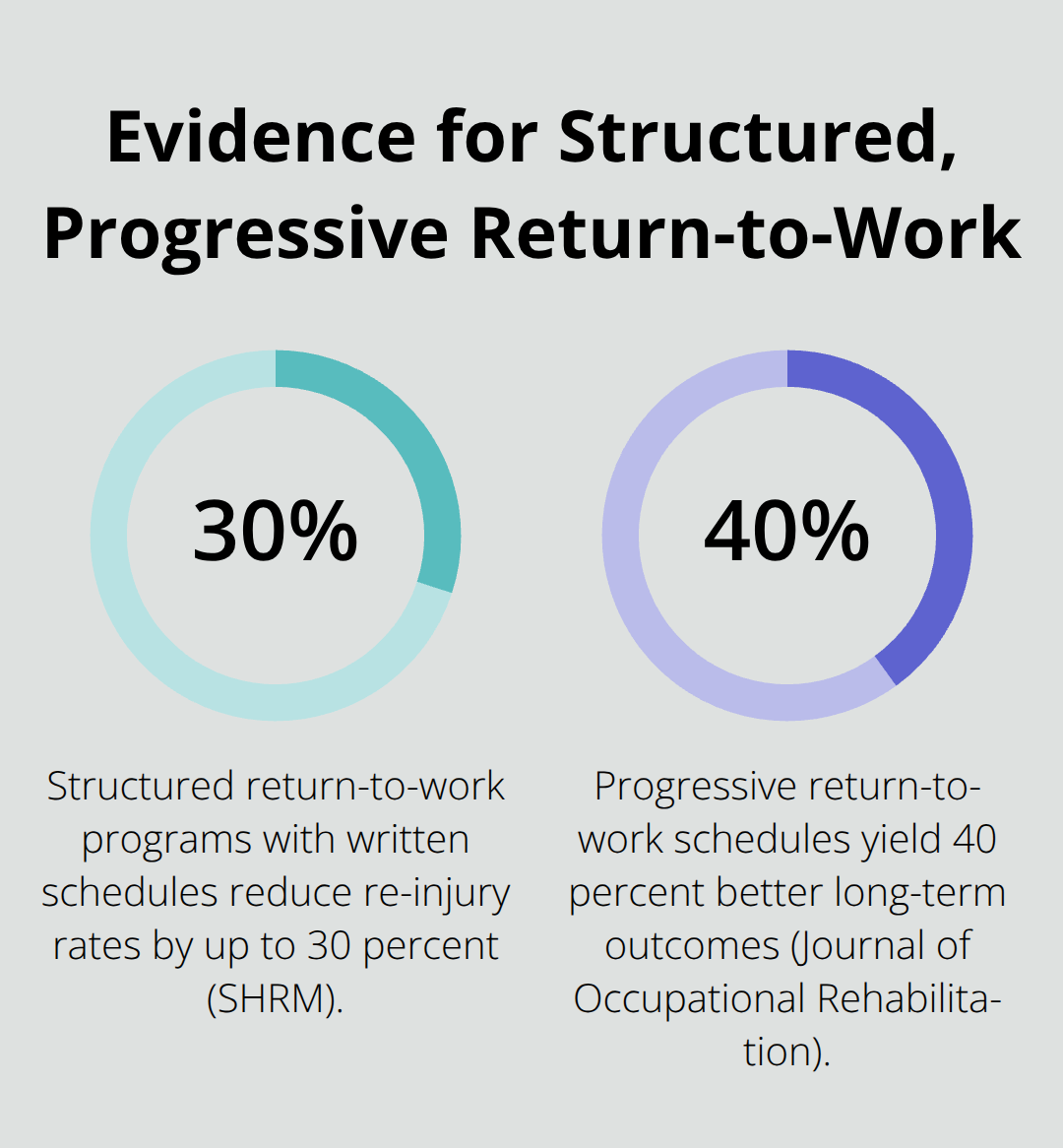
Ask your employer to provide a written schedule of your modified duties for at least the first two weeks. The Society for Human Resource Management reports that structured return-to-work programs with written schedules reduce re-injury rates by up to 30 percent compared to informal arrangements. Request a check-in meeting every three to five days during your first two weeks back, not monthly reviews. These frequent touchpoints allow you to address problems before they escalate and give your employer feedback on whether the modifications actually work. If your employer resists frequent meetings, that’s a red flag that they’re not taking your recovery seriously.
Gradual Return-to-Work Programs
Discuss with your employer whether a phased increase in hours makes sense for your situation. Some people benefit from returning part-time for two weeks before resuming full hours, while others do better with full hours but reduced task complexity. The key is matching the approach to your specific injury and job demands. Ask whether you can adjust your start or end times to avoid rush hour commuting, which reduces physical stress on days when you’re rebuilding your strength. Your employer should work with you to create a schedule that supports your medical restrictions rather than fighting against them.
Tools and Equipment That Support Your Recovery
Specific equipment and workspace modifications often matter more than broad duty changes. If you sit at a desk, ask for an adjustable desk that lets you alternate between sitting and standing every 30 minutes, which reduces strain far more effectively than remaining seated all day. If your role involves any lifting, request equipment like hand trucks, carts, or lift-assist devices that reduce the physical load.
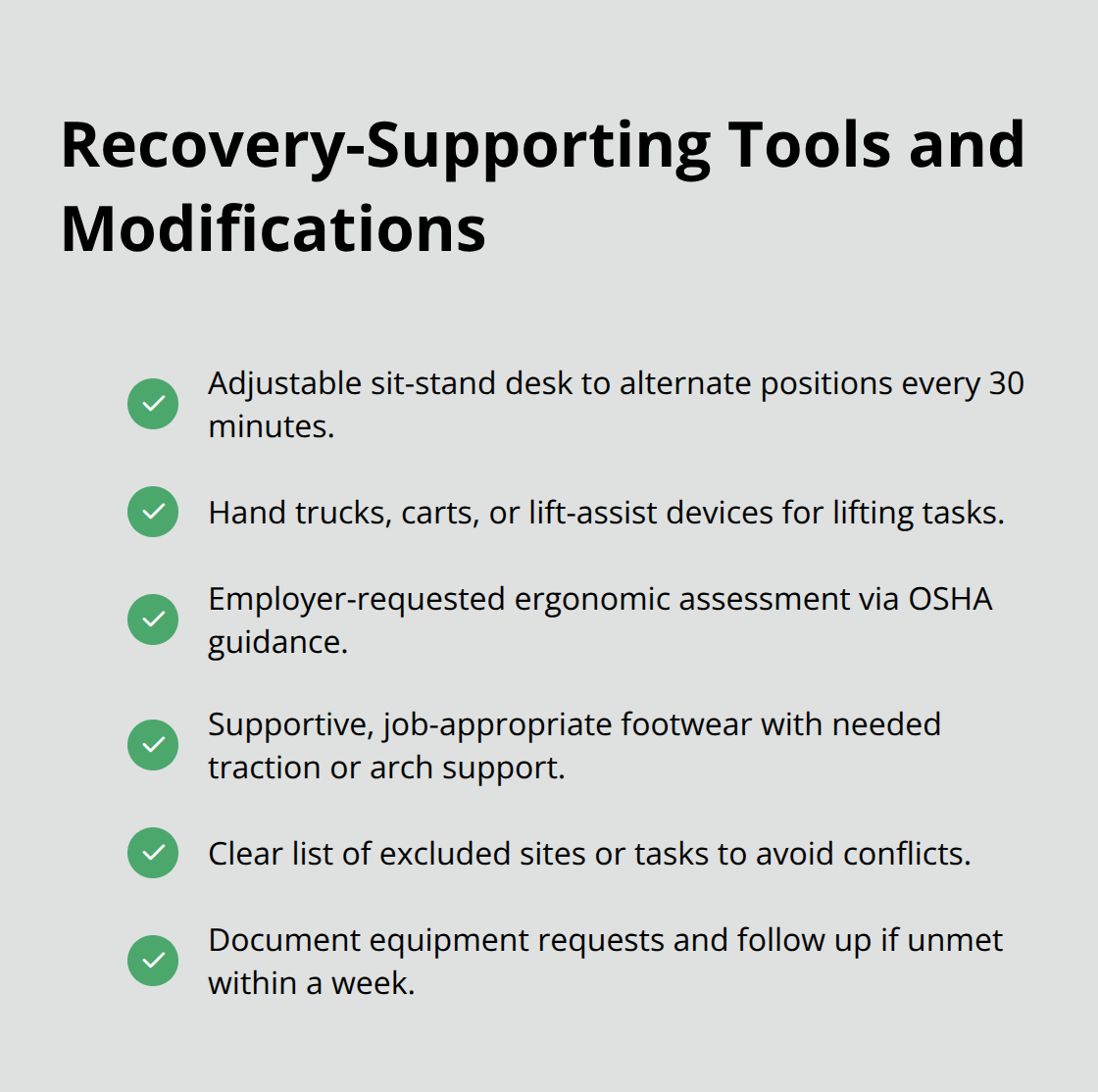
The Occupational Safety and Health Administration provides guidance on ergonomic assessments for modified duties, and your employer can request one at no cost to identify what tools would help you work safely within your restrictions.
Invest in supportive footwear designed for your specific job environment, whether that means shoes with arch support for standing roles or slip-resistant options for certain workplaces. If you work in construction or field-based roles, request clear communication about which sites or tasks you’re excluded from rather than discovering conflicts on the job. Document any equipment requests in writing and follow up if they’re not provided within a week. Your employer’s failure to supply basic accommodations that your medical provider recommended signals that returning to work at that location may not be safe right now-and that’s when you should consider reaching out to a workers’ compensation attorney who can help protect your rights.
Staying Safe During Your Return
Your body sends signals during your first weeks back at work, and most people ignore them. Pain that intensifies as the day progresses, swelling that doesn’t resolve overnight, or reduced range of motion the morning after work are clear indicators you’ve exceeded your physical capacity. The National Institute for Occupational Safety and Health found that workers who ignore early warning signs experience re-injury rates 2.5 times higher than those who adjust their activities immediately. Don’t wait for pain to become severe before taking action. If you notice increased symptoms by midday, modify how you approach your tasks the next day rather than pushing through. Swelling that persists into evening or the next morning means you’ve done too much, regardless of what your restrictions technically allow.
Recognizing Warning Signs of Overexertion
Track your symptoms in a simple note or phone memo for the first two weeks, recording what activities triggered increased pain or swelling and when symptoms appeared during the day. This documentation helps you identify patterns and shows your employer and healthcare provider exactly how your body responds to work demands. Increased pain, swelling, or reduced range of motion all signal that you’ve exceeded your current capacity. These warning signs appear at different times for different people-some notice them by midday, others the next morning. The timing matters less than your response: adjust your activities immediately rather than hoping symptoms improve on their own.
Building Strength and Endurance Progressively
Building your strength back takes deliberate progression, not wishful thinking. Your muscles have weakened during recovery, and returning to your previous capacity requires a structured approach. Ask your healthcare provider for specific guidance on progressive loading, which means gradually increasing physical demands in small increments rather than jumping back to normal duties. If your job involves standing and your restriction limits you to two hours initially, plan to increase standing time by 15 to 30 minutes every three to five days, provided your symptoms don’t worsen. The Journal of Occupational Rehabilitation reports that workers using progressive return-to-work schedules with documented increases in activity demands show 40 percent better long-term outcomes than those returning to full duties immediately.
Strength doesn’t return in a straight line, so expect some days to feel harder than others. If you have a particularly difficult day, that’s not a sign of failure-it’s information that your body needed more recovery time. Fluctuations in how you feel are normal and don’t indicate that your recovery plan has failed.
Knowing When to Seek Additional Medical Support
When your symptoms worsen despite following your restrictions and progressive plan, contact your healthcare provider rather than attempting to work through it. Worsening symptoms mean your current activity level exceeds what your injury can handle, and continuing risks setting back your recovery significantly. Your provider can adjust your restrictions, modify your progressive loading schedule, or recommend additional treatment to address what’s happening. Don’t assume that some discomfort is inevitable-your healthcare provider needs to know when your current approach isn’t working so they can help you find a better path forward.
Final Thoughts
A successful back to work transition requires three concrete actions: obtain specific medical documentation that outlines your exact limitations, communicate those restrictions clearly to your employer in writing, and monitor your body’s response as you rebuild your strength. Without medical clarity, your employer cannot accommodate you properly. Without clear communication, misunderstandings create situations where you work beyond your restrictions. Without honest attention to warning signs, you risk re-injury that sets back your recovery months.
Your role during this transition involves staying informed about your own limitations and speaking up when something isn’t working. Track your symptoms, request frequent check-ins with your employer, and adjust your activities immediately when you notice warning signs. Your employer’s role is to provide the accommodations and equipment your healthcare provider recommended, not to decide whether those recommendations are necessary. If your employer resists providing reasonable accommodations, ignores your medical restrictions, or pressures you to work beyond what your provider cleared you for, that’s when you need additional support.
A workers’ compensation attorney can help protect your rights and ensure you receive the benefits and accommodations you’re entitled to. At Robin J Peterson Company, LLC, we represent injured workers throughout Ohio who face barriers during their recovery and back to work transition. If you’re struggling with your return or your employer isn’t supporting your safe recovery, contact us to discuss your situation.