
Work injuries happen fast, but understanding your rights shouldn’t be complicated. We at Robin J Peterson Company, LLC know that navigating workers compensation benefits in Ohio can feel overwhelming when you’re hurt and unable to work.
This guide breaks down everything you need to know about eligibility, filing claims, and the benefits available to you.
Who Actually Qualifies Under Ohio Workers Compensation
Not every injury that occurs at work qualifies for workers compensation in Ohio. The Ohio Bureau of Workers Compensation operates a strict system, and understanding what counts matters before you file. You qualify as an injured worker if you sustained a work-related injury or occupational disease while performing job duties. This includes injuries that occur at your workplace, during work travel, or at off-site locations when you were performing work tasks.
Injuries That Qualify
Single traumatic incidents like falls, strikes from equipment, or crush injuries all qualify. Injuries that develop over time also count-if toxic exposure or repetitive job tasks caused your condition and it arose from your employment, you have grounds for a claim. The key factor is causation: the injury must stem directly from your work duties or the work environment.
Ohio law recognizes that workplace injuries extend beyond obvious accidents. Falls on icy surfaces, injuries from malfunctioning equipment, and incidents caused by coworker negligence can qualify for benefits. Off-site injuries receive coverage if work duties were involved at the time. Even injuries sustained during lunch breaks may qualify if work tasks were involved.
What Doesn’t Qualify
Certain injuries fall outside Ohio workers compensation coverage, and the exclusions are specific. Injuries you cause yourself intentionally do not qualify. If you were under the influence of drugs or alcohol when injured, your claim faces significant barriers. Pre-existing conditions are excluded unless your work duties worsened them substantially.
Injuries occurring away from work, without any connection to job duties, receive no protection. Short-term illnesses like the flu are not compensable. This matters because many workers assume all injuries are covered when they occur during work hours-they are not.
Why These Rules Exist
The exclusions prevent fraud and limit coverage to legitimate work-related harm. The Ohio Bureau of Workers Compensation applies these rules consistently across all claims. Understanding these boundaries helps you assess whether your injury qualifies before you file. If you sustained an injury at work and question whether it meets Ohio’s standards, the next step involves understanding how to file your claim and what the process requires.
The Claims Process and Your Rights
Timing matters when you file a workers compensation claim in Ohio. The Ohio Bureau of Workers Compensation requires you to report your injury to your employer immediately, and most employers must then submit a claim on your behalf within 14 days of learning about the injury. If your employer fails to file, you can file directly with the BWC yourself using their online system or paper forms available at their Columbus office at 30 W. Spring St. The sooner you report, the sooner the clock starts on your eligibility for medical benefits and wage replacement. Delays in reporting can jeopardize your claim, so do not wait to inform your supervisor or HR department about what happened.
Gather Documentation That Strengthens Your Case
When you file, collect specific documentation to support your claim. Write down the exact date, time, and location of your injury along with a detailed description of how it occurred. Collect names and contact information for any coworkers who witnessed the incident. Obtain your initial medical records from the healthcare provider who treated you, as these documents directly connect your injury to your work. The BWC uses this documentation to evaluate whether your injury meets Ohio’s eligibility standards.
How the Managed Care Organization Works
After filing, the BWC assigns your claim to a Managed Care Organization that coordinates all medical treatment related to your injury. This MCO reviews and approves medical requests, so your healthcare provider must obtain approval before scheduling certain procedures or treatments. You have the right to request a different MCO if you believe yours is not acting in your interest, and the BWC will consider your request. Once approved, your medical benefits cover all treatment necessary to address your work-related injury, with no out-of-pocket costs to you.
What Happens If the BWC Denies Your Claim
If the BWC denies your claim initially, you retain the right to appeal that decision through the Ohio Industrial Commission. Many injured workers overlook this option and accept denials without challenge, but appeals succeed regularly when proper documentation supports your case. An attorney experienced in Ohio workers compensation can review your denial, identify weaknesses in the BWC’s reasoning, and present evidence at a hearing before an administrative judge. This appeal process opens the door to securing the benefits you deserve, which brings us to the specific types of benefits available to injured workers in Ohio.
Benefits Available to Injured Workers in Ohio
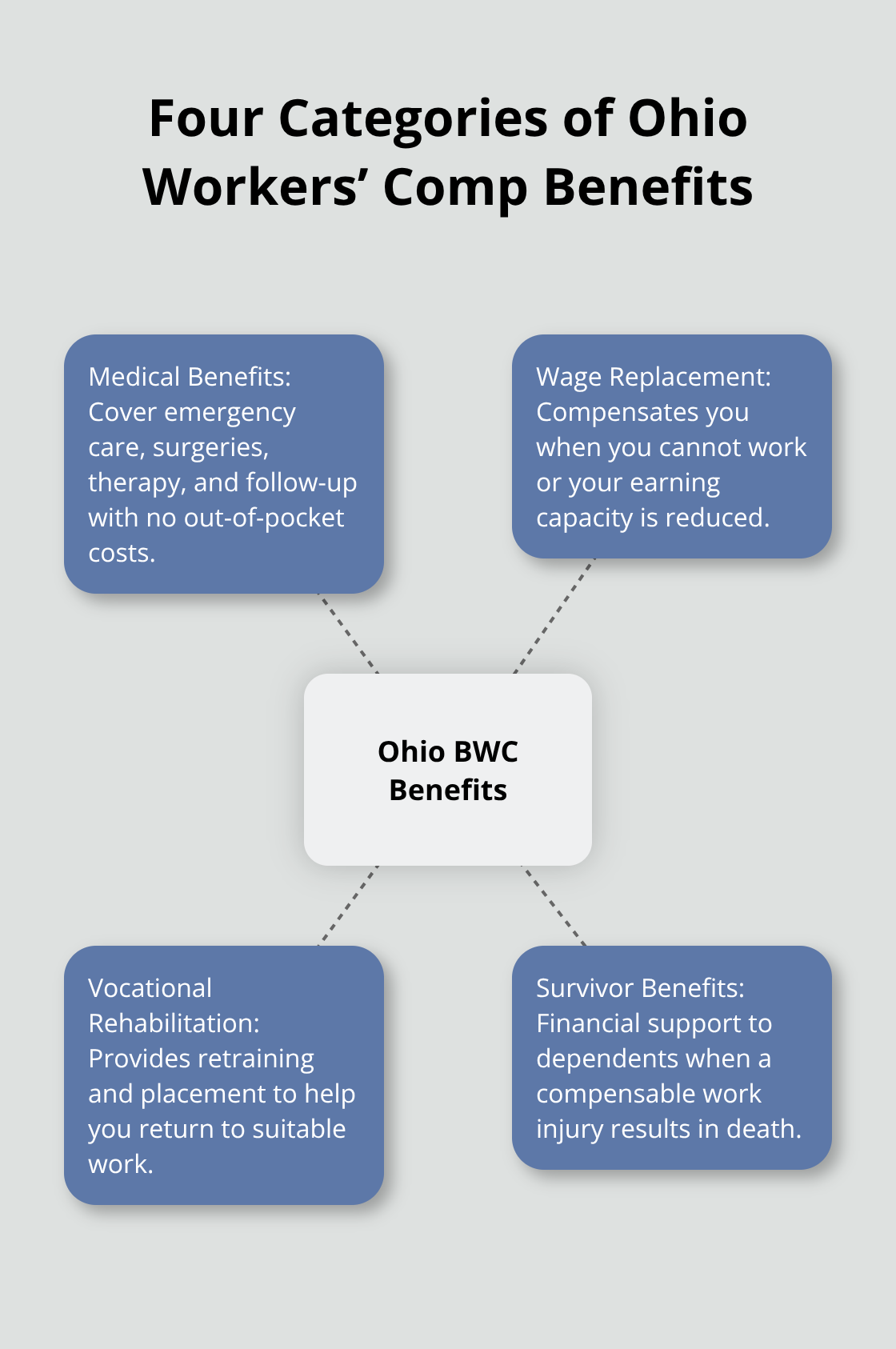
The Ohio Bureau of Workers Compensation provides four distinct categories of benefits to injured workers, and understanding which ones apply to your situation determines your financial recovery. Medical benefits cover all treatment necessary to address your work injury, including emergency care, surgery, physical therapy, and ongoing medical appointments with no out-of-pocket costs to you. Wage replacement benefits compensate you when your injury prevents you from working or limits your earning capacity. Vocational rehabilitation services help you return to suitable employment if your injury creates permanent restrictions. The BWC also provides survivor benefits to dependents when a work injury results in death, though this protection applies only in specific circumstances under Ohio law.
How Medical Coverage Works
Your medical care flows through a Managed Care Organization assigned to your claim, and this MCO coordinates all treatment approvals. When your healthcare provider requests authorization for a procedure or treatment plan, the MCO reviews the request against medical necessity standards and either approves or denies it within specific timeframes. You can switch MCOs if you believe yours is not serving your interests adequately, and the BWC accepts such requests without penalty.
Wage Replacement in Multiple Forms
Wage replacement comes in multiple forms depending on your situation. Temporary Total Disability payments replace your lost wages while you recover and cannot work, calculated at a percentage of your pre-injury average weekly wage. If you return to work but earn reduced wages because of injury-related restrictions, Wage Loss Compensation makes up the difference between your prior earnings and current earnings. Permanent Partial Disability applies when you sustain a permanent impairment that affects your earning capacity, and the BWC calculates these benefits based on the body part injured and the degree of impairment.
Permanent Disability and Long-Term Support
Permanent Total Disability provides lifetime benefits for workers who cannot return to any employment due to their injury, though Ohio sets strict standards for this classification. Vocational Rehabilitation Services assist you with job retraining and placement when your injury prevents you from returning to your previous occupation. Living Maintenance wage replacement supports you during approved rehabilitation programs so you maintain income while retraining for new work. These benefits exist specifically because Ohio recognizes that injured workers face genuine financial hardship, and the state system prioritizes returning you to suitable employment rather than leaving you permanently disabled and dependent.
Final Thoughts
Ohio workers compensation benefits exist to protect you when work injuries disrupt your life, yet the system contains complexities that trip up injured workers regularly. Denials happen, MCOs sometimes delay approvals, and disputes arise over whether your injury qualifies or how much compensation you deserve. When these obstacles appear, having experienced legal representation changes the outcome significantly.
You should contact an attorney if the BWC denies your claim, if your employer retaliates against you for filing, or if you question whether your injury meets Ohio’s eligibility standards. An attorney can review your case, identify weaknesses in the BWC’s reasoning, and present evidence at hearings before administrative judges. Many injured workers wait too long to seek legal help, missing critical deadlines or accepting inadequate settlements when workers compensation benefits Ohio law provides could have secured better outcomes.
Robin J Peterson Company, LLC represents injured workers throughout Ohio who face challenges navigating the workers compensation system. Contact Robin J Peterson Company, LLC for a consultation if you need guidance on your claim or want to discuss whether an appeal makes sense for your situation.